Italy’s justice system has quite a long road ahead but already scores better – The Italian View

by the Italian Ministry of Economy and Finance – Pier Carlo Padoan, Italy’s Minister of Finance, was OECD Deputy Secretary-General and Chief Economist from 2009-2014).

Italy’s justice system is gaining greater efficiency, thus gradually closing its paradoxical gap. On the one hand, the clearance rate (measured as the ratio of the number of resolved cases to the number of incoming cases) is 120% and Italy ranks second in the European Union after Slovakia. On the other hand, Italy ranks last for the average length of civil or commercial proceedings, because of the huge backlog that weighs on courts and slows down the wheels of justice. Disposition time decreased by 13% in two years, but it still is as high as 527 days compared with a European average of 248 days. In 60% of Italian courts 1 out of 5 cases has been pending for more than 3 years, thus exceeding the “reasonable time” envisaged in the Pinto law of 2001. As priority will be given to recent cases, disposition time in courts that have a bigger backlog will lengthen. The longer a legal case remains unsettled, the longer the court will take to reach final disposition. The total backlog of civil cases has decreased by 4% from 2015 to 2016 and by a significant 34% from 2009. Nonetheless, the total civil and commercial litigious cases backlog was still as high as 4,400 cases pending (1st instance/ per 100,000 inhabitants) in 2005, 2.6 times higher than the EU average. Court performance varies geographically. Sicilian courts have a backlog of cases 50% of which have been pending for more than three years and less than 10 or 15% of which have been pending for more than three years.

With €4.8 bn of public expenditure, Italy is still the third biggest spender in the EU after Germany (€9.6 bn ) and the UK (€6.6 bn). Despite the crisis, total expenditure increased by 4.2% a year from 2006 to 2016. Better performances are not just a matter of increasing staff levels. Evidence published by the CSM (Consiglio Superiore della Magistratura – the High Council of the Judiciary) shows no correlation between staff shortages and poor performance, at least in conditions of relative and temporary lack of resources. With 1,75 million new legal cases per year, litigation rates in Italy are now in line with the EU average.

Efficiency gains have been achieved thanks to the far-reaching reorganization of the Italian judicial system and the adoption of new best practices in case management. First, e-filing has continued since its introduction in 2014. E-filing of notices increased by 6.7% over 2016, increasing savings by 10% and speeding up the issuing of digital payment orders by over 50% in some districts. E- filing by lawyers and professionals increased by 12% last year (after a first +88% in 2014/15), increasing the average e-files stock by 50% over the last three years.

Alternative dispute resolutions (ADR) contributes to unburdening courts in terms of dispute settlements. ADR includes referral to arbitration, negotiation assisted by a legal counsel (outof- court settlement procedure) and civil mediation. On average around 186,000 civil mediation processes have been initiated each year since 2014. The last two years have seen an increase in filings, followed by more than 30% increase in the number of judgments pending. This has slowed down resolution time from 83 days in 2013 to 115 days in 2015, which remains considerably shorter than that of in-courts settlements; however, a further increase, would affect the effectiveness of the process. The most evident reduction has been observed in commercial litigation, whose disposition time decreased from 40 to 29 months. Figures show that the older and more complex cases are now being settled, thereby contributing to rendering the justice system fairer. Specialization also helps in better managing the workflow. Since their introduction in 22 provinces in 2012, business courts have performed well. They deal exclusively with cases involving industrial property, company law, public contracts and services and European Union public work contracts. The number of resolved cases increased from an initial 404 to over 5,600 at the end of 2016. The increase in registrations raised resolution time: in 2016 the percentage of disputes which took less than a year to be resolved fell to 57% from 74% in 2014. Predictable outcomes and the number of confirmed rulings remain high, which reflect the quality of pronouncements and the effectiveness of judges and prosecutors’ specialization. In Milan verdicts are confirmed in 70-80% of cases.

Alternative dispute resolution is accompanied by measures to discourage initiation of proceedings when unneeded (i.e. no more free appeal proceedings before Justices of the Peace after administrative sanctions have been imposed) and the introduction of a formula to determine attorney fees (together with the possibility of requesting quotes). These rules contributed to decrease the demand for judicial services (civil and commercial cases), from 4 to 2.5 (1st instance/ per 100 inhabitants) between 2010 and 2015. However, the drop may also be ascribed to the economic crisis (a low GDP means fewer filings).

There is a positive correlation between economic growth and a healthy, efficient, fair judicial system. This is an even more important aspect especially during an upswing such as the one Italy is now experiencing. Lengthy proceedings and high enforcement create a climate of uncertainty and skepticism which affects the business environment and keeps investors away from opportunities. Given the same infrastructure and initial business conditions, evidence has shown that differences in the efficiency of judicial systems at provincial level can determine a difference in turnover of €31 K – or 8% of turnover – for an average Italian medium-sized company. A few years ago ECB President Mario Draghi stated that the cost of Italy’s slow judicial system accounts for over 1% of GDP. Gains in efficiency remain a top priority for the Government, which keeps working on reforms to speed up digitalisation and increase the overall effectiveness of the justice system.

Italian View


The Italian banking system at a turning point – The Italian View

by the Italian Ministry of Economy and Finance, Pier Carlo Padoan, Italy’s Minister of finance, was OECD Deputy Secretary-General and Chief Economist from 2009-2014).

The Italian banking system has long since been waiting for a comprehensive reform addressing structural inefficiencies and structural rigidities. As of 2014, the Government has defined a comprehensive reform plan while also tackling the crisis affecting several banks.

Narrow path2

To begin with this latter topic, three interventions involved seven banks that were experiencing major strains. The first intervention required the resolution of four small and mediumsized regional banks that led to the formation of “bridge banks” in charge of continuing operations, thus rescuing 12 billion euros in savings for about 1 million customers.

The resolution procedures ended in April 2017 with the sale of three “bridge banks” to a larger bank (UBI). BPER acquired the fourth in June 2017. Buyers were selected through a fair, open and transparent procedure. This resolution did not imply any State aid, thus requiring a major effort by the banking sector. The private sector provided 4.7 billion euros to avoid bankruptcy and its social and entrepreneurial consequences, preserving the issue of loans to over 200,000 small and medium-sized businesses, small retailers and craftsmen.

More recently, the Government intervention was addressed to the liquidation of Banca Popolare di Vicenza and Veneto Banca. After the ECB recognized the two banks as “failing or likely to fail”, the Single Resolution Board stated – under the EU Banking Recovery and Resolution Directive – that the crisis had to be dealt with according to national insolvency rules, since a resolution was not applicable. Consequently, the Italian Government started a liquidation procedure assisted by public resources combined with the sale of some assets and liabilities of the two banks to Intesa Sanpaolo. The Government, after having shared the burden of the intervention with shareholders and junior bondholders, committed around 4.8 billion euros in cash and around 12 billion euros in guarantees for that purpose. As in previous cases, the procedure preserved the flow of credit to clients of the insolvent banks (families, businesses, craftsmen), and limited the impact on the social and business environments of one of the best performing regions in the Country.

Eventually, the precautionary recapitalization of Monte dei Paschi di Siena was approved at the beginning of July by the European Commission, as part of the restructuring plan 2017- 2021, including the disposal of 28.6 billion euros of gross bad loans. The recapitalization was needed to put the bank in conditions to successfully face the adverse scenario of the stress tests that the ECB ran in 2016. The precautionary recapitalization includes 3.9 billion euros of direct capital injection and up to 1.5 billion euros of compensation in favor of retail subordinated bondholders, meeting certain conditions, whose bonds are mandatorily converted into equity.

By facing each case with a suitable solution, according to the specific nature and magnitude, both European and Italian rules could be implemented offering the best possible solutions. Improvements in the banking industry are a different matter altogether, they require a deeper and more thorough approach, to be pursued through structural reforms designed to reduce inefficiencies and address the issue of non-performing loans (NPLs).

The reform of large cooperative banks (the so-called “Popolari”), introduced as early as January 2015, aims at consolidating and bolstering the Italian banking system. Banks included in the cluster were forced to transform into joint stock companies, and as a result, two of them merged, creating the third largest group in Italy. The reform of smaller cooperative banks promotes consolidation in the industry, as well as the adoption of more efficient business models reducing the exposure to market risks. Finally, the self-reform of banking foundations is meant to put greater emphasis on the community-based initiatives of the foundations in place of interfering with the management of participated banks.

Alongside such structural reforms of the banking sector, the Government has adopted measures to encourage the creation of a market for non-performing loans, which helps to reduce the burden of those assets and restore an adequate flow of lending to the real economy.

These provisions include the institution of a guarantee on the Securitization of Bad Loans (GACS), which is a State guarantee on ABS’ senior tranches granted upon request by the banks. Changes to Italian insolvency rules and to foreclosures procedures also may help in creating a market for NPLs, as they improve the efficiency of insolvency proceedings and streamline the enforcements of creditors’ rights. The legislation now includes a series of measures to reduce lead-time for foreclosures such as: competition in pre-bankruptcy agreements with creditors; acceleration of sale transactions to ensure higher NPLs value; new rules for debt restructuring; easier access to credit for troubled companies; amendment of the regulations governing the deductibility of credit losses; and agreements secured by real estate assets, where parties may agree that transfer of the assets will become effective upon default by the borrower.

Even after facing a long recession, the Italian banking sector has proven to be sound and resilient. The stock of NPLs is shrinking at an increasing pace, while the origination rate of new exposure is approaching pre-crisis level. Those comprehensive interventions on specific banks and on the industry as a whole reduced and in some cases excluded major sources of risk. Overall, after years of adjustments, the Italian banking industry is returning to positive, effective and promising levels of performance.

Further reading:

The Narrow Path | Issue #2 | August 2017 | www.mef.gov.it | Italian Ministry of Economy and Finance


The Narrow Path – The Italian View

by the Italian Ministry of Economy and Finance, Pier Carlo Padoan, Italy’s Minister of Finance, was OECD Deputy Secretary-General and Chief Economist from 2007-2014.

Growth in Italy is taking place more slowly than in other Eurozone countries. Public debate about this fact offers several explanations but rarely juxtaposes long-period trends with recent policies.

The narrow pathIt is common knowledge that – among other things – low productivity is one of the main causes of the poor performance of the Italian economy. Red tape, the relatively limited openness to competitiveness of some professional services, the tax burden, the limited size of SMEs, and the need to improve secondary education and the efficiency of the judicial system are – among other factors – affecting our ability to grow the economy.
All such structural obstacles to stronger growth are targets of the ambitious reform program that has been under way since 2014. In the view of national authorities, structural reforms are re-shaping the economic potential of the country, while the combination of expansionary monetary policy undertaken by the ECB and appropriate fiscal policies adopted by the Government is allowing for conditions that enable the reform process.  Let’s focus on what “appropriate” means for fiscal policy in Italy at the present time.

The Government believes that a fiscal adjustment is definitely needed for a country with a debt as high as Italy’s.  However, the decision about the pace of the adjustment is crucial as it may potentially affect the prospects of the economy, including the private sector.  While a slow pace of adjustment might not be effective for the purposes of debt reduction, an adjustment that is too fast may prove to be detrimental to the economy, and therefore to the debt-to-GDP ratio.

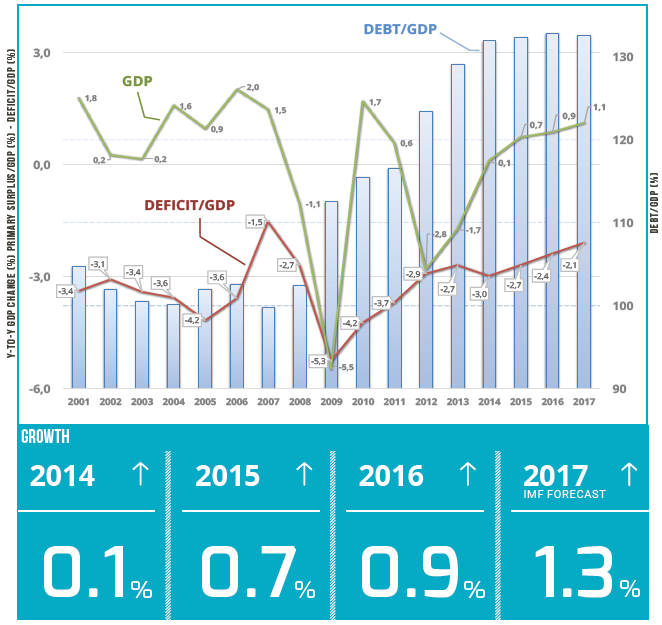
The situation in which the Italian authorities must move can be described as a “narrow path”: on one side, high debt looms (implying exposure to external financial shocks) while on the other side an infant recovery needs to be nurtured in order to rid ourselves definitively of the double–dip recession. This picture may help in understanding the Government’s search for a balance among such divergent needs. The search has apparently been successful in the latest four budgets. Since 2014 the Italian Government has managed to reduce the deficit-to-GDP ratio – and to stabilise the debt-to-GDP ratio by that means. At the same time, the composition of both revenue and spending has been re-arranged to improve the business environment and to support internal demand.

In order to appreciate the results of the “narrow path” policy mix, we must look at the trends for debt, deficit and GDP over a lengthy period of time. Between the years 2000 and 2013, the Italian economy alternated 4 years of recession, 4 years of positive but low growth (below 1 percent), 5 years of higher growth (between 1 and 2 percent). Nothing exciting at all. After the double–dip, growth turned positive again in 2014 (a small improvement of 0.1%), then it slowly increased in the following years (+0.7% in 2015 and +0.9% in 2016). For 2017, both the IMF and the Bank of Italy forecast better growth of 1.3%. Once again, a performance that nobody will consider at all satisfactory, but certainly it’s a reversal of previous uncertain trends.

Now when we look at the trend of the deficit we can see that such growth is not the result of an expanding budget. On the contrary, it is based on a sound primary surplus and a constantly contracting deficit (which is decreasing from 3.0% of GDP in 2014 to the expected 2.1% in 2017 – and even lower according to latest forecasts). Which will allow the debt-to-GDP ratio to stabilise notwithstanding very low inflation.

The comparison with other major economies in Europe since 2009 shows that Spain, France and the UK associate growth rates higher than Italy with a negative primary balance, whereas Italian governments have managed to keep the primary balance in positive territory since 1993 (with the single exception of the year of the deepest crisis, 2009). The other large country together with Italy that manages to combine positive primary balance and growth is Germany.

The road to recovering a higher growth potential is still long, but some of the reforms are beginning to bite. To mention some examples, the labour market is now more dynamic, thanks to the Jobs Act introduced early in 2015; cooperation between taxpayers and the tax administration is improving, as the principles of cooperative compliance and preventive assessment of tax planning are becoming common behaviour; the Italian customs rank #1 in the “Trading Across Borders” study (a component of the World Bank’s Doing Business project) due to extensive digitalisation.

The fiscal stance adopted for the last four budgets has contributed to alleviating the upfront costs associated with the introduction of reforms, and therefore to create favourable conditions for reforms to be accepted by all stakeholders. Currently, public investment in strategic infrastructure is rising, the tax burden on both families and business has been cut, and selective tax breaks have stimulated private investment in innovation.

At the same time, the stock of nonperforming loans is now declining. The NPLs have been a consequence of the crisis, but also contributed to its worsening, as they have limited the flow of lending from banks to the economy. The increase in lending to the real economy, along with new financial instruments introduced by the Government in recent years (for instance mini-bonds and individual savings plans focusing on SMEs) will sustain the recovery, which will reinforce the soundness of public finances.

The outlook is for an increase in the real growth rate combined with higher inflation, a continuing primary surplus and modest implicit debt (thanks to past pension reforms), all leading to a decline in public debt.

Further reading:

The Narrow Path | Issue #1 | July 2017 | www.mef.gov.it | Italian Ministry of Economy and Finance

Italy’s reforms are paying off but challenges remain | ecoscope – February 2017

OECD (2017), OECD Economic Surveys: Italy 2017, OECD Publishing, Paris