Strengthening economic resilience in Switzerland through trade

By Erik Frohm

The COVID-19 pandemic and escalating conflicts, such as Russia’s war of aggression against Ukraine, have sent shockwaves through energy markets and global value chains. This has reinforced the imperative to foster economic resilience in many countries, while raising calls for self-reliance, more active industrial policies to benefit domestic industries and trade restrictions (Figure 1).

For Switzerland, a country deeply embedded in global markets, navigating these challenges is vital. Central to Switzerland’s success has been its steadfast commitment to openness, enabling the flow of goods and services, capital, people and ideas. Although trade may act as a conduit for adverse shocks, less integration into the global economy would not make Switzerland more resilient, as highlighted in the 2024 Economic Survey. Instead, stable and predictable trade and investment regimes reduce uncertainty and lower trade costs. This empowers companies to diversify and fortify their supply chains cost-effectively, as open trade makes markets “thicker”, by expanding the number of possible suppliers and buyers.

Figure 1. Global trade restrictions pose challenges for Switzerland’s open economy
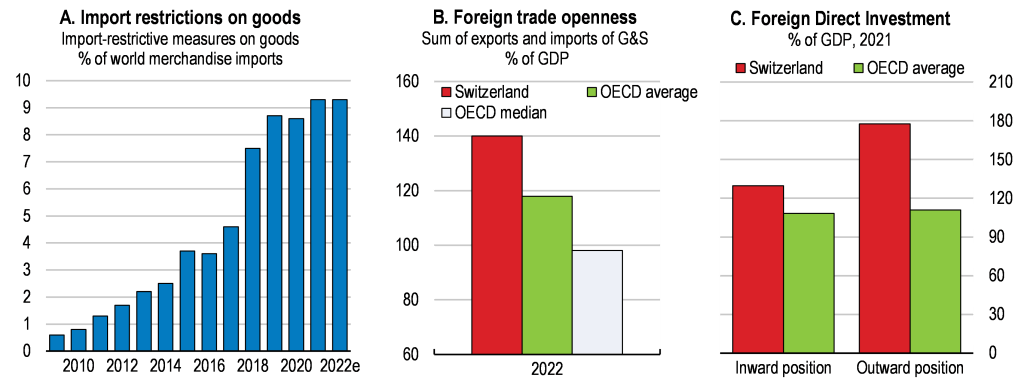
Notes: For panel A, the chart denotes the global cumulative trade coverage of restrictions on goods estimated by the WTO Secretariat, based on information available in the TMDB on import measures recorded since 2009 and considered to have a trade-restrictive effect. The estimates include import measures for which HS (Harmonised Commodity Description and Coding System) codes were available. The figures do not include trade remedy measures.
Source: WTO November 2022 Report; Economic Outlook database; OECD International Direct Investment Statistics database.

According to the WTO’s Trade Cost Database, effective trade costs, representing all factors constraining international trade versus domestic activity, are lower in Switzerland than the OECD average in manufacturing and services, yet higher than in the four neighbouring countries (Austria, Germany, France and Italy), see Figure 2. Trade costs can be lowered in many ways. Tariff cuts, deeper or new free trade agreements (FTAs), improved at-the-border regulations and procedures, as well as investments in digital infrastructure all help. In this regard, Switzerland unilaterally abolished tariffs on industrial goods from January 2024. Similarly, the signing of an FTA with India in March 2024 together with the EFTA member states (Iceland, Lichtenstein and Norway) represents an important milestone. Yet barriers to trade remain high in agriculture and the services sector. Less direct support and more import competition would raise agriculture productivity and lower prices. Minimising barriers to services trade will increase the gains from digital transformation and boost competitiveness.

Figure 2. There is scope to reduce effective trade costs, in particular in services and agriculture
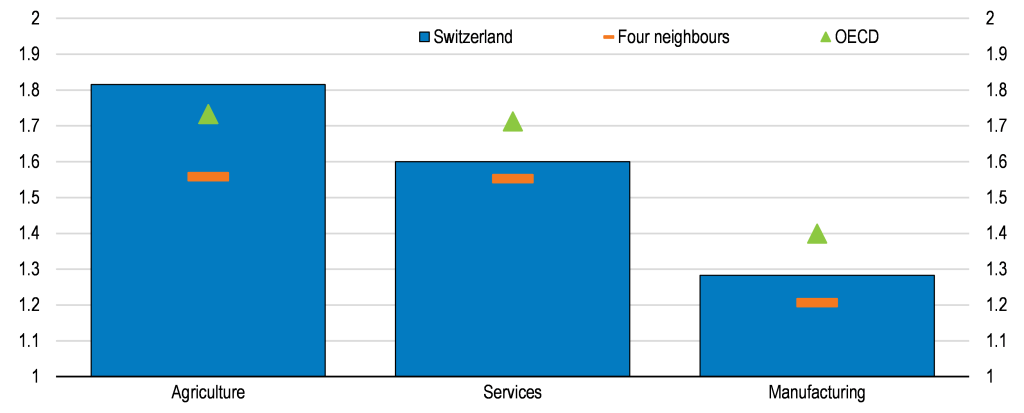
Notes: The effective trade costs are estimates of the costs involved with international trade relative to domestic activity. The figure shows trade cost estimates from the WTO, averaged across ISIC Rev. 4 sub-sectors in 2018. The trade costs are expressed as ad-valorem equivalents, in logarithms. Four neighbours refer to Austria, Germany, France and Italy. OECD is a simple average of OECD countries.
Source: WTO.

Most of Swiss exports and imports flow within FTAs. The usage rate is 73% for imports, which is higher than for the EU average yet lower than best performing countries. There are several reasons why companies may choose not to use the FTAs, depending on the products they trade and their preferential rules of origin. Complying with the rules may be difficult due to complex information requirements or involve large administrative costs. Reducing the administrative burden and providing centrallised, clearly structured and understandable information could increase the use of FTAs.

With the EU standing as Switzerland’s largest trading partner, the bilateral relationship is of paramount importance. The current partnership is governed by roughly 120 separate treaties, but faces uncertainties as efforts to reach a comprehensive “framework agreement” stalled since 2021. The Federal Council’s adoption of a new negotiating mandate with the EU in March 2024 is a welcome step, and opens the door to continued deep economic integration. An erosion of the Switzerland-EU partnership would raise uncertainty, be harmful for Switzerland’s external trade and competitiveness and undermine its economic resilience.

Addressing behind- and at-the-border regulations, as well as enhancing digital connectivity, are crucial steps to facilitating trade and limiting bottlenecks. While Switzerland outperforms the OECD average in several aspects of trade facilitation, there is further room for improvement, particularly in areas such as fees and charges, process automation, and external border agency cooperation (see Figure 3). Streamlining information availability and pre-arrival processing procedures for imports can significantly reduce the time and cost burden for businesses, particularly SMEs looking to expand internationally and diversify their supply chains.

As Switzerland charts its course through a changing global economic landscape, maintaining openness in trade and reducing regulatory burdens will be key to strengthening economic resilience. This approach can allow companies to improve the resilience of their supply chains, without unduly increased state influence or costly public support.

Figure 3. Improving trade facilitation measures would help reduce bottlenecks

OECD Trade Facilitation Indicators, from 0 to 2 (best performance), 2022
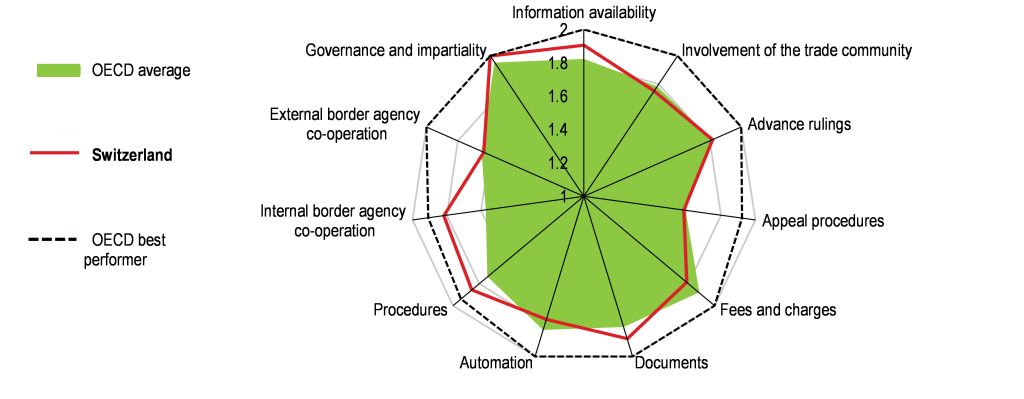
Source: OECD (2022), Trade Facilitation Indicators.   


What’s beyond 65? Why Switzerland should step up retirement preparations

by Christine Lewis and Patrice Ollivaud, Switzerland Desk, OECD Economics Department

The statutory retirement age in Switzerland (for men) has been age 65 since 1948 and it is currently 64 for women. Sixty-five appears to be very powerful: almost two-thirds of 60-64 year-olds are in the labour force but this plummets to less than one-quarter of 65-69 year-olds (Figure 1). The pension system, with a redistributive public old-age pension and funded occupational scheme, has delivered good retirement incomes, as highlighted in the latest OECD Economic Survey of Switzerland (OECD, 2019). An average full-time worker retiring today receives around 60% of their final wage from the mandatory part. And most have comfortable pensions thanks to the extra-mandatory scheme. Those with fewer financial resources can access financial support to meet their basic needs.

Back in 1948, retirement would have lasted 13 years – as against the 21 years a 65 year-old today can expect. On current policies, someone starting work today could look forward to some 25 years of retirement, or longer if mortality rates keep improving. But they would have a lower replacement rate of around 40% of their final salary at retirement from the mandatory pension. At the same time, the too-high conversion rate in the occupational scheme (converting assets into an annuity) is reducing future pension benefits.

Meanwhile, the pace of demographic change is quickening as baby boomers retire. This will place upward pressure on ageing-related public spending (OECD, 2019a). Moreover, the ratio of workers to retirees is likely to fall from 2-to-1 to around 1-to-1 by the early 2040s.

Thinking about working lives beyond 65 will help keep future generations on track towards the comfortable retirement enjoyed by many today. Elsewhere “age 67” is becoming the “new 65” (OECD, 2019b). Some countries, like Denmark and Portugal, have linked the retirement age to all, or part, of increases in life expectancy. For these reasons the Survey recommends:

  • Gradually raising the retirement age to 67 and then linking it to life expectancy. This would boost retirement incomes, help fund public spending and shore up the finances of the public pension system.
  • Reforms to help people work into older age. Switzerland’s annual conference on old-age workers could find ways of introducing greater flexibility into the wage-setting system to tackle the seniority wages that make older workers more expensive. This could include training opportunities to help workers upskill. Social security contributions increase sharply with age; this could be flattened.
  • Updating elements of the pension system, and in particular, lowering the conversion rate and making it a more flexible technical parameter.

References

OECD (2019a), OECD Economic Surveys: Switzerland, OECD Publishing, Paris. OECD (2019b), Working Better with Age, Ageing and Employment Policies, OECD Publishing, Paris.


Switzerland’s productivity puzzle: Being a leader and an underperformer

by Patrice Ollivaud, Economist, Switzerland Desk, OECD Economics Department

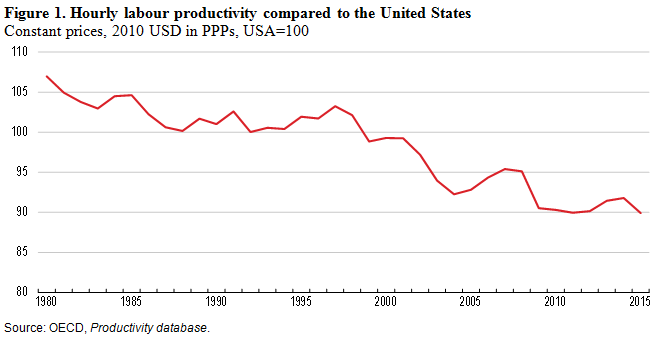
Switzerland is among the leaders in many global rankings including on R&D, innovation, infrastructure, universities and competitiveness. It is well integrated in global value chains, specialised in some high-value-added activities and home of many large multinationals. These factors should contribute to high, and rising, labour productivity. However, it has been falling behind other OECD countries, including the United States (Figure 1). Switzerland’s labour productivity still ranks amongst the top-10 OECD countries, but its growth performance has been poor in recent decades. During the 2000s its GDP per capita growth was driven mainly by an increasing employment rate, which reached record highs. That no longer has much scope to continue, which calls for focusing policy efforts on bolstering productivity to sustain Swiss living standards.

swissproductiv

The recently published OECD Economic Survey of Switzerland (OECD, 2017) studies Swiss labour productivity from a firm-level perspective using the KOF Swiss Innovation Survey database. The results point to a growing gap between Swiss frontier firms and the rest (Figure 2), similar to the pattern observed in other OECD countries (Andrews et al., 2016). This is particularly the case in the services sector.

Labour productivity growth is higher in firms that have introduced innovations and those with a larger share of high-skilled employees. However, fewer and fewer firms conduct R&D, while they spend more and more francs on it. This accentuates the concentration of R&D in a limited number of firms (around two-third of patents over 2006-11 originated from just 20 firms) and in pharmaceuticals (which accounted for nearly 30% of Switzerland’s business R&D in 2013). In addition, small firms report facing constraints in finding workers with needed skills.

This suggests the existence of a two-speed economy. A small segment of firms does extremely well. Others are suffering, driving the weak overall labour productivity growth outcome.

Swissprod2

Facilitating firm entry and exit are key ingredients for business dynamism and boosting productivity growth. Furthermore, entrepreneurship is not very high for the 18-24 year-old population. Several recommendations would boost the creation of innovative start-ups:

  • Promoting incubators at higher education institutions
  • Increasing the share of academic staff with entrepreneurial skills
  • Facilitating collaboration between firms through universities and research laboratories.

Risk-taking would also be facilitated – pushing up start-up rates – if Switzerland implemented a personal bankruptcy regime, allowing honest, hard-working entrepreneurs to have a second chance.

Bibliography:

Andrews, D., C. Criscuolo and P. Gal (2016), “The Best versus the Rest: The Global Productivity Slowdown, Divergence across Firms and the Role of Public Policy”, OECD Productivity Working Papers, No. 5, OECD Publishing, Paris, http://dx.doi.org/10.1787/63629cc9-en

OECD (2017), OECD Economic Surveys: Switzerland 2017, OECD Publishing, Paris, http://dx.doi.org/10.1787/eco_surveys-che-2017-en


Maintaining Switzerland’s enviable living standards into the future

by Christine Lewis, Switzerland Desk, Economics Department

Switzerland’s high living standards and quality of life are renowned. It has the third-highest level of GDP per capita in the OECD. Likewise, survey data show Swiss have the OECD’s second-highest rate of life satisfaction. Unemployment is low, including for young people. And income inequality (after taxes and transfers) is around the OECD average.

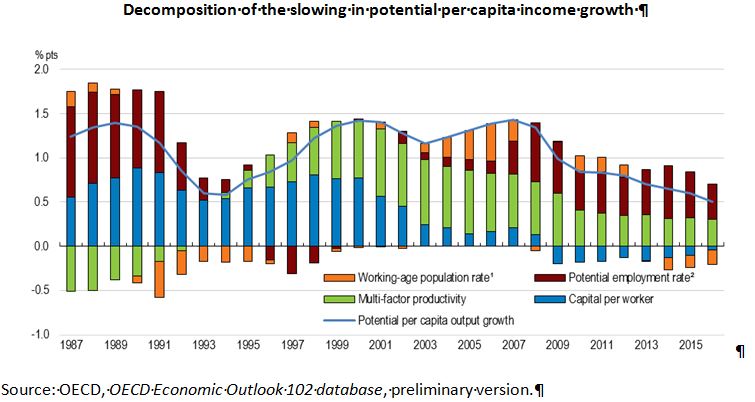
But Switzerland cannot take these enviable outcomes for granted. Indeed, trends are slowly eroding this favourable position. The rate of potential growth in per capita income has slowed to just 0.5%. While Swiss GDP per hour worked was one of was of the highest 40 years ago, growth has stalled due to slow increases in investment and in multi-factor productivity (Figure). Demographics are also playing a role by reducing the share of the population that is of working-age. And immigration, which had helped offset this effect and ease skills shortages, is slowing too. Ageing will add to the fiscal burden: spending on pensions, health and long-term care is projected to increase by 3.5 percentage points of GDP in the next three decades, which risks crowding out other spending and pushing up debt (Federal Department of Finance, 2016).

Switz

The OECD’s latest Economic Survey of Switzerland highlights several win-win policies that can counter these trends by raising labour supply and skills while contributing to the inclusiveness of growth (OECD, 2017):

  • Increasing affordability of childcare would allow mothers to increase their hours if they so choose and help them to maintain a career path. By better allocating women’s skills it would also raise productivity. Likewise, the disincentives in the tax system to take on more hours should be removed by shifting to taxation of individual incomes or undertaking some equivalent measure.
  • Participation in life-long learning should be promoted more actively to ensure that workers continue to maintain and adapt their skills as the economy changes at an ever-faster pace. Swiss workers have high levels of participation in continuing education and training overall, but it is not broad-based with a heavy concentration on those with strong educational attainment. To ensure that other workers are not left behind, subsidies should be offered to workers from groups with low participation rates.
  • Incentivising and assisting workers to delay retirement will help combat the effects of ageing on growth as well as alleviating fiscal pressures. Pension reform is urgently needed to ensure the financial sustainability of the system; reform should raise retirement ages and index them to life expectancy and also include stronger incentives to work longer. Promoting take-up of preventative health programmes, as well as career planning and tailored job-search assistance would lengthen healthy working lives.

[

References

Federal Department of Finance (2016), Report on the Long-term Sustainability of Public Finances in Switzerland, Federal Department of Finance, Bern.

OECD (2017), OECD Economic Survey of Switzerland, OECD Publishing, Paris.