A roadmap for efficient, inclusive and sustainable housing in Slovenia

By Volker Ziemann, OECD Economics Department

Like many other countries, Slovenia faces complex housing sector challenges that must be addressed to preserve the current high quality of life. High demand and a limited supply have led to low residential mobility, soaring prices, a high prevalence of commuting and increasing concerns about housing affordability. Slovenia’s investment in homebuilding lags behind both the EU and OECD averages (Figure 1). Insufficient investment is a major factor contributing to the housing shortage and rising prices.

Figure 1. Residential investment is subdued

Note: Data refers to the European Union including 27 countries. Unweighted averages for OECD and European Union aggregates.
Source: OECD Economic Outlook: Statistics and Projections database; Eurostat National Accounts database; OECD calculations.

The roots of Slovenia’s housing challenges can be traced back to the 1990s privatisations. While this led to high homeownership rates, it also had unintended consequences. The housing supply became restricted, mobility decreased, a private rental market remained in its infancy. As a result, many young families and first-time buyers find themselves today with limited housing options. Moreover, the ageing housing stock further defies ambitious climate goals. To address these challenges, the latest OECD Economic Survey of Slovenia proposes a comprehensive roadmap of reforms that would help to ensure that all Slovenians can access high-quality, affordable, and sustainable housing.

Inefficient spatial planning and cumbersome permitting processes have stifled residential construction. While there have been some recent improvements, the pace of investment remains insufficient to meet the growing demand. Streamlining spatial planning processes, notably through better coordination across levels of government (Figure 2), and establishing one-stop shops for building permits would help improve the governance of housing markets and unlock the potential for new housing.

Figure 2. Inefficient land-use governance restricts construction activity

Source: OECD Housing Governance Indicators Dashboard, https://www.oecd.org/housing/policy-toolkit/data-dashboard/housing-governance.

The private rental market is underdeveloped, and a more accommodating framework is needed to make it grow. A lack of standardised contracts, tax biases, and an imbalance in tenant-landlord rights have hindered its development. Slovenia can foster a thriving private rental sector that offers attractive long-term housing solutions by introducing clear regulations and ensuring fair treatment for both parties.

The proliferation of secondary homes and short-term rentals, fueled by favourable regulations and tax incentives, has further exacerbated the affordability crisis. These properties often sit vacant for much of the year, removing them from the long-term rental market and driving up prices. Harmonising the taxation of rental revenues and implementing a comprehensive recurrent tax on immovable property based on actual market values could incentivise owners to make these homes available for long-term rentals, increasing supply and easing pressure on the market. Taxing land more than the structure on it could further incentivise the construction of underdeveloped or idle land.

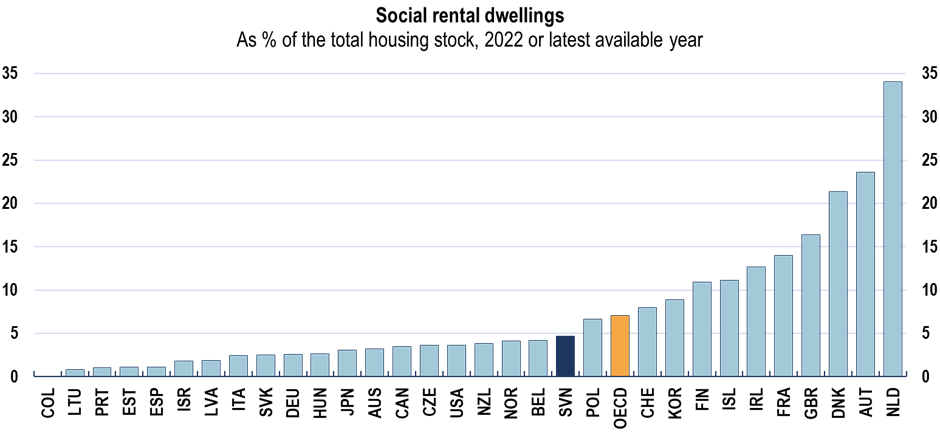
Figure 3. There is scope to expand the social housing stock
Source : OECD Affordable Housing Database (AHD).

Slovenia’s social housing sector is also underdeveloped compared to that of its European neighbours (Figure 3). The upcoming Housing Act presents an opportunity to rectify this situation. A revised social rent formula, coupled with incentives for potential providers, including limited-profit housing associations, could pave the way for increased investment in social housing, providing affordable options for low-income families and individuals.

Slovenia’s mortgage markets are small, limiting access to finance for aspiring homeowners. Promoting competition in the banking sector and empowering consumers with financial knowledge is crucial to expand housing finance and increase homeownership opportunities. Moreover, making more and better use of credit registers could reduce lending margins and fuel demand for mortgage financing.

Figure 4. Incentivising renovation is needed to accelerate the decarbonisation of homes

Note: Dotted line refers to projections.
Source: IEA Energy Efficiency Indicators, 2023.

Finally, the decarbonisation of Slovenia’s housing stock is a pressing concern (Figure 4). A significant portion of residential buildings are outdated and energy-inefficient. The recent energy crisis has underscored the urgency of transitioning to energy-efficient housing. While the investment required is substantial, a combination of fiscal support measures and enforceable regulations can help homeowners make the necessary upgrades.

Slovenia’s housing challenges are complex and multifaceted, but they are not insurmountable. By implementing comprehensive reforms that address inefficiencies and policy bottlenecks, Slovenia can create a more efficient, inclusive, and sustainable housing market.

Reference

OECD (2024), OECD Economic Surveys: Slovenia 2024, OECD Publishing, Paris, https://doi.org/10.1787/bc4a107b-en.


After the Covid-19 crisis, Slovenia needs to focus on population ageing challenges

by Jens Høj, Slovenia Desk, OECD Economics Department

Slovenia was one of the best preforming OECD economies until the Covid-19 outbreak. The health crisis was smaller than in most other counties, helped by early implementation of containment measures.

Extensive fiscal measures were implemented to support jobs and incomes. Nonetheless, the ensuing economic crisis will be as severe as in other countries, reflecting the openness of the small Slovenian economy. The economic recovery should pick up unless a new outbreak materialise, which could lead to higher long-term unemployment and lower growth.

Once the Covid-19 economic crisis is under control, the government needs to start addressing population ageing challenges as this will lead to a higher number of pensioners and as the labour force becomes smaller and older. These developments are creating two main long-term challenges. The first is to contain ageing-related spending increases in pensions and health and long-term care. Longer working lives is key to secure the pension system’s fiscal sustainability, while better use of economic signals is needed to improve the efficiency and effectiveness of the health and long-term care systems. The second challenge is to sustain growth with a changing workforce. In the near-term, underutilised labour resources, such as older and low-skilled workers, need to be mobilised. Thereafter, maintaining growth and income convergence requires faster productivity growth, pointing to a need for continuously improving labour allocation. For this to be realised, labour market institutions have to adjust to ensure that workers’ reward reflects to a higher degree individual productivity and efforts. In addition, more geographical labour mobility is needed, pointing to a need to develop further the housing market.

Reference:
OECD (2020), OECD Economic Surveys: Slovenia 2020, OECD Publishing, Paris, https://doi.org/10.1787/a4209041-en.


The Slovenian economy is bouncing back

by Rory O’Farrell, Slovenia Desk, OECD Economics Department

Slovenia would do well if its economy performed as well as its ski-jumpers. In 2015, Slovenian Peter Prevc became the first ski-jumper in history to jump 250 metres. As impressive has been his ability to land successfully, being among the few jumpers to receive a perfect 20 points for style. While the Slovenian economy has been successful in bounding forward, it has taken hard falls in the past, and a lack of resilience means it has taken a long time to recover.

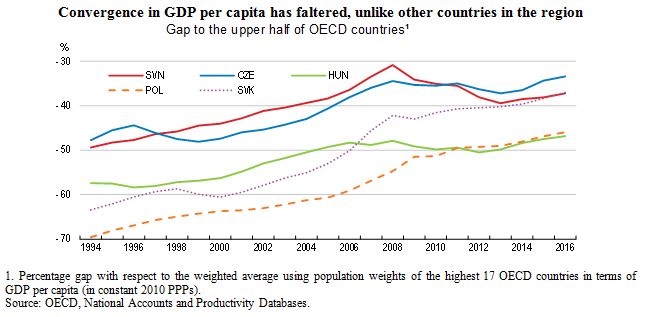
Prior to the international crisis, the bounding Slovenian economy converged with advanced OECD economies, before suffering a double hard landing with the onset of the international financial crisis and a subsequent domestic banking crisis. However, thanks to recent structural reforms, business restructuring, supportive monetary conditions and improved export markets, Slovenia is leaping forward again. GDP growth is accelerating and broadening, unemployment is down, and both consumer confidence and the trade balance are reaching record highs. The government may need to step in early with tighter fiscal policy to ensure a controlled landing.

Slovenia

However, unlike its agile youthful ski-jumpers, Slovenia is not breaking any records in terms of productivity. Indeed, its growth has lagged that of regional peers. Labour productivity is low compared to the OECD average, in part due to large numbers of workers employed in relatively low-productivity small firms, and this has yet to show a strong improvement. Productivity gains were also held back by low investment, as the crisis-afflicted banking sector was unable to lend to domestic firms, and Slovenia has been less succcesful in attracting foreign direct investment than other countries in the region. In addition, a lack of competitive pressure, due to heavy regulation and ineffective competition policies and enforcement, has inhibited Slovenian firms from developing the efficiency needed to drive productivity forward.

The nimbleness of the Slovenian economy is also being reduced by a rapidly ageing population. Older workers with obsolete skills have tended to take early retirement rather than retrain, and a poor reallocation of labour is leading to labour shortages. In the past such shortages were filled by training young Slovenians, but a shrinking youth population means this is no longer possible. In addition, public spending pressures due to ageing (in terms of health and pensions) are mounting.

However,  with an improving economy Slovenia is in a good position to move ahead with reforms that will boost long-term growth. As with any ambitious endeavour, occasional mishaps are inevitable. The just released OECD Economic Survey of Slovenia highlights the need to maintain a fiscal cushion to soften future landings as well as the reforms needed to create a more agile economy to sustain incomes and well-being.

Find out more:

OECD (2017), OECD Economic Surveys: Slovenia 2017, OECD Publishing, Paris.


Retraining can enable ageing Slovenians to keep pace with new technologies

by Rory O’Farrell, Slovenia Desk, OECD Economics Department

While workers in many OECD countries are worried whether robots will take their jobs, the inhabitants of the Slovenian town of Kočevje are less concerned. In 2016 Japanese robotics firm, Yaskawa, announced plans to produce robots in Kočevje, which could create up to 200 jobs. This is a continuation of a pattern seen since independence whereby Slovenia has continued to shift from traditional manufacturing to business services and high-tech production. However, not all Slovenians have been included in this progress.

Modernisation has mainly been achieved by training young Slovenians to fill new occupations. In contrast, those with obsolete skills tend to retire or become unemployed rather than retrain, leaving Slovenia with persistent long-term unemployment, and amongst the lowest employment rates of older workers in the OECD. An ageing population means this is no longer sustainable, and labour shortages are already emerging. To meet the need for skills that complement investment in knowledge-based capital, and the new technologies brought by foreign firms, more responsive education and training solutions are needed.

Slovenia

Slovenia performs poorly in terms of providing workers the opportunity to retrain later in life. While it has an effective system of vocational education, workers lack some basic skills that enable them to retrain later in life. Also, although tertiary attainment has increased rapidly, high fees for part-time students make it unattractive for older Slovenians to pursue tertiary education. There is also a lack of incentives to retrain, as wages rise automatically with age and thus do not reflect the relative demand for different occupations, and unemployment and disability insurance have served as pathways to early retirement.

The just-released OECD Economic Survey of  Slovenia outlines how a more flexible education and training system can help create a more flexible labour market. Policies such as greater problem-based learning for vocational students, more adult training, and equalising fees for part-time and full-time students can help workers adapt to future changes in the labour market. This can help ensure all Slovenians benefit from future economic growth.

Find out more:

OECD (2017), OECD Economic Surveys: Slovenia 2017, OECD Publishing, Paris.


Retraining can enable ageing Slovenians to keep pace with new technologies

by Rory O’Farrell, Slovenia Desk, OECD Economics Department

While workers in many OECD countries are worried whether robots will take their jobs, the inhabitants of the Slovenian town of Kočevje are less concerned. In 2016 Japanese robotics firm, Yaskawa, announced plans to produce robots in Kočevje, which could create up to 200 jobs. This is a continuation of a pattern seen since independence whereby Slovenia has continued to shift from traditional manufacturing to business services and high-tech production. However, not all Slovenians have been included in this progress.

Modernisation has mainly been achieved by training young Slovenians to fill new occupations. In contrast, those with obsolete skills tend to retire or become unemployed rather than retrain, leaving Slovenia with persistent long-term unemployment, and amongst the lowest employment rates of older workers in the OECD. An ageing population means this is no longer sustainable, and labour shortages are already emerging. To meet the need for skills that complement investment in knowledge-based capital, and the new technologies brought by foreign firms, more responsive education and training solutions are needed.

Slovenia2017blog1

Slovenia performs poorly in terms of providing workers the opportunity to retrain later in life. While it has an effective system of vocational education, workers lack some basic skills that enable them to retrain later in life. Also, although tertiary attainment has increased rapidly, high fees for part-time students make it unattractive for older Slovenians to pursue tertiary education. There is also a lack of incentives to retrain, as wages rise automatically with age and thus do not reflect the relative demand for different occupations, and unemployment and disability insurance have served as pathways to early retirement.

The just-released OECD Economic Survey of  Slovenia outlines how a more flexible education and training system can help create a more flexible labour market. Policies such as greater problem-based learning for vocational students, more adult training, and equalising fees for part-time and full-time students can help workers adapt to future changes in the labour market. This can help ensure all Slovenians benefit from future economic growth.

Find out more:

OECD (2017), OECD Economic Surveys: Slovenia 2017, OECD Publishing, Paris.