Addressing housing market challenges in the Slovak Republic

By Federica De Pace

As in many OECD countries, housing affordability deteriorated in Slovakia before the energy crisis. Between 2015 and 2022, house prices rose at a much faster pace than households’ income (Figure 1). Since 2022, the cost-of-living crisis has been squeezing real incomes, dampening housing demand and resulting in declining house prices. However, with interest rates and mortgage costs surging, housing affordability remains a challenge today. Moreover, Slovak households have been particularly exposed to the surge in energy prices, as nearly 10% of their budget accounts for electricity and gas expenditures – the highest share among OECD countries. The poor thermal performance of the housing stock, mostly comprising buildings that were constructed during the communist era, contributes to explaining such high costs for electricity and heat. Last, many low-income households, especially in the Roma community, live in low-quality and overcrowded housing, and homelessness has reached an alarming dimension over the past years.

Figure 1. House prices have increased faster than incomes until 2022

Price to income ratio, index 2015 = 100

Source: OECD Analytical House Prices database.

To address these housing market challenges, Slovakia needs to find ways to boost efficiency, promote affordability and inclusiveness, and accelerate environmental sustainability of housing. To do so, the 2024 OECD Economic Survey of the Slovak Republic suggests reforms in five broad areas:

1.Streamlining housing construction. Administrative inefficiencies in the building permits procedures contribute to slow the responsiveness of housing supply to demand pressures. The process for obtaining building permits is very slow: in 2019 it took on average 300 days versus 152 days in the average OECD country (World Bank, 2019). Expediting the adoption of digitalisation in building permits would accelerate procedures and enhance housing supply responsiveness, alleviating pressures on housing prices. Furthermore, land use policy is highly decentralised. This leads to inefficiencies in the management of resources, challenges in hiring qualified staff for construction-related tasks and an increased risk of policy capture by local stakeholders, resulting in blockages of construction projects at local level. Giving more responsibilities to higher levels of government in land use policy and construction-related activities would help to facilitate construction projects.

    2. Expanding the private formal rental market. As a consequence of the privatisation of state-owned housing during the transition to a market economy in the early 1990s, most households own their home, and the formal private rental market is thin. Developing the private rental market can spur residential (Figure 2) and labour mobility. This can help to reduce skill shortages and improve matching between employers and employees, with positive effects on productivity. It requires inter alia striking a better balance between the interests of landlords and tenants, for example by making provisions for a rental contract that ensures enough flexibility and security for both parties.

      Figure 2. Homeownership is negatively correlated with residential mobility

      Source: OECD Affordable Housing database; and OECD (2021), Brick by Brick: Building Better Housing Policies, OECD Publishing, Paris, https://doi.org/10.1787/b453b043-en

      3. Reforming housing taxation. Revenues from recurrent taxes on immovable property are low in international comparison. A comprehensive reform package shifting the burden from labour to property taxation has the potential to reduce distortions to economic growth.  Moreover, basing property taxes on regularly updated property values would help stabilise fluctuations in housing prices and improve equity. Gradually phasing-in the taxes and introducing tax deferrals, for example by paying the tax only when a house is sold or bequeathed, can increase acceptance and protect vulnerable homeowners.

      4. Increasing housing inclusiveness. Many low-income households live in poor housing conditions and are overburdened by housing costs. These issues are particularly pronounced among the Roma, where the overcrowding rate reaches 80% and almost a third of the community lives in dwellings without access to tap water (European Agency for Fundamental Rights, 2022). Accelerating the formalisation of property rights in Roma settlements would help to provide access to basic infrastructure, such as tap water and sanitary facilities, improving life conditions and promoting social integration. Higher investment in social housing, especially in areas connected to job centres and transports, and expanding targeted housing allowances would help to raise affordability and reduce social exclusion.

      5. Strengthening incentives to accelerate housing renovation. Higher carbon prices in the building sector, as planned at the European level from 2027, would provide strong incentives for renovating housing and shifting to lower-emission heating systems. In addition, implementing stricter regulation, including by extending coverage of high-quality energy performance certificates and relaxing voting rules for renovation works in multi-apartment buildings, together with targeted financial assistance to low-income households living in the most energy inefficient dwellings would help to further incentivise housing renovations, reduce energy poverty and advance environmental objectives. 

      Reference

      OECD (2024), OECD Economic Surveys: Slovak Republic 2024, OECD Publishing, Paris, https://doi.org/10.1787/397ca086-en.


        Towards a sustainable recovery in the Slovak Republic

        By Hyunjeong Hwang and Oliver Roehn, OECD Economics Department

        The COVID-19 crisis has disrupted the remarkable progress in lifting living standards of Slovakia, which had consistently ranked among the fastest-growing OECD economies since 2000. Timely policy support, including job retention schemes, limited the impact of the crisis. However, GDP still remained around 1.5% below its pre-crisis level in the fall of 2021 (Figure 1), as global supply chain disruptions together with subsequent waves of the pandemic have slowed the recovery.

        With about half of the population still unvaccinated, moving beyond the crisis will first and foremost require continued efforts to accelerate vaccinations, including by enhancing trust in vaccinations and tackling misinformation. At the same time, targeted and flexible policy support to the most vulnerable households and firms should be maintained until the recovery is self-sustained. The government’s recovery and resilience plan and substantial inflows of EU funds will strengthen the recovery, provided that investments and accompanying reforms are implemented effectively and in a timely manner.

        Figure  1. Activity has rebounded but the pace of the recovery has slowed

        Real GDP, index 2019Q4=100

        Note: Visegrad V3 includes Czech Republic, Hungary and Poland.
        Source: OECD Economic Outlook: Statistics and Projections database.

        Beyond the immediate priority to minimise the human and economic costs of the pandemic, the OECD Economic Survey of the Slovak Republic 2022 highlights two key economic policy challenges in the medium term: (i) addressing the challenges of rapid population ageing, and (ii) boosting productivity and sustainable economic growth.

        I. Addressing the challenges of population ageing

        Slovakia’s population is ageing rapidly. The share of the working-age population is expected to shrink by about a fifth between 2021 and 2050, which will weigh on future economic growth. Expenditures for pensions, health and long-term care are estimated to rise more than 10 percentage points of GDP by 2070, one of the largest increases among EU countries (Figure 2). This puts fiscal sustainability at risk, exacerbating the fiscal challenges from the COVID-19 crisis.

        Addressing the challenges of ageing will require longer working lives and higher efficiency of public spending, through a combination of pension, health, long-term care, and labour market reforms. Slovaks retire earlier than people in other OECD countries, reflecting a low statutory retirement age, many pathways to early retirement, and poor health outcomes. Extending working lives by re-linking the retirement age to life expectancy and tightening pathways into early retirement would significantly improve the sustainability of the public pension system and ensure adequate pension income in the future. Improving health outcomes is also essential to prolong working lives. Health and long-term care reforms should include improving preventative care, enhancing efficiency in hospitals, increasing the number of general practitioners and expanding home and community based long-term care. At the same time, labour market reforms should aim to help more mothers, low-skilled persons, Roma and older workers integrate into the labour market to mitigate the impact of a shrinking work force.

        Such a reform package should be part of a medium-term consolidation strategy. Strengthening the medium-term fiscal framework, including by implementing multi-annual spending ceilings and by better integrating spending reviews into the budget process, can help improve spending efficiency.

        Figure 2. Ageing-related public expenditures are expected to increase rapidly

        Change in expenditure between 2019 and 2070, % points of GDP

        Source: European Commission (2021), “The 2021 Ageing Report: Economic and Budgetary Projections for the EU Member States (2019-2070)”, Directorate-General for Economic and Financial Affairs, Institutional Paper 079, Luxembourg.

        II. Boosting productivity and sustainable growth

        Productivity growth and economic convergence to high-income OECD countries has slowed since the global financial crisis. Sustaining productivity gains, historically largely based on integration into global value chains by foreign-owned firms, is essential to increase living standards in an ageing society. This will require strengthening Slovakia’s own capacity to innovate, adopt new technologies and make the most of the digital transformation.

        Education reform needs to be at the forefront of these efforts to improve the opportunities of all children and ensure adequate skills of adults in a digitalised economy. This will require enhanced access to affordable early childhood education, better training and pay for teachers, improved opportunities of children from disadvantaged families, strengthening the responsiveness of the educational system to labour market needs and investing in adult learning. In addition, helping firms adopt new technologies, raising R&D spending and enhancing the business environment would help strengthen Slovakia’s capacity to innovate and benefit from the digital transformation. It is also vital to attract highly skilled workers from abroad, including Slovaks who have emigrated for their studies.

        Finally, reaching carbon neutrality by 2050 will require additional policy action. A higher and more consistent pricing of carbon across sectors would help ensure the associated costs are minimised, together with further efforts to improve energy efficiency and boost renewable energy. Planned investments in housing renovations including the replacement of inefficient and high-emission boilers and heaters will improve energy efficiency and reduce air pollution, which remains a serious health concern. More rigorous climate policies will have distributional impacts, requiring compensations for the most vulnerable households.

        Reference

        OECD (2022), OECD Economic Surveys: Slovak Republic 2022, OECD Publishing, Paris, https://doi.org/10.1787/78ef10f8-en.


        The Slovak labour market during the pandemic – who is at risk and how to protect all workers?

        by Gabriel Machlica, OECD Economics Department

        The COVID-19 pandemic triggered the most severe economic recession since World War II, causing enormous damage to people’s health, jobs and well-being. The Slovak economy is expected to decline by more than 11% in 2020 if a second wave of infections requiring renewed lockdowns hits before the end of this year (OECD, 2020a). The pandemic could lead to lasting demand changes and structural shifts in the economy. Real per capita income will fall to the level of 2015, implying a loss of five years of income growth. The unemployment rate will reach almost 10% this year. Around 100 thousand people could lose their jobs, with vulnerable workers at risk to bear the brunt of the crisis. In Slovakia, these high-risk groups include (i) the non-standard workers, particularly the self-employed and the temporary workers, (ii) the marginalised Roma community and (iii) young people. Well-targeted labour market activation policies should be coupled with a strong social safety net, to mitigate the inevitable adjustment costs of moving towards new jobs.

        Who is at risk?

        Non-standard workers are vulnerable to the loss of income as a result of the widespread shutdown. Since March, approximately 26% to 40% of Slovak workers have been directly affected by containment measures (NBS, 2020; OECD, 2020c). The most affected sectors were tourism and those services involving contact between consumers and service providers. In this respect, non-standard workers are particularly vulnerable, as they have less protection, they are less likely to receive any form of income support during out-of-work periods than standard employees, and when they do receive benefits they are often significantly less generous than for standard employees (OECD, 2019a).

        In Slovakia, non-standard workers accounted for one third of workers directly affected by containment measures, most of them self-employed (Figure 1). Over the last decade, the favourable tax treatment of self-employed workers led to an increase in the number of regular employment contracts disguised as self-employment contracts (Remeta et al, 2015). The share of own account self-employed workers who earn most of their income from just one client is the highest in the OECD (OECD, 2019a). The other group at high risk are temporary workers, particularly the workers with contracts of agreement for work performed outside an employment relationship, so-called ‘work agreements’. They have been significantly affected by the initial impact of the crisis (IFP, 2020). These groups are particularly vulnerable as their dismissal is less costly for employers and leaves them with less protection compared to standard workers.

        Source: OECD (2020), “Issue Note 4: Distributional risks associated with non-standard work: Stylised facts and policy considerations”, in Issues notes on macroeconomic and structural policy issues related to the COVID-19 outbreak, OECD Publishing, Paris, https://doi.org/10.1787/7f54e942-en.

        The Roma community is highly vulnerable to economic shocks. Roma account for almost one-tenth of the population in the Slovak Republic. Their labour market outcomes are much weaker compared to the general population, but have been considerably improving in the last couple of years (Machlica et al. 2019). However, they remain at particular risk during a downturn as they are mostly low-skilled and work in seasonal, temporary jobs which are much more affected by the economic cycle. Indeed, their employment reacts much more strongly to the economic cycle (Figure 2). In addition, many Roma work in the informal economy, which increases their income insecurity, as they are not entitled to unemployment benefits when they are out of work (Gatti et. al, 2016). All these factors place Roma at a higher risk of falling into poverty when faced with a health or employment shock. This is a significant concern as the vast majority of Roma have been at risk of poverty even before the crisis and almost one-third was living in households where at least one person went to bed hungry in the past month (Machlica et al. 2019).

        The crisis can significantly worsen the labour market prospects of youth as the initial labour market experience can have a profound influence on later working life. This year’s graduates will leave schools and universities with poorer chances of finding employment or work experience. This is a particular concern because of scarring effects that may lead to long-lasting negative labour market outcomes (Bell and Blanchflower, 2011; Helbling and Sacchi, 2014). Young people indeed appear most severely affected by the crisis as they generally work in less secure jobs, and are overrepresented among workers in hard-hit industries such as accommodation and food services (OECD, 2020b).

        Protecting all workers

        The Slovak government has rightly put in place a number of measures in response to the COVID-19 crisis, including incentives to preserve existing jobs, but the take up was much lower than in other OECD countries (Figure 3). These job retention schemes can help limit increases in unemployment and promote a quicker labour market recovery by reducing costs of matching employers to employees. However, this support should not be indefinite as it hampers the necessary reallocation of workers to new jobs (OECD, 2020a). Consumers may emerge from lockdown with new spending habits requiring new jobs, and the long-term preservation of existing jobs may not be efficient. The longer the recovery from the crisis takes, the more should the policy focus shift from “protecting jobs” towards “protecting workers”, providing them with expanded unemployment insurance and an effective activation framework to improve their employability. Strong activation policies can help mitigate some of the inevitable adjustment costs of moving towards new jobs.

        Vulnerable groups require special attention. First, the government should ensure adequate social safety nets to avoid the risk of some groups falling through the cracks of existing social protection system as outlined in a recent OECD report (OECD, 2020d) In the medium term, there is a need to enforce a clear distinction between self-employed and employee status. Many OECD countries are tackling false self-employment by reducing incentives for firms and workers to misclassify employment relationships, putting in place tests and criteria for assessing employment relationships and increasing the capacity of labour inspectorates to monitor and detect breaches (OECD, 2019a).

        A strong social safety net should be coupled with an extensive activation framework, which in the case of the Roma community should reflect their specific constraints such as poor health, housing and transport issues, indebtedness or limited availability of childcare. Tailored measures should offer a mix of training, counselling and mentoring programmes. Collaborating and outsourcing some of these services to non-governmental providers with a good track record of high-quality support for the Roma can help ease capacity constraints of the Public Employment Services. The OECD report on the social integration of the Roma in Slovakia suggests that more coordinated interventions in different policy areas are needed to avoid further exclusion of the Roma, as interventions in one area will not work without others (Machlica et al. 2019). For the young unemployed, training complemented by subsidies to private employers offering on-the-job training can improve skills and employability (OECD, 2019b). For example, Australia and Denmark as part of its economic response to COVID-19 have introduced wage subsidies to help companies maintain or expand their apprenticeship and in-firm training programmes (OECD, 2020b).

        References

        Bednarik, M., S. Hidas and G. Machlica (2019), “Enhancing the social integration of Roma in Slovak Republic”, OECD Economics Department Working Papers, No. 1551, OECD Publishing, Paris, https://doi.org/10.1787/197eb309-en.

        Bell, D. and D. Blanchflower (2011), “Young people and the Great Recession.” Oxford Review of Economic Policy, Vol. 27/2, pp. 241-267

        Gatti , R., S. Karacsony, I. Sandor, K. Anan, C. Ferré and C. de Paz Nieves (2016), Being Fair, Faring Better, Promoting Equality of Opportunity for Marginalized Roma, World Bank, Washington, DC

        Helbling, L. and S. Sacchi (2014), “Scarring effects of early unemployment among young workers with vocational credentials in Switzerland”, Empirical Research in Vocational Education and Training, Vol.6/12, http://link.springer.com/article/10.1186/s40461-014-0012-2.

        IFP (2020), “Trh práce v karanténe“ Komentár 2020/10, Institute of Finacial Policy, Ministry of Finance of the Slovak Republic, 2020

        NBS (2020), “Ekonomické dôsledky uzavretia odvetví s intenzívnym osobným kontaktom”, Analytický komentár č. 81, 4. mája 2020,   https://www.nbs.sk/_img/Documents/_komentare/AnalytickeKomentare/2020/AK81_Koronavirus_Obmedzenia_odvetvi_s_intenzivnym_kontaktom.pdf

        OECD (2020a), OECD Economic Outlook, Volume 2020 Issue 1, https://doi.org/10.1787/0d1d1e2e-en.

        OECD (2020b), OECD Employment Outlook 2020: Worker Security and the COVID-19 Crisis, OECD Publishing, Paris, https://doi.org/10.1787/1686c758-en.

        OECD (2020c), “Distributional risks associated with non-standard work: Stylised facts and policy considerations”  Chapter  English 03 Jul 2020  OECD  in OECD Economic Outlook, Volume 2020 Issue 1

        OECD (2020d), “Supporting livelihoods during the COVID-19 crisis: Closing the gaps in safety nets”  OECD Publishing, Paris,http://www.oecd.org/coronavirus/policy-responses/supporting-livelihoods-during-the-covid-19-crisis-closing-the-gaps-in-safety-nets-17cbb92d/

        OECD (2019a), OECD Employment Outlook 2019: The Future of Work, OECD Publishing, Paris, https://doi.org/10.1787/9ee00155-en.

        OECD (2019b), OECD Economic Surveys: Slovak Republic 2019, OECD Publishing, Paris, https://doi.org/10.1787/eco_surveys-svk-2019-en.

        Remeta, J., et al. (2015), “Moving Beyond the Flat Tax – Tax Policy Reform in the Slovak Republic”, OECD Taxation Working Papers, No. 22, OECD Publishing, Paris, https://doi.org/10.1787/5js4rtzr3ws2-en.


        The social exclusion of Roma in the Slovak Republic calls for immediate policy action

        by Gabriel Machlica, Slovak Republic Desk, OECD Economics Department

        Roma children’s paintings, Materská skola Hrebendova, Kosice

        The Slovak Republic has one of the continent’s largest Roma populations. Estimates differ, but it is assumed that they account for about 8% of the population The Roma communities vary based upon geographic location and the level of integration. Nevertheless, the average level of ethnic segregation is exceptionally high and Roma face social exclusion in almost every aspect of everyday life (Table 1.1.).


        The Roma can be trapped in a cycle of poverty for generations. If a child starts her or his life with limited access to education and lives in poor housing conditions, there is a high probability she will end up in poverty too. Indeed, results for Roma show exceptionally weak upward social mobility between generations. The probability that Roma born in concentrated residential area become unemployed or earn less than minimum wage in irregular work is almost 70%.


        Investment in Roma integration cannot only help improve the well-being of disadvantaged groups, but also yield positive fiscal returns from improved employment prospects. The Economic Survey of the Slovak Republic shows that increasing the Roma employment rate and their productivity to the level of the general population by the end of 2060 would increase GDP by more than 12%  with the economy growing faster on average by 0.3 p.p. per year.


        References

        OECD (2019), OECD Economic Surveys: Slovak Republic 2019, OECD Publishing, Paris,https://doi.org/10.1787/eco_surveys-svk-2019-en


        Slovakia…it’s time to invest in the future

        by Gabriel Machlica, Slovak Republic Desk, OECD Economics Department

        The Slovak Republic continues to exhibit robust economic performance. International competitiveness is strong, fiscal and financial policies are prudent, poverty and income inequality are low, and the country’s environmental footprint has improved markedly. Employment is rising, prices have been stable, and the external account is near balance. However, there are persistent, substantial public-sector deficiencies, which weigh on the wellbeing of the population and can undermine the sustainability of the economic expansion. These are mostly visible in terms of education and health-care outcomes.

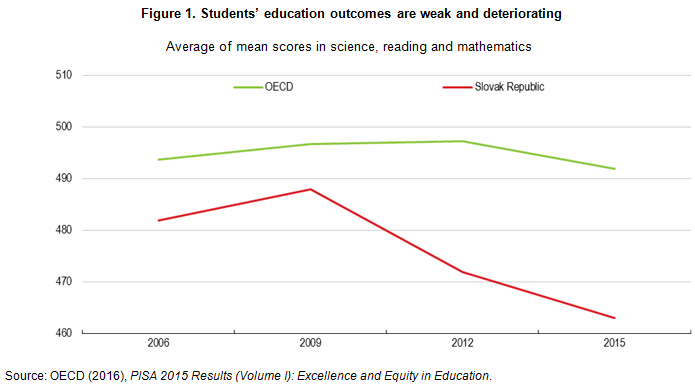
        The Slovak education system is not properly preparing students for the labour market. PISA outcomes for 15 year-old Slovaks are weak in international comparison and have deteriorated over time (Figure 1). At the same time, secondary schools fail to overcome the differences in learning outcomes stemming from students’ socio-economic backgrounds. Almost one-third of 15 year-old Slovak students did not obtain even a basic level of proficiency in assessed subjects. This is worrying, as weaker students have limited access to employment and better paying jobs. Slovak tertiary education is among the weakest in the OECD. University research quality as measured by international rankings is low even in a regional comparison. As a result, an increasing number of students choose to study abroad to get a better education.

        slovakia2017future

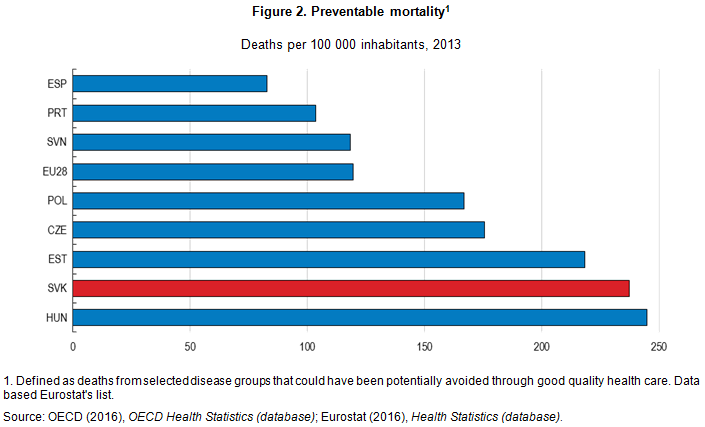
        Regarding health-care outcomes, Slovakia ranks poorly in international comparisons. Life expectancy at birth is shorter than in countries with similar or lower living standards. Life expectancy at 65 and health-adjusted life expectancy are among the lowest in the OECD. Infant mortality is high and more people in Slovakia die of diseases that could have been prevented (Figure 2). Improving the health-care system could bring large gains in well-being. For example, improving it to the EU level could save about 5000  lives per year.

        slovakia2017mortality

        Over the last decade the Slovak economy has improved markedly in terms of macroeconomic fiscal and financial-stability outcomes. Nevertheless, it is important to undertake significant reform of the public services, especially education and health care, in order to spread the benefits of solid economic performance more equitably across Slovak society.

        Further reading:

        OECD (2017), OECD Economic Surveys: Slovak Republic 2017, OECD Publishing, Paris, http://dx.doi.org/10.1787/eco_surveys-svk-2017-en

        Šiškovič, M. and M. Játi (2015), “Čo skutočne merajú medzinárodné rebríčky vysokých škôl”, Komentár 01/2015, Inštitút vzdelávacej politiky, Ministerstvo školstva, vedy, výskumu a športu SR.

        U21 (2016), Ranking of National Higher Education Systems, Melbourne Institute of Applied Economic and Social Research, University of Melbourne.


        Where should Slovakia look for workers?

        by Gabriel Machlica, Slovak Republic Desk, OECD Economics Department

        Slovakia’s economy continues to perform extremely well. More and more people are able to find jobs. Employment and hours worked are already at the highest since independence. The unemployment rate has fallen below historical norms. Nevertheless, more qualified people are needed. Difficulty in hiring qualified labour has become the main complaint of Slovak businesses. Shortages affect over half of all manufacturers and are particularly acute in the automotive sector. More than 80% of the sector’s suppliers signalled that labour availability and quality are major problems. Moreover, the demand for qualified IT workers is estimated to be four times the supply.

        In this regard, the 2017 Slovak Economic Survey argued that the authorities should step up efforts to improve education, ease barriers for foreign workers and enhance labour market access for disadvantaged groups. At the same time, more focus should be placed on the large Slovak diaspora and encourage them to return home.

        Almost one-tenth of the population now lives abroad, which is well above the OECD average (Figure 1, Panel A). Most of them left the country in the last decade. Slovak emigrants are mostly young and educated. Unfortunately, many Slovak emigrants with tertiary education work in low skilled jobs abroad (Figure 1, Panel B), which represents sunk costs for the education system.

        slovakia2017immigrants

        The government should try harder to attract return migrants. Although there are already two schemes to do so, they both support only a limited number of individuals with marginal impact. The authorities should scale up these programmes and monitor their effectiveness to ensure continuing good value for money. More importantly, the government should also develop a comprehensive strategy to maintain ties with the large expatriate community. A new information system could connect with the diaspora and facilitate its engagement. It should be able to target and address emigrants soon after emigration, as the probability of return decreases after five years of living abroad. Many OECD countries are providing online portals with details on job, training and business opportunities. These portals also help young adults studying abroad find information about work and internship offers back home, and companies could use the contact network to find employees among those studying abroad.

        Encouraging emigrants to return home can help to increase the supply of skilled labour. This will  address labour shortages. At the same time return migrants can bring home new skills, networks and financial capital, which can help spur innovation and growth.

        Further reading:

        OECD (2017), OECD Economic Surveys: Slovak Republic 2017, OECD Publishing, Paris. http://dx.doi.org/10.1787/eco_surveys-svk-2017-en

        Pungas, E., O. Toomet, T. Tammaru and K. Anniste (2012), “Are Better Educated Migrants Returning? Evidence from Multi-Dimensional Education Data”, NORFACE Migration Discussion Paper, No. 2012-18. www.norface-migration.org/publ_uploads/NDP_18_12.pdf