The rise of private credit markets: A threat to financial stability?

By Caroline Roulet.
Private credit has become an important source of financing
Private credit is a form of non-bank financing to firms, mainly through specialist funds that raise long-term capital from end-investors and offer long-term floating-rate loans to middle and smaller sized companies without access to capital markets or bank credit. End-investors such as pension funds and insurance companies value private credit for a number of reasons, including portfolio diversification, confidentiality, and potentially higher returns. Regulatory compliance costs could also be lower, although this varies by type of end-investor.
The latest OECD Economic Outlook documents the rapid expansion of this form of financing since the Global Financial Crisis and analyses the potential risks to financial stability. Private credit markets reached USD 2 trillion globally in 2023 (Figure 1). This was equivalent to 12% of bank loans to non-financial corporations, up from 5% in 2012. Private credit is very diverse but primarily US-focused, though is now also expanding rapidly in Europe and Asia.
Figure 1. Private credit continues to rise in advanced economies
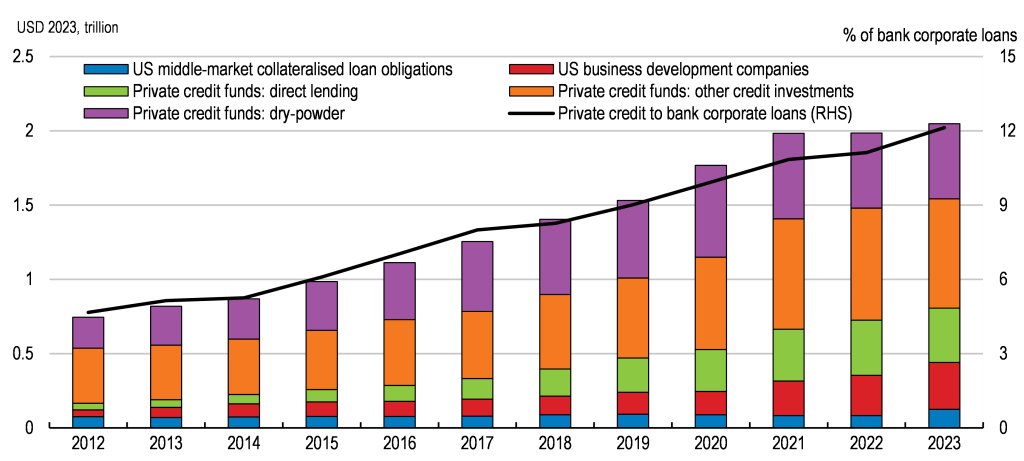
Note: Business development companies (BDCs) are SEC-regulated, closed-end or publicly traded investment companies that must invest 70% of their assets in US companies valued under USD 250 million. Middle-market collateralised loan obligations (CLOs) are a segment of the US CLO market backed by senior secured loans to smaller companies that are originated in either public or private markets. Dry-powder is unallocated or unused capital maintained as cash reserves or liquid assets for future investment. Data are expressed in USD trillion adjusted by the 2023 US consumer price index and as a share of bank loans to non-financial corporations in advanced economies. See note of figure 1.25 in the December 2024 OECD Economic Outlook for further details.
Source: Houlihan Lokey; International Monetary Fund (IMF) Financial Soundness Indicators database; Pitchbook; and OECD calculations.
The expansion of private credit markets raises potential financial stability risks
The growth in private credit has become a matter of interest for central banks and other regulators due to the relative lack of visibility of the market and the underlying risks, and the extent to which private credit funds are interconnected with other financial institutions, not least banks.
Losses by private credit providers could quickly spread to banks. Private credit funds rely increasingly on secured credit lines from banks, with these collateralised by private loans (Figure 2, Panel A). Private capital funds (such as private equity funds) have also become major investors in financial instruments that transfer risks from bank loan portfolios (so-called “credit risk transfers”). This generates risks for both private capital funds and banks if either credit quality deteriorates or if funds’ large end-investors are unable to provide the capital they have committed to.
Private credit funds are also directly interconnected to private equity funds and institutional investors (Figure 2, Panel B). For instance, large private capital funds often manage both private equity and private credit portfolios. Also, private credit funds often provide credit to companies wholly or majority-owned by private equity funds. Consequently, vulnerabilities in one segment of the private financing industry will likely spill over to the other. Liquidity pressures could also arise for end-investors, including insurance companies and pension funds, if there are unexpected capital calls by private credit funds. Such risks are more likely due to the rising amount of committed but so far uninvested capital by end-investors (so-called “dry powder”), frequently held as cash reserves by private credit funds. In the United States, systemic risk warnings are increasing due to insurers’ private credit exposures (Fournier et al., 2024). In Europe, the difficulties of an Italian insurer (Eurovita) illustrate similar risks (AMF, 2024).
Figure 2. Interconnections between private credit funds and the financial system are growing
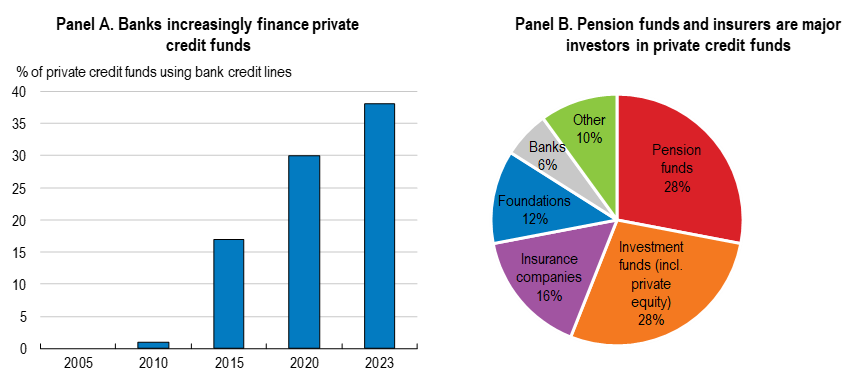
Note: In Panel B, credit lines to private credit funds are not included in banks’ investments, and data are as of June 2022.
Source: MSCI (2023), Blackrock (2023), and OECD calculations.
More broadly, the lack of transparency in private markets is a concern. Multiple layers of leverage from borrowers to funds to end-investors are a potential source of financial instability, with risks of liquidity shortages triggering fire sales and simultaneous deleveraging. Although most private credit funds are unleveraged, some use derivatives for leverage (Federal Reserve, 2023). Some private credit funds also permit redemptions, which increases their liquidity risk.
The recent deterioration in credit quality is a further source of potential risk. A heavier debt service burden for private credit borrowers has led some to delay repayments by adding interest coupons to the loan principal. Refinancing risks are also raised, especially for the most fragile borrowers, because around 50% of the outstanding loans of US private credit funds are due to be reimbursed within three years (Cai and Haque, 2024). With defaults among highly leveraged non-financial corporations rising, there are risks that losses on private credit loans could rise sharply. Such loans are often to firms in economic sectors with low collateralisable or tangible assets and hence low recovery rates in the event of business failure.
Private loans are non-traded, which hinders proper valuation by investors and monitoring by regulators. Credit risk assessments are also uncertain in the absence of clear regulatory standards and could result in losses being underestimated. In the event of a severe shock, a rapid loss of confidence could trigger margin calls in derivatives used by private credit funds, adding further to liquidity pressures from redemptions, with risks that distressed funds default with losses for end-investors. Many liquidity management tools at private credit funds have yet to be fully tested in severe scenarios. While divestment and fire sale risks seem low at present, close monitoring is needed given significant data gaps about the sector and its often limited prudential or conduct oversight. Greater transparency in regulatory reporting would close data gaps and enable better assessment and management of risks by private credit funds and end-investors (EBA, EIOPA and ESMA, 2024; IMF, 2024). Regulatory assessments and stress-testing of end-investors should also take appropriate account of their exposures to other non-bank financial institutions (Acharya, Cetorelli and Tuckman, 2024).
References
Acharya, V., Cetorelli, N., and B. Tuckman (2024), Where Do Banks End and NBFIs Begin?, National Bureau of Economic Research, Working paper 32316, April, https://www.nber.org/system/files/working_papers/w32316/w32316.pdf
AMF (2024), 2024 Markets and Risk Outlook, June, Autorité des marchés financiers, https://www.amf-france.org/sites/institutionnel/files/private/2024-07/2024-markets-and-risk-outlook.pdf
Blackrock (2023), Private Debt: a Primer – Unpacking the growth drivers, November, https://www.blackrock.com/institutions/en-zz/insights/private-debt-primer
Cai, F., and S. Haque (2024), Private Credit: Characteristics and Risks, FEDS Notes, Board of Governors of the Federal Reserve System, February, https://www.federalreserve.gov/econres/notes/feds-notes/private-credit-characteristics-and-risks-20240223.html
EBA, EIOPA, and ESMA (2024), Joint Committee Report on Risks and Vulnerabilities in the EU Financial System, August, https://www.eiopa.europa.eu/publications/joint-committee-report-risks-and-vulnerabilities-eu-financial-system-autumn-2024_en
Federal Reserve (2023), Financial Stability Report, Board of Governors the Federal Reserve System, May, https://www.federalreserve.gov/publications/files/financial-stability-report-20230508.pdf
Fournier, A., R. Meisenzahl, and A. Polacek (2024), Privately Placed Debt on Life Insurers’ Balance Sheets-Part 2—Increasing complexity, Chicago Federal Reserve letter 494, https://www.chicagofed.org/publications/chicago-fed-letter/2024/494
IMF (2024), “The Last Mile: Financial Vulnerabilities and Risks”, Global Financial Stability Report, Chapter 2, International Monetary Fund, https://www.imf.org/en/Publications/GFSR/Issues/2024/04/16/global-financial-stability-report-april-2024#Chapters
MSCI (2023), The Rise (and Rise) of Sub Lines in Private Capital, July, https://www.msci.com/www/blog-posts/the-rise-and-rise-of-sub-lines/04219806963
OECD (2024), OECD Economic Outlook, Volume 2024 Issue 2, OECD Publishing: Resilience in uncertain times, Paris, https://doi.org/10.1787/d8814e8b-en.


