Living longer and living better: an OECD perspective on Polish healthcare
Category: Poland
written by oecdecoscope | April 7, 2025
By Srdan Tatomir
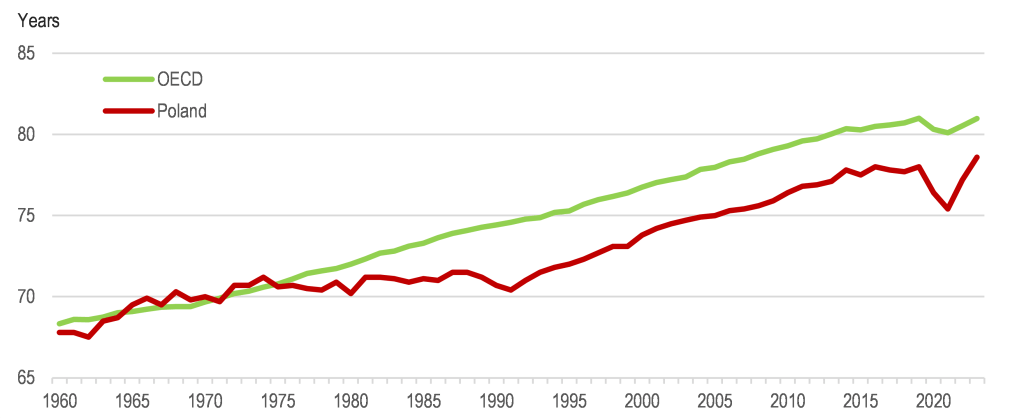
On today’s World Health Day Poland can celebrate the highest level of life expectancy in its history, after it bounced back from the COVID-19 pandemic (Figure 1). It is now 74.8 years for men and 82.4 years for women, longer than in many Central and Eastern European and Baltic countries. But Poland still lags behind the majority of OECD countries. Circulatory system diseases, such as heart disease, hypertension and stroke, account for nearly half of all deaths, while cancer contributes to around a further fifth. As our latest Economic Survey discusses, Poland can do more to boost healthcare.
Figure 1 – Life expectancy in Poland is historically high but there is room to catch up with average OECD life expectancy
Note: The data shown is for average life expectancy at birth. The OECD average is weighted. The latest data point is 2023. Source: OECD Health Statistics.
Poland has historically been among the lowest spenders on healthcare in the OECD. Before the pandemic, overall health spending accounted for 6.5% of GDP. Successive governments have recognised the need to improve healthcare and are implementing reforms. Current plans are to bring overall health spending closer to the OECD average of around 9% by 2027. Policy efforts should focus on key priorities to maximise the positive impact of additional spending on health outcomes.
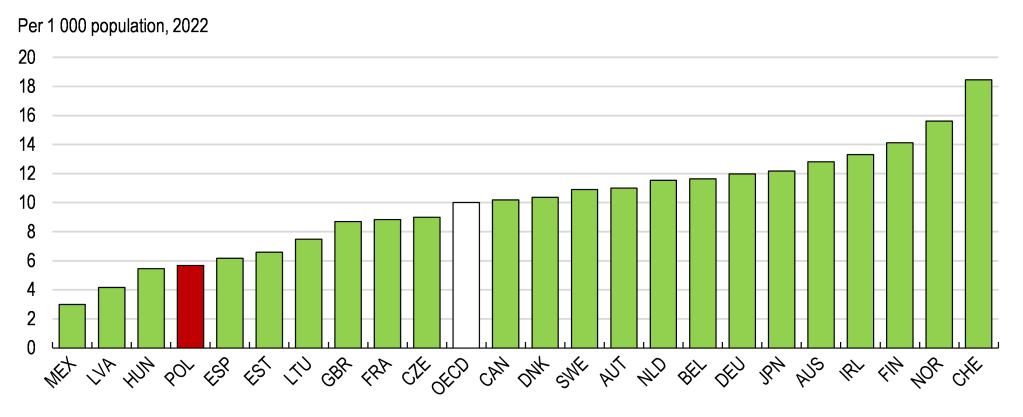
To deliver quality healthcare services an adequate healthcare workforce is essential. While the relative number of doctors in Poland is around the OECD average, the number of nurses is comparatively low (Figure 2). The number of training places for nurses has risen, but more are needed especially because many nurses are close to or over retirement age. Recent increases in salaries should help: in 2022 (the latest year for which the OECD has data), nurses’ salaries stood at 1.6 the national average wage, among the highest in the OECD in relative terms. When adjusted for purchasing power, salaries are now higher in Poland than in countries Polish nurses traditionally emigrated to, such as the UK and Ireland. However, working conditions matter as well. More explicit guidance on working practices, such as setting limits on the number of patient consultations and overtime hours, could improve working conditions and help attract more people to healthcare.
Figure 2 – The number nurses is relatively low compared to other OECD countries
2022, or latest available
Note: The OECD average is unweighted. Source: OECD Health Statistics.
Improving health requires faster treatment. Poland has given cancer patients priority in the health system and there is no cap on treatment costs. Yet cancer is often detected too late. Despite free nationwide screening programmes available since the early 2000s, participation rates are below the EU average, particularly among less educated people. Targeted outreach would help raise participation.
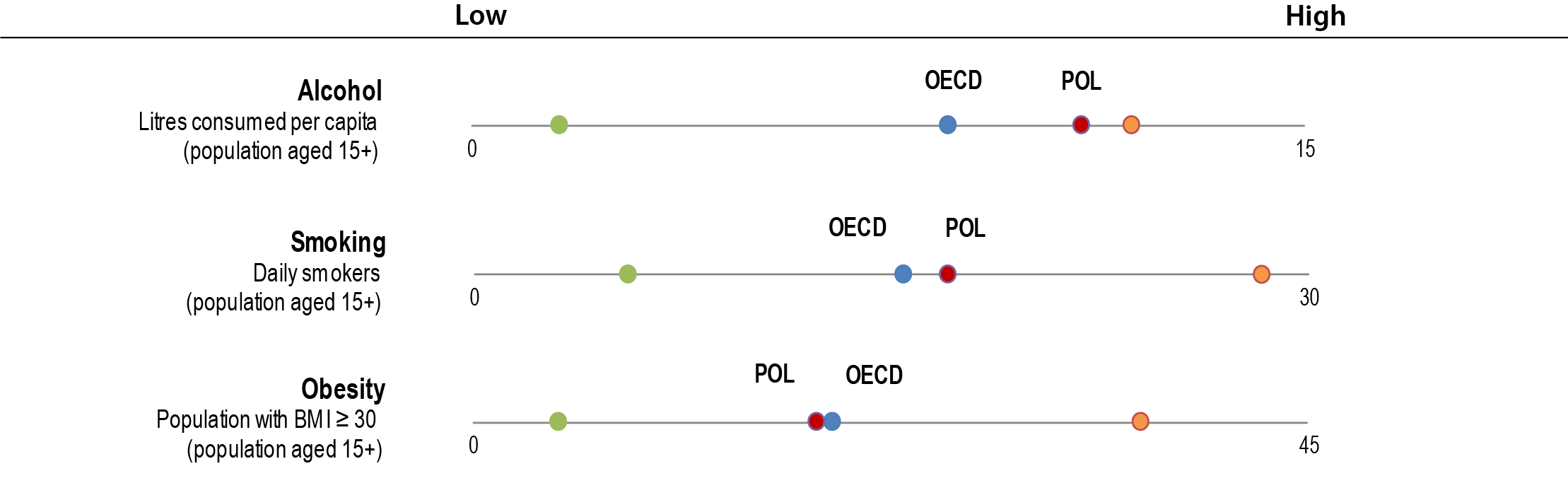
In the medium to long term, better prevention of key risky health behaviours could lead to better health. Alcohol consumption is among the highest in the OECD and smoking rates should be lowered further (Figure 3). Excise duties to make alcohol and tobacco less affordable are rising, and this could be complemented by restricting their availability to maximise the impact on consumption. Introducing taxes on unhealthy foods with high content of salt, sugar and fat could steer people towards healthier eating as has been done in Mexico and Hungary.
Figure 3 – Reducing alcohol and tobacco consumption would improve health outcomes
2022, or latest available
Note: The green circles represent the minimum and the orange circles the maximum observation in the OECD for each variable. Data for alcohol, smoking and obesity is for 2022. Source: OECD Health Statistics 2023, OECD Environment Statistics 2020, WHO Global Health Observatory.
Higher efficiency of the healthcare system can free up resources to fund better healthcare. Poland has made great progress in digitalising its healthcare services and the maturity of its e-health system has been ranked the fifth highest in the EU in 2022. User charges, with exemptions for children and those on low incomes, could be introduced to reduce the number of unnecessary consultations and improve the use of scarce resources. Consolidating the hospital network to reduce capacity, while better reflecting local health needs and improving hospital management quality, could reduce costs without compromising quality or access to care.
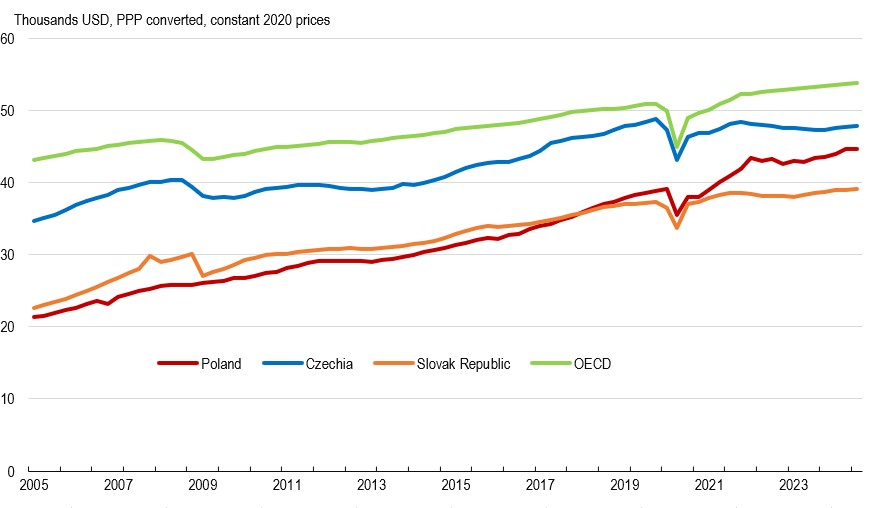
Standard życia w Polsce znacznie wzrósł w ciągu ostatnich dwóch dekad. PKB na mieszkańca podwoił się, zmniejszając dystans do Czech i Słowacji (Rysunek 1), a średnia długość życia wzrosła do 78,6 lat.
Postęp gospodarczy w ostatnich latach spowolnił z powodu dwóch zewnętrznych wstrząsów: pandemii COVID‑19 i reperkusji rosyjskiej wojny w Ukrainie. Niemniej jednak w zeszłym roku gospodarka odnotowała solidny wzrost o prawie 3%, i podobna dynamika wzrostu ma się utrzymać w tym i przyszłym roku. Silna kondycja gospodarcza znajduje odzwierciedlenie na rynku pracy, gdzie stopa bezrobocia osiągnęła historycznie niski poziom, a liczba osób pracujących przekroczyła poziom sprzed pandemii.
Rysunek 1. Silny wzrost doprowadził do znacznego zmniejszenia różnic w rozwoju gospodarczym
Note: Seasonally and calendar adjusted data. Source: OECD Economic Outlook database.
Opublikowany dziś przegląd gospodarczy Polski podsumowuje osiągnięty postęp i analizuje główne krótko i długoterminowe wyzwania stojące przed polską gospodarką. Najbardziej pilnym wyzwaniem jest obniżenie inflacji. Chociaż stopa inflacji spadła znacznie z 18% w lutym 2023 r., nadal jest wyższa od celu inflacyjnego banku centralnego. Inflacja bazowa również pozostaje wysoka i przekracza 4%. W tym kontekście polityka pieniężna powinna pozostać restrykcyjna, a stopy procentowe powinny być obniżane stopniowo jeśli wzrost płac spowolni i presja inflacyjna trwale się obniży.
Deficyt budżetowy Polski pogorszył się w ostatnich latach z powodu szybkiego wzrostu wydatków socjalnych, zdrowotnych oraz obronnych. Polska potrzebuje trwale obniżyć deficyt budżetowy zgodnie z planem rządowym aby sfinansować bieżące priorytety rządu i przygotować się na przyszłe presje wydatkowe. Po stronie wydatków pewne powszechne świadczenia rodzinne mogłyby zostać odebrane osobom o wyższych dochodach. Dochody można by zwiększyć dzięki zmianą w tak zwanych wydatkach podatkowych a także podatkach środowiskowych oraz od majątku. Na przykład pomocna byłaby zmiana opodatkowania nieruchomości, obecnie opartego na ich powierzchni, na system oparty na ich wartości (który istnieje w większości krajów OECD).
Sprzyjające środowisko biznesowe w połączeniu z dobrze wykształconą populacją przyciągnęło do Polski zagraniczne inwestycje oraz innowacyjne firmy. Jednak polskie firmy stoją przed wyzwaniami związanymi z awansem w łańcuchu wartości, starzeniem się społeczeństwa i niedoborem wykfalifikowanych pracowników. Ten ostatni problem należy rozwiązać poprzez zwiększenie szkoleń oraz podnoszenie kwalifikacji, zwłaszcza wśród małych i średnich firm, a także poprzez ukierunkowane kampanie informacyjne i kompleksową strategię migracji.
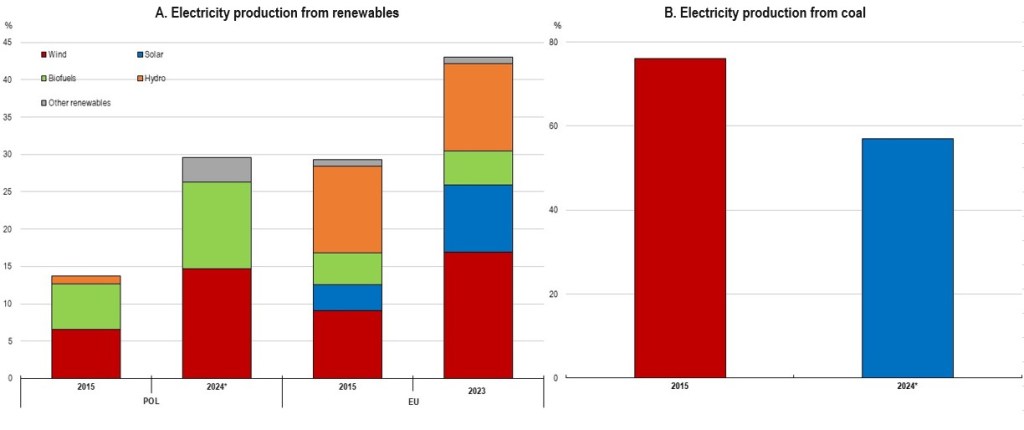
Biorąc pod uwagę ciągłe uzależnienie Polski od węgla, obniżenie emisji netto gazów cieplarnianych do zera do 2050 r. będzie niezwykle trudne (Rysunek 2). Cel ten wymaga przyspieszenia wdrażania polityk określonych w projekcie Krajowego planu na rzecz energii i klimatu na lata, wzmocnienia zachęt cenowych i szeregu form wsparcia dla najbardziej dotkniętych transformacją energetyczną. Bardziej ambitne wycofywanie węgla i skrócenie okresu wydawania pozwoleń na energię odnawialną pomogłyby osiągnąć niezbędne długoterminowe inwestycje sektora prywatnego. Emisje z sektora transportu podwoiły się w ciągu ostatnich trzydziestu lat. Aby odwrócić ten trend, potrzebne jest kompleksowe opodatkowanie pojazdów mechanicznych, obejmujące wszystkie samochody, co wzmocniłoby sygnały cenowe, a także utrzymanie inwestycji w transport publiczny.
Rysunek 2: Produkcja energii elektrycznej ze źródeł odnawialnych wzrosła, ale rola węgla pozostaje istotna
Note: * Preliminary estimates for 2024. Source: Forum Energii (2025), OECD Green Growth Indicators database, International Energy Agency.
Chociaż oczekiwana długość życia w Polsce wzrosła, utrzymuje się ona poniżej poziomu w wielu krajach OECD (Rysunek 3). Poza tym istnieje pole do poprawy wyników zdrowotnych. Finansowanie systemu opieki zdrowotnej zwiększyło się. Niemniej jednak racjonalizacja nadwyżki łóżek w szpitalach i większe wykorzystanie zachęt w opiece podstawowej pozwoliłoby na zwiększenie efektywności i poprawę opieki. Ulepszenia w leczeniu i większy nacisk na profilaktykę, szczególnie w odniesieniu do ryzykownych zachowań takich jak picie alkoholu i palenie tytoniu, mogą znacznie poprawić wyniki zdrowotne. W obliczu presji budżetowej wynikającej z starzejącego się społeczeństwa, rząd powinien w zrównoważony sposób rozszerzyć opiekę długoterminową.
Rysunek 3: Średnia długość życia znacznie się poprawiła, ale nadal pozostaje poniżej średniej OECD
Note: The OECD average is weighted. Source: OECD Health Statistics.
“Every breath you take”: Reducing exposure to environmental health risks in Poland
Category: Environment,Poland
written by oecdecoscope | April 7, 2025
by Paula Adamczyk, Priscilla Fialho, Antoine Goujard, OECD Economics Department
The COVID-19 crisis has spotlighted Poland’s environmental challenges, notably the heavy air pollution at which the Polish population is exposed, as it makes individuals more vulnerable to acute respiratory illnesses and to the ongoing sanitary crisis. As the government prepares its recovery plan to revive the economy in the aftermath of COVID-19, there is a unique opportunity to bring forward needed public investments into clean energy projects. “Green” investment projects would not only stimulate employment and aggregate demand, but also make growth more sustainable in the longer-term. The newly agreed “Next Generation EU” recovery plan will have dedicated funds to support the transition to climate neutrality and Poland should grasp the opportunity to enhance the resilience of its economy and society. The newly published 2020 OECD Economic Survey of Poland provides some advice on policies that could help supporting the transition to a greener and fairer economy.
Poland has made little progress to improve air quality. In many cities and regions, the level of atmospheric pollution remains well above the limits established in the European Union Air Quality Directive: an alarming 36 out of 50 most polluted European cities are located in Poland. The population exposure to fine particles is among the highest in the OECD (Figure 1), which causes a variety of adverse health outcomes and premature deaths (WHO, 2019).
CEEC is the average of Hungary and the Czech and Slovak Republics. Source: OECD (2020), OECD Green Growth Indicators (database).
The residential sector is responsible for high air pollution and levels of energy consumption. The burning of poor-quality coal, wood, or even waste, in old boilers used to heat individual houses is the main contributor for the high level of particulate matter in the air. The incomplete combustion of solid fuel in low-efficiency stoves and lamps used for cooking and lighting also releases a significant amount of fine particles. Moreover, a large share of the existing residential and commercial buildings date back from before 1990 and have poor thermal insulation. As a result, space heating requires a significant amount of energy and there is a lot of heat loss through the building envelope. In fact, the energy intensity of space heating in Poland is one of the highest among European Union (EU) countries.
The transport sector is another key driver of air pollution. In 2018, the average vehicle age in Poland was 14 years, compared to 11 years in the European Union. That same year, 80% of passenger cars in Poland’s roads were more than 10 years old (European Commission, 2019). The average CO2 emissions from new passenger cars sold in Poland are among the highest in Europe. In 2019, only 0.5% of newly registered passenger cars were electric vehicles, compared to an average of 3.6% in the European Union (International Council on Clean Transportation, 2020). Polish authorities have set welcome and ambitious targets to increase the fleet of electric vehicles in the coming years. These targets should be met. In June this year, the government made efforts in that sense and introduced Poland’s first fiscal incentive programme for the purchase of cleaner cars.
Progress to decarbonise electricity production in Poland has also stalled over the past few years. Coal still accounts for around 78% of gross electricity generation, compared to about 25%, on average, in other Visegrád countries and the OECD. Furthermore, most Polish coal-fired power plants are over 25 years old. The industry lags behind in terms of production efficiency and in the adoption of new technologies that could reduce the emission of pollutants.Coal mining is another source of air pollution as it releases fine particles in the air, such as dust, soot and smoke, which can be carried to nearby towns by the wind. Despite all the environmental challenges implied, Poland is still one of the largest coal producer in the world. The authorities have recently agreed to phase out coal mining by 2049, but plan to continue subsidising coal production until then (European Council for an Energy Efficient Economy, 2020).
Polish authorities need to step-up their efforts to improve air quality and reduce the health risks associated with ambient air pollution. The latest OECD Economic Survey of Poland establishes three policy priorities that can boost Poland’s transition to a greener economy and, in particular, bring the country on the path to meeting higher air quality standards:
Support building renovation to improve energy performance in the residential sector.
Two years ago, the government introduced a programme to offer means-tested financial grants and loans for the replacement of obsolete stoves and for thermal retrofits to single-family houses. However, the take-up rate has been far much lower than anticipated. Complex application procedures and low income-threshold for the highest grants have been pointed as possible reasons for the low take-up.
Polish authorities could consider extending nationwide the recently introduced anti-smog regulations in some regions (“voivodeships”) that aim at limiting the burning of fossil fuels in furnaces, as well as introducing fines for noncompliance. Continuing to simplify the administrative procedures associated with the loans and grants for replacing old heating and cooking equipment as well as easing access for low-income households would help to increase take-up. Expanding the use of smart meters would also contribute to reduce the energy consumption of the residential sector. Finally, improving the energy standards for new buildings (e.g. more stringent building energy codes, additional performance-based requirements or more demanding energy performance certificates) and imposing minimum requirements for the creation of reserve funds in multi-flat buildings dedicated to building renovation and thermal insulation, could significantly improve buildings’ energy efficiency.
Increase the effective tax carbon rate and the pricing of environmental externalities.
Tax rates on energy use in the residential sector and the electricity excise tax are low for international standards. Furthermore, there are several exemptions from energy taxes, such as from the tax on coal in the agricultural sector, from the tax on coal for households’ consumption, and from the coal and gas excise duties in some energy-intensive industries. Poland is also one of the very few OECD countries without a specific CO2-related vehicle tax and diesel is still taxed at a lower rate than petrol. Overall, this results in low carbon prices on road and non-road GHG emissions (Figure 2).
To encourage the takeup of greener technologies, the government should progressively phase out exemptions to energy taxes and gradually increase explicit carbon taxes, while using the generated revenues to support the transition of low-income households towards greener technologies and increase social adhesion.
Improve the regulatory environment surrounding the production and distribution of renewable energy.
Stringent regulation prevents the use of larger and more efficient turbines to generate electricity from onshore wind. The development of offshore wind, on the other hand, is held back by low energy transmission capacity, especially in the northern part of Poland. Frequent changes in regulations create a lot of uncertainty and reduce incentives for private investment in renewable energies.
A stable regulatory environment and further incentives to develop alternative sources of energy would help to reduce the reliance on coal for energy production. The renewable energy sector can quickly absorb capital investments and generate employment in both construction and manufacturing.
Towards an innovative and inclusive economy in Poland
Category: Labour markets,Poland,Uncategorized
written by oecdecoscope | April 7, 2025
by Nicola Brandt and Pierre Guérin, Poland Desk, OECD Economics Department
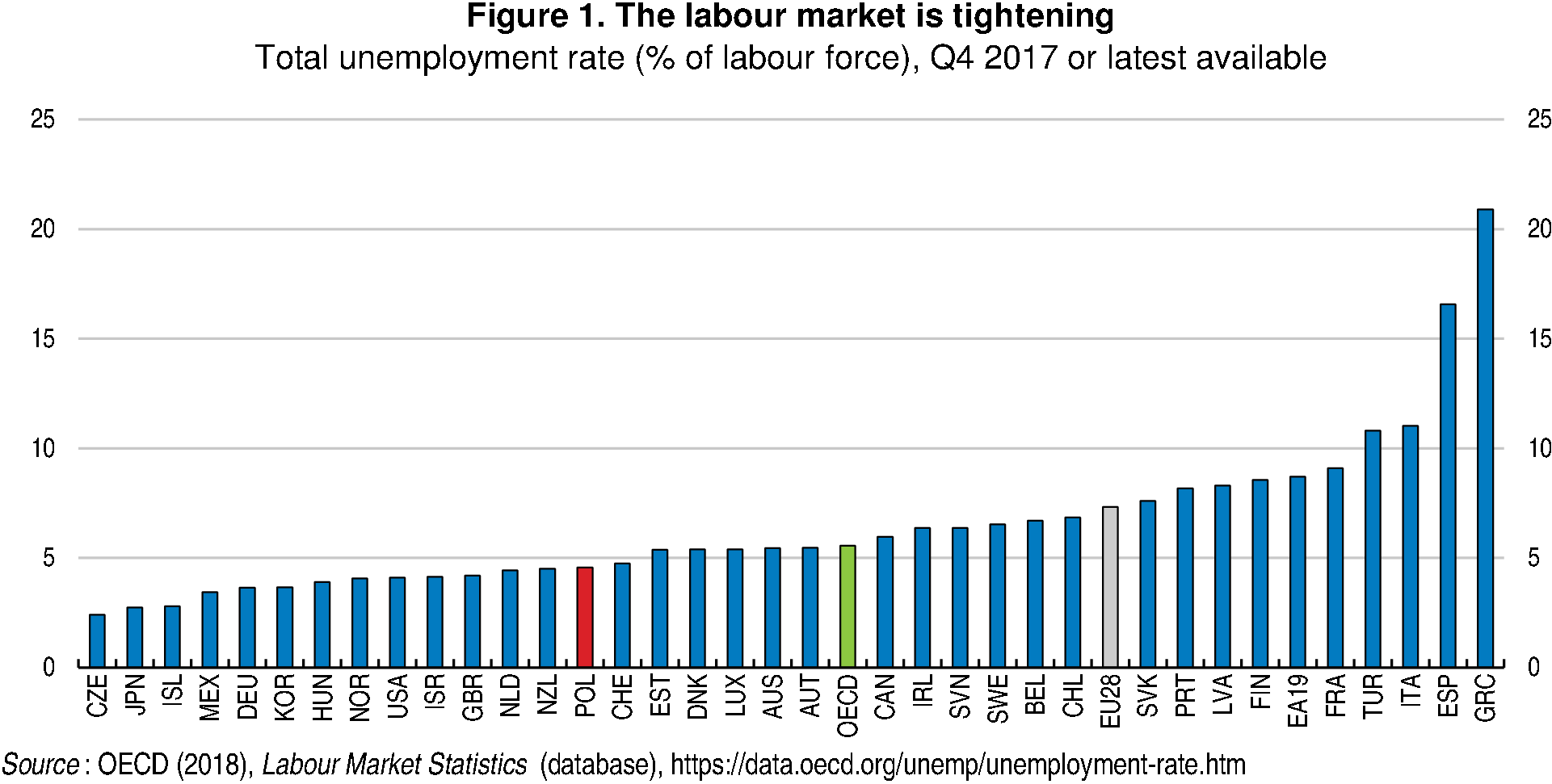
The Polish economy is in a strong position. Economic growth reached 4.6% on average in 2017 and the OECD expects it to continue at around 4% over 2018/19. A good external environment, with a solid recovery in the euro area, and the child benefits introduced in 2016, the “Family 500+” programme, are the main drivers of this strong performance. Together with a booming labour market, that has brought down the unemployment rate significantly (Figure 1), the Family 500 + programme has also helped make economic development more inclusive, as larger parts of the population now benefit from new job opportunities and rising incomes.
In the longer run, there are challenges related to Poland’s rapidly ageing population. The recent lowering of the retirement age back to only 60 for women risks weighing on senior employment and growth prospects and heighten risks of old-age poverty, in particular for women with patchy career paths. The OECD Economic Survey of Poland argues that the government needs to step up its efforts to improve currently limited access to affordable childcare services. Insufficient institutional care for the elderly is another barrier to female employment and improved well-being for seniors.
Raising Poland’s capacity to innovate in line with the government’s Strategy for Responsible Development would help strengthen productivity growth and ensure continued convergence to higher living standards. The envisaged higher education reform with its plans to strengthen the quality of doctoral training and currently weak science-industry cooperation is crucial in this respect, as research quality and the supply of researchers do not meet top OECD standards, yet. The Economic Survey recommends a continuous increase in funding for higher education and research over time and a better link of academics’ career progression with their research and teaching achievements. The new academic exchange agency is an excellent opportunity to strengthen ties to foreign universities and the Polish research diaspora.
Too many adults have weak basic and digital skills, including managers and tertiary graduates, and vocational training suffers from weak employer engagement and insufficient alignment with labour market needs. Yet, participation in adult training is weak. Developing a national skills strategy with a strong basic skills component and engaging employers to develop more workplace-based vocational education and adult training would boost skills and help secure stronger and more inclusive growth by building the basis for faster productivity gains in Poland’s numerous micro-enterprises.
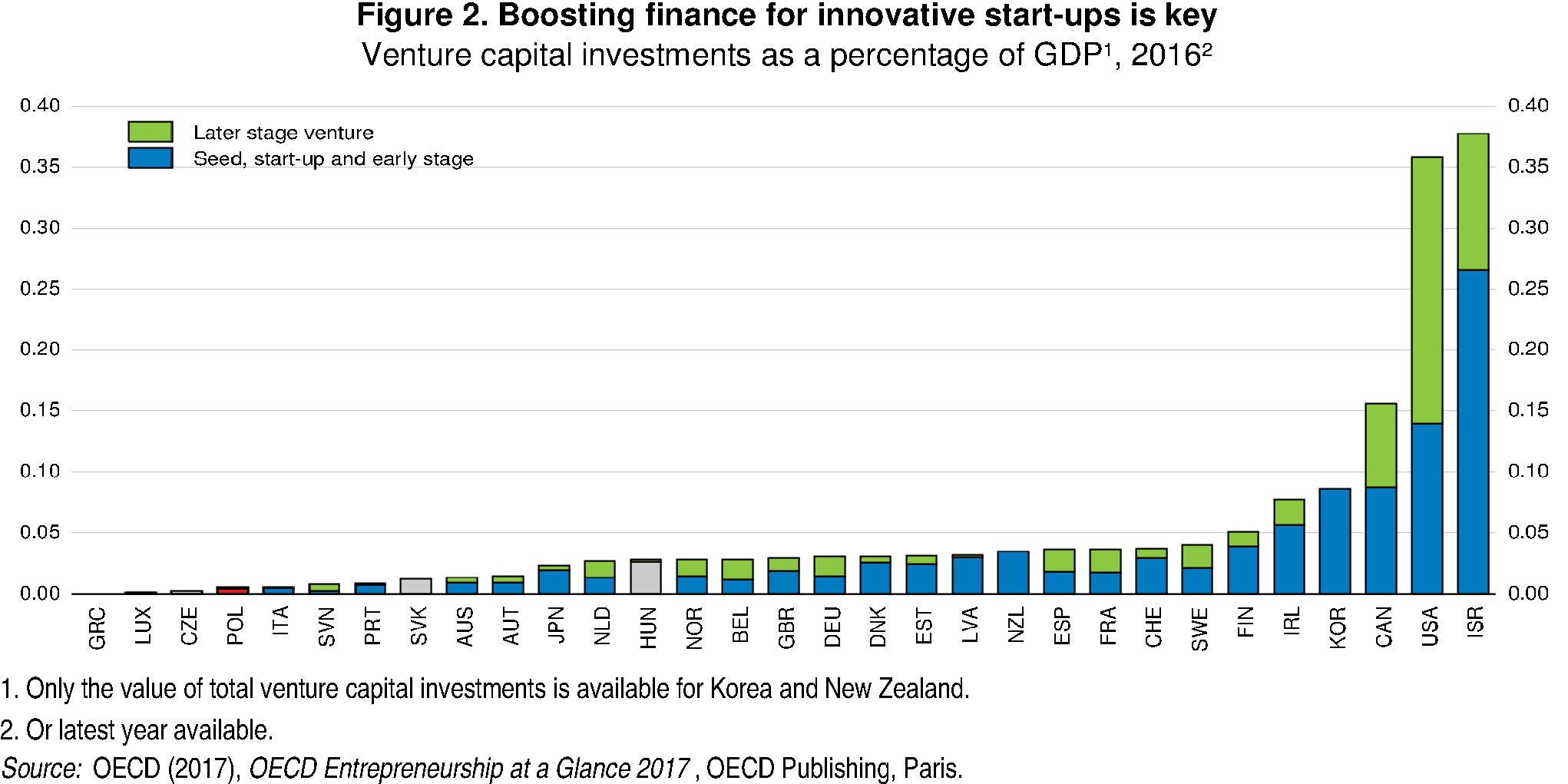
Private-sector R&D spending is low, particularly among SMEs, hindering new technology absorption and innovation. The government has stepped up the previously limited R&D tax relief and strengthened hitherto weak venture capital investments programmes, which can be well-suited for innovative firms engaging in high risk-return projects (Figure 2). To ensure the quality of such programmes, it will be important to strengthen impact assessment of public support for innovation. Examples from OECD countries, including Denmark, Australia, the Netherlands and New Zealand, suggest that more systematic private sector involvement into planning and monitoring innovation support programmes can help the government to identify the right policies.
Additional revenues or spending prioritisations are required to finance additional spending in higher education and research, skills, but also infrastructure and health care, and prepare for a possible decline of the availability of EU structural funds for innovation and public infrastructure programmes. Options include a stronger role for more progressive personal income taxes, more limited reliance on reduced VAT rates, and higher environmental taxes that would generate additional revenues with favourable effects on public health and environmental efficiency.
Improving local infrastructure investments in Poland
Category: investment,Poland,Uncategorized
written by oecdecoscope | April 7, 2025
by Antoine Goujard, Economist, Poland Desk,
OECD Economics Department
Over the last decade, Poland has significantly upgraded its infrastructure network, and public investment has risen rapidly (Panel A). However, bottlenecks still weigh on productivity growth and environmental and health outcomes, and the perceived quality of transport and energy infrastructure remains lower than in most OECD countries (Panels B and C). The EU 2014-20 programming period is an opportunity to improve the management of investment, as structural and cohesion funds that assist in the financing of numerous infrastructure projects are set to reach nearly 3% of 2013 GDP per year (Panel D).
Public investment and EU funds
1. Gross general government fixed capital formation.
2. Index from the lowest perceived quality (0) to the highest (7).
Source: OECD (2015), National Accounts Database; World Economic Forum (2015), The Global Competitiveness Report 2014-15; European Commission (2014), Summary of the Partnership Agreement for Poland, 2014-20.
Sub-central governments were responsible for about half of total public investment in 2014, above the OECD average and most other Central and Eastern European countries. As in other OECD countries, municipalities design legally binding local land-use plans. However, the quality of land administration appears relatively low (World Bank, 2015), and around 70% of the municipal territory lacks local spatial plans. Local governments have far-reaching responsibilities in transport and energy policies, but the quality of investment outcomes still needs to improve (OECD, 2015 and 2016).
The decentralisation of the allocation of EU funds over 2014-20 will give an even more prominent role to local governments, and there is a need to increase their administrative capacity, accountability and resources. The OECD (2016) analysis highlights three main areas of reforms:
Strengthening national and local planning.
The authorities have done much to adopt general investment strategies across all levels of governments. However, they are relatively recent and will need regular updates. At the metropolitan level, administrative fragmentation has partly obstructed effective land use planning and transport investments, thereby increasing urban-sprawl and congestion, and reducing a city’s attractiveness for individuals and businesses. A welcome recent law foresees the creation of metropolitan governance associations in 2016, notably for transport and spatial planning, but these will remain voluntary. New mechanisms under the 2014-20 EU perspective would also strengthen coordination in infrastructure delivery. In addition, before the recent elections, a draft law was intended to reduce barriers for municipalities to develop local land use plans, and this reform needs to be resumed swiftly.
Developing effective collaboration across levels of governments and improving public procurement practices.
As many local governments lack in-house capacity, and sometimes the financial resources, to conduct procedures and hire external advisors, relying more on central government assistance for project management would improve infrastructure delivery. Creating a central public-private partnership (PPP) agency, as currently discussed, and developing joint purchasing offices and integrated e-procurement procedures would also be good moves, as local governments have been responsible for most PPP projects and procurement procedures combining several public buyers have been relatively infrequent.
Ensuring long-term infrastructure financing.
Funding of local infrastructure management agencies is provided through central-government transfers fixed annually in the budget process, without reliable long-term commitments. The authorities should pursue reforms of public infrastructure pricing to ensure that long-term costs, including environmental and health externalities, are fully recovered. Road pricing could be expanded to ensure effective competition between transport modes and encourage green investments. In particular, the current legislative framework prevents local authorities from setting congestion fees or urban tolls, while such measures may be especially suitable for addressing congestion and local environmental impacts.
by Nicola Brandt, Head of Poland Desk,
OECD Economics Department
Adapting vocational education to the needs of a market economy has been a challenge in Poland as in other transition countries of Central and Eastern Europe. Average educational attainment and literacy rates were relatively high and vocational education was strong in Poland, when the economic transformation set in. Yet, competencies taught in vocational schools were often specific to enterprises to which they were attached, many of which disappeared.
Meanwhile, it took vocational schools time to establish links to newly created firms, and the process of developing high-quality training in management, IT and other advanced technologies is still ongoing. Rote learning was widespread, and skills that help people adapt to new circumstances, such as critical thinking, creativity and leadership, were long neglected. Programmes on offer have not always been adapted to labour market needs, leading to shortages of workers in some areas and a surplus in others. As a result, the reputation of vocational education suffered. During the transition young people abandoned basic vocational education in large numbers (Panel A), while a tertiary education boom set in.
Vocational education lost ground during the transition
1. The data are based solely on Flanders for Belgium and on England and Northern Ireland for the United Kingdom.
2. Mean reading score for 16 year-old students of Polish technical schools (Panel A) from an optional national study for the first grade of upper secondary school (16 year-olds) complementing PISA and mean PIAAC literacy proficiency score for Polish adults having attended technical schools (Panel B).
3. Mean reading score for 16 year-old students of Polish basic vocational education (Panel A) from an optional national study for the first grade of upper secondary school (16 year-olds) complementing PISA and mean PIAAC literacy proficiency score for Polish adults having attended basic vocational education (Panel B).
4. Mean PIAAC literacy proficiency score for adults with less than upper secondary education.
Source: GUS (2014), Education in the 2013/2014 School Year; OECD (2013), OECD Skills Outlook 2013 Database and OECD calculations.
The government has done much to adapt vocational schools to the needs of the market economy. Since 2012 curricula have been based on learning outcomes rather than on a narrow description of subject content. This has given schools more autonomy to adapt their programmes, including in collaboration with employers. There is now more emphasis on general competencies, such as basic skills, reasoning, problem-solving and teamwork, and the programmes also include training on setting up a business. The government launched an image campaign recently, and vocational education has started to re-gain some ground as shortages of workers with intermediate skills have become apparent.
But challenges remain. Many weak students are concentrated in basic vocational schools as evidenced by their low literacy scores in the OECD’s PISA test (Panels B and C). Helping them level their skills requires particularly qualified teachers. Offering interesting pay and career opportunities at basic vocational schools would be one option to attract such teachers. While around 65% of students now combine study and work in firms – a considerable increase from earlier years – the rest still receive their practical training in workshops set up for training purposes. The challenge is to engage Poland’s many small firms to offer work placements and contribute to the development of programmes to ensure that they are relevant for their needs.
Mertaugh, M. and E. Hanushek (2005), “ Education and training”, in Nicholas Barr (ed.), Labor Markets and Social Policy in Central and Eastern Europe: The Accession and Beyond, The World Bank, Washington, DC, pp. 207-51.
Nešperová, A. (2000), Employment and labour market policies in transition economies, International Labour Organization, Geneva.