Norway: Rougher waters ahead

By Hansjörg Blöchliger, head of Norway and Iceland desk, Economics Department

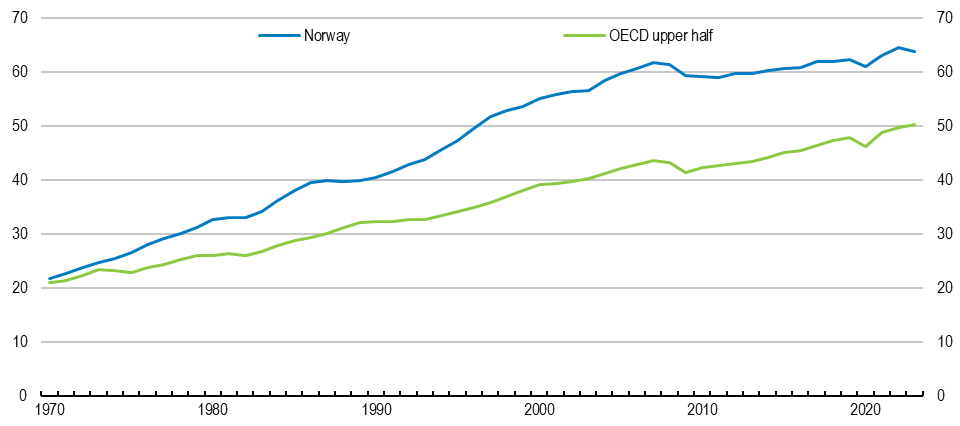
Life remains good in Norway. GDP per capita is still among the highest in the OECD, boosted by high oil and gas revenues and supported by sound fiscal and macroeconomic management. Thanks to huge domestic energy sources, the country has weathered the energy crisis well, as shown in the latest OECD Economic Survey of Norway. Norway is also one of the most egalitarian countries and offers largely equal opportunities for both men and women.

The unemployment rate is low at around 4% albeit rising slowly, and labour participation is reverting to historical highs. Overall economic growth is expected to accelerate from 0.5% in 2023 to 1.2% in 2024 and 2.1% in 2025, while the mainland economy excluding the oil sector will grow a bit less.

Figure 1. Living standards are among the highest in the OECD

GDP per capita, thousand USD PPP
Source: OECD, National Accounts database.

The lead is shrinking

Yet everything does not run smoothly. Growth is subdued, while inflation is too high for comfort at close to 4%. It is receding gradually and expected to reach the central bank’s target of 2% only in a couple of years. Since December 2023, the key policy rate has remained at 4.5%. Imbalances in the labour market are rising. Notably, qualified labour in the technical professions and in health care is lacking. And at around 0.5% per year, productivity growth is among the lowest in the OECD – it would have been even lower without the boost from the oil sector. Because of low productivity growth, Norway’s lead over the richer half of the OECD countries has shrunk from around 42% to 27% over the past 15 years.

Figure 2. Inflation is falling but remains too high for comfort

Consumer price inflation and key policy interest rate

Note: Inflation refers to national CPI adjusted for tax changes and excluding energy products (ATE).
Source: Statistics Norway; Norges Bank.

With economic activity picking up again, monetary policy should remain sufficiently restrictive to bring inflation down over the medium term. Fiscal policy should work in the same direction as monetary policy and avoid any stimulus. The electricity support scheme for households should be phased out. High housing demand should be met by making city space denser and by allowing for more construction notably close to public transport hubs.

Structural reform could help raise productivity

The administrative and regulatory burden is high, especially for young firms, and business dynamism is relatively weak. The government should improve the general legal and administrative environment for businesses, and it should conduct regular evaluations of regulation, to foster startups and to help them become more productive.

Stronger and more relevant skills could also reinvigorate productivity growth and employment. Norway has a well-functioning work-based secondary vocational education and training (VET) system, but tertiary VET lacks scope to meet the demand for high-skilled workers. The government should strengthen tertiary VET by extending the current short cycles and/or opening university colleges to upper-secondary VET graduates.

Public spending should be contained and made more effective

Public spending as a share of GDP is the highest in the OECD, partly reflecting a generous welfare system as well as ambitious regional development objectives. Yet depleting oil resources and the fiscal consequences of ageing call for fiscal prudence and for upgrading the fiscal framework. To contain public spending, Norway should implement a medium-term budgeting framework and an expenditure rule, and it should broaden the remit of the fiscal council.

Sickness and disability as a share of GDP are by far the largest of the OECD, and the share of young people receiving disability benefits has almost doubled over the past ten years. The government should reduce the sick leave compensation rate towards the level of the other Nordic countries. It should also strengthen early intervention, especially for the young, to encourage them to return to work after sick leave.

Reference

OECD (2024), OECD Economic Surveys: Norway 2024, OECD Publishing, Paris, https://doi.org/10.1787/cb13475f-en


Norway: Five messages from the latest OECD Economic Survey

By Ben Conigrave, Philip Hemmings and Isabelle Joumard, OECD Economics Department

Norway has handled the pandemic better than many other countries and continues to have good outcomes on many economic and social dimensions. GDP per capita remains among the highest in the OECD. Also, the country succeeds in maintaining low inequality and in delivering universal public services, including health and education – contributing to people’s wellbeing. Economic growth is expected to turn out at 3.7% in 2022 and 2.2% in 2023. The new Economic Survey of Norway presents recommendations aimed at ensuring good socio-economic outcomes are sustained.

As in many countries, increases in inflation are a concern. While core consumer price inflation  remains moderate, headline inflation increased by 3.2% in January compared with a year earlier.  This has been driven by large electricity price increases. The energy-price component of the consumer-price index has increased by over 50% since January 2020. Global supply pressures are also contributing to inflation in Norway. In addition, recent quarters have seen higher domestic wage growth.

Norway faces long-term fiscal challenges. Public spending is already high. Slower wealth-fund growth, including due to lower returns, will limit room for new spending initiatives. So will increased spending on healthcare and pensions due to population ageing. To offset this narrowing of fiscal space, there need to be cost-efficiency gains in public spending. Stronger productivity in public services is required, including follow up from spending reviews. Also, cost-benefit analysis should be used more extensively in public investment decisions.

Figure 1. Public spending remains high

Note: Norway total general government disbursements as % of mainland GDP.
Source: OECD (2021), OECD Economic Outlook (database).

Long-standing housing-market problems need to be resolved. Low interest rates and increased teleworking fuelled a house-price surge during the pandemic. Monetary-policy tightening is helping to cool the market, but the authorities should be ready to tighten macroprudential tools if risks mount again. Structural reform is needed to address the longer-run problems of declining homeownership accessibility and high rent burdens borne by low-income households. Easing land-use rules and making planning more efficient would free up housing supply. More investment in social housing is essential to take pressure off disadvantaged renters. Another priority is to address overly generous tax concessions for homeowners – taxing housing more like other assets could improve affordability, and make the tax system fairer and more efficient.

Figure 2. House prices have surged

Index 2010 = 100, s.a.

Source: Calculations based on Real Estate Norway (Eiendom Norge) data; OECD (2021), Analytical house prices database.

Norway needs to strengthen productivity and employment. Business-sector productivity was growing by nearly 3% annually in the early 2000s. In recent years productivity growth has been picking up. Yet it remains less than half the rates achieved two decades ago. Labour-force participation has also slipped. In 2000 Norway had the 3rd highest participation rate across OECD countries; it currently ranks 13th. Generous sick leave and disability compensation systems, in addition to the pension system, continue to have the unintended consequence of eroding labour supply. Sick leave compensation remains more generous than necessary and more could be done to facilitate return to work for those on disability pensions.

Figure 3. Labour force participation has declined

Labour force participation rate, 15-64 years

Note: Norway’s rank amongst the OECD countries is shown at the beginning and at the end of the period.
Source: OECD (2021), Employment and Labour Market Statistics.

In addition, Norway should follow through on its ambitious agenda on climate change. Norway is making good progress in green technology. The take up of electric vehicles is among the highest in the world and Norway has extensive hydropower. Around 50% of Norway’s energy supply is renewable. However, reflecting this advantageous position, much of Norway’s greenhouse gas emissions are now generated in sectors where further reductions will be challenging to achieve. Norway has raised its ambition on emission reduction. This is very welcome. Plans include a proposed schedule of increases in the price of carbon until 2030. It is important to follow through on this commitment.

Figure 4. The emission-reduction challenge is sizeable

Greenhouse gas emissions, million tons of CO2-equivalent

Note: Projections under current implemented policies do not include reductions that are intended via participation in the EU-ETS. Norway’s emissions targets are in “gross” terms, meaning notably that the CO2 absorption from forestry is not included.
Source: Climate Action Tracker, Country Assessments 2020 – http://climateactiontracker.org.

Reference

OECD (2022), OECD Economic Surveys: Norway 2022, OECD Publishing, Paris. https://doi.org/10.1787/df7b87ab-en


Norway’s economy, ensuring continued good outcomes in wellbeing

by Philip Hemmings, Norway Desk, OECD Economics Department

Norway’s economy is currently growing at annual rates well over 2%. Growth is expected to ease in the coming quarters, but remain sufficiently strong for increases in employment and wages. This good macroeconomic performance is helping sustain Norway’s living standards, which remain among the highest in the OECD area. Indicators of wellbeing rank among the top countries including self-reported well-being, job satisfaction, earnings and work-life balance. Norway remains highly inclusive in terms of income equality, labour participation and gender gaps.

However, international and domestic conditions make the economy vulnerable to trade and property-market risks. The global slowdown in trade and investment, together with faltering business and consumer confidence in the euro area, risks Norway’s predominantly European trade. Property markets and related credit appear to be heading for a soft landing but risks remain. House-price growth has resumed following some downward correction, suggesting demand for housing remains robust. Household debt continues to increase faster than disposable incomes, signalling a continued build-up of risk. Estimated selling prices of commercial real estate have been rising rapidly, which has previously foreshadowed wider economic difficulties. The high share of wholesale bank funding is also a concern. The Survey urges the authorities to maintain close monitoring on the financial market and housing risks and reduce tax concessions on home ownership.

For the longer term, sustaining the high levels of economic output and comprehensive public services that are key to Norway’s wellbeing is a challenge. There is no longer scope for rapid public spending growth financed by fast growth in the wealth fund and the Survey urges conservative application of the fiscal rule to ensure fiscal balances remain on track. It will become tougher to fund public services and develop new projects. Continued weak productivity growth, relatively high labour costs, plus weakening labour-force participation (an issue explored in the Survey’s in-depth chapter) are lessening economic capacity to support good outcomes in wellbeing. Sick leave and disability compensation systems require reform, old-age pensions need further attention to ensure people have the right retirement incentives and ongoing efforts to improve education and skills, along with immigrant integration are needed. Despite extensive hydropower, achieving greenhouse-gas abatement targets will be challenging; the Survey recommends intensification of greenhouse-gas reduction measures, particularly in transport and agriculture.

References:

OECD (2019), OECD Economic Surveys: Norway 2019, OECD Publishing, Paris,


Norway’s economy, a need to ensure policies can cope with upcoming challenges

By Philip Hemmings, OECD Economics Department

In its latest Economic Survey for Norway , the OECD underscores the importance of policy facilitating transition away from oil-related activities and helping businesses seize opportunities from digitalisation and globalisation, through providing i) macroeconomic and financial stability, and ii) improvements to structural-policy settings. It also recommends making public expenditure services more efficient, so as to reduce the injection of oil-money into the economy and to ensure an equitable participation in oil-wealth returns across future generations. An in-depth look at public spending on transport infrastructure is also discussed.

The Norwegian economy continues to perform well, despite low oil prices. Output growth is recovering, wellbeing remains high in many dimensions, and Norway stands as one of the OECD’s most inclusive countries in terms of income equality, labour participation and gender gaps.

Norway 2017

Source: OECD Economic Outlook 102 database.

Norway bli 2017

For Norway’s society to remain inclusive as its petroleum resources decline and its population ages, the business sector will have to diversify to non-oil sectors and continue to exploit opportunities from globalisation and technological change. The policy environment is business-friendly in general, with sound framework conditions and macroeconomic management. In particular, the floating exchange rate has proved a critical mechanism in adjustment to shocks. Also, the protection from ‘Dutch disease’ provided by Norway’s main wealth fund supports diversification of the economy. However, policy cannot afford to stand still. The house-price correction that is currently underway in a context of high household debt potentially poses near-term policy challenges.

Also, Norway, similar to many other economies, has experienced a step-down in productivity growth. In addition, unit labour costs remain comparatively high. Policy needs to help business seize opportunities from globalisation and facilitate diversification away from oil-related activities; this is the theme of Chapter 1 of the OECD’s latest Survey. The dynamism of Norwegian businesses would be helped if the public sector became more efficient. This would create room for lowering taxes, including those taxes that most strongly influence businesses costs and returns. The large role of publicly-financed services and investments in the economy means that returns to efficiency gains are substantial. However, oil-and-gas wealth has traditionally diminished motivation for seeking such gains. Chapter 2 of the OECD’s Survey focuses on transport infrastructure investment. Such investment can widen economic opportunities for business and increase welfare for households. Realising these returns requires that transport-infrastructure investment is well chosen and implemented efficiently.

References

OECD (2018), OECD Economic Survey, Norway, OECD Publishing, Paris.


Norway, higher education could deliver more for less

by Vassiliki Koutsogeorgopoulou , Economist, OECD Economics Department

Norway’s predominately public and tuition-free tertiary education system has encouraged participation and generated high attainment rates. However, few Norwegian universities rank high in international comparisons on the basis of research related and other indicators. Also, many students take considerable time to finish their studies. Moreover, despite an increase, enrolments remain low in fields such as science and engineering, although disaggregated data show quite different labour market outcomes across STEM disciplines; and supply shortages in some more “practical” areas, namely teachers and nurses, are looming. Spending on tertiary education is comparatively high, both in terms of annual expenditure per student and as a share of GDP. Efficiency and quality can be improved.

Degree completion times are long, despite various incentives to shorten them. For instance, conversion of loans to grants for early completion has had limited success. Higher education funding has overly incentivised institutions to produce study credit points (required for the completion of courses), rather than degree completions. Plans to include the graduation rates in the formula for performance-based funding should be pursued. Further incentives and financial support for students to complete their courses on time would be helpful. The outcomes should be monitored closely. Current efforts to improve data and dissemination via mechanisms such as the annual national student survey and the development of a portal of quality indicators need to continue.

Students’ choices should be better directed towards subjects with high demand, for instance, via loan discounts for such subjects. Moreover, the funding system of higher-education providers could offer differentiated rewards to institutions for successful study outcomes for students from disadvantaged backgrounds, or those taking up courses linked closely to labour market needs.

tertiary ed norway

The efficiency and quality of Norwegian higher education can also be influenced by the existence of many small institutions that aim to meet regional educational needs but which often do not have a critical mass of staff and students. Reforms underway to restructure the higher education through mergers that aim to overcome these problems, while retaining regional coverage, are therefore welcome.

Find out more:

OECD (2016), OECD Economic Surveys: Norway 2016, OECD Publishing, Paris.

Koutsogeorgopoulou, V. (2016), “Addressing the Challenges in Higher Education in Norway”, OECD Economics Department Working Papers, No. 1285, OECD Publishing, Paris.

OECD (2014), OECD Skills Strategy Diagnostic Report: Norway, OECD Publishing, Paris.


Norway… time to prune farm subsidies?

By Philip Hemmings, Head of Norway Desk,
OECD Economics Department

Norway puts a high priority on maintaining high levels of well-being in rural communities, many of which are in remote and challenging environments. While it is broadly successful in achieving this goal, it comes at a high price, most notably in the form of substantial support to farmers. Is there a better way?

Each agricultural holding in Norway receives, on average, support worth nearly € 62 000 each year, according to OECD calculations, making the country’s agricultural sector among the most heavily subsidised in the OECD area. Overall, subsidies to farms represent around 60% of gross farm income (see chart). Farmers are not only supported by government-funded subsidies but also benefit from special tax breaks and from custom’s tariffs on food imports, the latter contributing to Norway’s  comparatively high retail food prices. Furthermore, the status quo in farming is supported by concessions and special rules in legislation, which for instance limit corporate ownership of farms and provide advantageous inheritance laws for farming families.


Norway’s support to agricultural producers is high

norway phil

Note:  Calculations based on policy settings as of 2014. The OECD’s approach to estimating support for the agricultural sector takes into account not only direct payments to farmers from support schemes, but also forms of indirect support, such as customs tariffs and general support (e.g. publically funded agricultural research). This figure shows the producer support estimates, which measures the ratio of transfers from consumers and taxpayers to individual agricultural producers to gross farm receipts (including support, which means, for instance that a 50% PSE means that support equals that of net farm receipts, valued at world market prices).
Source: OECD (2015), “Producer and Consumer Support Estimates”, OECD Agriculture statistics (database).

Reform of Norway’s traditional fishing industry and the country’s hugely successful aquaculture industry demonstrates that the country’s rural communities have capacity for change and an ability to seize opportunity. Subsidies to fishing communities have fallen substantially, thanks to measures encouraging more economically competitive fleets. In aquaculture the lifting of price-setting and investment regulations in the early 1990s were key to the industry’s expansion. Furthermore, there remains considerable potential for Norway to develop rural tourism given its many dramatic and unusual landscapes (such as the fjords and arctic landscapes).

Norwegian agricultural support also now needs substantial reform. Though the current government has taken some welcome steps, a lot more should be done. Import-tariffs should be reduced, which would pare back the implicit subsidy that households pay through food prices. Also direct payments for producing should be lowered and linkages between subsidies and cultural and environmental goals strengthened. The agricultural reform should be central to a wider rural paradigm that is less focused on preservation of the status quo through subsidy and more channeled towards encouraging change that helps rural communities thrive in the long run.

References:

OECD, Economic Survey of Norway, January 2016, OECD Publishing.

Hemmings, P, (2016), “Policy Challenges for Agriculture and Rural Areas in Norway”, OECD Economics Department Working Papers, No. 1286, April 2016.