Strengthening institutions to improve the prosperity of all Mexicans

By Sonia Araujo and
Lisa Meehan, Mexico Desk, OECD Economics Department

Why are some countries wealthier than others? There is
increasing recognition that the economic success of nations depends on well-functioning
institutions (see, for example, Acemoglu and Robinson, 2012). Institutions
provide a framework that shape economic incentives, thus influencing decisions
in a multitude of areas, such as whether to become educated, start a business,
invest and so forth. The success of policy reforms in all areas therefore
hinges on the ability of institutions to create the right incentives. Quality
institutions also create certainty and a level playing field on which people
can build, thus bringing more fairness and greater access to opportunities. Overall,
quality institutions are of fundamental importance to economic outcomes.

It is therefore concerning that numerous indicators suggest that institutional quality is low and declining in Mexico (Figure). For example, symptomatic of weak institutions, perceived corruption is the highest in the OECD and has not improved over time. Also worringly, the already high levels of crime and violence have been increasing. Mexico has the highest homicide rate in the OECD, and the number of murders has risen sharply in the past decade (OECD, 2019; Figure). Impunity is also high, with over 90% of crimes going unreported, and just a small fraction of reported cases making it to the court system (Le Clercq and Rodríguez Sánchez Lara, 2016).

Corruption is a serious drag on the prosperity of all Mexicans and tackling it features high in the new government’s agenda. Corruption is a drain on fiscal resources, undermines the ability to deliver public services and also has an adverse effect on political stability, the business environment, private investment and inclusive growth . The OECD Economic Survey of Mexico 2019 highlights that improving institutional quality would have the largest growth benefits among all structural reforms and would also facilitate the effective implement of all other policy reforms

To fight corruption and improve transparency, Mexico’s
ambitious National Anticorruption System (NACS) was enacted in 2016 (OECD,
2019).  As well as establishing a federal
anticorruption system, it requires states to create local anticorruption
systems. However, implementation is behind schedule. For example, local
anticorruption systems were supposed to be in place by mid-2017, and while
important progress has been made, not all states have fully completed this
process. The current administration is committed to accelerating the
implementation of the NACS and has taken immediate actions. For example, key
positions are now being filled – in particular, the first Special
Anticorruption Prosecutor was recently appointed.

The experiences of other countries highlight that it is very
challenging to successfully tackle corruption in a wholesale manner. Going
forward, it will be important to monitor and evaluate the outcomes of NACS, and
address identified weaknesses, especially at a regional level, in order to
avoid exacerbating already stark geographic disparities, and take further
action if necessary.

Mexico has also undertaken other reforms in recent years to move the quality of institutions and economic oversight towards international best practice. This included the creation new independent sector regulators were created as part of the 2013 energy reforms and two new autonomous competition authorities and specialist competition courts were established in 2014. Ensuring the independence and adequate resourcing of these autonomous entities will be crucial to the continued strengthening of competition in Mexico.

References:

Acemoglu, D. and J.A.
Robinson. (2012). Why nations fail: The origins of power, prosperity,
and poverty
. New York: Crown Publishers.

Le Clercq, J. and G. Rodríguez Sánchez Lara (2016), Global
Impunity Index Mexico IGI-MEX 2016, Center of Studies on Impunity and Justice
(CESIJ), http://www.udlap.mx/cesij.

OECD (2019), OECD Economic
Surveys: Mexico 2019
, OECD Publishing, Paris. https://doi.org/10.1787/a536d00e-en


A renewed strategy to boost growth and well-being in Mexico

by Sonia Araujo and Lisa Meehan, Mexico Desk, OECD Economics Department

The Mexican economy has benefited from strong fundamentals. A strong macroeconomic policy framework has underpinned moderate growth, in the face of a number of shocks the economy has experienced in the recent past. Monetary policy has successfully tamed inflation and prudent fiscal policy has halted the rise in the debt-to-GDP ratio. The financial system is strong and a number of financial buffers in the form of stabilisation funds and international reserves cushion against tail risks.

The macro framework has brought stability to the economy but
it has not been enough to deliver strong growth. GDP growth has been moderate,
particularly compared with other emerging market economies, averaging only 2.2%
a year since 2009. The relatively modest growth that has occurred chiefly
reflects a demographic bonus, as Mexico’s young population entered the labour
market. Mexicans work far longer days than anyone else in the OECD.  But owning to low productivity, Mexico’s GDPpc
remains the lowest in the OECD as the country has not converged to higher
living standards (Figure 1). Mexico has the macro right, now it is time to work
on the micro.

The 2019 OECD Economic Survey of Mexico looks into policies that will make growth more robust and equitable. The main findings are:

  • Maintaining macroeconomic stability is key to
    smooth adjustment to shocks in the context of heightened uncertainty and to
    provide confidence to economic agents in the medium term.
  • Implementing a comprehensive strategy to boost
    productivity and inclusiveness calls for an integrated package of reforms
    across several policy areas as policy complementarities matter.
  • Increasing equity and providing opportunities
    for all, including women, indigenous populations, and lagging regions should be
    an integral element of the reform agenda to solve Mexico’s stark  disparities in economic dynamism, poverty and
    well-being (Figures 2 and 3).

Many reforms are able to simultaneously lift growth and
share the benefits more widely. These are: raising educational outcomes,
enhancing women’s participation in the labour market, improving incentives to
job and business formalisation, improving regulations to spur competition,
boosting infrastructure, further enhancing trade and participation in global
value chains, particularly SMEs. The redistributive role of fiscal policy also
needs strengthening.

Stronger institutions are key to attaining stronger growth and increasing fairness and opportunities for all. Reducing corruption, insecurity and crime would boost economic activity and especially benefit the poor and underprivileged. They are also an integral ingredient to making all other reforms work. Mexico should continue efforts to reduce crime and impunity and complete the implementation of the National and Local Anticorruption Systems reforms and monitor the results, especially focusing on the capacity of the different states to strengthen their institutional arrangements.

Further reading:

OECD (2019), OECD Economic Surveys: Mexico 2019, OECD Publishing, Paris. https://doi.org/10.1787/a536d00e-en


Una estrategia renovada para impulsar el crecimiento y el bienestar en México

por Sonia Araujo y Lisa Meehan, OCDE

La economía
mexicana se ha beneficiado de fuertes fundamentos. Un marco de política
macroeconómica muy sólido ha sustentado un crecimiento moderado, frente a una
serie de choques que la economía ha experimentado en el pasado reciente. La
política monetaria está controlando con éxito la inflación y la política fiscal
prudente ha detenido el aumento de la relación deuda / PIB. El sistema financiero
es sólido y varios fondos de estabilización y las reservas internacionales
actúan como colchones financieros que  protegen la economía contra los riesgos de
cola.

Se bien que
el sólido marco macroeconomico ha traído estabilidad a la economía, esto no ha
sido suficiente para generar un fuerte crecimiento. El crecimiento del PIB ha
sido moderado, particularmente en comparación con otras economías emergentes,
con un promedio de solo 2.2% al año desde 2009. El crecimiento relativamente
modesto que se ha observado refleja principalmente un bono demográfico, a
medida que la población joven de México fue ingresando al mercado laboral. Los
mexicanos trabajan jornadas más largas que todos los demás países en la OCDE.
Pero debido a la baja productividad, el PIB percápita de México sigue siendo el
más bajo en la OCDE, y por lo tanto el país no ha convergido a niveles de vida
más altos (Figura 1). México tiene buenos fundamentos macroeconómicos, ahora es
el momento de trabajar en los fundamentos microeconómicos.

El Estudio Económico de México de la OCDE de 2019 analiza políticas que podrían contribuyir a un  crecimiento más sólido y equitativo. Los principales hallazgos son:

• El
mantenimiento de la estabilidad macroeconómica es clave para un ajuste suave a
los choques en un contexto de una mayor incertidumbre y para brindar confianza
a los agentes económicos en el mediano plazo.

• La
implementación de una estrategia integral para impulsar la productividad y la
inclusión requiere de la implementación de un paquete integrado de reformas en
varias áreas, ya que existen complementariedades imporantes en las medidas de política
económica.

• Aumentar
la equidad y brindar oportunidades para todos, incluidas las mujeres, las
poblaciones indígenas y las regiones rezagadas, debe ser un elemento integral
de la agenda de la reforma para resolver las enormes disparidades de México en
materia de dinamismo económico, pobreza y bienestar (Figuras 2 y 3).

Muchas
reformas pueden aumentar simultáneamente el crecimiento y compartir los
beneficios más ampliamente. Las principales prioridades de política pública son:
mejorar los resultados educativos, aumentar la participación de las mujeres en
el mercado laboral, mejorar los incentivos para la formalización laboral y
empresarial, mejorar las regulaciones para estimular la competencia, impulsar
la infraestructura, incentivar aún más el comercio y la participación en las
cadenas de valor mundiales, en particular las PYME. Hay también que fortalecer
el papel redistributivo de la política fiscal.

Instituciones
más fuertes son clave para lograr un crecimiento más fuerte y aumentar la
equidad y las oportunidades para todos. La reducción de la corrupción, la
inseguridad y el crimen estimularían la actividad económica y beneficiarían
especialmente a los pobres y desfavorecidos. También son fundamentales para que
todas las demás reformas sean exitosas. México debe continuar los esfuerzos
para reducir el crimen y la impunidad y completar la implementación de las
reformas de los Sistemas Anticorrupción Nacional y Local y evaluar? los
resultados, especialmente enfocándose en la capacidad de los diferentes estados
para fortalecer sus marcos institucionales.


Positive economic outlook for the main economies in Latin America but downward risks have intensified

Alvaro S. Pereira (Director) and Latin American desks, Economics Department, Country Studies Branch, OECD

The global economy is navigating rough seas. Global GDP growth is strong but it has peaked. In many countries unemployment is well below pre-crisis levels, labour shortages are biting and inflation remains tepid.  Yet, global trade and investment have been slowing on the back of increases in bilateral tariffs while  many emerging market economies are experiencing capital outflows and a weakening of their currencies. The global economy looks set for a soft landing, with global GDP growth projected to slow from 3.7% in 2018 to 3.5% in 2019-20. However, downside risks abound and policy makers will have to steer their  economies carefully towards sustainable, albeit slower, GDP growth.

The economic recovery in the Latin American economies has become dissimilar. While in some countries, growth has been revised downwards, in others it has been revised upwards. This disparity is closely linked to how these economies have evolved in the face of the financial stress and increased financial volatility in recent months. The region’s economies with the best macroeconomic fundamentals, independent central banks, countercyclical monetary policies, sound fiscal policy framework and no major currency mismatches in corporate or sovereign debt, were better able to sail the adverse global financial conditions that led to capital outflows, weakening their currencies.

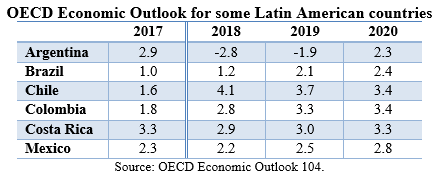
Table LAC EO104

While Chile and Colombia have gained momentum, Brazil has shown lower growth and Argentina has fallen into recession. Mexico and Costa Rica have also experienced less momentum than expected. Growth in Argentina, Brazil, Chile, Colombia, Costa Rica and Mexico, countries covering about 85% of Latin America’s GDP, is expected to be around 1.4% this year and to accelerate to 2.0% in 2019 and 2.7% in 2020 (weighted average) (see Table). However, downside risks abound while the region is vulnerable to the global context. Several indicators, such as the fiscal and current account deficits have been accentuated in the last decade in most of these economies (Figure), suggesting that the region is still vulnerable. Needs to be noted that the situation is uneven and a broader list of indicators should be analysed.

Figure LAC EO104

An accumulation of risks could create the conditions for a harder-than-expected landing. First, further trade tensions would take a toll on trade and GDP growth, generating even more uncertainty for business plans and investment. Second, tightening financial conditions could accelerate capital outflows from the region and depress demand further. Third, a sharp slowdown in China would hit Latin America and other emerging economies, but also advanced economies if the demand shock in China triggered a significant decline in global equity prices and higher global risk premia.

Looking ahead, it will be necessary to strengthen the macroeconomic policy framework to reduce vulnerabilities where necessary. Most of the region’s economies are starting, or will start in the near future, more restrictive monetary policies, while also undertaking fiscal consolidation. Depending on each country, it will be important to find a balance between the needs for social spending and public investment, with the need to put debt on a sustainable path. In Chile, Colombia and Mexico, this consolidation can be done gradually, but Argentina, Brazil and Costa Rica need to do it more urgently. Pension or tax reforms will be necessary in this regard.

Given the limited scope for countercyclical policies, in the face of external risks and a more pronounced slowdown, the time to promote the necessary structural reforms is now to guarantee a future with a sustained increase in productivity and greater inclusion. Many countries in the region have scope to reform the tax system and make it more effective in improving investment incentives and raising more resources. Depending on the characteristics of each country, possible measures may include limiting the use of tax exemptions and reduced rates, particularly in VAT, but also in corporate taxes, extending the tax base by including more people in personal income taxes, reducing evasion or making greater use of property, inheritance or environmental taxes. Other priorities should focus on export promotion and diversification, which would help reduce current account deficits. Investing in quality and innovative human capital, closing infrastructure and logistical gaps, and curbing corruption would support exports and their diversification, strengthening growth. Encouraging women’s participation in the labour force, reducing precariousness and informality in the labour market, as well as pension reforms are also urgent in several countries of the region and necessary to increase productivity and reduce inequalities.

Argentina: A combination of massive fiscal and monetary tightening will keep the economy in recession during 2018 and 2019. Private consumption and investment will remain depressed due to lower real incomes and high interest rates, and unemployment will rise. However, a better harvest and a lower real exchange rate will support stronger exports.

Brazil: Growth will gain momentum during 2019 and 2020 as private consumption, supported by improvements in the labour market, will increase. Recovering credit and greater policy certainty as a new administration takes office will buttress the recovery. Political uncertainty around the implementation of reforms remains significant and could derail the recovery, but if uncertainty fades and reforms advance as assumed, investment will become stronger.

Chile: Growth is projected to remain strong over the next two years. With an uncertain external environment, solid domestic demand will underpin growth, aided by a stable inflation environment, public infrastructure projects and a tax reform. Inequality, though  decreasing, remains high, as informality and unemployment remain high and social transfers low.

Colombia: Growth is projected to pick up as infrastructure projects, lower corporate taxes and higher oil prices will boost investment. Improving confidence and financing conditions will support consumption. As growth gains traction, unemployment will edge down. Social indicators are improving but informality and inequality remain high.

Costa Rica: Growth is projected to recover to around 3¼ per cent in 2020 and be broad-based, underpinned by both domestic and external demand. However, uncertainty, particularly surrounding the planned fiscal reforms, is weighing on growth in the near term. The projections are based on the assumption that the fiscal reforms will be implemented from 2019, with modest fiscal tightening holding back growth in 2019 and 2020.

Mexico: Growth is projected to pick up to 2¾ per cent in 2020. Low unemployment, strong remittances and the recovery of real wages  will support household consumption. Investment, which has been persistently low, will strengthen on the back of announced public investment plans and increased confidence associated with the US-Mexico-Canada trade agreement. Exports will decelerate owing to less favourable global conditions, especially in the United States. Inflation has been pushed up by rising energy prices, but expectations and core inflation remain anchored and within the central bank’s target band. Informality is slowly declining but remains elevated,  contributing to persistently high inequalities and low productivity.

To read more about the Economic Outlook and the main structural challenges visit the english and spanish/portuguese version (it includes OECD forecasts and a chapter on decoupling of wages and productivity and the implications for public policy).

References:

OECD (2018), OECD Economic Outlook, Volume 2018 Issue 2: Preliminary version, OECD Publishing, Paris, https://doi.org/10.1787/eco_outlook-v2018-2-en.


Las perspectivas económicas son positivas en los principales países de América Latina pero los riesgos a la baja se han acentuado

Alvaro S. Pereira (Director) y mesas de países latinoamericanos, Departamento de Economía, Directorado de estudios de países, OCDE

La economía mundial está navegando mares agitados. El crecimiento del PIB mundial es fuerte, pero ha alcanzado su punto máximo. En muchos países, el desempleo está por debajo de los niveles anteriores a la crisis de 2008, la escasez de mano de obra se empieza a sentir, aunque la inflación sigue siendo templada. Sin embargo, el comercio y la inversión mundiales se han desacelerado como consecuencia del incremento de aranceles bilaterales y de mayor incertidumbre política, mientras que varias economías emergentes están experimentando salidas de capitales y un debilitamiento de sus monedas. La recuperación del crecimiento global  comenzará a desacelerarse, mientras que los riesgos a la baja se han acentuado. Se prevé que el crecimiento del PIB mundial disminuya del 3,7% en 2018 a 3,5% en 2019-2020. Sin embargo, abundan los riesgos de recesión y los responsables políticos tendrán que orientar cuidadosamente sus economías hacia un crecimiento sostenible, aunque más modesto, del PIB.

En las principales economías de América Latina, la recuperación económica se ha vuelto despareja. Mientras que en algunas, el crecimiento se ha revisado a la baja, en otras se ha revisado al alza. Esta disparidad está estrechamente ligada a cómo estas economías han evolucionado frente al estrés financiero e incremento de volatilidad financiera de los pasados meses. Las economías de la región con mejores fundamentos macroeconómicos, bancos centrales independientes, políticas monetarias contracíclicas, un marco de política fiscal sólido y sin grande descalce de monedas en la deuda corporativa o soberana, fueron los que sortearon mejor las condiciones financieras globales adversas que sometieron a varios países a una repentina salida de capitales y debilitamiento de sus monedas.
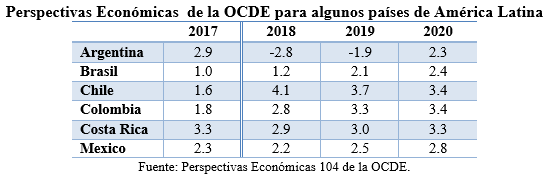
Table LAC EO104 Esp

Mientras que Chile y Colombia han ganado ímpetu, Brasil ha mostrado menor crecimiento y Argentina ha caído en recesión. México y Costa Rica también han experimentado menor ímpetu al esperado. Se espera que el crecimiento en Argentina, Brasil, Chile, Colombia, Costa Rica y México, países que cubren alrededor del 85% del PIB de América Latina, se sitúe en torno al 1.4% este año y se acelere a 2.0% en 2019 y 2.7% en 2020 (promedio ponderado) (Tabla). Sin embargo, abundan los riesgos a la baja, mientras que la región se encuentra vulnerable al contexto global. Algunos indicadores, como los déficits fiscales y de cuenta corriente (Figura) se han acentuado en la mayoría de estas economías en la última década, sugiriendo que la región es aún vulnerable. Debe notarse que la situación es dispar y se debe mirarse una lista más amplia de indicadores.

Una acumulación de riesgos podría crear las condiciones para una desaceleración de crecimiento más acentuada de la esperada. En primer lugar, nuevas tensiones comerciales afectarían al comercio y al crecimiento del PIB, generando aún más incertidumbre para las empresas y la inversión. En segundo lugar, el endurecimiento de las condiciones financieras globales podría acelerar las salidas de capitales y deprimir aún más las monedas de la región. En tercer lugar, una fuerte desaceleración en China afectaría a la región y otras economías emergentes, pero también a las economías avanzadas si el shock de la demanda en China provocara un descenso significativo de los precios mundiales de las acciones y un aumento de las primas de riesgo mundiales.

Figure LAC EO104Esp

De cara al futuro, será necesario reforzar el marco de las políticas macroeconómicas para reducir vulnerabilidades donde sea necesario. La mayor parte de las economías de la región están comenzando, o lo harán en el futuro próximo, políticas monetarias más restrictivas, al tiempo que también deben llevar a cabo una consolidación fiscal. Dependiendo de las holguras de cada país, será importante encontrar un ritmo que balancee las necesidades de gasto social y de inversión pública, con la necesidad de poner la deuda en una senda sustentable. En Chile, Colombia y México, esta consolidación se puede llevar a cabo de manera gradual, pero Argentina, Brasil y Costa Rica necesitan hacerlo de manera más urgente. Reformas pensionales o tributarias serán necesarias en este sentido.

Dado el escaso margen para hacer políticas contracíclicas ante la realización de riesgos externos y una deceleración más acentuada, el momento de impulsar reformas estructurales necesarias es ahora, para garantizar un futuro con incremento sostenido de la productividad y mayor inclusión. Muchos países de la región tienen margen para reformar el sistema tributario y hacerlo más eficaz para mejorar los incentivos a la inversión y recaudar más recursos. Según las características de cada país, posibles medidas pueden incluir limitar el uso de exenciones tributarias y tasas reducidas, en particular en el IVA, pero también en los corporativos, extender las bases de imposición incluyendo más personas en los impuestos a los ingresos personales, reducir la evasión o hacer mayor uso de impuestos a la propiedad, a la herencia o impuestos ambientales. Otras prioridades deberían focalizarse en fomentar las exportaciones, y diversificarlas, lo que ayudaría a reducir los déficits de cuenta corriente. Invertir en capital humano de calidad e innovación, cerrar las brechas de infraestructura y logística y frenar la corrupción apoyarían a las exportaciones y su diversificación, fortaleciendo el crecimiento. Alentar la participación de la mujer en la fuerza laboral, reducir la precariedad e informalidad del mercado laboral, así como reformas al sistema de pensiones son también urgentes en varios países de la región y necesarios para aumentar la productividad y bajar las desigualdades.

Argentina: La economía seguirá en recesión en 2018 y 2019 debido a un endurecimiento fuerte y simultáneo de políticas monetarias y fiscales. El consumo privado y la inversión seguirán siendo bajos a causa del descenso de los ingresos reales y de los elevados tipos de interés, y aumentará el desempleo. Sin embargo, una mejor cosecha y un tipo de cambio real más competitivo contribuirán al aumento de las exportaciones.

Brasil: El crecimiento cobrará impulso en 2019 y 2020 gracias al aumento del consumo privado, respaldado por mejoras en el mercado laboral. La reactivación del crédito y el descenso de la incertidumbre política una vez que el nuevo gobierno tome posesión apuntalarán la recuperación económica. La incertidumbre política sobre la implementación de reformas sigue siendo importante y podría frenar la recuperación pero, si desaparece y las reformas siguen adelante como se supone que deberían hacerlo, aumentará la inversión.

Chile: Según las proyecciones, el crecimiento seguirá aumentando en los próximos dos años. Ante una incierta coyuntura externa, el crecimiento estará respaldado por la sólida demanda interna con ayuda de un entorno de inflación estable, proyectos de infraestructuras públicas y una reforma fiscal. A pesar que las desigualdades han disminuido, permanecen altas, debido a que la informalidad y el desempleo siguen siendo elevados y las transferencias sociales escasas.

Colombia: Las proyecciones indican que el crecimiento repuntará, ya que los proyectos de infraestructuras, el descenso del impuesto de sociedades y la subida de los precios del petróleo potenciarán la inversión. La mejora de la confianza y de las condiciones de financiamiento respaldará el consumo. A medida que el crecimiento se vaya afianzando, el desempleo descenderá. Los indicadores sociales están mejorando, aunque la informalidad y la desigualdad se mantendrán en niveles elevados.

Costa Rica: Según las proyecciones, el crecimiento se recuperará hasta el 3¼ aproximadamente en 2020 y será generalizado, sostenido tanto por la demanda interna como externa. Sin embargo, la incertidumbre, particularmente respecto a las reformas fiscales planificadas está lastrando el crecimiento a corto plazo. Las proyecciones parten del supuesto de que las reformas fiscales se aplicarán a partir de 2019, con un modesto ajuste fiscal que frenará el crecimiento en 2019 y 2020.

México: Está previsto que el crecimiento repunte hasta el 2¾ por ciento hacia 2020. El bajo nivel de desempleo, fuertes remesas y la recuperación de los salarios reales reforzarán el consumo de los hogares. La inversión, que ha sido persistentemente baja, se reforzará a consecuencia de los planes de inversión públicos anunciados y del aumento de la confianza vinculado al acuerdo comercial entre Estados Unidos, México y Canadá. El crecimiento de las exportaciones se reducirá debido a unas condiciones internacionales menos favorables, en especial en Estados Unidos. La subida de los precios de la energía ha empujado la inflación al alza, pero las expectativas y la inflación subyacente siguen ancladas y dentro del rango meta del banco central. El alto nivel de informalidad contribuye a que haya una gran desigualdad y una escasa productividad.

Para leer en más detalle sobre las proyecciones macroeconómicas, así como los principales desafíos estructurales ir al reporte en la versión español/portugués o inglés (que incluye proyecciones para países de la OECD, principales desafíos y un capítulo especial sobre la desvinculación de los salarios y la productividad y las implicancias en términos de políticas públicas).


Mexico’s reforms are paying off, but there is much left to do

By Sean Dougherty, Mabel Gabriel, Patrick Lenain, and Julien Reynaud, OECD Economics Department

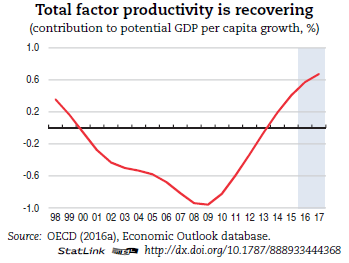
The overall economic and social situation has improved in recent years, but important challenges remain, such as high levels of poverty, extensive informality, low female participation rates, insufficient educational achievement, financial exclusion, weak rule of law, and persistent levels of corruption and crime. To address these problems, the government has rolled out major structural reforms since 2012 aimed at improving growth, well-being and income distribution. The initial wave of reforms, kicked-off by the multi-partisan political commitments in the Pacto por México, led to notable progress across a range of areas and put Mexico at the forefront of reformers among OECD countries. Key laws and constitutional amendments were approved, and secondary laws or regulations passed.

blog-reform-mexico

Reforms have already brought short-term benefits, especially on productivity growth, and helped to mitigate exteproductivityrnal headwinds such as lower oil prices and rising US interest rates. The OECD estimated in the last Economic Survey that a subset of the Pacto por México reforms could add one percentage point to GDP growth after five years. An additional set of selected reforms could add another percentage point to GDP. Strong progress has been made to open sectors such as energy and telecoms to more competition. Institutional designs have been improved with a new National Productivity Commission, a strengthened competition authority, and expanded sectoral regulators. Initial progress has been made with education and poverty alleviation, although parts of these plans ran into difficulties that are now being addressed.

growth-disparaties

Nonetheless, large differences prevail across sectors, states, and firms – a situation not unlike that in many OECD countries. Mexico’s most productive firms are performing well, such as in the sector of transportation equipment manufacturing, but the majority of firms are still struggling to perform better, leading to a growing dispersion in productivity,  with a few leading sectors pulling ahead. Inequalities continue to grow across states and sectors, emphasising the divergence of a modern Mexico – highly productive, competing globally, mostly located at the border with the United States, in the central corridor and in tourism areas; and a traditional Mexico, less productive, with small-scale informal firms, mostly located in the South. As a result, growth has not been inclusive enough to achieve better living conditions for many Mexican families.

Addressing this divergence is the main focus of the new Economic Survey (OECD, 2017).

References:

OECD (2017), Economic Surveys of Mexico, OECD Publishing, Paris.

OECD (2015), The Future of Productivity, OECD Publishing, Paris.


Is Mexico a new ‘China’?

By Sean M. Dougherty, Head of the Mexico Desk, OECD Economics Department.

China’s spectacular growth during the 1990s and early 2000s made it the envy of many other emerging economies. Yet more recently, relative labour costs have risen substantially, and economies such as Mexico’s, which lost export market share for some time, have made a partial comeback. However, Mexico’s increasing competitiveness masks one of the country’s fundamental concerns, which is weak productivity improvements. In a new working paper being released today, while the Global Forum on Productivity opens in Lisbon, we examined the evolution of multifactor productivity in Mexico’s manufacturing sector, as compared to China’s (see Dougherty & Escobar, 2016). Firm-level micro-data were used to examine the distribution of productivity across Mexico’s states, and also to track the misallocation of resources.

It turns out that Mexico’s increasing competitiveness and attractiveness masks one of the countries’ fundamental concerns, which is the absence of productivity improvements. Mexico’s productivity lags behind that of other major emerging economies, and it has suffered from a negative growth trend – at least until the recent package of structural reforms (OECD, 2015a). It turns out that multi-factor productivity differs considerably across firms and regions, a situation not unlike that in many OECD countries. While Mexico’s most productive firms are performing relatively well, and can compete with China’s, the vast majority of firms are struggling to perform better with limited success, leading to a growing dispersion in productivity (see figure below). A similar situation is observed in other OECD countries where there is a rising gap in productivity between the most advanced firms and the laggards, and the gains in productivity of the most advanced firms are not enough to improve aggregate productivity (OECD, 2015b).

Mex a new china

We also took advantage of Mexico’s federal structure to study the drivers of productivity using econometric techniques to address potential reverse causality. Our findings suggest that among other factors, a stronger rule of law increases productivity in Mexico. This is robust to previous OECD evidence, which suggests that firms in Mexico’s states with more effective legal systems tend to be substantially larger and more productive (Dougherty, 2014).

Our results also show that among the institutional quality-related variables, informality has the strongest effect on productivity. Moreover, we consider informality as a source of distortions that contribute to the misallocation of resources. Our results are robust to various methods, and imply a strongly negative relationship between informality and productivity. Among different size firms, informality in microenterprises (up to 10 workers) has the strongest negative effects on productivity. The results also suggest – for the first time that we know of – that more productive states and industries suffer more from informality than less productive ones. This is likely due to resources being perversely tied up in informal activities, akin to the ‘Zombie firms’ that are now being investigated at OECD. Tackling informality is a complex challenge, and one that requires a multi-faceted approach (OECD, 2013, 2015a).

The results also suggest that the mere presence of foreign investment improves productivity – with the exception of Maquiladora industries, which are missing out on productivity gains. This is likely due to Maquila’s undue emphasis on low-end, low-skill assembly operations, which have often not fared very well in competition with China. Moreover, weak education quality simultaneously acts as a major restraint on productivity, and it aggravates informality.

In summary, we can conclude that Mexico is not a ‘China’, yet.

References:

Dougherty, S. (2014), ‘Legal reform, contract enforcement and firm size in Mexico’, Review of International Economics, Vol. 22, No. 4, September 2014.

Dougherty, S. and O. Escobar (2016), ‘Could Mexico Become the new “China”?  Policy Drivers of Competitiveness and Productivity’, OECD Productivity Working Papers n°4. (Also forthcoming in the European Journal of Comparative Economics.)

OECD (2013, 2015a), Economic Surveys of Mexico, OECD Publishing, Paris.

OECD (2015b), The Future of Productivity, OECD Publishing, Paris.