Lithuania: Addressing demographic challenges 

Vilnius, Lithuania overview

By Pierre-Alain Pionnier

Lithuania’s population is expected to decline by 20% and its working-age population by 30% over the next 25 years (Figure 1). Few countries will face such a large demographic shock. This calls for policy responses across different areas, including fiscal and labour market policies, as explained in the 2025 Economic Survey of Lithuania

Figure 1. Lithuania will face a large demographic shock

Change in the working-age population (20-64 years old), %, 2022-2050
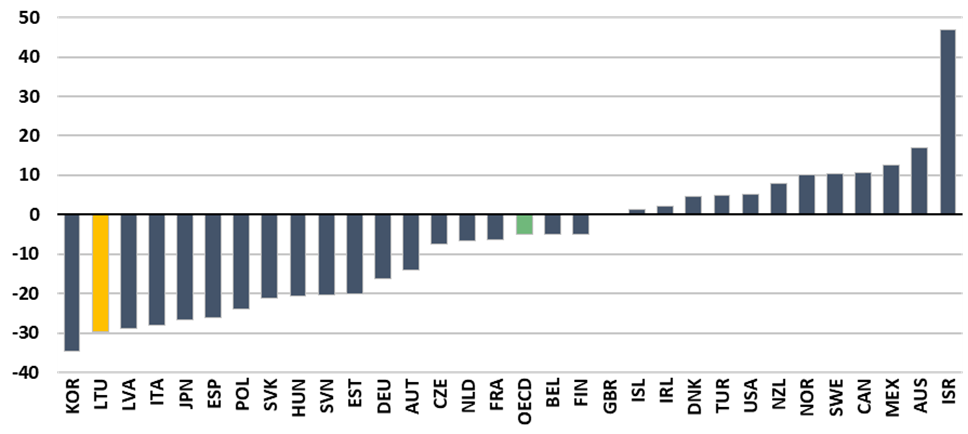
Figure showing Lithuania will face a large demographic shock
Source: UN World Population Prospects 2022 (Medium scenario)

Ageing-related expenditure is set to increase by 3.6% of GDP by 2045, most of it related to the financing of public pensions. At 37% of GDP in 2023 Lithuania’s public debt is one of the lowest in the OECD, but simulations show that it could increase rapidly due to ageing-related costs.

Unfortunately, there is not much that Lithuania can do to contain the expected increase in pension spending, at least in the short term.

The statutory retirement age is currently around 64, similar to the OECD average, and will increase to 65 in 2026 for both men and women. Significant disparities in life expectancy between men and women and across socio-economic groups make further increases in the retirement age difficult. Lithuanian men have one of the lowest life expectancies in the OECD and enjoy relatively short retirement periods. Even in an optimistic scenario, fiscal savings that could be obtained from linking the retirement age to life expectancy would be limited in Lithuania.

Adjusting pension benefits could in principle provide a way to improve the financial sustainability of the pension system. But pension replacement rates, which measure pension benefits relative to pre-retirement wages, are already the lowest in the OECD and old-age poverty is high (25%). This severely limits the scope for savings through benefit adjustments.

Ensuring fiscal sustainability will therefore require creating additional fiscal space outside of the pension system. Better spending efficiency can help to improve fiscal outcomes. For example, Lithuania has a larger public sector than other OECD countries and available estimates suggest that wages in the public sector are around 10% higher than in the private sector. Moreover, Lithuania’s fiscal revenues are comparatively low (Figure 2). This provides scope to increase taxes to contribute to the financing of ageing-related expenditure. One case in point is property taxes, which are among the taxes that are least detrimental to economic growth but also largely underused in Lithuania. A large shadow economy is another unexploited source of fiscal revenues. This shadow economy reduces revenues from value-added taxes. Further reducing the use of cash in the economy and reducing the tax wedge for low-income earners to make formal work more attractive could help, and the resulting revenue losses could be compensated by increasing income taxes for higher incomes.

Figure 2. Property tax revenues could be increased to strengthen fiscal sustainability

Structure of tax revenues, % of GDP, 2023
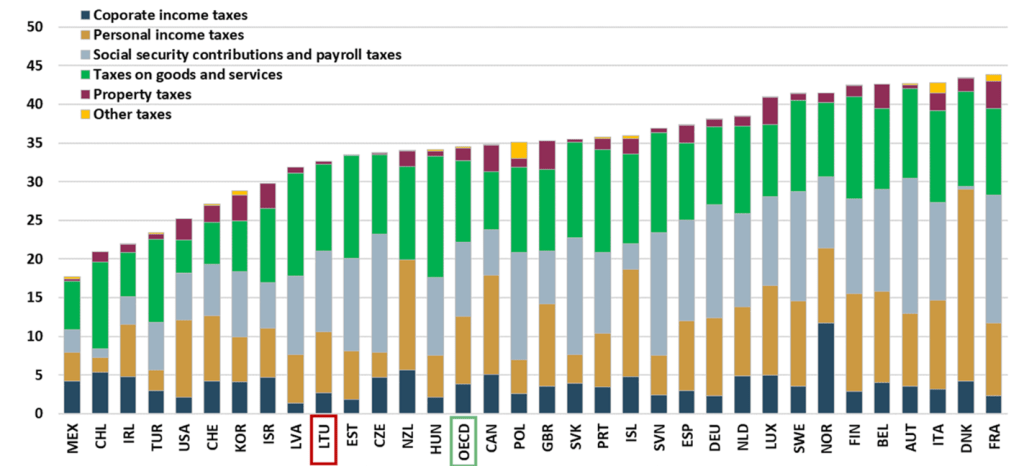
Increasing property tax revenues for fiscal sustainability in Lithuania
Note: OECD is an unweighted cross-country average
Source: OECD Revenue statistics

Bringing more people into the labour force would attenuate the impact of the demographic shock on the labour market.

Despite existing labour shortages in many sectors, the employment gap between higher- and lower-skilled workers is high in Lithuania. The creation of learning accounts for training courses in 2024 is a step in the right direction. If it turned out that current funding is insufficient to make a significant difference, targeting could be increased towards the groups that are most in need of training.

Increasing the employment prospects of older-age workers will also require improving their health. Poor health conditions are partly related to preventable diseases and behavioural factors such as poor diets, high alcohol consumption and low physical activity. Regulations and taxes have a key role to play by limiting the affordability of harmful substances.

Immigration is another way to mitigate labour shortages. Simulations presented in this Survey show that extending the positive net migration inflows that were observed just before the outbreak of the war in Ukraine would halve the impact of the demographic shock on the Lithuanian economy. Residence permits for non-EU workers could be made more attractive. With 1.3 million persons of Lithuanian descent living abroad, return migration also has a significant potential. Since migrants of Lithuanian origin may be easier to integrate, outreach towards the diaspora could be strengthened.

Visit the OECD’s Lithuania Economic Snapshot page for further information.

References:

OECD (2025), OECD Economic Surveys: Lithuania 2025, https://doi.org/10.1787/4abf1ea5-en, OECD Publishing, Paris.


Lithuania: Sailing through rough waters

By Hansjörg Blöchliger, OECD Economics Department

Russia’s war in Ukraine hits a buoyant economy

It was expected to last. Lithuania had been among the fastest growing OECD economies of the past decade, buoyed by rising exports and integration into global value chains. As portrayed in the 2022 OECD Economic Survey of Lithuania, the pandemic-induced recession had been one of the mildest in Europe, and the recovery had been swift. Ambitious public investment in infrastructure, innovation, education, digitalisation, and climate action had paved the way for long-term sustainable growth.

Then Russia started its unprovoked and unjustified aggression against Ukraine. Geographically close, Lithuania soon felt the fallout: trade with Russia collapsed, energy prices soared, and inflation has reached record highs (figure 1). Since it cut all energy ties with Russia, Lithuania relies on natural gas imports through its terminal in Klaipeda and electricity from Poland and the Nordic countries. With commendable generosity, Lithuania has so far given shelter to around 65 000 Ukrainian refugees or more than 2% of its own population.

Growth is projected to decline to 1.6% in 2022 and 1.3% in 2023, against 5% in 2021.

Figure 1. Inflation is record-high

Note: Inflation data for September are provisional.
Source: OECD, Consumer Price Indices database.

Fiscal challenges ahead

The government quickly set up a programme to shield households from the full blow of the energy crisis, and fiscal policy has become expansionary. Since the euro area monetary stance is also expansionary, policy is currently fuelling rather than damping inflationary pressures. Against this background, fiscal policy should tighten to reduce demand and to avoid inflation rising further. Fiscal support should focus on the most vulnerable households and on investment in energy security.

Long-term fiscal pressures are looming as well. Lithuania is one of the fastest-ageing countries of the OECD, with the share of people 65 years and older almost doubling until 2060. Additional pension and health care spending could push up public debt to unsustainable levels. Against this background, the government should consider establishing an automatic link between the retirement age and life expectancy, while combating old-age poverty through targeted support for low-income pensioners.

Structural reforms to raise productivity and employment

Productivity growth has accelerated over the past five years, jolted by policy reforms in the past, but it remains below the OECD average (figure 2). To sustain further productivity growth, the government should continue investing in structural reform, particularly in education, digitalisation, and the functioning of public enterprises.

Figure 2. Productivity is accelerating but remains below the OECD average

Note: Panel A, productivity is defined as GDP per person employed. Panel B, OECD refers to simple average of its member countries.
Source: OECD, Productivity database; OECD, Labour Force Statistics database; and OECD, National Accounts database.

A consolidation of the network of overly small schools and a new teacher framework would help improve quality of compulsory education. Strengthening vocational education and training, in particular expanding apprenticeships, will help reduce structural unemployment.

Modernising the public sector and improving digital skills are important drivers for innovation. More effective support for business R&D and stronger research-business collaboration could boost private investment in digitalisation.

State-owned firms are active in many sectors, and their governance can be improved further. Subjecting all public entities to the same legal, financial, and regulatory possibilities and constraints as private firms is essential to level the playing field.

Setting the priorities right will again lift sustainable growth in Lithuania.

References:

OECD (2022), OECD Economic Surveys: Lithuania 2022, OECD Publishing, Paris, https://doi.org/10.1787/0829329f-en.


Lithuania: Ensuring the rising tide lifts all boats

by Vassiliki Koutsogeorgopoulou, Lithuania Desk, OECD Economics Department
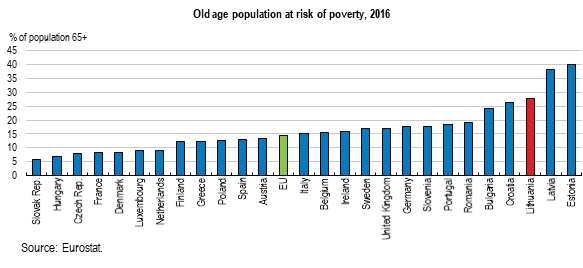
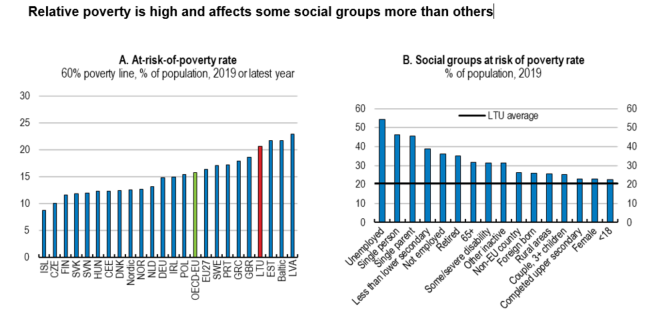
As a result of Lithuania’s strong economic growth performance since the mid-1990s, incomes are catching up fast towards the average of OECD countries. But relative poverty is high, especially among the unemployed, less educated, single parents, people with disabilities and the elderly. High poverty not only fuels social exclusion but it also dents the productive potential of those affected. The Covid-19 crisis adds to these challenges, not least through a sharp increase in unemployment since the onset of the pandemic. Tackling poverty calls for a comprehensive strategy that provides sufficient social support and better labour market opportunities for the vulnerable.

The at-risk-of-poverty rate is the share of persons with an equivalised disposable income below the at-risk-of-poverty threshold, set at 60% of the national median equivalised disposable income (after social transfers) (Eurostat definition). Averages are calculated for the most recent value of all countries with available data (unweighted). Average groups are as follows: EU27: European Union members; OECD-EU: EU countries who are OECD members; Baltic: Estonia, Latvia, and Lithuania; Nordic: Denmark, Finland, Iceland, Norway, and Sweden; CEE (Central European Economies): Czech Republic, Hungary, Poland, Slovak Republic, and Slovenia.
Source: OECD Income Distribution database; Statistics Lithuania; and EU-SILC.

The tax-transfer system could do more to reduce poverty. Social benefits remain low, despite recent increases, and the provision of support is not yet individual-based. Increasing social support that is well-tailored to the needs of the most vulnerable, while keeping work incentives, is essential. The pension system also needs to safeguard more against old-age poverty by ensuring adequate pension levels. More than a third of seniors have incomes below 60% of the national median. The additional spending can be financed through efforts to utilise under-exploited tax bases, including by tackling tax evasion.

Social services also need to improve. Not all children have access to early childhood education and care, despite its critical role in reducing the impact of social disadvantage. A case can therefore be made to maintain efforts to expand early education services, with a special focus on children from disadvantaged backgrounds and those living in rural areas. Another challenge is to meet the housing needs of the poorer segments of the population. Around 10 000 low-income households are still awaiting social housing, calling for increased investment in this area. Lithuania also needs an integrated approach to homelessness, guided by international best practices.

Fighting poverty in a decisive manner ultimately requires more and better quality jobs. There is scope, in this context, to improve the job opportunities for less-skilled workers through a further reduction in the labour tax wedge, which remains above the OECD average. Equally important are measures to boost the productivity of less-skilled workers, including through well-designed incentives to enhance participation in adult learning programmes, helping re-skilling and upskilling. At the same time, informality needs to be reduce to ensure high-quality jobs. The New Labour Code makes strides in this regard.

Increased spending on activation programmes, upon a close monitoring of outcomes, is essential to better integrate displaced workers in the labour market and to reduce poverty. Ensuring successful labour market and social integration of the vulnerable groups requires close collaboration of all stakeholders, with some encouraging initiatives already underway.

As the economy recovers from the Covid-19 crisis, the Lithuanian authorities will have the opportunity to make headways in all these areas through continued reforms so that all boats can be lifted as the tide rises anew.

References:

OECD (2020), OECD Economic Surveys: Lithuania 2020, OECD Publishing, Paris.
https://doi.org/10.1787/62663b1d-en.


Lithuania: A fast-growing economy needs to boost inclusiveness

Lithuania2018surveyby Hansjörg Blöchliger and Vassiliki Koutsogeorgopoulou, Lithuania Desk, OECD Economics Department

Lithuania is one of the fastest growing economies in the OECD. After a strong rebound in 2017, growth is set to average more than 3% over this year and the next led by buoyant investment. Falling unemployment and rapidly increasing wages support consumption, although a shrinking labour force weighs on growth. Export growth remains solid, although below last year’s peak. Following 10 years of deficits and rising debt, the budget moved to a small surplus in 2016 and has remained positive since then. Lithuania is considered one of the most open and business-friendly economies in the OECD, and financial markets are stable.

Important challenges remain. Productivity is still about 30 percent below the OECD average, even if some recent pick up is encouraging. Export performance has improved but exports are concentrated in low-medium value-added activities and integration into global value chains is weak. Skills often do not match needs by businesses and collaboration between firms and research institutions is weak. Most disquieting, emigration – mostly of the young – continues, depriving the country of its most dynamic people and contributing to skills shortages.

Lithuania fig 2

Inequality and poverty are high reflecting widespread labour informality and a pension system that leaves many elderly with low incomes.


Lithuania fig 3

The “New Social Model” is Lithuania’s most impressive achievement of the past few years to enhance productivity and inclusiveness. The reform made the labour market more flexible, protects better the unemployed, and ensures sustainability of the pension system. The New Social Model is “inclusive” in the best sense of the word. The reform is also a showcase on how to achieve a large reform with a difficult political process, by creating a win-win situation.

Lithuania should continue its reform vigour to boost productivity and inclusiveness further. Reforms should focus on improving the business environment and making firms more dynamic, including through a more efficient insolvency regime, and by making the education system more responsive to labour market needs. More and better-quality jobs in the formal sector are key to well-being and reducing poverty. More effective support for those in need and active labour market programmes would also help combat poverty. Finally, easing the rules for highly skilled immigrants could help address the negative consequences of emigration, as could strengthening social and economic ties with the Lithuanian diaspora. These issues and policies to address them are analysed in the 2018 Economic Survey of Lithuania.

Further reading

OECD (2018), OECD Economic Surveys: Lithuania 2018, OECD Publishing, Paris.


Pump-priming productivity through reform: the case of Lithuania

By Ben Westmore, Economist, Country Studies Branch, OECD Economics Department

In the past two decades, the income level in Lithuania has steadily risen toward that of OECD countries. Between 1995 and 2013, GDP per capita rose from one third to two thirds of the OECD average. Productivity catch-up was critical to this process, aided by enhanced integration into the global economy which enabled the adoption of more advanced production technologies from abroad.

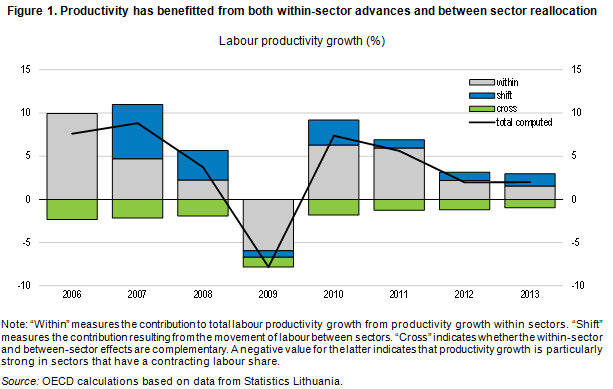
Decomposing Lithuanian labour productivity growth in the 2006-2013 period reveals that both reallocation of resources between sectors and within‑sector productivity growth have been important (Figure 1). The latter can be driven by reallocation between firms in the same sector as well as increases in within‑firm productivity.

Ben lithuania productivity

Compared with other countries, the contribution to productivity growth of between sector reallocation (i.e. the “shift” effect in Figure 1) has been large in Lithuania. This may reflect a series of reductions in regulatory barriers to firm entry over the past decade. According to the World Bank Doing Business indicators, the cost to start a business fell from 4% to 0.6% of income per capita between 2003 and 2015. Specific reforms included the establishment of a new form of legal company (a “small partnership”) that has no minimum capital requirement and a reduced number of regulatory procedures. A one-stop shop for online business registration was also introduced as well as measures to reduce the difficulty of companies to register as a value added taxpayer.

Indeed, new OECD empirical analysis at the industry-level across the 2006-2013 period identifies that these policy changes have been associated with increased contributions to productivity growth through both the “within” and “shift” effect in Lithuania (see Chapter 1 of the Lithuania Economic Assessment for details). One channel through which this likely arose is by such reforms enabling increased entry of young small firms that subsequently obtained market share at the expense of poorer-performing incumbents. This is consistent with the fact that the firm exit rate in Lithuania was around double the European Union average during the period.

The trends from firm-level data fit this interpretation. Firm-level estimates suggest that multifactor productivity growth in Lithuania would have been around one-third lower over the 2000-13 period without new firm entry. Accordingly, these data show a steep pick-up in the proportion of small businesses in Lithuania during the past decade (Figure 2).

Ben proportion of small firms

This is not to say that all the necessary reforms in Lithuania have been undertaken. The level of labour productivity is still around one-third below the OECD average. The education system at all levels can do a much better job at producing graduates with the skills required by firms, state-owned enterprises occupy a relatively large share of the economy (and many of these underperform) and innovation in the business sector is low. However, Lithuania’s recent record of productivity-enhancing product market reforms gives reason for optimism that policymakers can make the policy adjustments needed to further promote convergence and the living standards of the population.

Find out more:

Lithuania productivity country profile

OECD (2016), Economic Survey: Economic Assessment of Lithuania 2016, OECD Publishing, Paris.

OECD (2016), Review of School Resources: Lithuania, OECD Publishing, Paris.

OECD (2015), Regulatory Policy in Lithuania, OECD Publishing, Paris.

OECD (2015), Review of Lithuania’s Position Relative to the OECD Guidelines on Corporate Governance of State-owned Enterprises, OECD Publishing, Paris.


Reforming benefits in Lithuania to generate a double dividend: Making work pay while better protecting the jobless

By Lilas Demmou, Head of Lithuania Desk, OECD Economics Department

Inequality measures in Lithuania (like in Estonia and Latvia) are high. To an important extent this is related to the high risk of poverty for non-working individuals and to the low rewards to work. Therefore, increasing the quality of jobs, ensuring that the most vulnerable have access to employment and providing adequate income support for those that have lost their job are key for making labour markets and the economy more inclusive. Lithuania provides an interesting example on how to reform out-of-work benefits to reconcile three major objectives i) providing adequate support for living, ii) improving labour market matching by allowing job seekers to devote enough resources to job search iii) maintaining financial incentives to search for a job and accept a vacancy.

In Lithuania less than 20% of unemployed are covered by the unemployment benefit system and the replacement rate is comparatively low. Social assistance benefits have been in practice the main income buffer in the case of job loss: the number of recipients increased from 1% of the total population before the crisis to around 7% at its peak (Panel A).

However, the social assistance system provides also only a very low level of income replacement (at maximum half the poverty line for single individuals) and insufficient incentives to work due to complete and immediate benefit withdrawal in case of accepting a formal job for the large majority of social assistance recipients. As a result of restrictive and low out-of-work benefits, losing a job goes often hand-in-hand with high risks of poverty, generating an inactivity trap and skills mismatch.

lithuania one

In line with OECD countries experience (Immervoll and Pearson, 2009), providing in-work benefits could strike a balance between labour market inclusiveness and maintaining incentives to work. Recent studies on Lithuania show that effective marginal taxation related to benefits withdrawal reaches almost 75% of additional income for low paid jobs (Panel A). The current in-work benefit scheme reduces effective taxes and increases work incentives by adding up to 25% of total income for those eligible with the lowest earnings. However, the macro effect on poverty remains limited due to the narrow population covered by the current system (2% of social assistance recipients) because high informality requires strict eligibility.

Against that background, reforming unemployment benefits might generate a double dividend: it would improve the functioning of the labour market by providing adequate support for job search and would reduce incentives for informal wage payments. Our simulations show that modifying the unemployment benefit system in line with the government’s proposed reforms under the “New Social Model” would roughly double the level of the average annual replacement rate and would increase the number of benefit recipients by 13%. The reform would be associated with a large increase in the disposable income of those at the bottom of the income distribution and a large increase in the replacement rate at the upper part of the income distribution, as the level of the benefit ceiling is increased (Panel B).

disponsable lithuania

Source: Navicke J., Avram S. and Demmou L., (2016)

This stronger link established with previous earnings would allow in a second step strengthening in-work benefits system by reducing incentives for underreporting wages.

Find out more:

Immervoll, H. and M. Pearson (2009), A good time for making work pay? Tacking stock of in-work benefits and related measures across the OECD, OECD DELSA working paper n.81 

OECD (2016), Economic Survey: Economic Assessment of Lithuania 2016, OECD Publishing

OECD (2015), Investing in Youth :Lithuania, OECD Publishing

Navicke J., Avram S. and Demmou L., (2016), The effects of Reform Scenarios for Benefits Systems on Work Incentives and Poverty in Lithuania, OECD Economics Department working paper forthcoming