Ireland: Boosting housing supply to raise living standards and preserve competitiveness

By Patrizio Sicari and Müge Adalet McGowan.

Over recent decades, Ireland has seen significant gains in living standards, alongside a gradual decline in income inequality. These improvements are largely driven by economic growth stemming from substantial foreign investment inflows, attracted by Ireland’s favourable corporate tax regime, stable political environment, business-friendly regulations, and a skilled workforce. As a result, high-productivity sectors dominated by foreign-owned multinationals now account for nearly half of total value added, contributing significantly to domestic employment and tax revenues, which are at historical highs.

Against this background, however, Ireland’s infrastructure bottlenecks, resulting from a long spell of under-investment in the wake of the global financial crisis, are a growing drag on its competitiveness. As highlighted in the 2025 OECD Economic Survey of Ireland, these challenges are particularly pronounced in the housing sector. Since the 2010s, population growth, fuelled by strong net inward migration, has consistently outpaced forecasts and significantly exceeded the increase in the housing stock (Figure 1). Amid the economy’s continued strength, pent-up demand for housing collided with supply rigidities, resulting in a sharp rise in house prices, to which an underdeveloped private rental market could offer little relief. The resulting housing availability and affordability challenges have societal and distributional implications for individuals. There are also aggregate consequences on the competitiveness of the Irish economy, as the lack of sufficient housing, at affordable prices and in locations close to economic activity, is affecting employers’ ability to attract labour and their decision on where to grow and invest.

Figure 1. Housing supply and demand imbalances have pushed prices up
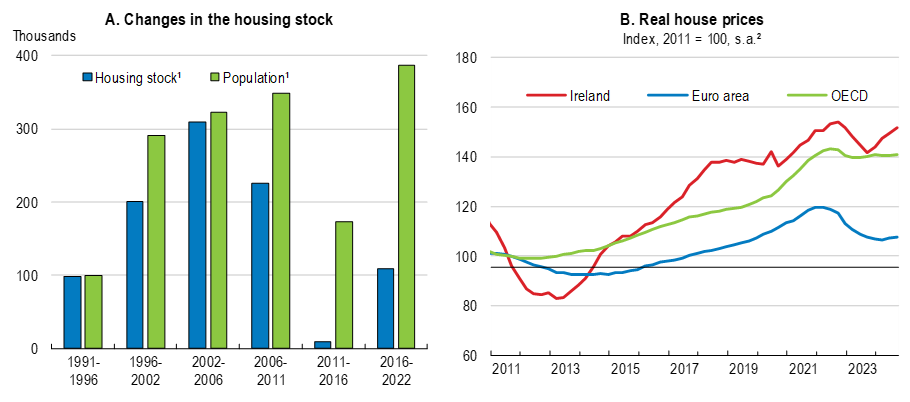
Note: 1. Changes relative to previous census. 2. Nominal house prices deflated by the private consumption deflator.
Source: Central Statistics Office; OECD, Analytical House Price Indicators.

Strong state support, in line with the comprehensive 2021 Housing for All plan, will be paramount to boosting housing supply, particularly affordable purchase and cost-rental units. The government recently raised the target for the average annual number of new houses to 50 500 – considerably higher than around 30 000 completions achieved in 2024. Effectively meeting these national targets, though, will hinge on having local sub-targets well-aligned with local conditions, as the regional distribution of residential zoned land and demand are mismatched. On-going reviews of the framework for determining local targets are thus warranted and should prevent local authorities from interpreting them as ceilings.

More efficient planning services are critical to reviving housing supply. The Planning and Development Act 2024 aims to ease barriers to new housing by streamlining planning processes and better qualifying the standing rights for initiating judicial review proceedings against administrative planning decisions. The Act also fosters consistency in planning decisions across all tiers of administration and restructures the national planning body. Alongside ongoing efforts to address staff shortages in local planning authorities, these measures are expected to improve planning efficiency. However, given the Act’s complexity, its full impact may take time to emerge, and will depend on the speed with which needed secondary legislation will be deployed. Meanwhile, faster adoption of e-planning and enhanced data collection frameworks should be prioritised to drive rapid improvements in planning authorities’ case management.

High costs and low productivity in the construction sector (Figure 2) are another barrier to meeting housing targets cost-effectively. This reflects a fragmented market, in which over-reliance on subcontracting and lack of standardisation hinder economies of scale. Reforming unit specifications and sizes, particularly for apartments, alongside better-defined housing types and improved designs, would improve cost efficiency and housing affordability. Regular updates to the technical guidance that accompanies building regulations would also facilitate the adoption of standardised construction methods. The government could leverage its purchasing power in the housing market by setting mandated targets for standardisation for the provision of new social housing.

Figure 2. Increased standardisation would lower costs and boost productivity in the construction sector

Gross value added per hour worked, construction sector, 2023
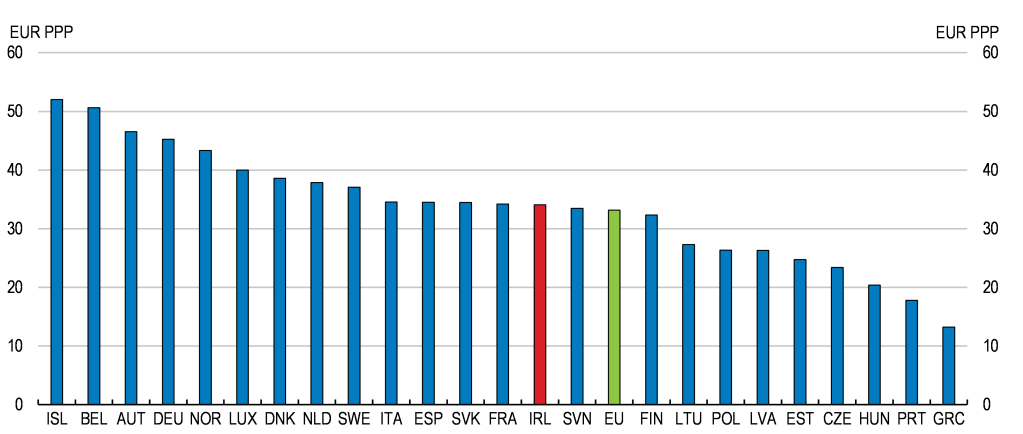
Source: Eurostat, National Accounts.

National land-use data are scattered and not standardised, and a land-use classification system is lacking, hampering planning. Enhanced efforts to adopt a national land-use map could significantly improve resource allocation and decision-making, supporting the government’s objective to prioritise compact urban growth in high-demand areas by identifying viable brownfield sites more effectively. Brownfield development, typically requiring less infrastructure investment than greenfield alternatives, would decrease fiscal costs. Greenfield options could be reserved for urban areas in which brownfield development proves unsustainable, provided they are well-connected to strategic transport networks. This would help reduce urban sprawl and minimise the environmental footprint of new developments.     

In addition, the 2025 OECD Economic Survey of Ireland provides an assessment of housing taxation, rental markets and social housing, and highlights the need for a coordinated and forward-looking approach to housing policies to create investment certainty and boost housing supply.

References

OECD (2025), OECD Economic Surveys: Ireland 2025, OECD Publishing, Paris, https://doi.org/10.1787/9a368560-en.


Securing the health of Ireland’s future

By Douglas Sutherland, Patrizio Sicari and Müge Adalet McGowan, OECD Economics Department

In recent decades, Ireland made impressive strides in developing its economy and raising living standards. This progress has allowed it to weather the COVID-19 pandemic and cope effectively with the repercussions from Russia’s war of aggression against Ukraine. Exports from the multinational part of the economy, benefiting from strong demand for medical and information communication technology goods and services, continue to support growth (Figure 1). The domestic economy, while moderating, also remains relatively resilient, despite strong headwinds from high inflation.

Figure 1. Exports continue to support growth

Gross domestic product, volume

1. Excludes those large transactions of foreign corporations that do not have a big impact on the domestic economy.
Source: OECD, National Accounts database and Central Statistics Office.

The 2022 OECD Economic Survey shows that the current Irish fiscal situation is favourable, with budget balance expected in 2022, in contrast to many European countries. This is partly driven by high tax revenues, especially corporate tax receipts, which have provided room for government support to households and businesses in the face of rising energy prices. As part of these tax receipts are potentially transitory, there is a need to ensure that expenditure policy is decoupled from windfall tax revenues, rather than facilitating an upward creep of permanent spending.

Two recent measures have improved the fiscal framework. First, EUR 6 billion of the windfall corporate tax gains have been put in the National Reserve Fund in 2022-23. Upside revenue surprises should continue to be saved in this Fund to help prepare for future shocks and long-term fiscal challenges, such as ageing. Second, a spending rule setting an annual cap of 5% on increases in the value of permanent spending (broadly the sum of trend growth of an underlying measure of economic activity assumed to be 3% and the 2% inflation target) over the medium term was introduced in 2021. However, the planned increase in spending to cushion households from high inflation is temporarily pushing outlays above the new rule. Ensuring adherence to the 5% rule as soon as possible will be important to move fiscal policy onto a more stable spending path and enable greater resilience to future shocks.

Ireland faces a number of challenges to sustain growth, improve well-being and ensure fiscal sustainability over the longer term. The 2022 OECD Economic Survey assesses the government’s plans to reform the pension system, overhaul the health system to improve quality of care and value for money, ensure affordable housing and achieve a just carbon transition. As various spending pressures materialise, reforms are needed to ensure debt sustainability. For example, the Irish population is expected to age more rapidly than in most OECD member countries. OECD simulations suggest that public health, including long-term care, and pension costs could rise by 5.7 percentage points of potential GDP by 2060 (Figure 2).

Figure 2. Population ageing will increase pressures on the government budget

Projected change in expenditures from 2021 to 2060

Source: Simulations based on the OECD Economics Department Long-term Model.

The government is investing to boost housing supply and reduce greenhouse gas emissions, but regulatory and legal hurdles should also be tackled to reduce uncertainty and high transaction costs. Planning and permitting delays coupled with judicial review concerning major investments constrain housing supply and slow the development of renewable energy capacity. Increased uncertainty deters investment and raises prices. The availability of construction workers may present an additional constraint on progress, given competing demands from residential construction, including for retrofitting the existing housing stock, and infrastructure projects. In this regard, working to lift supply by increasing the inflow of workers will be important.

The government has initiated a far-reaching overhaul of the health sector, which suffers from legacy issues, such as past underinvestment, centralised decision-making and long waiting lists. The latter, in particular, contributed to a de facto two-tier system, in which buyers of voluntary private health insurance enjoy a faster access to several public hospital services than low-income patients eligible for free care. In this context, Sláintecare reforms will reconfigure the sector by moving away from an expensive largely hospital-based system, which does not offer universal coverage of primary care, towards a better integrated primary, community and long-term care system to enhance access and efficiency. The plans to increase decentralisation, with the creation of Regional Health Areas, and improve data availability and governance as well as financial reporting and management should be prioritised. Effective implementation should remove the burden on expensive hospital care and create the conditions for streamlining the complex interactions between the private and public elements of the system.

References

OECD (2022), OECD Economic Surveys: Ireland 2022, OECD Publishing, Paris, https://doi.org/10.1787/19990324.


Promoting inclusive growth in Ireland in the context of population ageing and continued technological diffusion

By Haruki Seitani and Ben Westmore, Ireland Desk, OECD Economics Department.

The Irish economy has performed well in recent years. The unemployment rate has plummeted by over 10 percentage points since 2012 to around 5% and the average real wage well exceeds the OECD average. Nevertheless, economic uncertainty is elevated and Irish policymakers face significant challenges from population ageing and in making the most of further technological progress. Ireland is also unlikely to achieve its carbon emission reduction targets in the coming decade based on current policy settings. The 2020 OECD Economic Survey of Ireland explores ways to address these challenges.

First, recent improvements in Ireland’s fiscal position have largely reflected unexpected corporate tax receipts and interest savings. Non-recurring receipts have been partly used to fund within-year cost overruns in areas such as health and social welfare. General government debt per capita remains very high compared with other OECD countries, a legacy of the financial crisis. Given the downside risks weighing on the economy, including an increase in barriers to trade between the United Kingdom and the European Union, the government should commit to saving windfall tax receipts and ensuring fiscal prudence.

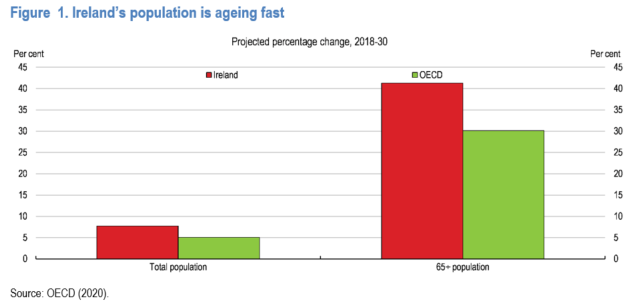
Second, Ireland’s population is set to age faster than in most OECD countries (Figure 1). Simulations suggest that public health and pension costs could rise by ½ per cent of GDP by 2030 and by 6½ per cent of GDP by 2060. To meet these obligations, opportunities for greater public spending efficiency and revenue sources that minimise economic distortions need to be identified.

Third, technological change is transforming Ireland’s economy, leading to new jobs and innovative products that benefit consumers. Nevertheless, the adoption of new technologies has been uneven across sectors and has had scant productivity impact, particularly in sectors with low firm turnover. Furthermore, there is a shortage of the skills needed to ensure that new technologies have the maximum positive impact (Figure 2). Further adoption of new technologies can be encouraged through a reduction in barriers to firm entry and their productivity potential better realised through the cultivation of complementary skills. Policy settings in other areas, including competition and the labour market, also need to be revisited to adapt to features of digitally-intensive markets.

The Survey’s key recommendations to cope with these challenges include:

• Using windfall corporate tax revenues to pay down government debt or to further build up the Rainy Day Fund.
• Broadening the tax base to prepare for future ageing costs, by streamlining the Value Added Tax system and more regular revaluation of the local property tax base. At the same time, public spending efficiency needs to be enhanced through the establishment of universal access to primary care and better health budget controls.
• A gradual increase in the carbon tax rate and other measures that will benefit the environment, including the introduction of congestion charging in the busiest locations, further investment in public transport, abolition of preferential VAT rates for synthetic fertilisers and greater afforestation.
• Promoting inclusive technological diffusion through improving the licensing process for start-ups, increasing financial assistance for and flexibility of training programmes, harmonising labour market regulations across forms of employment, and enhancing the enforcement powers of the competition authority.

Reference: OECD (2020), OECD Economic Surveys: Ireland 2020, OECD Publishing, Paris.


Unblocking the productivity potential of local businesses in Ireland

By Yosuke Jin and Ben Westmore, Ireland Desk, OECD Economics Department.

Irish GDP growth made headlines recently due to enormous upward revisions (e.g. + 25.6% for the sole year of 2015) related to the activities of a small group of multinationals. This raises the question of how much Irish productivity relies on multinational companies alone. In fact, while it has not made headlines as much as the GDP revisions, the divergence in productivity performance among firms in Ireland over recent years is particularly striking. This matters a lot for the sustainability of Irish living standards.

New firm-level analysis undertaken in tandem with the OECD Economic Survey of Ireland 2018 finds that the majority of businesses in Ireland have actually experienced falling productivity since the mid-2000s (Department of Finance, 2018). This analysis also identifies rising dispersion in the productivity between top-performing firms and other firms in most industries (Department of Finance, 2018: Figure 1), with most top-performing firms being multinational enterprises (MNEs). Indeed, a rise in aggregate productivity observed in official statistics has relied on a small group of very large successful firms, most likely the same ones whose activities have been chiefly responsible for the eye-catching GDP outturns of recent years.

Capture.JPG

At first glance, the efficiency of resource allocation in Ireland appears to be very high (Figure 2). However, this result owes largely to the presence of MNEs that can raise a huge amount of resources from different channels. Once the MNE-dominated sectors have been excluded, the efficiency of resource allocation in the Irish economy is greatly reduced and is close to the average of other OECD countries (Figure 2).

Ireland.JPG

Recent OECD studies show that non-viable firms (i.e. those kept alive by forbearance loans but otherwise insolvent) have reduced the investment and employment growth of healthy businesses in many OECD countries over the past decade (Adalet McGowan et al., 2017). In Ireland, SME default rates are among the highest in the euro area countries, while forbearance has frequently been granted to defaulted loans, which instead could be reallocated to enable highly-productive businesses to expand (OECD, 2018). This could be a major explanation of the lower productivity of domestic firms.

Another key channel through which productivity gains occur is via knowledge spillovers from top, “frontier” firms. Given Ireland’s high share of multinational enterprises, there is potential for virtuous productivity spillovers from high-productivity foreign firms to local businesses. However, such spillovers cannot be taken for granted. Other firm-level empirical analysis undertaken in tandem with the OECD Economic Survey of Ireland 2018 finds that such knowledge spillovers are overall limited in Ireland and local firms are even crowded-out by MNEs in some instances (Di Ubaldo, Lawless and Siedschlag, 2018).

What explains these limited spillovers? First, trade linkages, expressed as the intensity of supply chains between foreign- and locally-owned firms, are weak (OECD, 2018). Moreover, the productivity gains of such linkages can only be fully realised if local firms have the capacity to absorb the new ideas and technologies utilised by frontier firms, which requires investment in knowledge-based capital and human capital by local firms. For example, the above mentioned analysis shows that trade linkages produce positive productivity spillovers for those local firms that exhibit high absorptive capacity, captured by R&D investment (Di Ubaldo, Lawless and Siedschlag, 2018).

Could local firms take greater advantage of the performance of multinational enterprises? Policymakers should promote reforms that encourage the absorptive capacity of local businesses. At present, the capacity of local firms to absorb and implement new technologies is impeded by relatively weak managerial skills. This partly reflects the low proportion of workers participating in lifelong learning activities. With burgeoning skill demand, there should be an increase in the share of training funding to those in employment. Innovation and the ability for Irish firms to fully utilise new technologies is also weakened by low research and development activities. There is scope to reorient innovation policy to better promote the research intensity of local firms. In particular, targeted public grants for business research and development could be increasingly used, as it would better reach local entrepreneurs that may be in a loss-making position and hence less swayed by tax exemptions on research funding.

Finally, the OECD Economic Survey of Ireland 2018 argues that, beyond spillovers, the productivity potential of local businesses can be raised through reducing regulatory barriers to entrepreneurship and the costs of business failure. Access to finance for young firms needs to improve as well and will benefit from further efforts that mend the health of the banking sector and raise the efficacy of state-supported lending initiatives. Further improvements in Irish infrastructure will also promote firm growth. The government plans to increase capital spending significantly over the coming four years and the projects undertaken must continue to be carefully prioritised through evidence-based evaluation of those with the highest returns. To do this more effectively, systematic collection of information on the performance of existing assets is crucial.

References:
Adalet McGowan, M., D. Andrews, and V. Millot (2017), “The Walking Dead?: Zombie Firms and Productivity Performance in OECD Countries”, OECD Economics Department Working Papers, No. 1372, OECD Publishing, Paris.
Department of Finance (2018), “Patterns of firm level productivity in Ireland”.
Di Ubaldo, M., M. Lawless and I. Siedschlag (2018) “Productivity spillovers from multinational activity to indigenous firms in Ireland”, ESRI Working Paper 587, March 2018.
OECD (2018), OECD Economic Surveys: Ireland 2018, OECD Publishing, Paris.


How do you improve the durability of a Celtic Tiger?

By Ben Westmore and Yosuke Jin, Ireland Desk, Economics Department

The Irish economy is booming and is expected to continue expanding at healthy rates over the next few years. But as the 2018 OECD Economic Survey of Ireland highlights, the outlook is clouded with uncertainty.

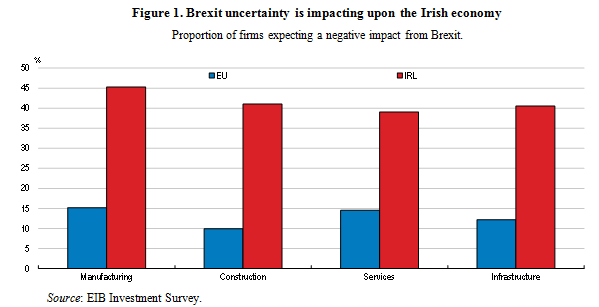
Brexit could have serious implications for the Irish economy given the close economic relationship between Ireland and the UK (Figure 1). New OECD estimates suggest that a trade arrangement between the UK and EU governed by the World Trade Organisation’s Most-Favoured Nation Rules would reduce total Irish exports by 20% in some sectors such as agriculture and food.

Ireland 2018 Brexit1

In addition to Brexit risks, rising international tax competition is a concern for Ireland. The Irish economy has been highly successful at attracting foreign direct investment, with foreign-owned firms accounting for close to half the country’s gross value added over recent years. As a result, reductions in effective corporate tax rates in other countries may have a negative impact on the Irish economy if they encourage some multinational firms to relocate their operations elsewhere.

In this context, the importance of raising the resilience of the Irish economy cannot be overstated.

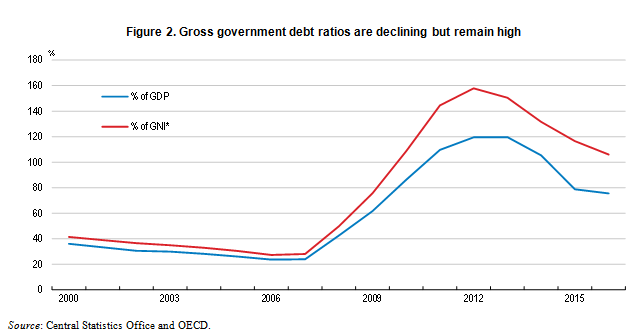
Public finances have improved noticeably, but government debt remains high and tax receipts have become more subject to volatility (Figure 2). Further reducing public debt would create scope for budgetary policy to support the economy in the event of a negative shock – such as a disorderly Brexit. This could be achieved by broadening the tax base in a growth-friendly way. For example, VAT preferential rates and exemptions should be phased out and the property tax yield raised through more regular revaluations of the tax base.

Ireland 2018 Brexit2

Financial sector vulnerabilities also need to be further addressed. While non-performing loans on bank balance sheets have declined by around 60% from their peak, the stock remains high. Measures that reduce judicial inefficiencies relating to the repossession of collateral and further encourage NPL write-offs will promote the efficient allocation of capital as well the ability of the banking sector to withstand any further adverse economic shocks.

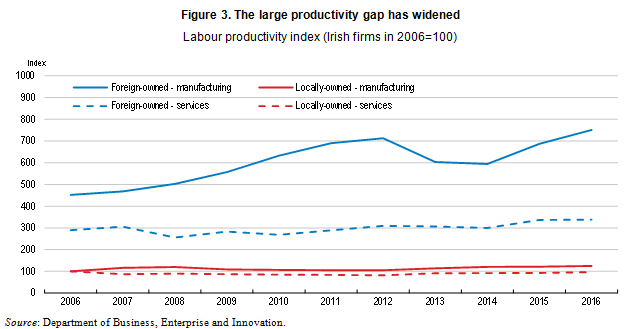
Above all else, the long-term durability of the Irish economy will rely on policy reforms that encourage a broad-based recovery in productivity. Most Irish firms have experienced declining productivity over the past decade. This has largely reflected the poor performance of local firms, with the large productivity gap between foreign-owned and local enterprises having widened (Figure 3). New firm level analysis undertaken in tandem with this Economic Survey confirms this is the case (Department of Finance, 2018; the findings of this work will be discussed in more detail in a blog post over the coming days). The resilience of the Irish economy hinges on unblocking the productivity potential of these local businesses. Pruning back regulatory barriers to entrepreneurship, such as costly regulations related to commercial property and legal services, is a start. However, productivity spillovers between foreign-owned firms and local businesses also need to be fostered by encouraging the accumulation of high-level managerial skills and research and development intensity in the latter.

Ireland 2018 Brexit3

Creating a more sustainable growth environment will raise the ability of policymakers to confront key challenges that exist for the wellbeing of the population. Particular areas that should be a focus include health, housing and getting people into work. To address these challenges, universal healthcare coverage should be provided, stringent housing regulations that are constraining dwelling supply rationalised and some social benefits withdrawn more gradually as labour earnings rise.

References

Department of Finance (2018), “Patterns of firm level productivity in Ireland”, forthcoming.

OECD (2018), OECD Economic Surveys: Ireland 2018, OECD Publishing, Paris.


Ireland…trading in the global talent pool.


by David Haugh, Head of the Ireland Desk,
OECD Economics Department

Passing through Dublin airport’s sparkling, spacious Terminal 2, sprinkled with bi-lingual English, Irish signs is a fine experience – it’s a modern, global emporium but with a very Irish flavour as anyone partial to a Guinness in departures can attest to. On arrival before you know it, a phalanx of escalators and travellators have whooshed you to the immigration hall. Standing in the non-EU citizens line gazing across at the streaming mobs of EU passport holders, strangely you can feel almost a little exclusive with your own little gateway to Ireland. The other thing you notice is that a good chunk of the non-EU citizens line are young tertiary students, coming to Ireland to further build their educational achievements. Many others in-line are already experienced professionals. This is migration, a phenomena Ireland has experienced for hundreds of years, 21st century style.

Following the severe banking and fiscal crisis 2008-2011, the Irish economy is again growing at a blistering pace. At 7.8% per annum in 2015 it was the fastest growing economy in the OECD for the second year running. By historical norms rapid growth after a banking-crisis-related recession is unusual. As I argue in the January 2016 OECD Observer, the swift expansion is thanks to Ireland’s huge pool of foreign investment and success in the third great globalisation wave. A key ingredient of this success is Ireland’s capacity to attract and integrate skilled migrants and so far it’s doing quite nicely. It may be a cliché but the Irish people really are loquacious and welcoming. That may be one of the reasons why Google brings staff to Ireland, not just to work in Dublin, but also to train for its offices worldwide.

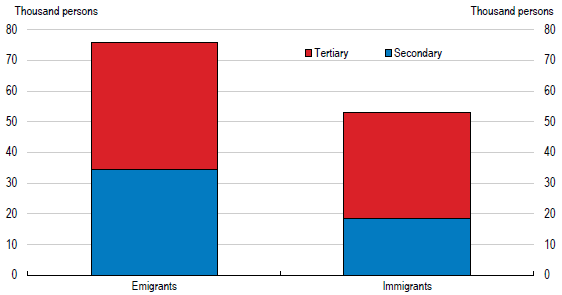
It is true that in the wake of the crisis, mass immigration turned into a mass exodus. The economic recovery has seen this start to turn around but at the trough in 2012 net migration reached -34000 per annum (0.75% of the population). A good chunk of those leaving were prime age workers. The big concern with this is that Ireland is suffering a “brain drain”. However the data presented in the latest OECD Economic Survey of Ireland suggest that rather than “brain drain” Ireland exhibits “brains exchange”, a large proportion of emigrants and immigrants are well qualified. Skilled immigrants complement Ireland’s well-qualified workforce with “hard-to-classroom-learn” capabilities, such as native speaker-level ability in foreign languages. Migrants also allow Ireland to draw on a wider range of education and experiences than a small economy, even with high quality educational institutions, can be expected to provide. Ireland’s large stock of foreign investment is not just there for low corporate tax rates. The ready availability of a global talent mix is an important part of the attractiveness of Ireland to the world’s most innovative multinationals.

More than half of immigrants are tertiary qualified

Educational Attainment, 2014

Imm daveSource: Central Statistics Office (CSO)

Large migration flows can have important implications for trends across the economy and vice versa: large migrant flows can push around housing markets, or fast rising rents and houses prices, as have been occurring recently in Dublin, could discourage them. The system of work permits and qualifications must recognise that to succeed in a global market Irish firms need to be able to draw on a global talent pool. The policy framework should be fine-tuned to deal with these realities and foster an economy and institutions flexible enough to cope with sizeable migration flows.

Ireland is a high-home-ownership country for many reasons but one of them is that rental accommodation has traditionally often been of poor quality. What is required is a more developed rental market and high quality apartments in city centres where many young, educated migrants want to live and work. Government should carry through on plans to densify city centres and height restrictions should be eased from three or four stories as part of this…think the seven stories of Paris…hardly ugly is it?

The government has improved work permit processing but could do more on qualifications recognition. It could also give non-EU student graduates more time to find a job. This is a rich potential talent pool, combining education and skills from Ireland and their own home countries. And training in Ireland is a perfect platform to integrate successfully from. Ireland has invested in these people, why let that handsome return walk out the door?

References:

OECD (2015). OECD Economic Survey of Ireland , OECD Publishing, Paris

O’Connor, B., T. Hynes, D. Haugh and P. Lenain (2015), “Searching for the inclusive growth tax grail”, OECD Economics Department Working Papers, No. 1270, OECD Publishing, Paris.

Kennedy, S., Y. Jin, D. Haugh and P. Lenain (2015), “Taxes, income and economic mobility in Ireland”, OECD Economics Department Working Papers, No. 1269, OECD Publishing, Paris.