Strengthening the recovery and accelerating the green transition in Hungary

By Pierre-Alain Pionnier and Donal Smith

After a strong demand-based recovery from the economic fallout of the COVID-19 pandemic, Hungary’s economy contracted in 2023 while inflation climbed higher than elsewhere in the European Union, at some point surpassing 25%. The good news is that growth has restarted in mid-2023 and inflation is receding. At the same time, both fiscal and monetary policies will need to work hand-in-hand to fight remaining inflationary pressures and recreate fiscal space for future spending needs, as highlighted by the recently published OECD Economic Survey of Hungary (OECD, 2024).

One of the big challenges of the next decades will be to move towards a greener and more sustainable economy. Hungary has made progress in this direction, but this progress needs to accelerate. For a large part, emission reductions achieved so far have been related to the changing industry structures as the economy transitioned to a market economy in the early 1990s. Regulations and standards are currently the main tools used to support the green transition, but they will likely be insufficient to reach the 2030 and 2050 emission targets. Price signals are key for an efficient decarbonisation. The European Union’s Emission Trading Scheme is the main price-based measure to curb emissions in Hungary, but it only covers a third of emissions. As a result, average carbon prices are low in international comparison, exacerbated by energy subsidies on fossil fuels (Figure 1).

Figure 1. Carbon prices are low

Net effective carbon rates, all sectors, EUR per tonne of CO2, 2021
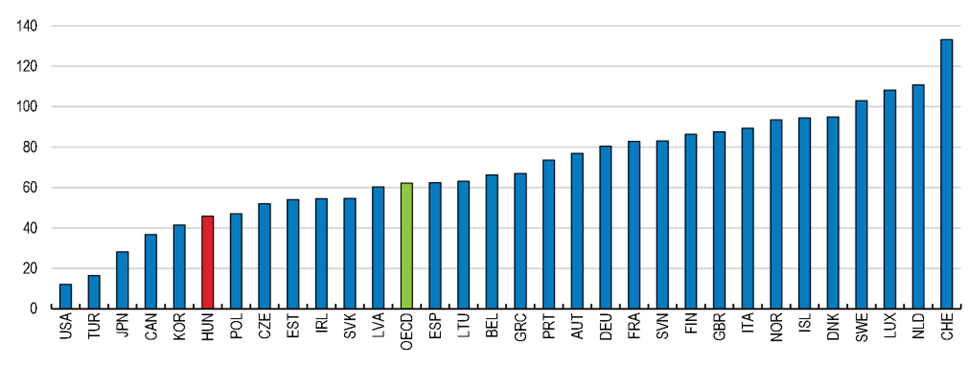
Note: Net effective carbon rates consist of emission trading prices, carbon taxes, and fuel excise taxes, minus fossil fuel subsidies. The OECD average is an unweighted average of net effective carbon rates across OECD countries.
Source: (OECD, 2022)

In the residential sector, price caps keep retail electricity and gas prices low for many households. Along with poor dwelling insulation, this may explain why household energy consumption is among the highest in Europe (Figure 2). If energy support to households were restructured and price caps replaced with targeted cash transfers, this would not only protect vulnerable households, but it would also improve energy efficiency incentives and cost less, as energy subsidies reached 2.5% of GDP in 2023. Part of the fiscal savings could be allocated to upgrade the housing stock of financially constrained households.

Figure 2. Households’ energy consumption is high

Energy consumption of households for heating, in kilograms of oil equivalent (koe) per m²

Note: For each country, energy consumption is corrected for changes in meteorological conditions across years.
Source: Odysee-Mure, https://www.odyssee-mure.eu/

Emissions from the transport sector have increased since 1990 and now represent 20% of overall greenhouse gas emissions. Car ownership has expanded along with rising income levels, but Hungarians drive one of the oldest car fleets in Europe, and over longer distances than elsewhere in Europe. Transport emissions could be limited through better incentives to replace high-polluting cars and choose public transportation where available, but also by improving the quality of public transportation and limiting urban sprawl, especially around Budapest.

On the supply side, meeting emission targets will require a significant increase in electricity production from low-carbon sources. Current plans are mostly focused on solar energy and biomass, particularly wood. While burning wood is a low-emission energy source seen over the long run, when accounting for the replanting of trees, in the short run it would increase emissions and reinforce an already acute air pollution problem. Hungary could make better use of its potential for wind and geothermal energy, but that will require removing restrictive rules on windmill installation and easing licensing procedures for geothermal energy projects. Moreover, the development of intermittent energy sources like solar and wind energy will require massive investments in the electricity grid.

Ensuring a sufficient low-carbon electricity supply will be a challenge. Hungary currently imports 40% of its electricity from neighbouring countries, which are engaged in a similar decarbonisation process. Eventually, Hungary will also have to replace an ageing nuclear plant, and large projects like this can be subject to financial, technical, and even geopolitical risks.

All of these considerations will make it even more important to speed up progress on rolling out low-carbon renewable energy sources. Only this can make Hungary’s progress towards living standards more sustainable and leave a brighter future for the next generation.

References:

OECD (2022), Pricing Greenhouse Gas Emissions: Turning Climate Targets into Climate Action, OECD Series on Carbon Pricing and Energy Taxation, OECD Publishing, Paris, https://doi.org/10.1787/e9778969-en

OECD (2024), OECD Economic Survey of Hungary, March 2024, OECD Publishing, Paris, available at https://doi.org/10.1787/795451e5-en.


Hungary: Policies for a stronger and sustainable recovery

By Jens Høj and Martin Borowiecki, OECD Economics Department 

The COVID-19 pandemic abruptly ended the strong economic growth performance in 2016-19, which entailed large increases in employment and real incomes, and the lowest unemployment rate in thirty years. What followed was a severe economic contraction as containment measures and a drop in international demand hit hard the export-oriented economy.  

The Hungarian economy is now emerging from the crisis. A fast vaccination rollout allows a rapid economic recovery from mid-2021 onwards. The 2021 Economic Survey of Hungary projects annual growth of about 5% per annum in 2021 and 2022, with GDP recovering to pre-crisis level at the beginning of 2022. The recovery will be driven by the release of pent-up demand and stronger external demand.  

Prepare for fiscal consolidation once the recovery becomes self-sustained 

However, the crisis is not over yet. Uncertainties around the strength of the recovery remain, reflecting the potential scarring of the economy arising from the prolonged crisis. For instance, semiconductor shortages could continue to interrupt the Hungarian car production. Also, new COVID variants may emerge and could potentially lead to new restrictions and lower domestic spending. The Survey recommends to continue to provide targeted fiscal support as needed. Once the recovery has become self-sustained, the government should prepare for fiscal consolidation. Such consolidation is needed to address long-term fiscal challenges that arise from population ageing.  

Exit from unconventional monetary policy measures  

As the recovery gathers pace, a combination of stronger wage growth and supply shortages could fuel rising inflation expectations. Inflation is above the inflation target of 3% and moved outside the central bank’s upper tolerance band of + 1% in spring 2021. Now is the moment to gradually exit from unconventional monetary policy measures. Monetary policy should also continue to increase policy interest rates if inflation expectations become unanchored.

Reforms for strong and sustainable growth 

As the recovery becomes self-sustained, attention should be given to structural reforms to secure the impressive income gains achieved before the pandemic. The OECD Economic Survey of Hungary highlights three main challenges to long-term growth and provides recommendations to address them.  

Bolster productivity growth 

First, population aging will lead to an older and smaller work force, reducing growth. Demographic change makes it necessary to improve the productivity performance of the economy, which has been weak in the decade leading up to the pandemic. Stronger productivity growth will help to continue the income gains achieved before the pandemic and close the income gap vis-à-vis richer OECD members.  

The OECD provides in this Survey key recommendations to achieve faster productivity growth. In the near-term, the employment prospects of low‑skilled workers need to be raised through skills upgrading and higher labour mobility. Thereafter, faster productivity growth requires improved vocational and tertiary education, more competitive markets, and faster adoption of new technologies, particularly to accelerate the digital transformation of the economy (Figure 1). Also, intensifying efforts to fight corruption would ensure a better use of public resources, including the efficient use of procurement in the roll-out of public investments, and foster stronger business dynamics. 

Figure 1. Hungary lags in ICT adoption

Note: Firms from the financial sector are excluded. High-speed broadband are subscriptions with 100+ Mbps.
Source: OECD ICT Access and Usage by Businesses database.

Secure the fiscal sustainability of the pension system 

Second, population ageing is accelerating, boosting ageing-related spending in areas such as health and pensions. If not contained, these will lead to sharp increases in public debt. This reflects that many pensioners retire early, despite recent increases in the effective retirement age. Addressing this challenge requires longer and healthier work lives.  

To this end, the OECD recommends to complete the ongoing increase of the statutory retirement age to 65 by 2022, and thereafter, to link further increases to gains in life expectancy. To prepare the health care system for an older workforce, the autonomy of hospitals should be enhanced to adjust the supply of health services to future needs. 

Improve environmental outcomes 

Third, better environmental outcomes require a further decoupling between economic growth and greenhouse gas emissions. Environmental policy is currently based on a combination of regulations, subsidies and tax rates that vary across sectors. This means that polluters do not necessarily pay the cost of pollution. In addition, prices of energy, water and waste collection are regulated for affordability reasons, often to below-cost levels. Low regulated prices discourage investment in much-needed greener technologies. Addressing the challenge of reducing greenhouse gas emissions requires setting higher and more uniform prices on emissions.  

To make polluters pay a higher price for polluting, the OECD recommends to gradually unify carbon taxes. Non-carbon environmental taxes should be set according to the polluter pays principle. In addition, the government should ensure cost recovery in regulated energy sectors. Higher waste collection fees and water and wastewater service tariffs can help finance the needed investments. To help low-income households, the government should introduce well-targeted affordability measures.  

References 

OECD (2021), OECD Economic Surveys: Hungary 2021, OECD Publishing, Paris, https://doi.org/10.1787/1d39d866-en