Greece: Boosting firm growth and innovation to raise living standards 

Cover of the greece economic survey 2024

By Antoine Goujard and Timo Leidecker

The Greek economy has weathered recent crises well and GDP growth has outpaced the euro area since early 2021. As headwinds are subsiding, the economy is emerging with significant gains in competitiveness, growing investment and more high-tech exports, and historically low levels of unemployment. Helped by solid growth, inflation and fiscal consolidation, public debt levels dropped significantly, and Greece regained the investment grade rating of its sovereign debt in 2023. GDP growth is expected to continue to outpace the Euro area over the next two years, with real incomes picking up and European funds supporting investment.  

While Greece’s performance has been strong, boosting firm growth and innovation remains a key challenge to support long-term gains in living standards. As highlighted in the  2024 OECD Economic Survey of Greece (OECD, 2024), despite recent improvements, productivity remained 40% below the OECD average in 2023, reflecting performance gaps that are visible in all sectors of the economy. Business investment has declined following the Great Financial Crisis and has just started to rebound in recent years (Figure 1). More than in most other OECD countries, the business sector is dominated by micro and small firms, which often struggle to seize the opportunities of new technologies, innovate and grow. Skill shortages are high and prevent firms from growing and implementing new technologies. This is despite the high -albeit declining- unemployment of 9.8% in October 2024, and reflects the fact that many workers do not have the skills needed by firms. The 2024 OECD Economic Survey of Greece identifies three policy areas where further action could help to strengthen firm growth and innovation.   

Figure 1. Business investment and innovation remains low despite recent progress 

Panel A. Data refer to the business sector excluding real estate activities, public administration and defence, compulsory social security, education and human health and social work activities. 
Source: Panel A: Eurostat (2024) National Accounts database ; Panel B: OECD (2024), Business enterprise R&D expenditure. 

One area with further scope for reforms is to continue removing regulatory burdens. Greece’s regulatory framework has become more business-friendly in recent years, recording the largest improvement in the OECD Product Market Regulation Indicator over 2018-23. However, restrictive regulations persist for professional services and hold back business innovation. Tools to identify and revise burdensome regulations are being applied but have yet to be used to their full potential. Improving the quality and scope of regulatory impact assessments and formalising the review of the stock of existing regulations together with stakeholders would be one way forward. Denmark, for example, does this well with its Business Forum for Better Regulation. In addition, Greece could also minimise regulatory burdens arising from new legislation by implementing its existing rules for quality control and consultations more systematically. Ensuring the effective and timely consultation of stakeholders on new draft legislation is key to continue to improve the business environment.  

Another important avenue will be to make more of the current labour force and improve skills. Better activating youths, women and foreign-born workers, would boost productivity and employment, as would equipping workers with the skills required by rapidly changing technologies. Vocational Education and Training (VET) should be developed further by increasing apprenticeships and the role of employers in the design of curricula. The roll-out of compulsory traineeships in 2024 and the more direct involvement of social partners in the design of vocational training are welcome steps, but there is space to devise a better combination of school and work-based programmes, an area where the success of Germany and Switzerland can provide useful lessons. Policies to support those already in the labour market, so-called “active labour market policies”, are still too much focused on low-effective direct-job creation programmes, and some of that spending could be redirected to training programmes for workers and the unemployed, while regularly assessing and certifying the quality of training providers. Barriers to labour market participation should also be removed, notably by continuing to expand childcare facilities and making it easier to recognise prior learning and skills gained abroad.  

Greek firms could grow stronger by boosting their access to finance. Low business investment, including in research, development and innovation, limits growth prospects, and there are only limited spillovers from foreign direct investment to domestic firms. Greece has made extensive use of loan-guarantee and subsidised lending programmes to improve access to finance, but these programmes should be regularly evaluated to avoid the risks of locking in resources in low-productivity firms and crowding out alternative financing sources. Bank health has improved greatly but non-performing loan exposures remain sizeable in the banking sector and among loan servicing companies. Reducing the length of court procedures, building on the recent bankruptcy law and the 2024 reform of the judicial system, would help restructure non-performing assets. With growing EU and national funding for business innovation and entrepreneurship, regular evaluations will also be key to enhance the effectiveness of public incentives for business innovation.  

Boosting productivity and innovation is not just a short-term priority for Greece—it is fundamental for achieving more sustainable and inclusive growth, especially as Greece’s population ages and the share of those in working age decreases.  

Reference: 
OECD (2024), OECD Economic Surveys: Greece 2024, OECD Publishing, Paris, https://doi.org/10.1787/a35a56b6-en


Five priorities to help rejuvenate Greece’s labour market after the COVID-19 crisis

by Tim Bulman, Greece Desk, OECD Economics Department

Across the globe, the COVID-19 crisis has hit workers with temporary contracts and those working in tourism and consumer-related services particularly hard. These groups make up large shares of Greece’s workforce, and tourism’s strong growth in recent years.

Greece’s government is currently planning how the European Recovery and Resilience Facility will help overcome the COVID-19 shock and move the economy to a path of sustained and stronger growth. To support Greece’s workers through the COVID-19 crisis and to set the labour force for a stronger recovery, the OECD’s new Working Paper on ‘Rejuvenating Greece’s labour market to generate more and higher-quality jobs’ highlights five policy priorities:

1. Strengthen the social safety net’s protection for low-income households (Figure 1). Reforms to Greece’s social protection in recent years helped reduce poverty prior to the COVID-19 crisis but important coverage gaps remain. Further raising the value of Guaranteed Minimum Income transfers while tapering transfers to ensure that work pays would help protect households from income losses. Responsive and efficient administrative processes are vital for vulnerable households to access this support when they need it.

2. Better support caregivers. Around the world, the COVID-19 crisis has disrupted schools and workplaces, and added to the pressures on family caregivers. In Greece, comparatively few young children are enrolled in early childhood education and care, while support to care for elderly relatives is limited. This can make the barriers to working or to engaging in adult education and training insurmountable (Figure 2), contributing to low employment rates among women in Greece.

3. Improve access to active labour market policies for job search, training and work experience. This will improve employment prospects and help employers find the skills they need (Figure 3). Greece has been boosting the capacity of its public employment services, but they play a smaller role in Greece’s labour market than in other OECD countries and suffer a legacy of under investment. Leveraging private sector providers to complement the public employment services would allow Greece to swiftly boost its capacity to support jobseekers to find lasting jobs.

4. Dramatically expand access to adult education and reskilling programmes. This would help prepare Greece’s workers for new career opportunities, and ensure workers are ready for the coming opportunities and disruption from digitalisation. Historically, participation in lifelong learning has been low in Greece, and much of the workforce’s skills need upgrading to employers’ modern needs. Deep downturns such as the COVID-19 crisis are the best time to invest in adult education. Greece can do this by financing access to courses, encouraging universities to provide courses for adults that develop professional skills, and by certifying the quality and contents of private providers’ courses.  

5. Reducing social contribution rates while aligning effective income tax rates across different employment types would reduce both the cost of employing workers and the incentives to work semi-formally. Greece’s high labour income tax and social contribution wedge create high employment costs and reduce the return from working. The government is cutting some tax and social contribution rates. Large differences in tax rates depending on the legal form of employment can encourage self-employment. The self-employed are generally less productive and more at risk from income shocks, such as the shock from the COVID-19 crisis. Aligning tax rates across employment types would reduce the incentive to be self-employed. It would boost the tax base, and so support revenues.

The Working Paper discusses how Greece can pursue these priorities. The Paper accompanies the 2020 Economic Survey of Greece , launched in July 2020. The Survey estimated that pursuing these priorities would boost incomes by 5% by 2030 and by more over the following years. Along with other reforms outlined in the Survey, these five priorities can contribute to Greece reversing the COVID-19 shock and moving to stronger and sustained recovery.

For more details see:

Bulman, T. (2020), “Rejuvenating Greece’s labour market to generate more and higher-quality jobs”, OECD Economics Department Working Papers, No. 1622, OECD Publishing, Paris, https://doi.org/10.1787/8ea5033a-en.

2020 OECD Economic Survey of Greece


Looking forward to a new summer in Greece: Returning Greece’s economy to a stronger, sustained and inclusive recovery from the COVID-19 shock

by Mauro Pisu and Tim Bulman, OECD Economics Department

Normally in mid-July each year, hundreds of thousands of families across Europe and the world would be packing their summer outfits and swimming costumes and heading to a long-awaited holiday in Greece. The 2020 global COVID-19 pandemic has disrupted such plans for most, just as it has disrupted livelihoods and well-being in so many respects.

COVID-19 has also interrupted Greece’s recovery from the great financial crisis. The newly launched 2020 OECD Economic Survey of Greece reports how Greece has responded swiftly to the first phase of the pandemic. Through tight containment measures, it has effectively limited infections and deaths (Figure 1). But the economy has been hit hard. As in other countries, containment measures, travel restrictions, social distancing and high uncertainty have led to a temporary but extraordinary drop in production. Weak activity is undercutting many jobs and is putting businesses at risk. To buttress households’ incomes and firms’ liquidity, the government swiftly rolled out emergency measures.

COVID-19 creates extraordinary uncertainty (Figure 2). While some parts of the economy have the potential to rebound quickly, others are likely to face an extended period of weak demand. The Survey identifies measures that can help Greece navigate this crisis:

  • Adjusting income and liquidity support measures, as the epidemiological and economic situation requires, will continue to protect households and firms. Boosting guaranteed minimum income support while strengthening job-search and training opportunities would protect households from the shock while opening new opportunities and help firms and workers moving towards activities with better prospects.
  • The COVID-19 shutdown has underscored the benefits of the government’s digitalisation agenda, with many public services moving online. Ensuring all the population has digital skills is likely to become even more essential to job prospects and job quality in the post COVID-19 world. Now is the time to invest in these skills, by boosting opportunities for adults to access education and training.
  • The COVID-19 containment measures have added to the pressures on family caregivers in Greece. More places for children in early childhood education and greater care support for families would open opportunities for primary caregivers to train and work outside the home.
  • The COVID-19 shock is likely to create new non-performing loans, yet reviving investment hinges on returning banks to health. The government’s Hercules plan is expected to lower banks’ non-performing loans significantly over the next two years. However, the shock has slowed progress. Urgently designing a strategy to address the deferred tax credits and the bad loans that will remain on banks’ balance sheets after the Hercules scheme can help banks contribute sooner to financing Greece’s recovery. Priority should also be given to expanding spending on infrastructure and improving support for research and development.

As the emergency passes, the Survey identifies priorities to place Greece back onto a path of a stronger, sustained and inclusive recovery. It finds that these measures together can raise long-term growth rates by 1% a year (Figure 3). These measures include:

  • Allowing small firms to flourish, create jobs and become more productive by reducing regulatory burdens. Greece has made great progress in recent years, but barriers remain high for professional services, such as lawyers and notaries. Codifying existing laws and regulations would make operating in Greece easier, both for firms and for the public administration responsible for implementing and enforcing regulations. The government’s digitalisation agenda makes great promises for reducing red tape, and can make courts more accessible and responsive.
  • The government has many research and development support schemes. Improving the take-up of these, for example by consolidating programmes, would provide a fillip to research and innovation in Greece, raising competitiveness and allowing new activities to emerge.
  • Taxes on labour are very high, discouraging employment. Reducing social security contributions, especially at low incomes, while continuing the fight against evasion, would support revenue.
  • Greeks suffer from high levels of air pollution, especially in urban areas. Reducing the subsidies for fossil fuels, while protecting the most vulnerable, would help clear the air, improve health and well-being.

For more details see:
OECD (2020), OECD Economic Surveys: Greece 2020, OECD Publishing, Paris, https://doi.org/10.1787/b04b25de-en.


Achieving an inclusive and sustainable recovery in Greece

by Mauro Pisu and Tim Bulman, Greece Desk, Economics Department

Greece is finally recovering from a deep depression. In 2017 GDP expanded by 1.3%, according to initial estimates, and is projected to accelerate to 2% in 2018 and 2.3% in 2019 (Figure 1). Labour market reforms have improved competitiveness and exports are leading the expansion. Overall the economy is becoming more open. Exports rose from 24% of GDP in 2008 to 34% in 2017. Employment is rising strongly while the external and fiscal imbalances are being addressed. Public finances are outperforming European Stability Mechanism (ESM) Stability Support programme’s targets, helping to restore fiscal credibility. Financial markets are taking notice, with bond spreads falling and agencies upgrading their ratings of Greece’s public debt.

Greece1.JPG

Despite these positive developments, the long crisis has left deep scars in the society that have yet to heal. GDP per capita is still 25% below its pre-crisis level. The public debt is still high. Wages are low. Though poverty has stabilised, it remains near a record high, especially among the young and families.

The OECD’s 2018 Economic Survey of Greece suggests that maintaining the reform momentum and strengthening reform ownership will be essential to sustaining the recovery and moving towards a more inclusive and prosperous society. Keeping the reform momentum is crucial to tackle the three key challenges highlighted in the 2018 Survey: Improving debt sustainability, sustaining job growth and reducing poverty, boosting investment.

The public debt has stabilised but at about 175% of GDP is still one of the largest in the world. A three-pronged strategy would place this on a downward path for the long-term (Figure 2). This includes: additional pro-growth reforms; large but realistic primary surpluses; and additional debt restructuring, as needed:

  • Pro-growth reforms, focusing on improving the functioning of public administration and product markets as well as boosting labour force participation, will do most to bolster long term GDP growth.
  • Maintaining the primary surplus above 2% of GDP into the long-term will be challenging but can be achieved through further broadening the tax base – by improving tax collection and reducing the informal economy – and improving spending effectiveness – by using spending reviews regularly and continuing the ambitious public administration reform.
  • As concerns debt restructuring, locking-in the currently low interest rates on concessional loans would reduce public debt below 80% of GDP by the 2050s, under prudent assumptions, if combined with additional pro-growth reforms.

Greece2.JPG

For Greece’s recovery to be inclusive, it must be rich in jobs. Greece’s recent labour market reforms have improved flexibility and supported job creation. However, over 1 million people are still unemployed, three-quarters for over a year. New jobs often pay the minimum wage, and are part-time or temporary. Reintroducing sectoral collective wage agreements should aim at maintaining the flexibility of the current system, ensuring wages align with productivity and better protecting individuals from labour market risks. They should cover broad working conditions and have no automatic extensions. Since small firms employ most workers, wage agreements need also to be flexible enough to take into account their specific circumstances.

The number of Greeks suffering from poverty doubled between 2010 and 2016, to almost 2.4 million on some measures, harming families with children the most. Recent reforms have already started to address this problem by better targeting social programmes. However, the many small and poorly targeted programmes and cumbersome administrative processes lower the effectiveness of and access to the welfare system. Progress towards better targeting social programmes and simplifying administrative processes should continue so as to create a fairer and more effective welfare system.

Investment has dropped by 60% since the onset of the crisis and has yet to recover, because of a mixture of weak demand, tight financial conditions and structural problems. The productive stock capital is now falling, dragging down GDP growth.

Recent reforms have already improved important areas of the investment climate, but Greece’s business environment still lags other countries. Further addressing product market restrictions, improving regulatory quality and transparency through Regulatory Impact Assessments, completing the land registry, and fully implementing the legislated insolvency reforms are priorities the OECD survey highlights.

Greece also needs to continue tackling the challenges facing its banking sector. Governance standards have improved drastically but these still need to become entrenched practices. Addressing the large stock of non-performing loans will require fully implementing out-of-court workout procedures and e-auctions, and strengthening temporary tax incentives to encourage the disposal of banks’ non-performing loans. Carefully phasing out capital controls, while preserving financial stability, will also be needed to restore access to finance.

References:

OCDE (2018) OECD Economic Surveys: Greece 2018 OECD Publishing.


Enhancing Greek exports is key to jobs and growth

By Christine de La Maisonneuve, Economist on the Greek desk, Economics Department

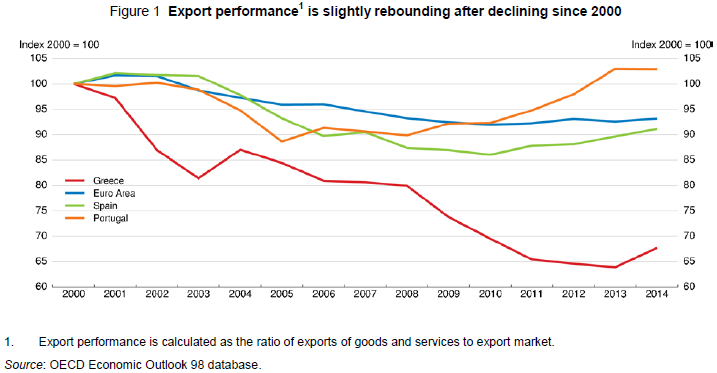
With weak domestic demand and a relatively low export share in the economy there is much potential to raise exports. Despite a recent pick-up Greek export performance deteriorated in the last decade particularly in the service sector and by much more than in the Euro area on average (Figure 1).

DLM Greece fig 1

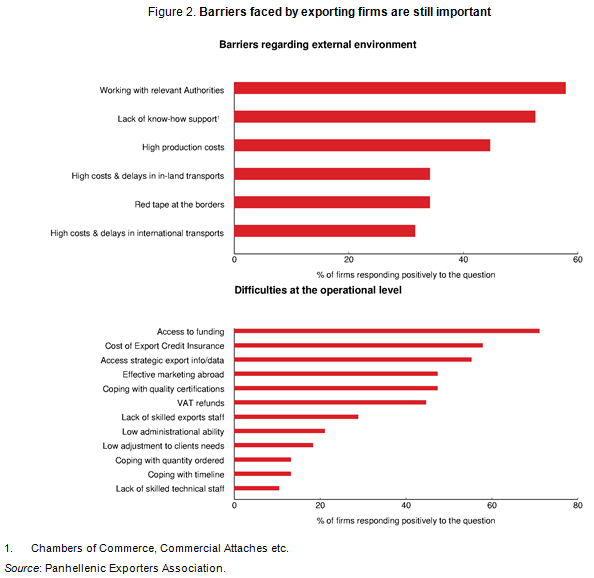
The decline in unit labour costs since 2010 has restored cost competitiveness, but the response of exports has been sluggish due to severe liquidity constraints and lagged price adjustment. While some of the decline reflects drops in oil prices and world shipping demand, structural problems in product markets, barriers to exporting, access to finance and administrative burden affect competitiveness and export performance (Figure 2).

DLM Greece fig 2

Export performance is also affected by low integration in global value chains (GVCs). The small size of the manufacturing sector, low FDI flows, inefficient infrastructure and dominance of small and informal enterprises have contributed to a low technology content of  goods exports  and make integration difficult (Bank of Greece).

Competitiveness and exports can be boosted by policy reforms. Policies that create a business environment where firms can easily enter (and exit) the market and young high-performing firms can thrive and grow are particularly important. Increasing the efficiency of the judiciary system is important to improving the business environment as it reduces uncertainties and transaction costs. The implementation of a ‘national single window’ for exports, as foreseen by the National Trade Facilitation Strategy (NTFS) for Greece, would act as a one-stop shop, specifically for export procedures and is expected to significantly alleviate the high cost and long time periods involved in exports. This would help competitiveness. Liberalising further product markets and better bankruptcy procedures would also help SMEs grow.

Improving investment in human and knowledge-based capital would enhance integration in GVCs. This calls for more support to quality education and skills training. This will require improving the quality of teachers by linking teaching evaluation to effective professional development, making schools more autonomous and accountable and introducing a performance evaluation system for universities. Also innovation and investment in ICT would enable product differentiation and gains in market shares. For instance, only around 10% of Greek firms sell via e‑commerce compared to 21% in OECD countries on average.

As many services particularly related to R&D, product design and development are inputs to export products, it is important to reduce inefficiencies in input markets. Further liberalisation in regulated professions such as engineers would boost high-technology goods exports.  The quality of transport infrastructure could also be improved. The gap is particularly important for railroad and, albeit to a lesser extent, road infrastructure. Reforms have been put in place to enhance the weak transportation sector, but there is still considerable scope for developing port activities as a gateway to the land transportation network, not just for Greece but for the entire region. Boosting investment in logistics should continue. One way forward would be to make better use of public land through concessions or privatisations to facilitate investment in logistics and infrastructure.


References

De la Maisonneuve, Christine (2016), How to Boost Export Performance in Greece, OECD Economics Department Working Paper no. 1299.

OECD (2016), Economic Surveys: Greece 2016, OECD Publishing, Paris.

OECD Economic Outlook 98 Database


Structural reforms for more inclusive growth in Greece

by Christian Daude, Senior Economist, Office of the Chief Economist, OECD Economics Department (former head of the Greek Desk)

The Greek economy is turning around lately, but it remains in a deep depression. GDP has fallen by more than a quarter between 2007 and 2015, unemployment remains extremely high at 25 percent and anchored poverty – which measures poverty relative to its pre-crisis income level – has nearly tripled between 2007 and 2014, reaching a third of the population. According to our latest OECD Economic Outlook, growth in 2016 will be slightly negative (-0.2%) and pick up to 1.9% in 2017. Unemployment will remain high and wage growth muted.

If the upcoming negotiations with its European creditors reduce Greece’s debt burden, greater confidence and less fiscal headwinds would support investment and a stronger cyclical recovery.  However, policy makers in Greece cannot rely only on a cyclical rebound if they want to overcome the profound costs of the crisis and provide better lives for their citizens.  OECD estimates show that the prolonged depression has reduced the long-term potential growth of the Greek economy by 2 percentage points. This means that without reforms to raise investment and productivity it would be extremely difficult to achieve pre-crisis living standards in a reasonable timeframe. More importantly, unemployment would remain at very high levels, as long unemployment spells have led to significant scarring effects in the labour market (OECD, 2016).

In a recent paper, we show that Greece has implemented significant labour market reforms, but less progress has been achieved on reducing oligopoly power, on simplifying the regulatory burden and on addressing weaknesses in the public administration, due to administrative capacity constraints, weak ownership of past reform programmes and vested interests. Our estimates show that changing the mix of structural reforms towards raising competition in product markets and improving general framework conditions for doing business, could boost GDP by around 13% over the next decade if implemented fully.

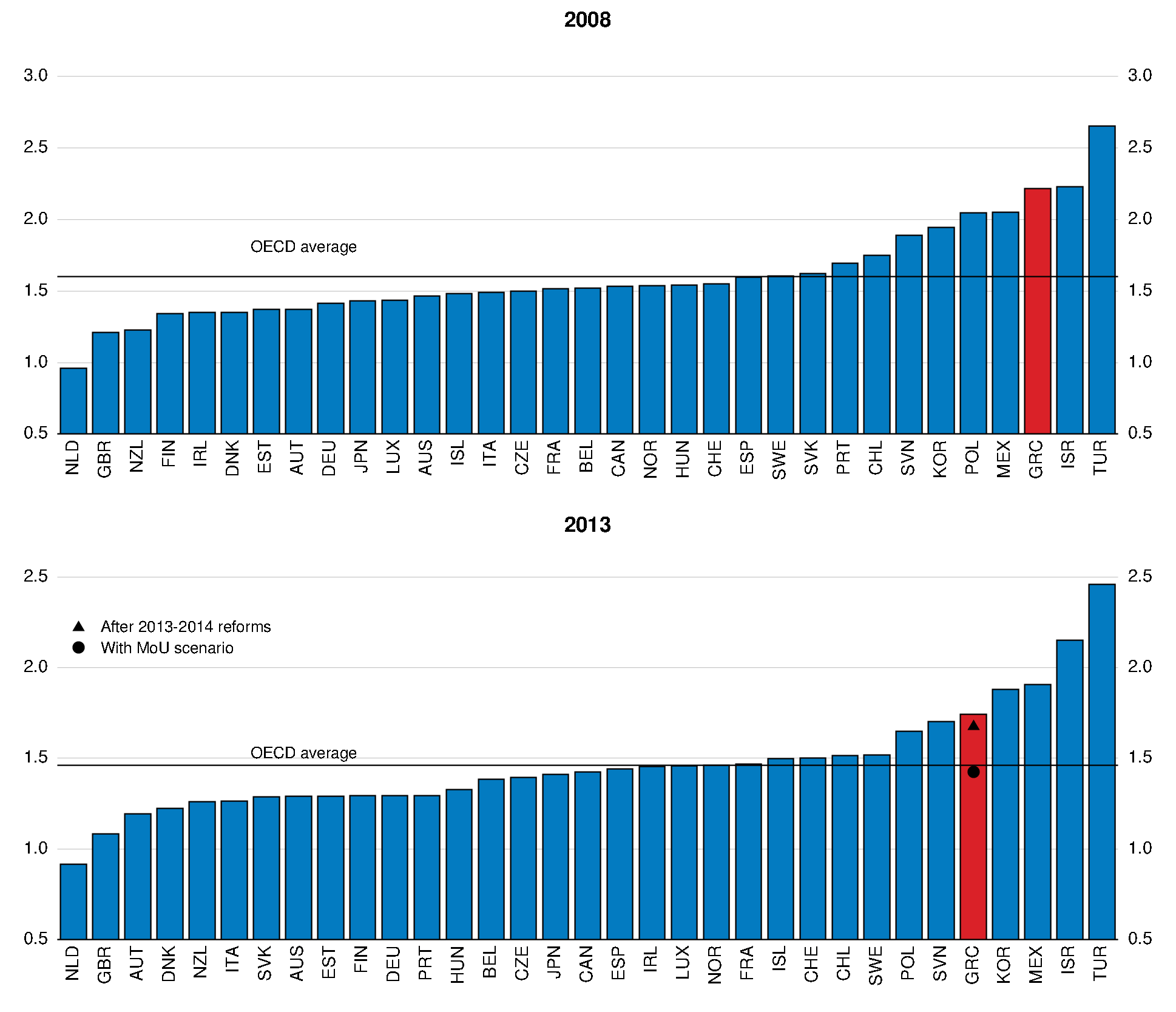
Figure: Product market regulation index

Index scale 0 – 6 (least to most restrictive)

Greece struc refm

Note: The MoU scenario represents the estimated level of the PMR index under full implementation of product market reforms included in the Memorandum of Understanding of the August 2015 ESM agreement. See Daude (2016) for details.
Source: OECD (2015) Product Market Regulation database and OECD calculations.

Further product market reforms are crucial to increasing productivity and getting investment started again. Although reforms so far have moved Greece close the OECD average in restrictiveness of product markets, there is still significant room for improvement, even if the current memorandum of understanding (MoU) is fully implemented. Regulations in network sectors remain restrictive. In particular, in rail and road transport, as well as electricity and gas, a combination of public ownership, barriers to entry and a significant vertical integration create relatively high costs that undermine the competitiveness of the rest of the economy.

At the same time, reforms that improve the business climate, the functioning of the judiciary, tax administration and the overall effectiveness of the public administration are needed. The OECD is currently working together with the Greek government on several of the reforms needed. The challenges are significant, but a more balanced reform package and better implementation could not only contribute to a more inclusive recovery but also create stronger public support for reforms and greater ownership to modernise the Greek economy.

References

Daude, C. (2016), “Structural reforms to boost inclusive growth in Greece,” OECD Economics Department Working Papers, No. 1303, OECD Publishing, Paris.

OECD (2016), Economic Surveys: Greece 2016, OECD Publishing, Paris.

OECD (2016), OECD Economic Outlook, OECD Publishing, Paris