Charting a course for Australia’s future: navigating the seas of ageing, climate transition and gender equality

Alvaro Leandro and Ben Westmore, OECD Economics Department

The Australian economy rebounded robustly in the wake of the pandemic. However, supply constraints coupled with rising global energy prices sent inflation to its highest level since the early 1990’s, prompting a significant tightening of monetary policy. Subdued economic growth is projected over the coming years, as higher interest rates and cost of living pressures dampen spending.

In the medium term, external forces loom large over the economic outlook. As an economy that benefits significantly from foreign commodity demand, rising geopolitical tensions and global fragmentation are a risk to national income. The global climate transition will impact the economy, both through the influence on demand for Australian fossil fuel exports and the reshaping of domestic industry in line with net zero commitments. At the same time, the ageing demographics will lower the share of the working age population and lead to structural changes throughout the economy.

Addressing fiscal challenges

In anticipation of the challenges ahead, fiscal buffers need to be rebuilt. Australia’s public debt ratio remains in the lower half among OECD countries, but it has risen substantially for both the federal and several state governments over the past decade. The demographic and climate transitions will create further spending pressures and require improved mechanisms for fiscal dialogue across levels of government.

Spending and tax reforms can help address rising fiscal costs. Encouraging more patient care in primary care settings and greater emphasis on preventive health policies would reduce public spending growth as the population ages. Revenues could be raised through reducing exemptions in the goods and services tax base and further limiting tax concessions on private pensions.

Facilitating labour force and business sector adaptation

Amid ongoing structural change, policies need to promote an adaptable labour force and business sector. A concerning trend has been the slowdown in GDP per capita growth in Australia: whereas Australia used to outperform OECD counterparts, GDP per capita growth has been comparatively weak through the past decade (Figure below).

Trend GDP per capita growth has slowed

GDP per capita growth, average rate


Made with Flourish

Source: OECD Growth in GDP per capita, productivity and ULC Dataset.

Immigration will be key for supporting labour supply, but the composition of the skilled migrant intake needs to be more responsive to changes in the skill needs of industry. In parallel, school reforms could improve the foundational skill base. Straightforward measures such as providing all teachers with access to high-quality curriculum resources would allow them to focus on activities where they add most value, helping address declining standardised test scores of Australian students.

As the economy adjusts, greater flexibility in land zoning systems would improve the ability of new businesses to enter new markets and grow in desirable locations. Competition policies can also support healthy competitive dynamics in the business sector, despite Australia’s geographic distance from foreign markets. The authorities have commenced a broad competition policy review, which should consider more closely aligning the merger regime with other OECD countries.

Improving gender equality

Achieving further improvements in gender equality is also a key priority. In addition to being a fundamental human right, improving gender equality would support fuller participation of women in the labour force as the population ages. A significant gender gap in labour income remains, despite recent progress (Figure below). This results from differences in employment rates between men and women (employment gap), the intensity of work (hours gap) and the amount workers are paid per hour (hourly wage gap).

The gender gaps in income persist


Made with Flourish

Note: The gender gap is defined as the labour income of men-women.
Source: The Household, Income and Labour Dynamics in Australia Survey, OECD calculations.

A key factor is high marginal effective tax rates when increasing work hours for low earners, due to the loss of benefits as earned income rises. This is especially the case for single parents, who are disproportionately women, and should be remedied by reducing the speed of benefit withdrawal as earnings increase.

Additional improvements to parental leave and childcare arrangements would support mothers staying in work and labour market re-entry after childbirth. Parental leave duration and the rate at which it is paid is low by OECD standards, while out-of-pocket childcare costs are relatively high, especially for low-income households.

Achieving the climate transition

The authorities are committed to achieving net zero emissions by 2050, a significant challenge given a historical reliance on coal generation and the presence of large mining and agriculture sectors (Figure 3). This will require a rapid transformation of the electricity grid and significant emission reductions in highly-polluting sectors such as industry and transport.

Large emissions reductions are needed

Source: Department of Climate Change, Energy, the Environment and Water.

Given the energy sector’s central role in the climate transition, the government should stand ready to provide further policy support and accelerate the planning and implementation of renewable energy projects to ensure that the renewable energy target of 82% by 2030 is met.

In the industrial sector, welcome reforms to the Safeguard Mechanism, which sets limits on the emissions of industrial facilities, have the potential to deliver significant emission reductions. Regular reviews of the mechanism are planned and should consider design changes if emission reduction targets are not met, such as switching from baselines based on emissions intensity to limits on total emissions.

Based on current policies, transport is projected to become the largest source of emissions in Australia by 2035. Introducing stringent fuel economy standards would help curb emissions in the sector, and these should be progressively tightened to zero emissions by 2035. Existing fuel tax exemptions for heavy and off-road vehicles should also be reconsidered.

Climate adaptation also needs to be a focus given Australia’s high exposure to climate-related hazards such as wildfires, extreme heat, and heavy rainfall. Adapting to climate change will require substantial investment and careful planning. Mandatory disclosure of climate-related risks in certain cases such as the sale of property can help raise awareness and encourage more effective adaptation. In addition, incorporating climate hazard considerations in land-use planning will help reduce risks by limiting development in more hazard-prone areas and mandating specific risk-prevention measures for new and existing constructions.

References
OECD Economic Surveys: Australia 2023, OECD Publishing

https://doi.org/10.1787/1794a7c9-en


Tackling tightness in the Dutch labour market

Labour-saving innovation alone is unlikely to reduce overall labour demand. To lift supply, childcare, immigration, and adult training need an overhaul.

By Daniela Glocker and Nicolas Gonne, OECD Economics Department

The Netherlands has a very strong labour market. The employment rate is one of the highest in the OECD, while unemployment is low. Workers are paid well on average and experience significantly less job strain than in many other OECD countries. This contributes to making the Netherlands a country with a high reported life satisfaction.

But the Dutch labour market is also very tight. Job openings are plenty and available workers are scarce (Figure 1). Pervasive labour shortages across occupations and regions prevent businesses from operating at their desired production level. Shortages are reported in many OECD countries, reflecting the unprecedented speed of the post-pandemic recovery. However, labour market tightness is structural in the Netherlands: the number of people available for work, either unemployed or inactive, has declined steadily in recent years.

Figure 1. Dutch labour market tightness predates the pandemic

Labour market tightness
vacancies per 100 unemployed

Note: OECD (resp. EA17) average based on 23 (resp. 17) countries for which data are available.
Source: OECD Labour Market Statistics (database); Eurostat Job Vacancy Statistics.

Lifting labour supply to tackle tightness is urgent in the Netherlands: not only do enduring shortages generate wage inflation, but they also hold back the green and digital transitions, weighing on potential growth. In complement to raising productivity, the latest Economic Survey of the Netherlands identifies areas for policy reform that together have the potential to increase labour supply.

Strengthening incentives to work full time

More than a third of employees work fewer than 30 hours per week in the Netherlands, by far the highest incidence of part-time work in the OECD, with a particularly unequal distribution between genders. The system of taxes and benefits implicitly promotes the “one-and-a-half earner model” (Figure 2, Left), whereby one partner (often a man) works full-time and the second earner (often a woman) works relatively few hours. Expensive or unavailable childcare weighs on incentives to work more (Figure 2, Right), as looking after a child is the main reason for part-time employment in the Netherlands.

Figure 2. Stronger incentives on moving to full-time employment and more affordable childcare would increase labour supply

Note: LHS refers to second earners with two children. (more details). Source: OECD Benefits, Taxes and Wages (database); OECD Social and Welfare Statistics (database).

Reducing work disincentives arising from childcare, school hours, and leave arrangements is a necessary complement to the steady reduction in the effective tax rate on moving to full-time employment. The planned reform to make childcare free for all working parents is expected to worsen staff shortages in childcare facilities, raising doubts about feasibility. Phasing in the reform gradually, monitoring access and evaluating the repeal of the link between hours worked and the amount of the childcare support would help.

Realising the potential of migration

While labour market participation overall is high, the gap between the native-born and the foreign-born is the largest in the OECD (Figure 3), especially for migrants from outside of the European Union. Most highly educated foreign-born work in jobs that require a lower level of formal education than what they hold or are not in employment. Moreover, the immigration system is not responsive to labour market needs, and no migration scheme exists for medium-skill workers, despite their importance for the green transition.

Figure 3. Better migrant integration could attenuate labour shortages in some occupations


Made with Flourish

Source: OECD Migration Statistics (database).

Streamlining and accelerating the processes of recognition and validation of qualifications acquired abroad for shortage skills would improve employment outcomes for underemployed groups and partially address labour shortages. Repealing labour market tests, whereby employers are required to search for applicants from the Netherlands or other EU countries before turning to non-EU migrants, would increase supply for the middle-skill segment of the labour market and for occupations related to the low-carbon transition.

Promoting a culture of lifelong learning

Training needs are important in the Netherlands, given the massive number of new jobs that will be necessary for the low-carbon transition and the continued digitalisation of the economy. Yet, the country only allocates a relatively little share of active labour market policy spending to training (Figure 3). In a first approximation, a threefold increase in public spending on training is necessary to achieve the required reskilling and upskilling. Moreover, concerns have surfaced regarding the quality and relevance of some trainings subsidised under the recently discontinued individual learning scheme STAP.

Figure 4. Higher spending on quality public training would promote growth in expanding industries


Made with Flourish

Source: OECD Statistics on Labour Market Programmes (database).

Major scaling-up and stronger incentives for co-financing by employers are needed to deliver on the stated objective of promoting a new culture of lifelong learning. Focusing expenditure on adult learning related to occupations where shortages are the most pressing would reduce the overall fiscal cost and better channel labour towards the tightest segments of the labour market. More emphasis should be placed on ensuring that providers maintain training quality, including renewing providers’ accreditation regularly, assessing the outcomes of education activities, and ensuring that the ensuing information is transparent and publicly available.

References

Borowiecki M., J. Pareliussen and D. Glocker (2021), “Chasing the frontier: Digitalisation for stronger productivity in the Netherlands”, OECD Economics Department Working Papers, No. 1680, OECD Publishing, Paris, https://doi.org/10.1787/e800ee1d-en

Abendschein M., O. Causa, N. Luu, E. Soldani and C. Soriolo (2022), “The post-COVID-19 rise in labour shortages”, OECD Economics Department Working Papers, No. 1721, OECD Publishing, Paris, https://doi.org/10.1787/e60c2d1c-en.

Gonne N. (2023), “Lifting labour supply to tackle tightness in the Netherlands”, OECD Economics Department Working Papers, OECD Publishing, Paris, forthcoming.


In Tax, Gender Blind is not Gender Neutral: why tax policy responses to COVID-19 must consider women

by Michelle Harding, Grace Perez-Navarro, and Hannah Simon, OECD Centre for Tax Policy and Administration (CTPA)

Women are at the core of the fight against the COVID-19 crisis: they make up the vast majority of healthcare workers and shoulder much of the childcare and home schooling burden during lockdowns. And while tax policy measures play a crucial role in supporting individuals and businesses as we navigate this crisis, the gender impact of taxation is often overlooked – with serious consequences for gender equality.

Gender equality is a fundamental human right, as laid out in the UN’s Sustainable Development Goal #5, and failing to achieve it costs us up to 16% of world income every year. Yet, in the context of government revenue collection, gender balance is often neglected as a policy rationale. Could it be that there simply is no need to assess the interaction of tax and gender, or have gender imbalances in tax systems so far been overlooked? And what does this mean for policy-makers in the face of Covid-19?

Gender blind or gender neutral?

The good news first: tax provisions that explicitly disadvantage women relative to men are rare, although they used to be more common. Historically, married men in the Netherlands for example, were granted a higher income tax-free allowance than married women (until 1984). Meanwhile, on the Island of Jersey, married women will continue to need their husbands’ permission to talk to tax authorities and to file taxes under their own name until a new law comes into force in 2021.

While examples of explicit bias are rare, this does not mean that our tax systems do not affect men and women differently. Tax systems that are gender-blind on paper can, in practice, exhibit a hidden, implicit bias and may even exacerbate gender inequalities, particularly in times of crises. As long as men and women face different socioeconomic realities, tax systems will affect them in different ways. Therefore, it is necessary to go beyond a cursory analysis of the tax law and to understand how it interacts with the different socioeconomic realities of men and women – such as persisting gender gaps in income levels, labour-force participation, consumption, entrepreneurship and wealth.

The hidden impacts of taxation are most visible in personal income taxation. Although men and women are typically taxed under the same rules, their different income levels and labour force participation characteristics mean that the impact of the tax system can be far from neutral.

In more than two-thirds of OECD countries, second-earners face a disproportionately high tax burden when entering the workforce. Compared to a single worker at the same level of income, second earners face higher average tax rates, meaning that, due to family-based taxation and reductions in dependent spouse credits, their household income increases less for every dollar earned. In the nine OECD countries with family-based taxation, the net personal average tax rate of second earners is 40%, meaning that they take home only 60% of their gross wage – seven percentage points less than a single individual at the same wage level.

This – alongside various other factors that influence the decision of individuals to enter (or re-enter) the workforce, such as educational level or the availability of childcare – reduces the incentives for second earners to work. And given that a large majority of second earners are female, it is mostly women that face this disincentive.

Add consumption taxes to the picture and this disincentive is exacerbated. Consumption taxes on services such as cleaning and childcare make it more attractive to produce these services at home rather than buying them on the market, especially for low-income households. This further decreases the (predominantly female) second-earner labour supply. Consumption taxes can also directly affect the distribution of income between men and women due to gendered differences in consumption patterns, but these are harder to infer.

COVID-19 amplifies these dynamics by increasing women’s unpaid work burdens and by destabilizing the labour market. Widespread closure of schools and childcare facilities and other confinement measures will increase the time that parents have to spend on childcare and home schooling as well as on routine housework such as shopping, cooking and cleaning – much of which is likely to fall on women. Fulfilling these demands will be difficult for many parents, especially for dual-earner households, which increases the risk of second-earner women to leave the workforce.

In addition, men and women typically exhibit differences in employment patterns: in OECD countries, men are overrepresented among the self-employed, while female employees are, on average, almost three times more likely to work part-time. These non-standard workers are among the most vulnerable during the current crisis, facing higher risks of job or income loss, and often fall outside of standard safety nets. This makes fair taxation of different employment forms as well as increased access to out-of-work benefits for non-standard workers – which some countries have temporarily introduced in response to the current crisis – a key dimension of gender balance.

In developing countries, the challenge is magnified by large degrees of informality and limited fiscal space. With the majority of female workers in informal employment, lockdown measures and the resulting economic hardship pose an acute threat to women’s livelihoods, and a focus on officially labeled taxes does not fully capture the complex linkages between gender and taxation. User fees and informal taxes, often used to finance basic goods such as education, healthcare and water, can impose a significant financial burden on households and can discourage low-income individuals from accessing healthcare, which is particularly problematic in the midst of a pandemic.

During the Ebola epidemic in West Africa, donor money shifted to the most urgent humanitarian and public health needs and away from financing local public goods and services, such as schools, teachers and water wells. A similar shift in donor money during the current crisis would increase the financial burden on individuals and communities in funding these goods and services, which is likely to reinforce unequal societal practices: if schooling is too costly, girls are the first to stay home, particularly during times of extreme economic hardship.

“This is not the last pandemic we’re going to have”, said Ngozi Okonjo-Iweala, who previously served as Nigeria’s minister for both finance and foreign affairs and is one of the governing board members of the OECD-UNDP TIWB programme. “We had better make sure that those at the bottom of the ladder are not pushed further back. That inequality is not exacerbated”, she added in a recent interview with TIMES.

How can governments address gender differences in their tax systems?

Government spending programmes and tax policy measures play a central role in supporting individuals and businesses as we navigate and exit this crisis. However, as the Finnish Prime Minister Sanna Marin said at the World Economic Forum in Davos earlier this year, gender equality “just doesn’t happen by itself”.

To ensure that the tax system does not inadvertently reinforce gender biases in society, governments need to include the impact of taxes on gender as a key policy dimension in their tax policy responses to COVID-19. Improving data on the impact of COVID-19 on women as well as on previously unexplored dimensions such as intra-household dynamics, asset ownership and corporate participation will be crucial to understand these impacts.

To address the complex interactions of tax and gender, governments will need to consider options to redesign key taxes to avoid exacerbating existing gender differences, or use tax or other instruments to compensate for differences in income levels as part of their long-term response to the crisis. When it comes to tax and gender, let’s #BuildBackBetter!

For more information, please see:

Milanez, A. and B. Bratta (2019), Taxation and the future of work: How tax systems influence choice of employment form, OECD Taxation Working Papers, No. 41, OECD Publishing, Paris.

OECD (2020a), Emergency tax policy responses to the Covid-19 pandemic, Updated 20 March, OECD, Paris.

OECD (2020b), Tax and Fiscal Policy in Response to the Coronavirus Crisis: Strengthening Confidence and Resilience, OECD, Paris.

OECD (2020c), Women at the core of the fight against COVID-19 crisis, OECD, Paris.

Saint-Amans, P. (2020), Tax in the time of COVID-19, 23 March 2020 on The Forum Network


How’s Life for Women in the Digital Age?

by Fabrice Murtin, OECD Statistics and Data Directorate

How does the digital transformation affect women’s and men’s well-being? Digital technologies are radically and rapidly changing the way people work, consume, get information and communicate, but their consequences may differ for women and men. Statistics can help understand whether and how the transformation risks widening the gender gap. This Statistical Insight previews some of the evidence from How’s Life in the Digital Age?(OECD, 2019), which provides a comprehensive overview of how the digital transformation is impacting women and men’s lives.

The digital transformation
creates gender gaps in some dimensions of well-being, but the overall impacts
on women and men are balanced

The digital transformation
doesn’t just affect ICT access and usage. 
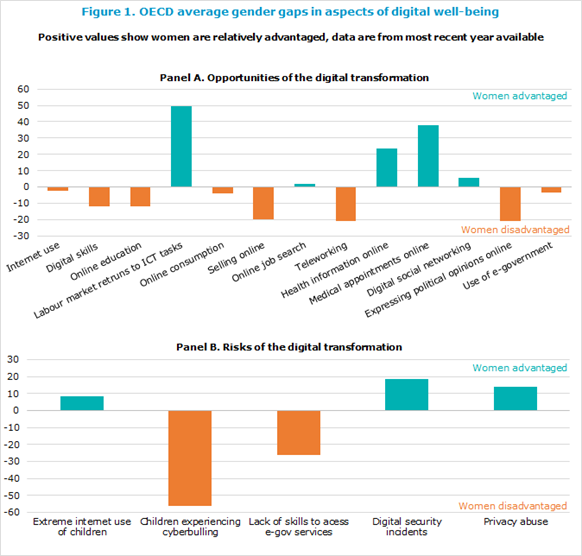
In reality, it entails both opportunities (see Figure 1 Panel A) and
risks (Panel B) that affect all the dimensions covered in How’s Life?, the OECD flagship report on people’s well-being. 

Overall, Figure 1 suggests that
the digital transformation has mixed effects on women relative to men, with
women outperforming men on 8 of the 18 indicators. Compared to men, they make
greater use of the internet for health purposes (making medical appointments
online, seeking health information) and when searching for a job or for social
networking. Women also obtain much larger labour market returns for their
digital skills (as measured by ICT task-intensity of jobs), and are also much
less likely to experience security incidents, abuse of personal information and
digital addiction during childhood. 

On the other hand, girls are much more likely to be victimised through cyberbullying than boys, and more women than men report that they lack the skills to use e-government services. Similarly, women use online education facilities less than men. They are also less likely to use the internet to buy or sell goods and services, or to express their political opinion. Teleworking is also much less used by women than by men.

Overall, while the digital transformation is affecting
the well-being of women and men in broadly similar ways, significant gender
gaps are emerging in some specific dimensions of education, work-life balance,
health, social connections, governance and digital security. Two specific
examples are highlighted below.

Girls are more exposed than boys to
cyberbullying

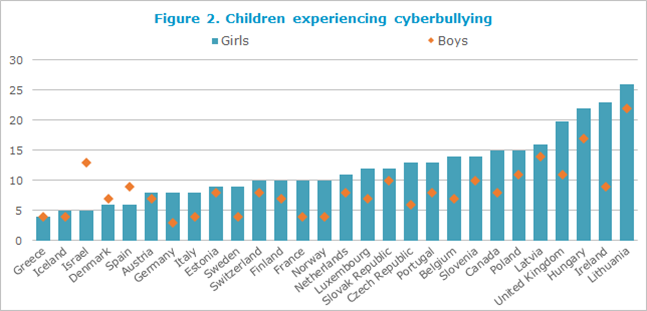
The link between cyberbullying and mental health problems has been extensively documented (Lindert, 2017). On average, across OECD countries with available data, about 12% of girls report having been cyberbullied, compared to 8% for boys. Girls report victimisation more often than boys in all countries except Denmark, Israel and Spain. Cyberbullying is particularly prevalent in a number of Eastern European countries as well as in Ireland and the United Kingdom. Conversely, children in Greece and Iceland report relatively few instances of cyberbullying.

Note: Cyberbullying is measured as the share of girls and boys aged 15 who report having been cyberbullied by electronic messages at least once in their life. For the United States, self-reported cyberbullying covers a wider range of experiences, including being the subject of hurtful information online, having private information shared online, and cyberbullying while gaming. Data refer to 2013 for the United States, and to 2014 for other countries. Source:  OECD calculations based on the 2014 Health Behaviour in School-Aged Children Study (www.hbsc.org/news/index.aspx?ni=3473) and the 2013 United States School Crime Supplement of the National Crime Victimization Survey (www.icpsr.umich.edu/icpsrweb/NACJD/studies/34980).

Women telework less
than men

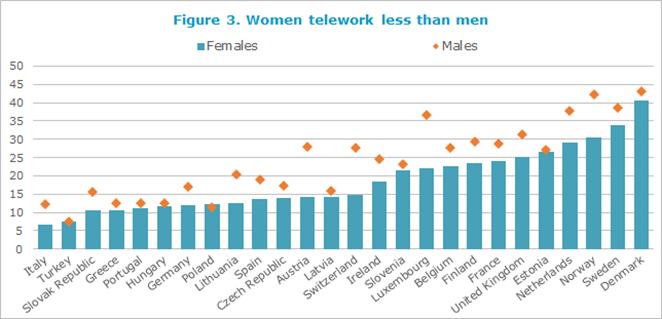
Teleworking provides an opportunity for better work-life balance when it improves time management and reduces the time spent in commuting. Evidence from the American Time Use Survey shows, for instance, that reducing commuting time by using the Internet increases labour force participation in the United States, in particular among married women (Dettling, 2016). However, women do not seem to have equal access to teleworking.  On average, 20% of male workers reported having teleworked at least once, compared to 16% of women. The gender gap was widest in Luxembourg, Austria, Switzerland and Norway, but very small in Estonia, Hungary and Poland.

Note: Teleworking is measured as the share of workers who report using ICTs at work at least 75% of the time and having worked outside the employer’s premises at least once; in the case of the United States, the survey question asks workers if they have ever worked from their home using a computer to communicate for their job.
Source: OECD calculations based on the Gallup World Poll (www.gallup.com/services/170945/world-poll.aspx).

The measure explained

The new OECD publication
How’s Life in the Digital Age?
uses the OECD How’s Life? framework to assess the impacts of the digital
transformation on 11 key dimensions of people’s well-being (Income and
wealth, Jobs and earnings, Housing, Health status, Education and skills,
Work-life balance, Civic engagement and governance, Social connections,
Environmental quality, Personal security and Subjective well-being). ICT access
and use is also included as a cross-cutting aspect of the digital
transformation. Drawing on a large number of existing studies, How’s Life in the Digital Age? shows positive
impacts of the digital transformation when new technologies expand the range of
available information and enhance human productivity and well-being, but also
highlights risks ranging from cyber-bullying to overuse or cyber-hacking. It is
based on 33 key indicators of the impacts of the digital transformation –
20 to measure digital opportunities and 13 to reflect digital risks.

Among the 18 indicators that allow for a gender breakdown, 13 refer to opportunities and 5 to risks. Altogether they span 9 dimensions of people’s well-being, i.e. ICT access and usage, Education and skills, Income and wealth, Jobs and earnings, Work-life balance, Health status, Social connections, Governance and civic engagement, and Digital security.

For more reading

  • OECD (2019), How’s
    Life in the Digital Age?: Opportunities and Risks of the Digital
    Transformation for People’s Well-being
    , OECD Publishing, Paris,https://doi.org/10.1787/9789264311800-en.
  • J Lindert; Cyber-bullying and it its impact on mental health:
    Jutta Lindert, European
    Journal of Public Health
    , Volume 27, Issue suppl_3, 1 November
    2017, ckx187.581, https://doi.org/10.1093/eurpub/ckx187.581
  • Dettling, L. J. (2017). Broadband in the Labor Market: The Impact
    of Residential High-Speed Internet on Married Women’s Labor Force
    Participation. ILR
    Review
    70(2),
    451–482. https://doi.org/10.1177/0019793916644721


Delivering on the promise of better outcomes for Canadian women

by Andrew Barker, Canada Desk, OECD Economics Department

The current Canadian government has declared itself feminist and has taken a number of steps to improve labour market outcomes for women. This includes increased funding for early learning and child care and improving equality of parental leave by introducing five weeks of leave for the second parent (generally fathers) on a take it or lose it basis. In terms of employment and labour force participation, Canadian women do much better than the OECD average.

However, there remains a sizeable gap in earnings between Canadian men and women (Figure 1).

Canadawomenblog 2018

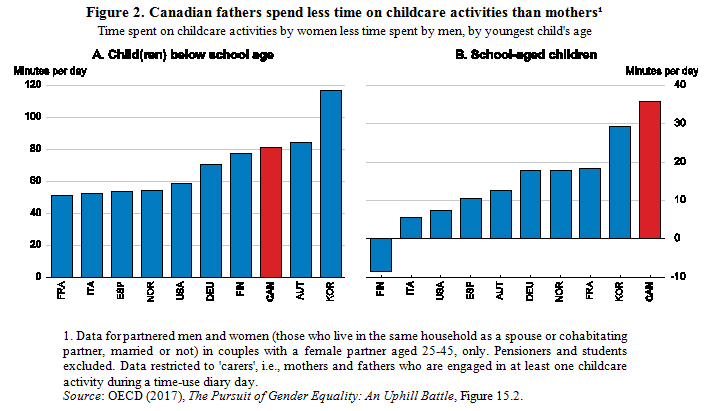
The earnings gap is particularly large for women with children, in part explained by fewer years of work experience and more hours devoted to unpaid work (Figure 2). This might be fine if it was the result of personal choices on how to split paid and unpaid work between couples, but international survey evidence indicates that women would like to work more and, within Canada, comparison with Quebec – where women have for many years enjoyed affordable child care and more equitable division of parental leave – indicates that Canadian women would choose to work more if given access to more family-friendly policy support.

Canadawomenblog2 2018

An important step in this regard is to make sure that new fathers use the additional leave that they are now entitled to. Governments need to work with businesses and lead by example to create a culture where men are encouraged to take leave to look after their young children. Payment rates for parental leave may need to be adjusted if take-up remains low, as it has in some other OECD countries with low payment rates.

Improving access to high-quality, affordable early childhood education and care (ECEC) is the best way to improve labour market outcomes for Canadian women. Canada stands out among OECD countries for the high cost of childcare (in the comparison province of Ontario, at least) and the low share of Canadian youth who have attended ECEC for two years or more. Affordable and high quality ECEC can address barriers to mothers’ labour force participation, reduce the motherhood wage penalty and support child development, particularly for disadvantaged children. While there are upfront fiscal costs, these are offset over a longer period through women’s higher participation and productivity. Women’s productivity, and thus incomes, would also be assisted by further steps to promote female entrepreneurship and to boost women’s representation in senior management, computing and engineering.

References:

OECD (2018), OECD Economic Surveys: Canada 2018,  OECD Publishing, Paris.


Sweden is a champion of gender equality, but parity is not reached yet

by Christophe André, Swedish Desk, Country Studies Branch, OECD Economics Department

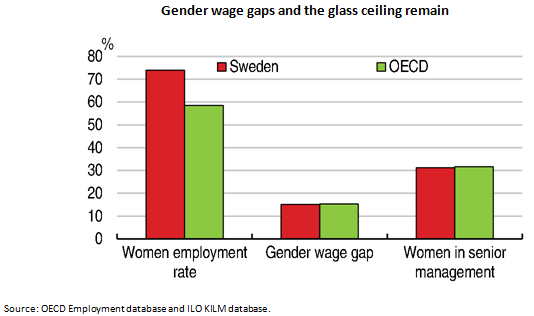
As shown in the Economic Survey, Sweden ranks among the OECD’s frontrunners in terms of gender equality. Women have a high employment rate, outperform men in education and are well represented in government and parliament. These achievements were made possible by policies which for decades have been promoting equality, notably through childcare and parental leave arrangements, individual taxation and mainstreaming gender issues.

Nevertheless, without further policy measures, achieving parity is still a distant prospect in several areas. Wage differences between genders persist, even though a large part of the gap results from differences in age, education, occupation, sector of employment and hours worked. Women are under-represented on private company boards, in senior management positions, in many well-paid and influential professions and among entrepreneurs.

blog-gender-wage-gaps

Hence, there is scope for further progress on gender equality. Paid parental leave has facilitated the rise in women’s employment rate, which is now close to that of men. However, 75% of the leave is still taken by women, which has a detrimental impact on their careers. Last year’s extension of the share of the parental leave reserved for each parent to three months is a move in the right direction, as it sends a signal which will contribute to shift social norms. Nevertheless, it would be desirable to move further in that direction to reduce the stigma associated with long leaves, even though there is a trade-off with the benefits of free choice.

The women’s share of board members of listed companies is still below one third. The recent government proposal to impose quotas, as Norway did more than a decade ago, has not received the necessary support from other parties. Notwithstanding, firms should continue to increase their share of female board members, and perhaps even more importantly, to increase the representation of women in senior management, which research shows to generally enhance economic performance. Gender inequalities can also be reduced through the fight against stereotypes in education and further promotion of women’s entrepreneurship.

Last but not least, special attention should also be paid to the integration of foreign-born women, whose employment rate is much lower than for their male counterparts. Helping foreign-born women to strengthen their contribution to the economy and society has to be a key ingredient of a more inclusive Sweden.

References:

OECD (2012), Closing the Gender Gap: Act Now, OECD Publishing. http://dx.doi.org/10.1787/9789264179370-en

OECD (2015), The ABC of Gender Equality in Education: Aptitude, Behaviour, Confidence, PISA, OECD Publishing. http://dx.doi.org/10.1787/9789264229945-en

OECD (2016), Working Together: Skills and Labour Market Integration of Immigrants and their Children in Sweden, OECD Publishing. http://dx.doi.org/10.1787/9789264257382-en

OECD (2017), OECD Economic Surveys: Sweden 2017, OECD Publishing, Paris.


Conquering utopia anew – Income inequality in Sweden

by Jon Pareliussen, Swedish Desk, Country Studies Branch, OECD Economics Department

“Equality is a utopia (…) that must be constantly redefined and constantly conquered anew.”

-Olof Palme, 30 July 1965.

Equality, a long-standing hallmark of Swedish society, carries multiple benefits in terms of economic performance, trust, opportunity and well-being. Income inequality is relatively low in Sweden compared to the OECD average, but a rapid rise from the 1990s calls for new efforts to redefine and re-conquer equality once again. Chapter one in the new Economic Survey is dedicated to understanding and addressing the rise of inequality in Sweden (OECD, 2017).

Top incomes grew strongly from the 1990s, mainly as a result of increasing capital gains and dividends, but the collection of wealth statistics was discontinued from 2007, which makes analysing the underlying causes challenging. In the bottom end of the income distribution, working-age benefits were cut or frozen following the economic crisis of the early 1990s. Decades of slow uprating led to a gradual decline of benefits relative to earnings. Analysing the distributional consequences of different uprating scenarios annually would highlight the consequences of inaction, but leave actual increases at the heart of political debate and decision-making, where it firmly belongs.

blog-fig-1-stagnating-sweden

Significant demographic and structural changes, with ageing, more single and single parent households, higher educational attainment, a shift away from manufacturing, and higher, mostly non-labour, immigration, are behind more than 40% of the increase in the Gini coefficient from 1987 to 2013 (Robling and Pareliussen, 2017). These trends increase the importance of redistribution and labour market policies as countermeasures.

One such trend is the increasing number of humanitarian and family reunion migrants, who have lower incomes than natives and less adequate housing. Furthermore, residential segregation leads to school segregation. With low skills compared to natives, partly as a result of lower education attainment, partly due to difficulties with language and culture, many struggle finding employment (OECD, 2015; Bussi and Pareliussen, 2015).  Relatively well-developed integration policies can be further harnessed by learning from successful experiences at the local level, continuing to individually adapt upskilling activities, shortening the time it takes to get residence and work permits, simplifying and consolidating wage subsidy schemes.

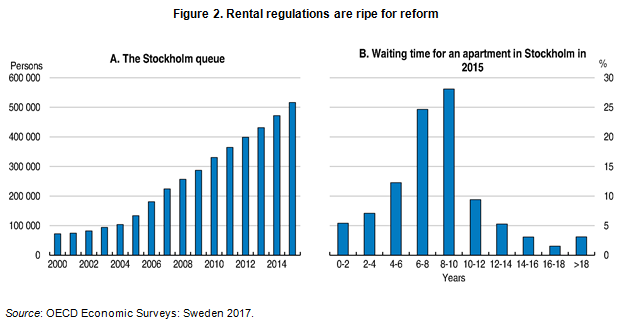
Finally, housing market inefficiencies hit the least well-off. The difference in housing conditions between the rich and the poor is high in Sweden. Tightening the generous tax treatment of owner-occupied housing would increase affordability. Easing strict rental regulations while maintaining tenant protection against abuse would increase mobility for those who cannot afford to buy, incentivise rental housing supply and lead to better utilisation of the housing stock. Some prioritisation to municipal housing with well-designed allocation rules could help low-income households and limit residential segregation.

blog-fig-2-rentals-in-sweden

References:

Bussi, M. and J. Pareliussen (2015), “Skills and labour market performance in Sweden”, OECD Economics Department Working Papers, No. 1233, OECD Publishing, Paris. http://dx.doi.org/10.1787/ 5js0cqvnzx9v-en.

OECD (2015), OECD Economic Surveys: Sweden 2015, OECD Publishing, Paris.
DOI: http://dx.doi.org/10.1787/eco_surveys-swe-2015-en.

OECD (2017), OECD Economic Surveys: Sweden 2017, OECD Publishing, Paris.
DOI: http://dx.doi.org/10.1787/eco_surveys-swe-2015-en.

Robling, P. and J. Pareliussen (2017), “Structural inequality – The case of Sweden”, OECD Economics Department Working Papers, forthcoming, OECD Publishing.