Doombot versus other machine-learning methods for evaluating recession risks in OECD countries

by Thomas Chalaux and David Turner

Predicting when a recession will hit is no easy task, and economists have long tried to make sense of a wide variety of financial and business cycle data from both domestic and international sources. The challenge of picking the right variables for each country and time frame, which can take on different functional forms, makes machine-learning methods especially useful.

Recent OECD research has compared traditional machine-learning models, including the popular LASSO (Least Absolute Shrinkage and Selection Operator), with a new algorithm the OECD researchers developed called “Doombot.” LASSO works by simplifying models, helping to improve their accuracy by limiting unnecessary variables. Doombot, however, takes a more exhaustive approach, testing a wide range of variables and placing restrictions to ensure its predictions better align with an overall economic story.

What data was used?

The OECD research tested several algorithms on data from 20 OECD countries, looking at how well they could predict recessions at different time frames, from immediate quarters to two years ahead. The most frequently picked data were financial indicators, such as credit, house prices, share prices and interest rates (like the yield curve slope). Economic activity data, like GDP and unemployment, were used more often for shorter-term forecasts. Notably, these predictors weren’t limited to each country’s domestic economy; international aggregations of the same variables played a significant role.

Doombot performs best on predictive accuracy 

When predicting rare events like recessions, it’s important to test models on data they haven’t seen before—this is called “out-of-sample” testing. This helps avoid overfitting, where a model looks good on historical data but performs poorly when making real-time predictions. Doombot outperformed the competition across multiple metrics when tested on OECD countries. In particular, it gave a clearer early warning of the 2008 Global Financial Crisis (GFC) than LASSO and other methods. By rolling forward predictions and comparing across different countries and timeframes, Doombot consistently ranked higher than other models.

Doombot tells a better economic story 

In addition to being more accurate, Doombot’s predictions align better with economic narratives. It uses fewer variables—typically less than three per equation—compared to LASSO, and its predictions are more consistent across countries. The signs on the variables (indicating whether a variable should increase or decrease recession risk) are in line with economic logic, which isn’t always the case with other algorithms. Furthermore, Doombot produces smoother recession probability forecasts, avoiding the erratic jumps seen in some other models. These features make it easier for economists to break down the drivers of recession risk and spot trends across different countries.

For example, ahead of the GFC, Doombot predicted a steady rise in recession risk for the United States, primarily driven by an inverted yield curve and falling stock prices (see Figure 1). In the longer term, declining house prices and rising oil prices also played a role. Similar patterns appeared in other countries, with house prices and credit developments standing out as key factors leading up to the GFC.

Figure 1. Contributions to predicted recession probabilities for the United States ahead of the GFC

Out-of-sample projections made with data available in early December 2007
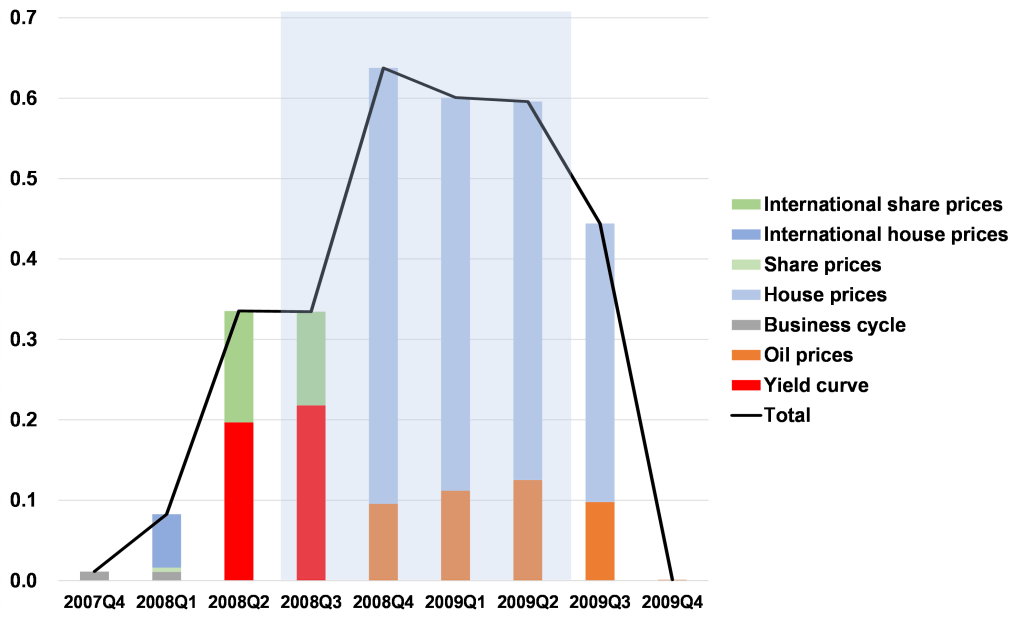
Note: This chart shows an approximate decomposition of the recession probabilities into the contribution from each explanatory variable. The predictions are made with the Doombot algorithm using data available in early December 2007. The United States was in recession from 2008 Q3 to 2009 Q2, corresponding to the shaded background area.

The benefits of combining accuracy with narrative 

The constraints imposed on the Doombot algorithm help to provide a more coherent economic narrative and so mitigate the common ‘black box’ criticism of machine-learning methods. Perhaps the most interesting and important finding from this work is that there is no trade-off between predictive performance and better story-telling, so that imposing judgmental constraints consistent with economic priors tends to improve rather than hinder the predictive performance of Doombot. This could have important implications for future machine-learning applications in economics.

References

Chalaux, T.  and D. Turner (2024) , “Doombot versus other machine-learning methods for evaluating recession risks in OECD countries”, OECD Economics Department Working Papers, No. 1821, OECD Publishing, https://www.oecd.org/en/publications/doombot-versus-other-machine-learning-methods-for-evaluating-recession-risks-in-oecd-countries_1a8c0a92-en.html


Doombot Recession Outlook

Doombot robot made of blocks

by Thomas Chalaux and Dave Turner, OECD Economics Department

Macroeconomic forecasters make their biggest errors because of a failure to predict future recessions.[1] The problems of predicting the timing of cyclical turning points or future shocks can, however, be mitigated by a prescient discussion of risks surrounding the central published forecast. For example, the recently published OECD Economic Outlook, warns “[T]he unusually fast and large-scale tightening of monetary policy … could continue to expose vulnerabilities among households, firms, financial market participants and countries”, so that “[O]verall, the risks to the projections remain skewed to the downside”. Recent work at the OECD attempts to take such risk assessments further by quantifying the probability of a future recession (Chalaux and Turner, 2023).

An algorithm, “DoomBot”, selects parsimonious models to predict recessions over different quarterly horizons covering the ensuing two years for 20 OECD countries. The models are country- and horizon-specific and are automatically updated as the estimation sample period is extended, so facilitating out-of-sample evaluation of the algorithm. A limited combination of explanatory variables is chosen from a much larger pool of potential variables that include those that have been most useful in predicting downturns in previous OECD work. The most frequently selected variables are financial variables, especially those relating to credit and house prices, but also include equity prices and various measures of interest rates (such as the slope of the yield curve). Business cycle variables — survey measure of capacity utilisation, industrial production, GDP and unemployment — are also selected, but more frequently at short horizons. The variables selected do not just relate to the domestic economy of the country being considered, but also international aggregates, consistent with findings from previous OECD work.

Looking at the performance of the algorithm over past episodes, the models provide a clear out-of-sample early warning of the Global Financial Crisis (Figure 1, LHS panel). The models are less good at predicting the euro area crisis out-of-sample, but it is clear from the evolution of the choice of variables that the algorithm learns from this episode, for example through the more frequent selection of a variable measuring euro area sovereign bond spreads.

Figure 1. Distribution of recession probabilities among 20 OECD countries

Comparing Doombot projections made in June 2008 and December 2023

Note: The box and whiskers chart shows the distribution of recession probabilities among a sample of 20 OECD countries according to out-of-sample probit model predictions made using the DoomBot algorithm. The LHS panel shows the out-of-sample predictions using information available at the time of the publication of the June 2008 Economic Outlook, whereas the RHS panel shows the current predictions made with the latest available data. The box shows the inter-quartile range for the 20 countries; the whiskers the extremes; the X is the simple average; and the horizontal bar is the median.

Recession risks to the current outlook

The latest Doombot predictions suggest that the probability of recessions among OECD countries is much lower than prior to the GFC (comparing RHS and LHS panels of Figure 1), although it still remains quite high in historical context, especially over the coming year and among European countries:

  • There are 5 European countries — Germany, France, Finland, Portugal and Sweden – where recession probabilities exceed 50% in two consecutive quarters over the next year and a further four —  the United Kingdom, Italy, Switzerland and Belgium — where they exceed 25%. The main driver in most of these cases is the turning of the house price cycle, often supplemented by weak signals from activity variables.

  • For Japan, recession risks for the first two quarters have risen above 25%, partly because of the rise in oil prices. Although oil prices enter into many other country risk models, Japan seems particularly vulnerable in this respect. For Canada, recession risks reach 25% in coming quarters driven by weak survey measures of capacity utilisation and a negative yield curve slope.

  • For the United States, risks of a recession in 2024 appear to be small; there is no warning signal from share prices or survey measures of capacity utilisation that usually pick up weakness at short horizons, and the slope of the yield curve (a popular signal of recession risks) has recently become less negative. The turning of the house price cycle suggests recession risks increase in 2025, although the models are less reliable at longer horizons.

References

An, Z., J. Jalles and P. Loungani (2018), “ How well do economists forecast recessions?”, IMF Working paper, WP/18/39.

Turner, D., T. Chalaux and H. Morgavi (2018), “Fan charts around GDP projections based on probit models of downturn risk“, OECD Economics Department Working Papers, No. 1521, OECD Publishing.

Chalaux, T.  and D. Turner (2023) , “Doombot: a machine learning algorithm for predicting downturns in OECD countries“, OECD Economics Department Working Papers, No. 1780, OECD Publishing.


[1] For discussion and evidence of the difficulties in forecasting recessions, see An et al., (2018) and Turner et al. (2018) as well as references therein.


No ordinary recovery

Laurence Boone | Economista-Chefe da OCDE
Laurence Boone,
OECD Chief Economist

Also available in Français | Español | Portugués | Deutsche

It is with some relief that we can see the economic outlook brightening, but with some discomfort that it is doing so in a very uneven way. Amid renewed virus outbreaks, less frequent but more dispersed throughout the world, global growth continues to recover. We are projecting global output to rise by nearly 6% this year, an impressive surge after the 3½ per cent contraction in 2020. While the recovery will bring most of the world back to pre-pandemic GDP levels by the end of 2022, this is far from enough. The global economy remains below its pre-pandemic growth path and in too many OECD countries living standards by the end of 2022 will not be back to the level expected before the pandemic.

Swift policy actions have paved the way for the health and economic recovery. Sixteen months into the pandemic, many countries are coping better with new outbreaks of the virus. Governments have administered close to 2 billion vaccine doses and the global capacity to test, produce and administer vaccines has improved rapidly. The unprecedented protective policy net that governments deployed has preserved the economic fabric, firms and jobs in most advanced and some emerging-market economies. Never in a crisis has policy support – be it health, with the record speed of vaccine development, monetary, fiscal or financial – been so swift and effective. As a result, the manufacturing sector is growing rapidly, merchandise trade is rebounding strongly as borders gradually reopen and travel is slowly resuming. Moreover, reopening is being accompanied by a surge in consumption and hours worked. This is very encouraging, as it should limit the scars that arise from the crisis.

Yet, too many headwinds persist.

It is very disturbing that not enough vaccines are reaching emerging and low-income economies. This is exposing these economies to a fundamental threat because they have less policy capacity to support activity than advanced economies. A renewed virus-driven weakening of growth would be harder to cushion, resulting in further increases in acute poverty and potentially sovereign funding issues if financial markets were to become concerned. This is all the more troubling because, notwithstanding the impact on lives and livelihoods, the global economic and social cost of maintaining closed borders dwarfs the costs of making vaccines, tests and health supplies more widely available to these countries. 

More broadly, as long as the vast majority of the global population is not vaccinated, all of us remain vulnerable to the emergence of new variants. Confidence could be seriously eroded by further lockdowns, and a stop-and-go of economic activities. Firms, so far well protected but often with higher debt than before the pandemic, could go bankrupt. The most vulnerable members of society would risk further suffering from prolonged spells of inactivity or reduced income, exacerbating inequalities, across and within countries, and potentially destabilising economies.  

A new, much-debated risk is the possibility of higher inflation. Commodity prices have been rising fast. Bottlenecks in some sectors and disruptions to trade are creating price tensions. These disruptions should start to fade towards the end of the year, as production capacity normalises and consumption rebalances from goods towards services. There is still a lot of slack in labour markets, restraining wage growth. Against this backdrop, as long as inflation expectations remain well anchored and wage growth remains subdued, we are confident that central banks will remain vigilant but look through these temporary price rises. What is of most concern, in our view, is the risk that financial markets fail to look through temporary price increases and relative price adjustments, pushing market interest rates and volatility higher. Vigilance is needed.

When bottlenecks arise in sectors where production is heavily concentrated, like electronic chips, threatening large parts of the supply chain, governments should do their utmost to reduce such tensions, through more co-operation on trade and measures to diversify the sources of supply. One of the key lessons of this crisis is to pay more attention to the resilience of supply chains, as underlined by the price spikes in sectors where production is overly concentrated. More broadly, governments also have a role to play to address inflation threats by pursuing policies that lift potential output growth and strengthen competition and trade.

As countries transition towards better prospects it would be dangerous to believe that governments are already doing enough to propel growth to a higher and better path, especially keeping in mind the objective of decarbonisation. Flexible, state-contingent measures for people and firms are essential to anchor expectations that fiscal support will be maintained and targeted as long as economies are not back to, or close to, full employment. In particular, shoring up the balance sheets of viable small firms through deferred taxes or grants is crucial. Moreover, it is essential that sufficient public investment is made available for the digital and green transitions and that the funds are swiftly and efficiently spent. This would help to also encourage private investment in these areas. Finally, confidence would be bolstered by signalling that a clear, effective and sustainable fiscal framework is to be put in place and medium-term fiscal plans are starting to be developed, based on reviews of public spending to ensure priorities match ambitions and citizens’ needs, and reassessments of taxation to ensure a fair, efficient and progressive tax system. 

The world economy is currently navigating towards the recovery, with lots of frictions. The risk that sufficient post-pandemic growth is not achieved or widely shared is elevated. This will very much depend on the adoption of flexible and sustainable policy frameworks, and on the quality of international cooperation.

Editorial from the OECD Economic Outlook


Global growth is weakening: coordinating on fiscal and structural policies can revive euro area growth

by Laurence Boone, OECD Chief Economist

The
global expansion is continuing to lose steam, and faster than anticipated a few
months ago. Growth in Europe has been particularly disappointing, as trade
growth both within the EU and with external partners has stalled. Business and
consumer confidence has plummeted in advanced economies as trade tensions
persist, high levels of policy uncertainty in Europe linger, and the pace of China’s
slowdown continues to raise concerns.

Global growth is projected to ease further from 3.6% in 2018 to 3.3% in 2019 and 3.4% in 2020 in our latest Interim Economic Outlook. It has been revised downwards in almost all G20 economies, with particularly large revisions in the euro area in both 2019 and 2020, driven by weakness in Germany and Italy, but also in the UK, Canada and Turkey. And the manufacturing sector seems to take a hit across the G20 on the back of trade tensions.

Some
factors are supporting growth, including easier financial conditions, with
major central banks having signalled a pause in monetary policy normalisation.
Also labour markets remain resilient for now, and wage growth is slowly picking
up, supporting household incomes and spending. However, worryingly, downside
risks continue to build up and growth could be much weaker if these risks were
to materialise.

Three major sources of risks are our main concerns.

First,
the continued uncertainty about trade policies remains a significant drag to
global investment, jobs and, ultimately, living standards. Even if the United
States and China conclude a trade agreement soon, we cannot exclude that other
measures will be implemented later in 2019, or that new restrictions will be
put in place in specific trade-sensitive sectors, such as cars. If the US imposed
tariffs on European cars, this would hit the European economies particularly
hard. Motor vehicle exports represent around 10% of total EU merchandise
exports to the United States and there are significant supply-chain linkages
within Europe that would spread the impact widely across countries and firms.

Second,
there is considerable uncertainty about the extent of China’s slowdown. The government has
put in place sizeable monetary and fiscal stimulus, including tax cuts and
infrastructure investment. However, the jury is still out regarding the effectiveness
of these fiscal measures. Meanwhile, corporate sector indebtedness is at very
high level, posing risks to financial stability.

China
has significantly contributed to global growth for the past two decades, so
that any sharper deceleration than expected would cascade to the rest of the
world. Countries in East Asia, commodity exporters and Japan would be
particularly hard hit by a sharp slowdown in Chinese demand growth. Reduced
demand in China would also affect global confidence adding significantly to
these costs, particularly in the advanced economies. Overall, taking direct trade
and confidence effects into account, our simulations suggest that a decline of
2 percentage points in the growth rate of demand in China for two years would
lower global GDP growth by over 0.5 percentage point in the first year already.

Third,
in Europe further weakness coming from China, Germany, Italy or the United
Kingdom could quickly spread to other European economies, given the importance
of trade linkages across the EU: EU countries trade more between themselves
than with the rest of the world, and very often goods or services are produced across
several countries. In the euro area, where most credit to firms is distributed
through banks, the weakness could be aggravated if sovereign yield increased,
raising banks funding costs and in turn reducing credit supply, dampening
investment and consumption, and ultimately jobs. Brexit is also an immediate
downside risk. We have already seen a clear dent in the growth rate of
investment in the UK since the Brexit referendum. And the costs of a no-deal
would be significant. According to our estimates, it could amount to 2% of GDP for
the United Kingdom by 2020 already.

One
final risk is that a sharper-than-expected slowdown in global growth could
trigger corporate bonds downgrades or even defaults. The outstanding stock of corporate
bonds at the end of 2018 was twice that in 2008 in real terms (at USD 13
trillion), the quality of outstanding debt has continued to decline, and there
are signs that corporate earnings growth has begun to slow. Significant bond
repayments are also due in emerging-market economies in the next three years,
especially in China.

In
this environment, governments must intensify multilateral dialogue on trade, and
in the euro area coordinate all levers of policy to avoid a sharper downturn.

Monetary policy normalisation has been on pause in the main advanced economies, and rightly so given rising uncertainty, weaker growth prospects and contained inflation. But monetary policy can and should not act alone.

Taking advantage of accommodative monetary conditions, euro area governments should coordinate fiscal and structural policies to revive growth both in the short and medium term. A moderate fiscal stimulus in countries that have fiscal space, targeted at public investment, would lift growth during the time it takes for structural reforms to deliver their full effect. On the structural front, there is ample scope for reforms to encourage innovation and business dynamism in Europe by streamlining permits and licenses, improving the transparency of regulation and reducing barriers to entry in network industries, professional services and retail sector. The co-ordinated fiscal and structural policy action would also benefit workers and give a necessary boost to wages. But more importantly, the coordinated action could lift confidence in governments’ capacity to reap the full benefits of the euro area. Euro area governments would show, that by acting together they can lift growth and improve the lives of all. This would demonstrate that Europe is stronger than its individual member states.


Continuing the reform process in France to improve job and income prospects

by Nicola Brandt and Pierre Guérin, France Desk, Country Studies Branch, OECD Economics Department

Economic growth is strengthening in France, supported by consumption and investment, and the labour market is gradually recovering, as past reductions of comparatively high labour and business taxes are starting to take effect. However, GDP and employment growth are still lagging relative to the euro-area average (Figure 1). As in many other OECD countries, a weakening of productivity gains is limiting the government’s ability to continue providing its citizens with a high level of social protection and good prospects for high-quality jobs and rising incomes. The new government is passing a major labour market reform. It is also reducing business and labour taxes on low wages and plans to strengthen workers’ rights to unemployment benefits, while tightening obligations to accept job offers. It intends to make the pension system more universal by aligning rights across different regimes, and ease access to high-quality vocational training and adult learning. This ambitious reform agenda can make an important contribution to securing stronger and more inclusive growth and job creation.

France2017ref1

High levels of public spending, while contributing to low poverty and good health care, requires burdensome taxes that limit firms’ ability to invest and create jobs. The new government has set an ambitious target to reduce public expenditures by three points of GDP by 2022. The recently released OECD Economic Survey of France proposes structural reforms that would help cut inefficient and non-essential spending, while better targeting public money where it is most needed. This includes lowering the relatively high public payroll, by not replacing every public servant who retires, reducing overlap in sub-central governments’ competencies and merging France’s often particularly small municipalities, aligning different pension regimes to increase transparency and reduce administrative costs, and gradually raising the minimum retirement age. In health care, improving prevention, while limiting unnecessary prescriptions and treatments would go a long way in containing spending growth, while preserving and further improving overall good health outcomes. Education spending needs to be better targeted at schools with many struggling pupils and public infrastructure spending should focus on poor neighbourhoods that suffer from poor connection to public transport.

Unemployment is still high, and spells are long, particularly for young people; too many of them are not in employment, education nor training. Those who do work often find it difficult to  begin their careers, as most new hires are on temporary contracts few of whom are transformed into permanent jobs. The ongoing labour market reform aims at facilitating negotiations in small firms and simplifies the governance of firm-level institutions representing employees. Also, the needs of small and medium-sized enterprises (SMEs) will be better taken into account as sector-level agreements will have to include explicit provisions for them. This will allow firms and workers to better adapt their working conditions to their specific needs and makes it easier for small and innovative firms to enter the market and grow, promoting productivity growth. Moreover, labour courts setting indemnities for unfair dismissals will now be constrained by a binding range.  Compared to other countries, indemnities in France are indeed particularly variable, and limiting their range will reduce uncertainty for employers regarding dismissal costs, reducing hurdles to hiring on open-ended contracts. However, the Survey also points out that the quality of France’s labour court procedures needs to improve. They  are unusually lengthy, and judgements are appealed in roughly 70% of the cases. One solution would be to introduce professional judges to support the lay assessors who currently handle the process. France is indeed the only OECD country besides Mexico where such legal actions are reviewed by lay assessors alone.

Too many French adults have weak basic skills (Figure 2). Access to training is hampered by a complex training system that is characterised by a large number of training and financing schemes.  The recently introduced personal training account (compte personel de formation, CPF) is difficult to use and provides access only to a limited number of training offers that differ by sector. The government intends to  implement a national vocational training plan of 15 billion euros.  To maximize the impact of that investment the Survey recommends improving information about providers  by strengthening  the quality label system so that workers become fully aware of the label and can understand it. The CPF should be simplified and give access to all training measures that have obtained a quality label. The number of competing schemes should be reduced to concentrate financing on one measure that works.

Fra2017ref2

Further reading

OECD (2017), OECD Economic Surveys: France 2017, OECD Publishing, Paris.


Will risks and financial vulnerabilities derail the modest recovery?

By Catherine L. Mann, OECD Chief Economist and Head of Economics Department

Global growth is projected to pick up to around 3½ per cent in 2018, from just under 3% in 2016 in our latest Interim Economic Outlook. The forecast modest recovery is supported by fiscal initiatives in major economies and broadly unchanged from the November Economic Outlook. While the pick-up is welcome, it would still leave global growth below the historical average of around 4% for the two decades prior to the crisis.

This comes against the background of a five-year period where the global economy has been stuck in a low-growth trap. Consumption, investment, trade and productivity are far from strong and inequality is rising. Productivity gaps between frontier firms and laggard firms have widened, contributing to a growing income gap as wages have stagnated at less productive firms.

Moreover, financial vulnerabilities and policy risks could derail the modest recovery. There are apparent disconnects between the positive assessment reflected in financial market valuations and forecasts for the real economy. For example, equity prices have increased significantly over the past six months, despite the large rise in nominal interest rates and with long-term real GDP growth and inflation expectations barely changed.

The global interest-rate cycle turned in mid-2016. Some normalisation of interest rates as a result of rebalancing demand support from monetary to fiscal policy is welcome. However, the market response to higher rates, following a prolonged period of exceptional monetary stimulus and low yields, may not be smooth. Market expectations imply a rising divergence in short-term rates between the major advanced economies in the coming years. This creates risk of exchange rate volatility, which could lead to wider instability in financial markets.

Risks to emerging market economies are high, including from high and rapid growth in private credit, notably in China, and rising non-performing loans, particularly for India and Russia. Many emerging market economies are also vulnerable to external shocks and currency mismatches, particularly those with high levels of overseas borrowing or those with a mismatch between foreign currency denominated debts and export revenues.

IEO March 2017

Policy uncertainty and low trust in government cloud the policy environment. Global policy uncertainty increased significantly in 2016 according to news-based measures. Many countries have new governments, face elections this year, or rely on coalition or minority governments. More generally, falling public trust in governments makes it more difficult to pursue reforms needed to achieve strong and inclusive growth.

There is now significant uncertainty about the future direction of trade policy globally, in part because of falling public support for trade linked to disparities in outcomes across industries, workers and regions. But as I have written previously, trade matters for productivity, living standards and inclusive growth. More efforts are needed to strengthen domestic social protections, invest in human capital, promote skills and provide support for workers in transition which supports trade openness, and helps to maximise the gains from trade and ensure the benefits are shared. A roll-back of trade openness, on the other hand, would be costly for global GDP and the large number of jobs linked to global value chains.

Policy needs to manage these risks, strengthen growth and ensure it is more inclusive. Countries should use increased fiscal space to implement effective fiscal initiatives that boost demand and make government taxes and spending more supportive of long-term growth and equity. Most countries have room for additional fiscal initiatives to boost growth and employment and enhance inclusiveness without compromising debt sustainability.

A durable exit from the low-growth trap also requires greater political commitment to implement policy packages to boost inclusive growth. However, as shown in our forthcoming OECD Going for Growth 2017 (to be released on 17 March), the pace of reform has continued to decline in recent years. Reforms can be more effective and draw greater political support if implemented together, for example with actions to develop skills, remove barriers to competition and trade, and improve labour markets to raise incomes and share the gains widely.

References

OECD Interim Economic Outlook, March 2017.

See also: www.oecd.org/economy/growth/economic-resilience.htm


Forecasting GDP during and after the Great Recession

by Patrice Ollivaud, Economist, OECD Economics Department,  Pierre-Alain Pionnier, Head of Unit, OECD Statistics Directorate and Cyrille Schwellnus, Senior Economist, OECD Economics Department

How was it possible not to see the Great Recession of 2008-09 coming? How could economic forecasters blindly ignore financial developments? These are typical questions asked by the media in the wake of the Great Recession.

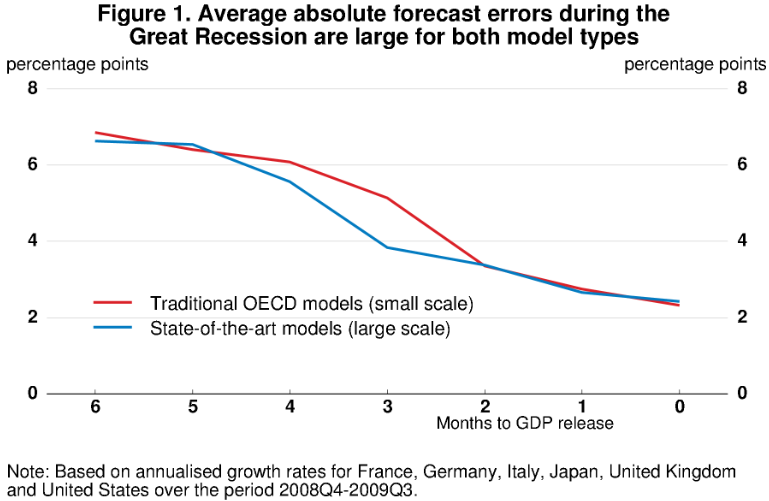
The OECD has drawn a number of lessons from the failure to forecast the Great Recession for the monitoring and statistical modelling of near-term economic developments. Crucially, a broader range of information, including financial developments, is now accounted for in OECD forecasts (Lewis and Pain, 2014). In an attempt to systematise this approach, OECD economists have recently estimated state-of-the-art statistical models that allow extracting meaningful signals from a large set of economic indicators, including equity and credit market indicators, real estate and consumer prices, disaggregate industrial production, as well as business and consumer surveys. They compare these models’ ability to forecast quarterly GDP growth during and after the Great Recession with that of the smaller-scale traditional OECD forecasting models (Ollivaud et al., 2016).

The main lesson of this research is that relying on more data does not mechanically improve forecast performance. This is because some economic indicators are redundant and because more data also means more noise to filter out. Identifying which variables are most relevant for the GDP forecast is tremendously difficult in real time, even though with hindsight the relation appears obvious, as for instance with financial market developments during the Great Recession.

Ollivaud et al. (2016) show that traditional OECD forecasting models based on a reduced set of 5-6 economic indicators perform similarly to the state-of-the-art models that exploit up to 150 indicators. While forecasts become more precise as more up-to-date indicators become available, forecast errors during the Great Recession are large for both types of models even around the publication date of GDP (Figure 1).

ollivaud-et-companie

As was emphasised at a workshop on complexity and policy recently organised at the OECD, big data and models that include non-linear features can certainly help to better understand economic phenomena and are worth pursuing further. However, the results in Ollivaud et al. (2016) suggest that implementing this approach in practice will be a long endeavour. In the meantime, smaller and simpler models can play an important role in tracking short-term economic developments and also have the advantage that it is easier to understand what is behind any forecast revision.

References

Lewis C., Pain N. (2014): Lessons from OECD forecasts during and after the financial crisis. OECD Journal: Economic Studies

Ollivaud P., Pionnier P.-A., Rusticelli E., Schwellnus C., Koh S.-H. (2016): Forecasting GDP during and after the Great Recession. OECD Economics Department Working Paper No. 1313