Emergency plans and solidarity: Protecting Europe against a natural gas shortage

By Jörg Haas, Tomasz Kozluk, Giuliana Sarcina, OECD Economics Department

The dramatic decline in Russian gas exports to Europe threatens to create a natural gas shortage this coming winter (Birol, 2022; European Commission, 2022a). In a recent paper (Haas, Kozluk and Sarcina, 2022), we argue that filling storage will be insufficient to eliminate that risk. Unless European countries reduce demand now, they might have to ration gas this winter. The emergency plans and solidarity provisions in place in case of a shortage offer strong protection for households and social services but would leave firms bearing the brunt of the burden of adjustment. The economic and employment costs could be severe, which underlines the need to reduce demand across all sectors of the economy now in order to prevent the risk of rationing during the winter. Moreover, solidarity between EU members is well-established on paper but may prove challenging to implement. It needs to be made operational by putting the necessary bilateral agreements in place or agreeing on EU legislation to this effect.

Storage and supply are limited

Replenishing gas storage levels to prevent a shortage in winter is a salient approach in the public debate, but it offers only a partial solution. EU gas storage levels currently stand at above 90%, with most member states well in excess of the 80% target set by the European Commission for November 2022 (GIE, 2022). This equals about 100 billion cubic meters (bcm) of gas, while the European Union typically consumes about 290 bcm between November and April. In most countries, gas reserves are seasonal rather than strategic: they decline in winter amid continued imports. If imports from Russia cease completely and the European Union does not reduce its gas consumption, it risks a shortage in early 2023. Consumption would have to shrink by between 10 and 20%, depending on gas flows from Russia, deliveries from alternative suppliers, and winter temperatures (Figure 1) (Kennedy, 2022; McWilliams and Zachman, 2022). A further consideration is the fact that the United Kingdom typically imports substantial amounts of gas throughout winter and may need to rely on EU storage due to its very limited own storage capacities. Finally, even if consumption is reduced sufficiently at the aggregate EU level, individual countries could still face shortfalls as the EU internal gas grid has limited transmission capacity between member states.

Figure 1. Without demand reductions, Europe risks gas supply interruptions

Stylised scenarios of EU and UK gas storage level developments, %

Note: Assuming 90% storage levels at the end of September 2022, no imports from Russia, imports from other sources at 30 bcm/month, and domestic production at average 2019-21 levels. “No change” assumes consumption at the average 2017-21 levels. “Cold winter” assumes consumption at the maximum 2017-21 levels. “10% reduction” is relative to the 2017-21 average consumption.
Source: Bruegel; Eurostat; GIE; IEA; ONS; and OECD calculations.

National emergency plans

What happens if demand reduction turns out to be insufficient and gas must be rationed? National emergency plans define which consumers will lose access (European Commission, 2022b). As a last resort, the gas supply to certain customer groups can be reduced, while “protected customers” should still be supplied in full. EU countries typically protect households, social services, essential infrastructure, and district heating systems from cuts (Figure 2) (European Commission, 2019). By contrast, firms would have to bear the brunt of the adjustment. The order in which unprotected customers are supplied is not specified in emergency plans, although the European Commission suggests prioritising customers that provide socially critical products like food or medicine, as well as those that could have large downstream effects on value chains (European Commission, 2022c).

Figure 2. Households are protected against gas cuts, but most firms are not

Share of EU member states with regulation that protects customer groups against gas cuts, %

Source: OECD calculations based on national gas emergency plans.

EU solidarity

EU solidarity provisions aim to provide additional protection across borders. They oblige EU members to ensure that households, social services, infrastructure and heating systems everywhere in the European Union are able to access gas, even in the worst-case scenario of a severe shortage (EU Council Regulation 2017/1938). If an EU member state requests solidarity, connected member states are obliged to reduce gas supply to non-protected customers and pump the gas that has been saved to a member state in need. In return, natural gas providers are entitled to financial compensation. Flows must be ensured until the demand of protected customers in the requesting member state is satisfied (Fleming, 2019).

The details of gas-sharing under the solidarity mechanism have to be specified in bilateral agreements between neighbouring countries. However, as of now, only six such agreements have been concluded. The list includes Germany and Denmark; Germany and Austria; Estonia and Latvia; Lithuania and Latvia; Italy and Slovenia; as well as Finland and Estonia (European Commission, 2022b). The European Commission has therefore proposed harmonised clauses that would be directly applicable in the absence of bilateral agreements, but these have not yet been signed into law.

As long as the coverage of bilateral agreements is sparse and there is no additional European legislation to fill that gap, solidarity may face practical and political challenges. An agreement on and enforcement of common standards (e.g. minimum acceptable interior temperature standards) across the European Union may help alleviate this problem. Solidarity could be crucial not just to avoid major disruptions in individual countries, but also to help limit the severity of disruptions in the extreme scenario of widespread shortages.

What can governments do?

While emergency plans and solidarity provisions are crucial in ensuring that citizens and critical infrastructure will not lose access to energy, they can only serve as measures of last resort. Rationing the gas consumption of firms would imply large economic costs and unpredictable cascading effects along supply chains. Governments should thus aim to ensure energy savings now and spread them across all sectors of the economy, rather than risk burdening firms with the costs of a sudden emergency adjustment in early 2023. High prices will and already are incentivising demand reductions. However, some government support policies blur or weaken the price signal. To this extent, they merit a review as they may discourage energy savings and can be fiscally costly. In addition, governments have a wide range of measures at their disposal, including appeals for voluntary reductions and restrictions on certain uses of gas or electricity, as well as investment in energy efficiency.

References

Birol, F. (2022b). Coordinated actions across Europe are essential to prevent a major gas crunch: Here are 5 immediate measures. Available at: https://www.iea.org/commentaries/coordinated-actions-across-europe-are-essential-to-prevent-a-major-gas-crunch-here-are-5-immediate-measures.

EU Regulation 2017/1938 of the European Parliament and of the Council of 25 October 2017 concerning measures to safeguard the security of gas supply. Available at: https://eur-lex.europa.eu/legal-content/EN/TXT/?uri=CELEX%3A02017R1938-20220701.

European Commission (2019). Commission’s opinions on the preventive action plans and emergency plans submitted by EU countries in 2019. Available at: https://energy.ec.europa.eu/topics/energy-security/secure-gas-supplies/commissions-opinions-preventive-action-plans-and-emergency-plans-submitted-eu-countries-2019_en.

European Commission (2022a). Opening remarks of Commissioner Simson at the press conference of the Extraordinary Energy Council of 26 July 2022. Available at: https://ec.europa.eu/commission/presscorner/detail/en/SPEECH_22_4727.

European Commission (2022b) Secure Gas supplies. Available at: https://energy.ec.europa.eu/topics/energy-security/secure-gas-supplies_en.

European Commission (2022c). A European gas demand reduction plan. Available at: https://ec.europa.eu/commission/presscorner/detail/en/fs_22_4611.

Fleming R. (2019). A legal perspective on gas solidarity. Energy Policy 124, pp.102-110. Available at: https://doi.org/10.1016/j.enpol.2018.09.037.

GIE (2022). Aggregated Gas Storage Inventory. Available at: https://agsi.gie.eu/.

Haas, J., Kozluk, T., and Sarcina, G. (2022). Emergency plans and solidarity: Protecting Europe against a natural gas shortage. OECD Policy Spotlight, October 2022. Available at: https://read.oecd-ilibrary.org/view/?ref=1160_1160374-3tkm8gj0xp&title=Briefing-Note-Gas-Emergency-Plans-and-Solidarity.

Kennedy, C. (2022). IEA chief: Europe must cut gas usage 20% to survive winter. Oilprice.com, 21 July 2022. https://oilprice.com/Latest-Energy-News/World-News/IEA-Chief-Europe-Must-Cut-Gas-Usage-20-To-Survive-Winter.html.

McWilliams, B., and Zachmann, G. (2022). European Union demand reduction needs to cope with Russian gas cuts. Bruegel Blog Post, July 2022. Available at: https://www.bruegel.org/2022/07/european-union-demand-reduction-needs-to-cope-with-russian-gas-cuts.



Surging energy prices are hitting everyone, but which households are more exposed?

By Hélène Blake and Tim Bulman, OECD Economics Department.

In the 12 months leading to March 2022, average home energy costs jumped by 41% in the European Union, and the price of fuels for private transport by 38%. These rises have strongly contributed to the return of inflation after more than two decades of subdued price growth across EU countries. The cost of the average consumption basket rose by between 4.5% to 15.6% across EU countries in the year to March 2022, and available data for April suggest that stronger price growth has continued.

While everyone is experiencing rising living costs, energy makes up a larger share of some households’ budgets than others, so this shock risks amplifying existing inequalities. As governments across the OECD introduce measures to buttress households from this price shock (Boone and Elgouacem, 2021), it is important to understand which households are most exposed.

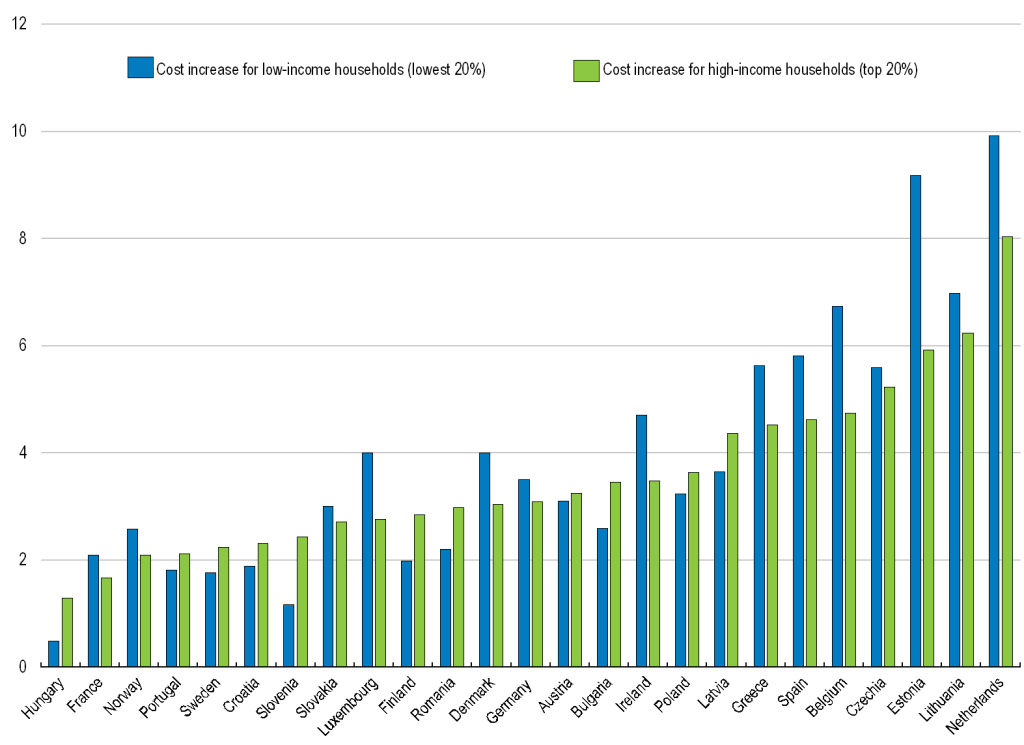
Analysing household budget surveys across the EU shows marked differences in spending on energy between countries and across households. Interestingly, low-income households are not systematically the hardest hit (Figure 1).

Figure 1. The impact of the recent energy price surge on household budgets differs between countries and income groups

Impact of the increase in energy prices on households’ budget for rural and urban households (as a % of total spending)

Note: March 2021- March 2022 increase.
Source: Eurostat; HBS 2015, HICP, author’s calculation.

Which households experience the largest losses in real incomes depends on the type of energy consumed, the price increases of different types of energy, and the share of energy in overall consumption. Home energy prices affect the poorest 20% of households more than higher income households in each country across the EU (Figure 2). For transport costs, the picture is less clear-cut, with increasing transport costs affecting high-income more than low-income households in several countries (Figure 3). Indeed, in a third of European countries higher income households spend larger shares of their income on running their car than lower income households, generally reflecting car ownership that is less common and is concentrated among higher-income households in these countries (Figure 3).

Figure 2. Across the EU, lower income households spend a larger share of their budgets on home energy, higher income households a larger share on transport costs, and remoter households spend larger shares on both

Average share of home energy and transport costs as a % of total spending, across income and geographical groups, EU average (2015)

Source: Household Budget Survey (2015).

Higher energy prices also exacerbate inequalities between urban and rural areas. Households in rural areas and small towns spend 10% to 80% larger shares of their overall budget on home energy and transport costs than their urban counterparts (Figure 4). In some EU countries (e.g. Bulgaria, Hungary or Spain), households in rural areas and small towns are more likely to have low incomes than urban households, exacerbating their loss of purchasing power from rising energy prices.

Figure 3. Higher transport costs have a larger impact on high-income households in countries where car ownership is less common

Share of budget spent on running cars by households with highest 20% of incomes relative to lowest 20% of incomes (2015)

Note: The graphic shows the ratio of income spent on transport of the 20% highest income to the 20% lowest income households. 100 indicates both groups spend equal shares of their budgets. For example, in Bulgaria, the share of income dedicated to transport costs by the 20% richest households is 280% the share of the 20% of households with the lowest incomes.
Source: Household Budget Survey (2015).

The distributional analysis can help governments respond to the recent price rises with measures that target the most exposed and vulnerable households, while limiting the cost of these measures to public finances and sustainability. Means-tested cash transfers are the most cost-efficient tool to reduce inequalities in the loss of purchasing power between income groups. Austria, for instance, gave a lump-sum support to the beneficiaries of social transfers, while Ireland increased the mean-tested payment helping households on their energy bill. Other countries are providing a mean-tested voucher for energy expenses (for example, France and Italy). By not distorting the price signal, such support measures also have the advantage that they do not discourage households from saving energy. Accelerating support to vulnerable households to improve their energy efficiency and to rely less on fossil fuel could bring the greatest and longest-lasting benefits, such as Greece’s support for insulating housing and to develop new photovoltaic stations to provide power for vulnerable households (Bruegel, 2022).

By contrast, price subsidies and tax expenditures (such as cuts to excise taxes) reduce households’ incentives to save energy (Pototschnig, A. et al., 2022). Moreover, price support for transport fuels risks supporting the highest income households the most.

Figure 4. Higher home energy and transport prices disproportionately affect rural households in all countries

Impact of the increase in energy prices on households’ budget for rural and urban households (as a % of total spending)

 Note: Change between March 2021- and March 2022.
Source: Eurostat; HBS 2015, HICP, author’s calculation

References

Boone, L. and A. Elgouacem (2021), At the cross-roads of a low-carbon transition: what can we learn from the current energy crisis?, ECOSCOPE, https://oecdecoscope.blog/2021/10/22/at-the-cross-roads-of-a-low-carbon-transition-what-can-we-learn-from-the-current-energy-crisis/ (accessed on 14 April 2022).

Bruegel (2022), National policies to shield consumers from rising energy prices, https://www.bruegel.org/publications/datasets/national-policies-to-shield-consumers-from-rising-energy-prices/ (accessed on 11 April 2022).

Pototschnig, A. et al. (2022), “Consumer protection mechanisms during the current and future periods of high and volatile energy prices | Florence School of Regulation”, EUI Policy Brief, https://fsr.eui.eu/publications/?handle=1814/74376 (accessed on 11 April 2022).


At the cross-roads of a low-carbon transition: what can we learn from the current energy crisis?

By Laurence Boone and Assia Elgouacem, OECD Economics Department

When it rains it pours. The energy crisis we face today is the result of a confluence of several forces at play: persistent underinvestment in the energy sector and fragile market regulation coupled with unfavourable weather events and insufficient buffers (Figure 1A) (IEA, 2021b). Together with the strong COVID-related demand recovery, they created an unsettling mismatch in our global energy markets leading to skyrocketing energy prices, in particular in Europe (Figure 1B). The crisis has brought to bear the multiple sources of tension that could threaten the stability and reliability of our energy system. It has also triggered a multiplicity of emergency measures to contain costs for households and firms at a time when the energy transition is set to accelerate. As countries embark on what promises to be the most ambitious energy transformation of our times, the current events show how transition to a climate neutral world needs to minimise the risk of such disruptions while securing public support.

Note: Panel A shows the filling rate of European natural gas storage over 2020, 2021 and the 10 year average filling rate. Panel B uses the EEX EGIX THE Index (European Energy Exchange European Gas Index) as the reference price for natural gas for one month ahead contracts. It is based on exchange trades which are concluded in the respective current front month contracts (THE). The EGIX corresponds to the current market price for gas deliveries in the next month at any time.
Source: Panel A: Aggregated Gas Storage Inventory, AGSI+ (gie.eu). Panel B: Refinitiv.

Between calls for greater energy security and energy affordability, particularly at a time when mounting inflation pressures are already raising concerns about people’s purchasing power (OECD, 2021c), this crisis is very much exposing difficulties governments will face to stay on course towards a climate neutral world. Countries representing around 70% of the world’s global carbon emissions have already announced climate neutrality targets by mid-century (IEA, 2021a), which necessitates a rapid and unprecedented transformation of the way we produce and consume our goods and services. Yet the steps to achieving this transformation remain unclear in many jurisdictions.

According to the recently published IEA World Energy Outlook, a net-zero emissions world requires accelerating clean electrification of many energy uses, improving energy efficiency, substantially reducing methane emissions and boosting innovation (IEA, 2021c). This requires a major shift in investment (Figure 2), R&D, regulation and carbon pricing.

Note: The scenarios are from the IEA World Energy Outlook 2021. The Announced Pledges Scenario maps out a path in which the net zero emissions pledges announced by governments so far are implemented in time and in full. The Net Zero Emissions Scenario sets out what needs to be done to move beyond these announced pledges towards a trajectory that would reach net zero emissions globally by mid-century, which is consistent with limiting global warming to 1.5 ˚C.
Source: (IEA, 2021c).

Reasons for the current shortages are multiple, but some of them reflect future challenges that could be linked to decarbonisation. The post-Covid demand surge is partly responsible for a global shortage of energy, but it coincides with an undersupply due to a lack of investment in clean energy at a time when investment in brown energy has been receding over the past decades (IEA, 2021b) .

In short, the current situation should provide lessons to prepare better for the transition to a climate neutral world through strengthening our energy systems as our energy infrastructure morphs into one that relies much more on variable renewable energy sources. Policy makers thus need not only steer incentives towards clean energy but they should also ensure that as energy systems become cleaner they remain reliable and affordable. This requires larger and more timely investment, a focus on electricity system flexibility, and better pricing systems. The IEA estimates that investment in clean energy projects and infrastructure needs to more than triple over the next decade to reach net-zero emissions (Figure 2).

Failure to better prepare our energy system would only exacerbate public finances pressure while weakening the price signals. Countries are currently scrambling to provide aid to their citizens to soften the blow from rising energy prices at the cost of higher emissions. Interventions range from means-tested transfers to low-income households, energy tax cuts, caps on energy prices, and excess profit taxes on energy companies (Table 1). While protecting vulnerable households is necessary, it is important that such measures remain time limited and not undermine incentives for clean energy.

The OECD has long since highlighted the importance of policy alignment and how a comprehensive, inclusive and cost-effective strategy to address climate change will require bringing in complementary policy areas and exploiting synergies among them (OECD, 2015e) (OECD, 2021a). The current episode highlights this further, especially since higher energy prices could render already contentious policies, such as carbon taxes, even less palatable and politically tenable (Politico, 2021). To this end, governments need to strengthen targeted social support to vulnerable populations, including through well-designed revenue-recycling schemes, and to bolster active labour market support to help workers and encourage a more efficient reallocation of labour (OECD, 2021d) (Vona, forthcoming). They need to upgrade market regulation to ensure greater stability as well as competition, and to encourage investment in energy system flexibility. Reforming financial sector regulation is also key, such as requiring greater disclosure in financial markets to better account for climate risk and mobilise private funds (OECD, 2021b). Lastly, transparency, better communication and carefully assessing compensation packages would be necessary for garnering public support so as to not derail the energy transition.


References

IEA (2021a), Net Zero by 2050: A Roadmap for the Global Energy Sector, OECD Publishing, Paris, https://doi.org/10.1787/c8328405-en.

IEA (2021b), What is behind soaring energy prices and what happens next?, https://www.iea.org/commentaries/what-is-behind-soaring-energy-prices-and-what-happens-next.

IEA (2021c), World Energy Outlook 2021, OECD Publishing, https://doi.org/10.1787/14fcb638-en.

OECD (2021a), Economic Policy Reforms 2021: Going for Growth: Shaping a Vibrant Recover, OECD Publishing, https://doi.org/10.1787/3c796721-en.

OECD (2021b), Financial Markets and Climate Transition, https://www.oecd.org/finance/Financial-Markets-and-Climate-Transition-Opportunities-Challenges-and-Policy-Implications.pdf.

OECD (2021c), OECD Economic Outlook, Interim Report September 2021: Keeping the Recovery on Track, OECD Publishing, https://doi.org/10.1787/490d4832-en.

OECD (2021d), The Inequalities-Environment Nexus, https://www.oecd-ilibrary.org/environment/the-inequalities-environment-nexus_ca9d8479-en.

OECD (2015e), Aligning Policies for the Low-carbon Economy, https://www.oecd.org/fr/gov/aligning-policies-for-a-low-carbon-economy-9789264233294-en.htm.

Politico (2021), Soaring power prices drive anxiety over EU climate plans, https://www.politico.eu/article/soaring-power-prices-anxiety-eu-climate-plans/.

Vona, F. (forthcoming), Managing the Distributional Effects of Environmental and Climate Policies: The Narrow Path for a Triple Dividend.