Enhancing digital diffusion for higher productivity growth in Spain

By Aida Caldera Sánchez, Müge Adalet McGowan and Yosuke Jin

Digitalisation is transforming the Spanish economy, changing the way firms operate, with positive implications for productivity. However, these changes are not evenly shared between high and low productivity firms, or small and large firms (Figure 1), which can help explain why aggregate productivity gains from digitalisation have been modest in Spain so far. Hence, Spain still has considerable scope to reap the benefits of the adoption of digital technologies and, perhaps more importantly, their effective use to produce new business models and products, as discussed in the 2021 Economic Survey of Spain (OECD, 2021; Jin, 2021).

Figure 1. The adoption of digital technologies varies with firm size
Percentage of firms which adopt each technology, 2019

Note: “Small firms” stands for small enterprises with 10-49 employees, while “Large firms” stands for large enterprises with 250 employees and more.
Source: OECD, ICT Access and Usage by Businesses (database).

The pandemic has shown the benefits of a more digitalised economy (e-commerce, teleworking) and accelerated the pace of digital adoption, with the extent of teleworking and digital sales increasing in Spain during the last year.  The Spanish Recovery, Resilience and Transformation Plan allocates 29% of funds to digitalisation, which will help Spain achieve its ambitious objectives laid out in its national digital strategy, “Digital Spain 2025”. In this context of the increasing importance of digitalisation in Spain, the Survey analyses the challenges and opportunities that digitalisation offers through three types of policies.

First, good communications infrastructure is a prerequisite to adopt and use digital technologies. This is an area where Spain ranks relatively well in international perspective, with a high share of fibre in total fixed broadband subscriptions and a relatively widespread internet usage. The coverage of fibre networks in rural areas is also well above that in other European countries (46% vs. 21%). Nonetheless, the digital divide between urban and rural areas in Spain remains, even if it has narrowed recently. Barriers to “rights of way” – permission to install necessary equipment – are high in some regions and municipalities, and should be reduced to lower deployment costs.

Second, there are complementary factors that are key to take full advantage of digitalisation. These include organisational capital and managerial skills, R&D and digital skills. There are important gaps in these areas in Spain. For example, business investment in intangible assets and R&D are relatively low.  To boost innovation and reap the full benefits of digitalisation, the Survey recommends boosting partnerships between the public and the private sector, for example by enhancing the role of Technology Centres to increase cooperation between research institutes and SMEs, which need to innovate and use digital technologies more.

There is also ample room to develop ICT skills, especially for low-educated and older people (Figure 2). Reducing the mismatch between the skills employers need and the qualifications of jobseekers should be a priority. This would help in particular low productivity firms and low-skilled people, making the benefits of digitalisation shared by all. Targeting training to those with lower digital skills and shifting financial incentives for lifelong training at least partially to training programmes chosen by individuals rather than employers would help achieve these outcomes.

Figure 2. There is room to develop digital skills
Percentage of respondents claiming to have basic digital skills, 2019

Source: Eurostat, Digital skills (database).

Finally, policies, which raise competitive pressures and sharpen incentives to better use digital technologies and better access to finance, can also enhance the diffusion of digital technologies. For example, the Survey recommends fostering the implementation of the Markey Unity Law to reduce regulatory differences across regions and facilitate the growth and entry of new firms and this way encourage the adoption of new technologies. It also recommends strengthening targeted support to new and high-potential firms through public guarantee schemes. In addition to these policies, which facilitate the entry and expansion of innovative firms, it is also important to ensure the efficient exit of non-viable firms and restructuring of viable firms in temporary distress. An effective insolvency regime can help reduce the barriers and costs of firm restructuring or exit and facilitates technological experimentation. In this context, promoting out-of-court insolvency proceedings, especially for SMEs, is key.

References:

Jin, Y. (2021), “Enhancing digital diffusion for higher productivity growth in Spain”, OECD Economics Department Working Papers, No. 1673, OECD Publishing, Paris.

OECD (2021), OECD Economic Surveys: Spain 2021, OECD Publishing, Paris, https://doi.org/10.1787/79e92d88-en.



The role of online platforms in weathering the COVID-19 shock

By Mauro Pisu, Hélia Costa, Hyunjeong Hwang, OECD Economics Department

While the COVID-19 pandemic has forced many businesses, big and small, around the world to shut down and fire or furlough workers, others thrived. Online platforms that allow people and firms to buy and sell product and services through the internet and without physical contact boomed. A prime example is Amazon, whose revenues in the second quarter of 2020 increased by around 40% on a yearly basis while GDP plummeted worldwide. Likewise, transaction volumes and revenues of digital payment processing companies, such as Paypal and Square, jumped to new highs and their market capitalisation surpassed that of most retail and investment banks.

Understanding the shift of economic activities to online marketplace during the COVID-19 is important as there is no close parallel in recent history to draw insights from. On the one hand, online platforms might have helped to mitigate the negative economic impacts of COVID-19 by allowing firms and people to keep producing and working during lockdowns, thus strengthening resilience to shocks disrupting traditional economic activities. On the other hand, the shift towards online platforms may have helped to strengthen and consolidate their market share, heightening concerns about unfair competition, data privacy and non-standard forms of work. The shift could also outlast the COVID-19 shock as people and businesses build new habits.

A new OECD Policy Brief sheds light on the use of online platforms during the first half of 2020 using a new comprehensive dataset of about 1 400 online platforms active in OECD and G20 countries in nine activity areas. The analysis shows that, during lockdowns, businesses and people increasingly turned to online platforms to pursue economic activities. This was especially the case in activity areas requiring little or no physical proximity for product and service delivery (such as mobile payments, marketplace to consumers, professional services and restaurant delivery) (Figure 1). In these areas, online platform use, as proxied by Google Trends data, increased by about 20% in the first half of 2020. However, in activity areas requiring physical proximity (such as accommodation, restaurant booking and transport), platform activity declined markedly (by around 90% in the first half of 2020), reflecting the generalised economic disruption caused by the COVID-19 pandemic.

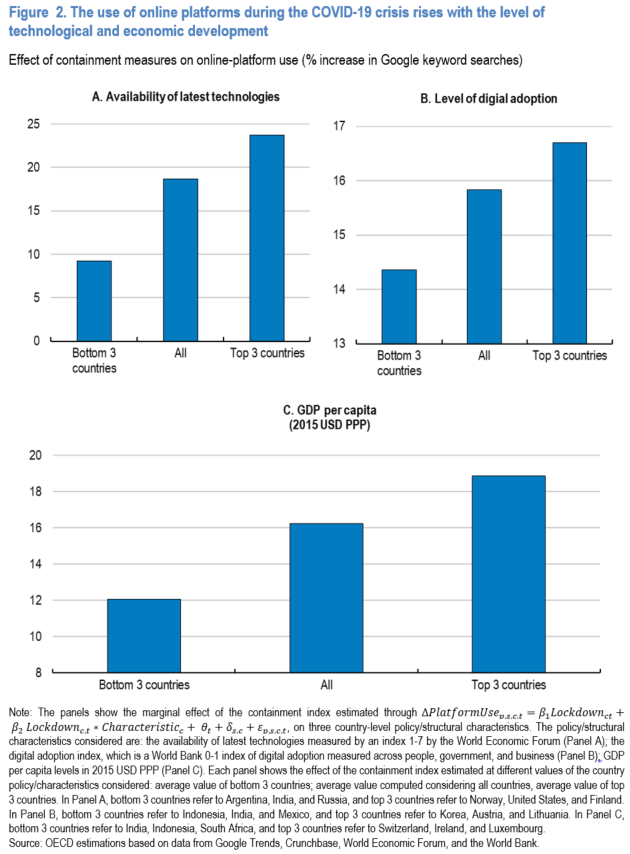
The analysis also reveals that the increase in online-platform use varied across countries depending on pre-existing structural conditions and policies. The increase tended to be larger in more developed and technologically-advanced countries, those with easier access to infrastructure and connectivity, higher skill levels, and more widespread use of the Internet (Figure 2). These results highlight the varying degree of countries’ digital preparedness. When COVID-19 hit, some countries were better prepared than others and in these countries people and businesses may have found it easier to shift activities towards online platforms.

The COVID-19 shock has added urgency to policies aiming at accelerating the digitalisation of public and private sector activities. During the crisis many OECD and G20 countries implemented a range of such policies including, for instance, improving broadband connectivity, helping firms adopt online business models, promoting online payments, and enhancing digital skills (G20, 2020; OECD, 2020a; OECD, 2020b).

This new urgency is welcome but a coordinated approach is needed to exploit synergies across policy areas. For instance, to make the investment in digital infrastructure effective, complementary investment in skills is necessary. Moreover, policies to protect the privacy of personal data and strengthen cybersecurity can enhance trust in digital technologies and online platforms, accelerating their adoption. Designing or updating Industry 4.0 plans in view of the new challenges the COVID-19 has created would be a good way to build such a coordinated approach.

For more details see:

OECD (2020), “The role of online platforms in weathering the COVID-19 shock”, OECD Policy Responses to Coronavirus (COVID-19), OECD Publishing, Paris, https://doi.org/10.1787/2a3b8434-en.

References:

OECD (2020), Policy Options to Support Digitalisation of Business Models during COVID-19, Annex, http://www.oecd.org/sti/policy-options-to-support-digitalization-of-business-models-during-covid-19-annex.pdf

OECD (2020a), Keeping the Internet up and running in times of crisis, http://www.oecd.org/coronavirus/policy-responses/keeping-the-internet-up-and-running-in-times-of-crisis-4017c4c9/ (accessed on 9 October 2020).

OECD (2020b), The potential of online learning for adults: Early lessons from the COVID-19 crisis, http://www.oecd.org/coronavirus/policy-responses/the-potential-of-online-learning-for-adults-early-lessons-from-the-covid-19-crisis-ee040002/ (accessed on 9 October 2020).


Tax challenges from digitalisation: A global two-pillar solution could increase tax revenues and support economic activity

By David Bradbury, Tibor Hanappi, Pierce O’Reilly, Ana Cinta González Cabral (OECD Centre for Tax Policy and Administration), Åsa Johansson, Stéphane Sorbe, Valentine Millot, Sébastien Turban (OECD Economics Department)

The international corporate tax system faces growing challenges. While the OECD/G20 Base Erosion and Profit Shifting (BEPS) project represented an unprecedented multilateral effort to tackle profit shifting, many questions over the allocation of taxing rights remain unresolved. Digitalisation and globalisation have highlighted certain vulnerabilities in the existing framework, which allocates taxing rights principally on the basis of physical presence. In addition to this, some BEPS issues remain. In this context, an increasing number of jurisdictions are taking uncoordinated and unilateral actions (e.g. digital services taxes), contributing to an increase in tax and trade disputes and growing tax uncertainty.

The COVID-19 crisis is exacerbating these tensions by accelerating the digitalisation of the economy and increasing pressures on public finances. The fact that many firms have benefitted from direct or indirect government support during the crisis is also likely to intensify public dissatisfaction with tax avoidance by multinational enterprises (MNEs).

Towards a global two-pillar solution

Against this backdrop, the OECD/G20 Inclusive Framework on BEPS (Inclusive Framework), which brings together 137 member jurisdictions, is discussing proposals for a consensus-based reform of the international tax rules to address the tax challenges arising from the digitalisation of the economy. The proposals fall under two pillars, which are described in the Pillar One and Pillar Two Blueprint reports released last week (OECD, 2020a; OECD, 2020b). In their latest communiqué, G20 Finance Ministers confirmed that they remain committed to further progress on both pillars and urged the Inclusive Framework to address the remaining issues with a view to reaching a global and consensus-based solution by mid-2021 (G20, 2020).

Pillar One seeks to adapt the international corporate tax system to the digital age through significant changes to the rules applicable to business profits to ensure that the allocation of taxing rights on business profits is no longer exclusively determined by reference to physical presence.

Pillar Two aims to address remaining BEPS challenges and is designed to ensure that large internationally operating businesses pay a minimum level of tax regardless of where they are headquartered or the jurisdictions they operate in.

This blog post summarises the main findings of the Economic Impact Assessment of the proposals carried out by the OECD Secretariat (OECD, 2020c). This is an ‘ex ante’ assessment, which relies on a number of illustrative assumptions on proposal design and parameters, without prejudice to the final decisions of the Inclusive Framework.

The proposals would increase global tax revenues

Pillar One and Pillar Two could increase global corporate income tax (CIT) revenues by about USD 50-80 billion per year. Taking into account the combined effect of these reforms and the US GILTI regime, the total effect could represent USD 60-100 billion per year or up to around 4% of global CIT revenues.

  • Pillar One would involve a significant change to the way taxing rights are allocated among jurisdictions, as taxing rights on about USD 100 billion of profit could be reallocated to market jurisdictions. This would lead to a modest increase in global tax revenues. On average, low, middle and high income economies would all benefit from revenue gains, while ‘investment hubs’ would tend to lose tax revenues.
  • Pillar Two would yield a significant increase in CIT revenues and significantly reduce the incentives for MNEs to shift profits to low-tax jurisdictions, which would generate revenue gains in addition to the direct gains resulting from the implementation of the new rules.
  • The combined revenue gains from the two pillars are estimated to be broadly similar – as a share of current CIT revenues – across low, middle and high income jurisdictions (Figure 1).

A consensus-based solution would support investment and economic growth

A consensus-based multilateral solution involving Pillar One and Pillar Two would lead to a more favourable environment for investment and growth than would likely be the case in absence of an agreement by the Inclusive Framework:

  • The two pillars would lead to a relatively small increase in the average (post-tax) investment costs of MNEs (Hanappi and González Cabral, 2020). The ensuing negative effect on global investment is estimated to be very small, as the proposals would mostly affect highly profitable MNEs whose investment is less sensitive to taxes (Millot et al., 2020). Overall, the negative effect on global GDP stemming from the expected increase in tax revenues associated with the proposals is estimated to be less than 0.1% in the long term.
  • In contrast, the absence of a consensus-based solution would likely lead to a proliferation of uncoordinated and unilateral tax measures (e.g. digital services taxes) and an increase in damaging tax and trade disputes. This would undermine tax certainty and investment and also result in additional compliance and administration costs. The magnitude of the negative consequences would depend on the extent, design and scope of these unilateral measures, and the scale of any ensuing trade retaliation. In the “worst-case” scenario, these disputes could reduce global GDP by more than 1% (Figure 2).

The COVID-19 crisis has increased the need for reform

The full impact of the COVID-19 crisis remains highly uncertain at this stage, but a few likely implications for the impact assessment of Pillar One and Pillar Two already stand out:

  • The COVID-19 crisis is likely to reduce the expected revenue gains from the proposals at least in the short run as the crisis weighs on the profitability of many MNEs, even though some digital-intensive MNEs have managed to sustain or enhance their profitability since the beginning of the crisis.
  • The crisis has accelerated the digitalisation of the economy, increasing the need to address the tax challenges arising from digitalisation.

References

G20 (2020), “Communiqué – G20 Finance Ministers & Central Bank Governors Meeting”, https://g20.org/en/media/Documents/FMCBG%20Communiqu%C3%A9_English_14October2020_700pm.pdf.

Hanappi, T. and A. González Cabral (2020), “The impact of the pillar one and pillar two proposals on MNE’s investment costs : An analysis using forward-looking effective tax rates”, OECD Taxation Working Papers, No. 50, OECD Publishing, Paris, https://dx.doi.org/10.1787/b0876dcf-en.

Millot, V. et al. (2020), “Corporate Taxation and Investment of Multinational Firms: Evidence from Firm-Level Data”, OECD Taxation Working Papers, No. 51, OECD Publishing, Paris, https://dx.doi.org/10.1787/9c6f9f2e-en.

OECD (2020a), Tax Challenges Arising from Digitalisation – Report on Pillar One Blueprint: Inclusive Framework on BEPS, OECD/G20 Base Erosion and Profit Shifting Project, OECD Publishing, Paris, https://dx.doi.org/10.1787/beba0634-en.

OECD (2020b), Tax Challenges Arising from Digitalisation – Report on Pillar Two Blueprint: Inclusive Framework on BEPS, OECD/G20 Base Erosion and Profit Shifting Project, OECD Publishing, Paris, https://dx.doi.org/10.1787/abb4c3d1-en.

OECD (2020c), Tax Challenges Arising from Digitalisation – Economic Impact Assessment: Inclusive Framework on BEPS, OECD/G20 Base Erosion and Profit Shifting Project, OECD Publishing, Paris, https://dx.doi.org/10.1787/0e3cc2d4-en.


Korea: Roadmap to narrow digital gaps

By Mathilde Pak, OECD Economics Department

When it comes to emerging digital technologies, Korea is a top player, with an outstanding digital infrastructure and a dynamic ICT sector. 5G has been introduced nationwide earlier than in any other country in the world and has spurred numerous projects supported by the governement to enhance competitiveness, innovation and the quality of life: smart factories, smart grids, smart healthcare, smart cities, smart roads. Korea also stands out for its swift and effective use of advanced digital tools to contain COVID-19 without shutting down the economy. For instance, artificial intelligence enables fast testing, mobile apps provide real-time information on locations visited by patients diagnosed with COVID-19 (Figure 1) and untact (contactless) lifestyle limits the spread of the virus. The recent New Digital Deal further supports the use of digitalisation with projects exploiting synergies between the government and the business sector, including strengthening data infrastructures, expanding data collection and usage, establishing 5G network infrastructure early, promoting untact industries and developing artificial intelligence.

However, the diffusion of digital technologies among firms and workers is slow. The digital gap between SMEs and large enterprises is wide because SMEs face obstacles to the adoption of advanced technologies, like cloud computing and big data: lack of innovation, lack of information and funds, lack of skilled workers and low access to training. This digital gap creates wide productivity gaps, weighing on economy-wide productivity, which is far below the OECD average. Moreover, the digital gap between generations is the highest among OECD countries (Figure 2). In an ageing and increasingly digitalised society, this exacerbates well-being inequalities, as part of the population is left behind.

Digital opportunities to boost productivity and well-being are numerous but are not used to their full potential. To promote the diffusion of technology, the 2020 OECD Economic Survey of Korea highlights recommendations focussing on three main areas.

First, regulations for product and service markets remain stringent, holding back innovation and new business models, as well as competition and productivity growth. The government has introduced regulatory sandboxes allowing firms in new technologies and new industries to test their products and business models without being subject to all existing legal requirements. The temporary lifting of the ban on telemedicine during the COVID-19 outbreak illustrates the potential benefits of a timely review of regulations. After four years at most, if a regulatory sandbox is considered effective and safe, it can lead to the permanent suppression of the regulation that was temporarily waived, its amendment, or the extension of the trial period. It can also lead to the creation of licences with a narrower scope, for example for FinTech companies, which could be allowed to provide some banking services without needing a full banking licence. Follow up on this strategy should allow identifying excessive regulation and revise or abolish it, notably in the case of telemedicine.

Second, subsidies to SMEs should better target innovative and productive companies. Extensive government R&D support still largely props up low-productivity companies and scale-up success is limited. Innovation vouchers in the form of a one-off payment should be provided to SMEs in manufacturing and services to commission R&D and studies on potential for new technology introduction from universities and research institutions. They would help develop innovation networks, which are still limited in Korea, and facilitate the diffusion of digital technology. In addition to promoting collaboration between SMEs and academia, collaboration between SMEs and large enterprises should be further strengthened to enhance innovation diffusion, for instance through open collaborative platforms to exchange new products, services and big data. Financial support for technology R&D should also be reallocated to commercialisation for SMEs that successfully developed new technology.

Third, addressing the lack of adequate skills and awareness of digital benefits or dangers is crucial. SMEs face a lack of skilled workers in digital fields, limited access to ICT training and insufficient awareness of managers of the potential of digital technologies. Older generations often lack digital and basic skills to participate in online activities like e-commerce. Most teachers feel they are not sufficiently prepared to use ICT for teaching, which has been a hurdle during the COVID-19 school closures. A relatively high share of individuals experience privacy violation and youth are at higher risk of cyber-bullying and addiction to ICT technologies. More specialists and high-level researchers are needed in fourth industrial revolution core technologies like artificial intelligence and big data, as well as next-generation security technologies like blockchains and quantum cryptography communication. Higher-quality ICT education and training should be provided to enable students, teachers, SME workers and older people to thrive in a digital society.

The COVID-19 outbreak is strengthening the existing trend towards digitalisation, with a growing use of artificial intelligence and remote services like telework, telemedicine and e-commerce by firms and households. Narrowing the digital gap between firms and between workers is key to bring about a more rapid diffusion of technology and to make the most of digital opportunities to raise productivity and well-being.

References:

OECD (2020), OECD Economic Surveys: Korea 2020, OECD Publishing, Paris.
https://doi.org/10.1787/2dde9480-en

Pak, M. (2020), “Promoting the diffusion of technology to boost productivity and well-being in Korea”, OECD Economics Department Working Papers, OECD Publishing, Paris, forthcoming.


The COVID-19 crisis creates an opportunity to step up digitalisation among subnational governments

By Luiz de Mello, OECD, and Teresa Ter-Minassian, OECD Fiscal Network

Recent decades have seen rapid growth of advanced digital technologies, including high-speed computing, big data, artificial intelligence, the internet-of-things and blockchain. This “digital revolution” creates significant opportunities for all levels of government to improve the delivery of public goods and services, and to raise more and better revenue.

This is particularly important in the context of the COVID-19 crisis. Fighting a pandemic while minimising the associated economic costs calls for appropriate digital infrastructure for the design and enforcement of containment measures, as well as to ensure access by the population and enterprises to critical government services. After all, subnational governments (SNGs) account for about 40% of government spending on average in OECD countries; they also play an important role in the delivery of key services that are at the heart of the policy actions being taken to slow the spread of the pandemic, including on health care and social protection.

Much of the literature has focused so far on the scope for advanced digitalisation at the central/federal level of government. In a recent OECD paper, de Mello and Ter-Minassian (2020) focus on the opportunities and challenges that digitalisation creates for SNGs.

Advanced digital technologies can help improve the quality and efficiency of subnational programmes. Geographic information systems (GIS) are being used to identify potential environmental and health risks, which is important when it comes to controlling the spread of a pandemic and avoiding its recurrence. Of particular interest is the use of sensors, to control road and railway traffic, maintain regional or local infrastructure, and monitor water and sanitation usage, just to cite a few. Digital portals facilitate SNGs’ communication with their populations and the delivery of certain public services, and well-designed information systems can strengthen all aspects of subnational public financial management, and facilitate subnational transparency and accountability.

At the same time, regional and local governments are having to operate digitally in periods of confinement and to broaden the range of services provided on-line to the population, including in some cases in the area of e-health. The case of testing, tracing and tracking through digital devices to contain the spread of COVID-19 is a case in point, where the local governments are in many cases actively involved in these efforts, and privacy/confidentiality concerns are prompting important debates among policymakers.

Digitalisation can also help to improve both shared and own subnational revenues. This is particularly important to prepare governments to restore the sustainability of the public finances, once the post-COVID-19 recovery has been firmly established. Especially promising are possibilities to introduce, or strengthen, the enforcement of consumption taxes, regional personal income taxes (PITs), or regional surcharges on national PITs; make more efficient and equitable the administration of local property taxes; and better utilise user fees for local services.

Digitalisation, however, also poses significant challenges for SNGs, whose capacities to deal with such challenges vary widely both across and within countries (see Figure). The most important constraint in many SNGs is likely to be the scarcity of requisite skills, not only in government leadership and bureaucracy, but also across the population at large. Lack of skills breeds, in turn, distrust and resistance to digitalisation.

Other significant constraints can be posed by inadequate physical infrastructure and financial resources to improve it. Less recognized, but also important, can be legal or regulatory constraints. Tackling cyber security risks, and adequately addressing citizen’s privacy concerns constitute further significant challenges.

These challenges in SNG digitalisation highlight the need for a well-structured overall strategy beginning with a stocktaking of the initial state of, and main obstacles to, digitalisation. Within these constraints, SNGs need to define priorities (e.g. which public services should be digitalised first); identify needs for legal and organisational supporting changes; define responsibilities for different tasks; set up realistic timetables for implementation; appropriate the necessary budgetary resources, and procure any needed skills and materials; and closely monitor the implementation of the strategy.

Early involvement of main stakeholders and clear communication to the public at large of expected results, are essential for securing citizens’ support for the digitalisation effort.

Moreover, co-operation among and within different levels of government can play a significant role in supporting effective and efficient digitalisation of SNGs. The case for support by national government is made more compelling by the fact that different SNGs are differently equipped to meet the challenges of digitalisation. Smaller and poorer urban, and especially remote, rural communities are more likely to suffer from skill shortages, limited connectivity and scarcity of budgetary resources.

Policy innovation is another important area for inter-governmental co-operation in the digital sphere, with considerable potential for SNGs to launch pilot programmes that can be tested and subsequently taken up by other same-level jurisdictions and/or up-scaled to other levels of administration through gradual experimentation. The pandemic is actually triggering a lot of promising innovation by SNGs that can do much to improve their preparedness to deal with future crises.

National governments can support subnational digitalisation efforts. This can be achieved in particular through appropriate reforms to intergovernmental fiscal relation systems, including the assignment of own tax bases to SNGs; greater clarity in the assignment of expenditure responsibilities, and the implementation of equalization transfers; by giving adequate weight to regional digital inclusion in public investment choices; by defining appropriate nation-wide standards to facilitate seamless interfaces among the national and subnational digital systems; and through technical assistance and training of subnational officials.

There is also significant scope for horizontal co-operation among SNGs. Peer support can include demonstration effects, technical assistance and joint training of officials, as well as effective interfaces among subnational digital systems in areas of common interest. Dedicated forums for inter-regional and inter-municipal dialogue on digitalisation issues, possibly under the umbrella of broader horizontal co-operation forums, can be instrumental in facilitating both the exchange of experiences and consensus building on common digitalisation issues.

The COVID-19 crisis provides an opportunity to step up the digital transformation of SNGs given the need to act steadfastly during the ongoing containment phase but also in preparation for the post-crisis recovery. The lessons that are emerging from the current experience, if put to good use, can do much to make SNGs better equipped to cope with future crises.

Reference

de Mello, L. and T. Ter-Minassian (2020), “Digitalisation Challenges and Opportunities for Subnational Governments”, OECD Working Papers on Fiscal Federalism, No. 31, OECD, Paris.


International corporate tax reform could support global tax revenues

By David Bradbury, Tibor Hanappi, Pierce O’Reilly, Ana Cinta Gonzalez (OECD Centre for Tax Policy and Administration), Asa Johansson, Stéphane Sorbe, Valentine Millot, Sébastien Turban (OECD Economics Department)

Recent economic analysis suggests that a proposed solution to the tax challenges arising from the digitalisation of the economy under negotiation at the OECD would have a significant positive impact on global tax revenues.

The analysis puts the combined effect of the two-pillar solution under discussion at up to 4% of global corporate income tax (CIT) revenues, or USD 100 billion annually. The revenue gains are broadly similar across high, middle and low-income economies, as a share of corporate tax revenues.

The analysis was released just weeks after the international community reaffirmed its commitment to reach a consensus-based long-term solution to the tax challenges arising from the digitalisation of the economy, and to continue working toward an agreement by the end of 2020, according to a Statement by the OECD/G20 Inclusive Framework on BEPS.

The Inclusive Framework on BEPS, which brings together 137 countries and jurisdictions on an equal footing for multilateral negotiation of international tax rules, decided during its January 29-30 meeting to move ahead with a two-pillar negotiation to address the tax challenges of digitalisation.

Participants agreed to pursue the negotiation of new rules on where tax should be paid (“nexus” rules) and on what portion of profits they should be taxed (“profit allocation” rules), on the basis of a “Unified Approach” under Pillar One. The aim is to ensure that multinational enterprises (MNEs) conducting sustained and significant business in places where they may not have a physical presence can be taxed in such jurisdictions. They also decided to continue discussions on Pillar Two, which aims to address remaining base erosion and profit shifting (BEPS) issues and ensure that international businesses pay a minimum level of tax.

The economic analysis and impact assessment of the Pillar One and Pillar Two proposals is being undertaken to inform key decisions on the design and parameters of the tax reform to be agreed by Inclusive Framework members as part of the negotiations underway at the OECD. The analysis covers data from more than 200 jurisdictions, including all members of the Inclusive Framework, and more than 27,000 MNE groups. Assumptions in the preliminary analysis are illustrative, and do not pre-judge decisions to be taken by the Inclusive Framework.

The analysis shows that the Pillar One reform – designed to re-allocate some taxing rights to market jurisdictions, regardless of physical presence – would also bring a small tax revenue gain for most jurisdictions. Under Pillar One, low and middle-income economies are expected to gain relatively more revenue than advanced economies, with investment hubs experiencing some loss in tax revenues. More than half of the profit re-allocated would come from 100 large MNE groups.

The analysis shows that Pillar Two could raise a significant amount of additional tax revenues. By reducing the tax rate differentials between jurisdictions, the reform is expected to lead to a significant reduction in profit shifting by MNEs. This will be important for developing economies as they tend to be more adversely affected by profit shifting than high-income economies.

The overall direct effect on investment costs is expected to be small in most countries, as the reforms target firms with high levels of profitability and low effective tax rates. The reforms would also reduce the influence of corporate taxes on investment location decisions. In addition, failure to reach a consensus-based solution would likely lead to further unilateral measures and greater uncertainty.

References

OECD Webcast presentation of the preliminary results of the Economic analysis and impact assessment of potential reforms to address the tax challenges arising from the digitalisation of the economy (February 2020):  www.oecd.org/tax/beps/webcast-economic-analysis-impact-assessment-february-2020.htm.

OECD Secretary General Tax Report to G20 Finance Ministers and Central Bank Governors (February 2020): http://www.oecd.org/ctp/oecd-secretary-general-tax-report-g20-finance-ministers-riyadh-saudi-arabia-february-2020.pdf

Statement by the OECD/G20 Inclusive Framework on BEPS on the
Two-Pillar Approach to Address the Tax Challenges Arising from the Digitalisation
of the Economy (January 2020): http://www.oecd.org/tax/beps/statement-by-the-oecd-g20-inclusive-framework-on-beps-january-2020.pdf


Policy changes to turn the tide

by Laurence Boone, OECD Chief Economist

For the past two years, global growth outcomes and prospects have steadily deteriorated, amidst persistent policy uncertainty and weak trade and investment flows. We now estimate global GDP growth to have been 2.9% this year and project it to remain around 3% for 2020-21, down from the 3.5% rate projected a year ago and the weakest since the global financial crisis. Short-term country prospects vary with the importance of trade for each economy though. GDP growth in the United States is expected to slow to 2% by 2021, while growth in Japan and the euro area is expected to be around 0.7 and 1.2% respectively. China’s growth will continue to edge down, to around 5.5% by 2021. Other emerging market economies are expected to recover only modestly, amidst imbalances in many of them. Overall, growth rates are below potential.

The mix between monetary and fiscal policies is unbalanced. Central banks have been easing decisively and timely, partly offsetting the negative impacts of trade tensions and helping to prevent a further rapid worsening of the economic outlook. Thereby, they have also paved the way for structural reforms and bold public investment to raise long-term growth, such as spending on infrastructure to support digitalisation and climate change. However, to date, other than a few countries, fiscal policy has been only marginally supportive, and not especially of investment, while asset prices have been buoyant.

The biggest concern, however, is that the deterioration of the outlook continues unabated, reflecting unaddressed structural changes more than any cyclical shock. Climate change and digitalisation are ongoing structural changes for our economies. In addition, trade and geopolitics are moving away from the multilateral order of the 1990s. It would be a policy mistake to consider these shifts as temporary factors that can be addressed with monetary or fiscal policy: they are structural. In the absence of clear policy directions on these four topics, uncertainty will continue to loom high, damaging growth prospects.

The lack of policy direction to address climate change issues weighs down investment. The number of extreme weather events is on the rise and insufficient policy action could increase their frequency. They may lead to significant disruptions to economic activity in the short term, and long-lasting damage to capital and land, as well as to disorderly migration flows. Adaptation plans are in their infancy, while mitigation, moving away from fossil fuels, through measures such as carbon taxes, has proved technically and politically challenging. Governments must act quickly: without a clear sense of direction on carbon prices, standards and regulation, and without the necessary public investment, businesses will put off investment decisions, with dire consequences for growth and employment.

Digitalisation is transforming finance, business models and value chains, through three main channels: investment, skills and trade. So far, only a small fraction of businesses appear to have successfully harnessed the strong productivity potential of digital technologies, which partly explains why digitalisation has been unable to offset other headwinds on aggregate productivity. Reaping the full benefits of digital technologies requires complementary investments in computer software and databases, R&D, management skills and training, which remains a challenge for too many firms. Digitalisation is also affecting people and work, because it confers a huge advantage to people whose main tasks require cognitive and creative skills, and penalises those whose work has a large routine element, and at the same time generates new forms of contractual arrangements that escape traditional social protection. But the policy environment to harness new technology – concerning skill upgrading, social protection, access to communication infrastructure, digital platform development, competition in digital markets and regulation of cross-border data flows – lags behind, making it difficult to reap the benefits of digitalisation in full.

The Chinese economy is structurally changing, rebalancing away from exports and manufacturing towards more consumption and services. Increasing self-sufficiency in core inputs for certain manufacturing sectors is reflecting a desire to move away from importing technology towards national production. A shift in energy utilisation to address pollution, and the rise in services also induce additional changes in Chinese demand for imports. China’s traditional contribution to global trade growth is set to slow and change in nature. While India is set to grow rapidly, its growth model is different and its contribution to global trade growth will not be enough to substitute for China as a global engine for traditional manufacturing.

Trade and investment are also structurally changing, with digitalisation and the rise of services, but also with geopolitical risks. The rise in trade restrictions is nothing new. About 1500 new trade restrictions have been implemented by G20 economies since the global financial crisis in 2008. Yet, the past two years have seen a surge in trade-restricting measures and an erosion of the rules-based global trading system, which is deep-rooted. Coupled with rising government support across a range of sectors, this induces disruptions in supply chains and reallocations of activities across countries that both exert a drag on current demand by reducing incentives to invest and undermine medium-term growth.
Against this backdrop, there is scope and an urgent need for much bolder policy action to revive growth. Reducing policy uncertainty, rethinking fiscal policy, and acting vigorously to address challenges raised by digitalisation and climate change, all have the potential to reverse the current slippery trend and lift future growth and living standards.

First, a clear policy direction for transitioning towards sustainable growth amidst digitalisation and climate challenges would trigger a marked acceleration of investment. Governments should focus not only on the short-term benefits of fiscal stimulus, but primarily on the long-term gains and to this end they should review their investment policy frameworks. The creation of national investment funds, focused on investing in the future, could help governments design investment plans to address market failures and take account of positive externalities for society as a whole. A number of governments already have dedicated funds of the sort, but their governance could be improved to ensure higher economic and social returns on investment.

Second, greater trade policy predictability and transparency could go a long way to reduce uncertainty and revive growth. For instance, there is a need to bring more transparency to the numerous forms of government support that distort international markets and to agree global rules on the transparency, predictability, reduction and prevention of such support.

Third, fiscal and monetary policies can be better activated, and to powerful effect if coordination prevails. There is scope to strengthen automatic stabilisers to preserve household income and consumption. Active coordination across the euro area would contribute to lift growth now. Moreover, should the outlook deteriorate more than we project, coordinated fiscal and monetary action across the G20, even allowing for the limited policy space some central banks have, could efficiently avert a recession, not least because coordination would bolster confidence.

The current stabilisation at low levels of economic growth, inflation and interest rates does not warrant policy complacency. The situation remains inherently fragile, and structural challenges – digitalisation, trade, climate change, persistent inequalities – are daunting. Rather, there is a unique window of opportunity to avoid a stagnation that would harm most people: restore certainty and invest for the benefit of all.

http://oecd.org/economic-outlook/


Competition in the digital age

Laurence Boone, OECD Chief Economist, Chiara Criscuolo, OECD Science and Technology Directorate, and James Mancini, OECD Directorate for Financial and Enterprise Affairs

Digital technologies have the potential to bring huge
benefits in terms of productivity, jobs and ultimately living standards. At the
same time, consumers will gain access to new, innovative, and cheaper products.
However, for digitalisation to bring benefits to all firms and citizens, we
need a healthy competitive environment, which encourages and diffuses innovation, and helps bring the
gains from technology to people.

There is a growing debate in the media and among
policymakers about how competition is functioning in digital markets, with a
focus on market power, concentration and data protection, among other concerns.
The OECD’s analysis is beginning to shed light on this important issue, and
develop policy options to harness the benefits of digitalisation.

To start with, let’s recall what makes digital markets
unique and shapes the business models and competitive dynamics in digital
sectors. These characteristics include:

  • Substantial network effects in platform markets, meaning that as the number of users grows, the value of a platform to users increases.

  • Low variable costs and high fixed costs, meaning that there are significant economies of scale and scope in digital markets.

  • Data from users playing an increasingly important role as an input and competitive asset. New firms may find that data constitutes a substantial barrier to entry in digital markets, and consumers may not be fully aware of the data collected when they use online services.

These characteristics can result in a small number of firms
holding very high market shares and potentially dominant positions in some
digital markets.

However, it is important to recognise that a firm having a
large share of a given market is not automatically a cause for concern. In
fact, it may simply be the reward for having the most innovative ideas, or
attracting the highest number of users to increase the usefulness of a digital
platform. As long as the large market share is not defended through
anticompetitive conduct, and the market is accessible enough for new entrants,
the market can function well.

However, there are some signs that markets are becoming less
dynamic than before

  • First,
    the OECD and others have found that mark-ups (defined as the ratio of unit
    price over marginal cost) charged by firms are increasing. This could be an
    indicator that competitive intensity is weaker than before.

  • Second, there is evidence that fewer start-ups are being created, particularly in the digital sector, which also has implications for the entrenchment of large firms, as shown in Figure 1 below.

  • Third,
    there has been an acceleration of M&A activity that focuses on digital
    firms (see Figure 2 below). Many mergers can have broadly procompetitive
    benefits, for example in terms of innovation. But there is concern about
    transactions involving small start-ups that are not captured by competition
    authorities, and which may have anticompetitive effects.

  • Fourth,
    there are signs that the largest firms are earning an increasing share of
    revenues. While revenue concentration is not a very meaningful indicator of
    competition on its own, in combination with the other evidence above, it may
    suggest that something is changing about competitive dynamics in markets.

The OECD is working to understand
the implications of these findings, especially the role of digitalisation. There
is currently no single “smoking gun”, whether technological entry barriers,
regulatory distortions to competition, or firm misconduct. A variety of factors
may be at play.

In the meantime, policymakers can take
steps to address competition risks in digital markets.

First, there are opportunities to strengthen competition law enforcement. Agencies may need to adjust merger notification thresholds to ensure they capture potentially anticompetitive acquisitions of digital start-ups. They will also require vigilance in assessing merger harms associated with dynamic competition (i.e. effects on potential future competition) and innovation, as well as addressing potential abusive conduct by firms.  Ex-post assessments of merger decisions can also help authorities review the analysis and tools used in past cases in order to draw lessons going forward. Authorities may also need additional tools to analyse and detect novel forms of firm misconduct, such as algorithmic collusion.

Second, we need to consider whether
current legislative frameworks are themselves contributing to problems
regarding digital competition. For example, the OECD is adapting its
Competition Assessment Toolkit to assist policymakers in identifying regulatory
barriers to competition in digital sectors. The adapted toolkit for digital
markets will be released later this year.

Third, new policy solutions may be
needed to protect and promote competition in digital markets, such as data
portability measures. Such measures could potentially help innovative new firms
overcome the barriers to entry associated with data, and empower consumers by
reducing switching costs. New business models could emerge that involve paying
consumers for their data, allowing them to share in the value generated by
their online activities.

Consumer and data protection
regulators can also address growing consumer concerns about digital firms while
at the same time promoting competition. This can include clarifying the rights
consumers have, and ensuring that they are given meaningful opportunities to
exercise those rights through fair contracting standards and default options

Fourth, competition authorities can
strengthen cooperation with international counterparts given the global scale
of many digital businesses. Investigation and advocacy cooperation is also
needed with consumer protection and data protection authorities, who may be
dealing with overlapping concerns. The OECD has a range of resources for
competition authorities on emerging digital
competition issues
, assessing
their past decisions, and using non-enforcement
tools
.

More broadly, policymakers must
ensure that the fundamentals are in place for new businesses to succeed, namely
by ensuring the right skills mix in the economy, keeping administrative burdens
to a minimum, and promoting broadband internet access.

OECD will be jointly hosting with the French Ministry of the Economy and Finance, and the French Autorité de la concurrence, a conference exploring many of these issues on June 3, 2019. The conference, Competition in the Digital Economy, will be webcast, and available to watch during and after the event here.

Further reading

Bajgar, M., et al. (2019), “Industry Concentration in Europe and North America”, OECD Productivity Working Papers, No. 18, OECD Publishing, Paris, https://doi.org/10.1787/2ff98246-en.

Calvino, F. and C. Criscuolo (2019), “Business dynamics and digitalisation”, OECD Science, Technology and Industry Policy Papers, No. 62, OECD Publishing, Paris, https://doi.org/10.1787/6e0b011a-en.

More resources on the digital economy, innovation and competition