The Czech Republic: Towards net zero emissions

By Erik Frohm and Urban Sila, OECD Economics Department

The Czech economy is in the midst of a remarkable transformation as it is moving towards a more sustainable future. The country has reduced its greenhouse gas emissions by 43% over the past three decades, by decreasing the share of coal in the energy mix, shifting to less polluting technologies in the industrial sectors and improving the energy efficiency of buildings. However, ambitious climate targets at the EU level demand even more rapid progress over the coming years, which poses significant challenges for the Czech Republic. Furthermore, disruptions in energy markets in the wake of Russia’s war against Ukraine have heightened the need for the green transition.

To reach its climate commitments, the Czech Republic will have to phase out coal and implement more ambitious policies. The country’s emissions intensity remains among the highest in the OECD (Figure 1). Coal still makes up a large share of electricity and heat generation. About 300 000 households use coal boilers to heat their homes, and roughly a third of these are non-compliant with environmental regulations. The government should boost support and increase investments in renewable energy sources, including necessary upgrades to the electrical grid. With considerable funds available at the EU level, there is an opportunity to step up spending to decarbonise the economy.

Figure 1. CO2 intensity is among the highest in the OECD

CO2 emissions, kg per unit of GDP, 2021

Source: OECD Green Growth Indicators; IEA World Energy Statistics and Balances.

Improved design of regulations and subsidies will incentivise efforts to raise energy efficiency. The energy use per square meter of dwellings is among the highest in the EU, owing to inefficient heating systems and relatively old and poorly insulated housing. Existing subsidy programmes have suffered from low awareness and a lack of public interest, resulting in a low uptake. Cumbersome and lengthy construction processes delay investments in green technologies and infrastructure. The time to obtain building permits is among the slowest in the OECD (Figure 2), spatial planning is restrictive and the process for getting electricity production licenses is complex. Further progress in streamlining and simplifying these processes is key to improve the investment climate.

Figure 2. Red tape and lengthy processes hinder green investments

Number of days to obtain a construction-related permit, 2020 or latest available year

Source: World Bank, Alternative Doing Business Indicators.

Higher effective carbon rates would discourage polluting and spur investments in green technologies. The Czech Republic imposes transport fuel excise duties and is also part of the EU’s Emissions Trading System (ETS). Yet, effective carbon tax rates are among the lowest in the OECD (Figure 3), which limits incentives to save energy or to switch to cleaner fuels. Furthermore, carbon is inconsistently priced and tax exemptions are applied to various fuel uses, for instance in residential heating and agriculture. Once the high energy prices subside, the country should introduce an explicit carbon price to cover all emissions for sectors outside the EU ETS. Carbon prices have been shown to be a cost effective and efficient instrument to reduce emissions. Phasing in the carbon price with pre-announced emissions price trajectories can help reduce uncertainty about future costs, facilitating long-term investment in low-carbon technologies.

Figure 3. Effective carbon tax rates are among the lowest in the OECD

Percentage of GHG emissions subject to a positive Net Effective Carbon Rate (ECR), 2021

Source: OECD (2022), Pricing Greenhouse Gas Emissions: Turning Climate Targets into Climate Action, OECD Series on Carbon Pricing and Energy Taxation, OECD Publishing, Paris.

Policy needs to facilitate the transformation while sufficiently shielding the vulnerable to ensure a fair green transition. On the path towards net zero, the Czech economy will have to restructure. Some of this change will be disruptive. The price of products with high carbon-content and energy will likely rise. Since vulnerable households spend a larger share of their incomes on these items, they will be the most impacted. Redistributing revenues from environmental taxes towards vulnerable households, including to support their green spending, is essential to help mitigate energy affordability concerns and maintain public support for environmental policies.

During the transition, jobs in some sectors will be shed while other opportunities will arise. Employment in mining and quarrying of energy-related materials (mostly coal) has already decreased by more than 50% since the mid-2000s. In the meantime, total employment rose by almost 10% and the unemployment rate dropped to among the lowest in the OECD. Despite overall labour market conditions, job losses associated with the green transition can be concentrated in some sectors and regions (Figure 4). Avoiding long-lasting spells of unemployment for these workers must be a key priority. The Czech Republic spends close to the OECD average on active labour market policies for the unemployed but spends very little on training programmes. The structural transformation brought on by the green transition calls for a review of these priorities. Spending on retraining and job-market advice must be boosted and targeted towards workers likely to be most affected, such as low-skilled and older workers, to help them find jobs more quickly.

Figure 4. Labour reallocation will continue with some regions and sectors more at risk

Share of jobs at risk of job losses related to climate mitigation, % of total regional employment, 2019

Source: Eurostat database; OECD Regional Statistics database.

References:

OECD (2023), OECD Economic Surveys: Czech Republic 2023, OECD Publishing, Paris, https://doi.org/10.1787/e392e937-en.


Improving the Czech health care system

by Falilou Fall, Czech Republic desk, OECD Economics Department

czech rep 2018

Health outcomes in the Czech Republic have improved considerably over the last decade. Life expectancy rose by 2.6 years to 78.7 years between 2005 and 2015 towards the OECD average of 80.6 years. This was achieved with relatively low expenditures on health care of about 7% of GDP. However, the population is ageing challenging the financial sustainability of the health care system. As the old-age dependency ratio deteriorates, so do revenues of the health care system as they rely heavily on social security contributions of the working population. Ageing is expected to account for roughly half of the future rise in health care spending, which would reach about to 40% of the government budget by 2060 (OECD 2018).

healthcareCzecrep2018

To maintain and  improve health outcomes and to set a basis for healthy ageing, healthier lifestyles need to be promoted. Risky behaviour, such as smoking, alcohol consumption and obesity are close or above the OECD average. Excise taxes on alcohol are among the lowest in the OECD, contributing to the relatively high alcohol consumption that reached 11.5 litres per capita in 2015 – compared to an OECD average of 9 litres per capita. Price incentives through higher taxation of tobacco, alocohol and unhealthy food and beverages could reduce consumption. Policy measures to promote healthier lifestyles should however follow an integrated approach beyond tax incentives and include further development of health education, disease prevention and screening programmes.

Alcoholczechrep2018

A well functioning primary care sector can bring both efficiency gains through reducing avoidable use of hospital facilities, and better quality of care through better management of patients’ pathways. However, in the Czech Republic, the efficiency of delivery of primary care is suffering from lack of co-ordination. Patients’ ability to access specialist care without a prior general practitioner (GP) consultation, poorly defined mutual responsibilities of outpatient specialists and GPs and current payment systems mean that primary care’s potential to lead for instance chronic disease management is not being fulfilled. GPs should be entrusted with a greater gate-keeping and co-ordination role to ensure that patients are better directed to the most appropriate place for their treatment. User fees for specialist visits without referral could be introduced to strengthen GP’s gate-keeping role.

As the economy is doing well, reforms to the health care system and its financing should be adressed now. The Czech health system is heavily regulated by the government through the Reimbursement Decree. Through this decree, most prices and volume limitations of activities of health providers are set. Having a genuine negotiation process between health care providers and insurance funds would help reduce some of the inefficiencies in service delivery. Overall, there is a need to rebalance the system towards more competition between health providers and insurance funds and private funding to improve quality, efficiency and reduce the reliance on public funding.

References:

OECD (2018), OECD Economic Surveys: CZECH REPUBLIC 2018, OECD Publishing

OECD (2017), Health at a Glance 2017: OECD Indicators, OECD Publishing, Paris


The Czech economy is thriving but labour shortages will limit growth

by Falilou Fall, Head of Czech Desk, OECD Economics Department

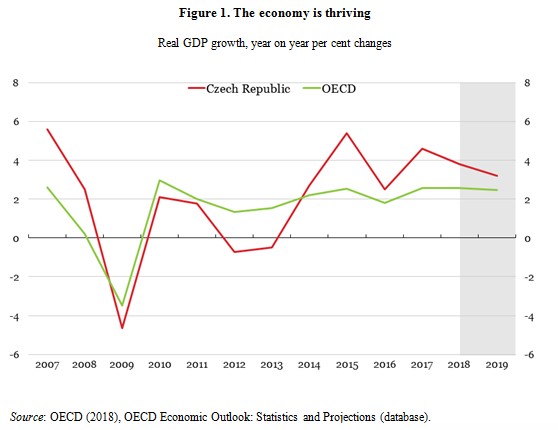
Growth, driven by both internal and external demand, has been accelerating since 2013 and at 4.6% in 2017 it was more balanced than in previous years. Household consumption is supported by income growth, a declining savings rate as confidence is high, and by rising credit. Going forward, private investment is projected to increase thanks to favourable credit conditions, and greater withdrawal of European Structural and Investment Funds. Moreover, the relative higher cost of labour than capital should stimulate physical capital investment.  Also, high housing demand and prices will continue to drive housing investment. However, growth will slow down in 2018 mainly due to labour supply constraints, but at 3.8%, growth will remain above its potential.

czech rep launch 2018 fig 1 blog

Inflation picked up strongly in 2017 reaching on average 2.5% after three years of being around 0.5%. Inflation will remain above the 2% target of the Central Bank, driven by high wage growth, strong household consumption and increasing oil prices. The current account has been positive in the last four years contributing to foreign reserve accumulation. However, after the exit from the exchange rate floor policy in April 2017, reserves (as a percent of GDP) started to decrease and the koruna to appreciate. As wages and inflation are rising, monetary policy should raise interest rates further at a gradual pace.

The fiscal position is strong but will be challenged by an ageing population. The primary balance increased to 2.3% in 2017 and has been in surplus for three years in a row. Therefore, debt-to-GDP is decreasing rapidly and at 35% of GDP in 2017 is one of the lowest in the OECD (Maastricht definition). According to new measures announced by the newly elected government, there is a risk of fiscal policy becoming pro-cyclical. In view of signs of overheating economy, fiscal policy should avoid being pro-cyclical. Some fiscal space is also needed to prepare for the rise in future ageing-related spending.

czech rep launch 2018 fig 2 blog

The lack of workers is becoming the main bottleneck to higher growth. The unemployment rate fell further in 2017 and at below 2.4% is among the lowest in the OECD. Until recently, labour shortages driven by demographic changes and high employment were partly offset by higher economic activity rates. However, the economy is facing constraints on the labour market and vacancies registered at employment offices increased more than seven-fold, from 30 803 in end 2010 to almost 267 000 in April 2018. Increasing labour productivity would sustain wage growth and help to cope with labour shortages. Providing workers with the right skills and training, as well as strengthening the effectiveness of R&D and innovation policies will be crucial to generate sustainable productivity gains and achieve inclusive growth.

References:

OECD (2018), OECD Economic Surveys: CZECH REPUBLIC 2018, OECD Publishing, Paris.


When size matters: scaling up delivery of Czech local services  

By Christine Lewis, Economist, Country Studies, OECD Economics Department

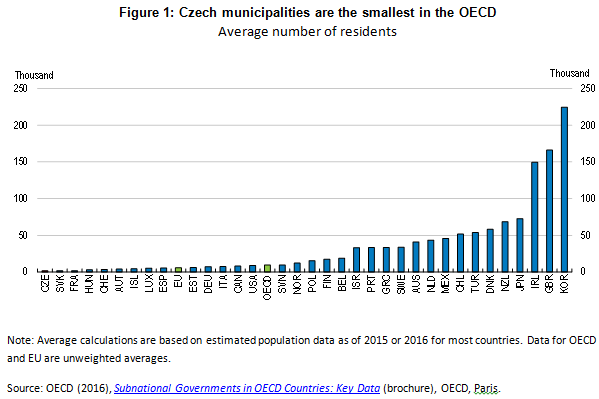
A key argument for small local governments is that they can better deliver the services that their residents want and need. A key question is: what size is too small?  When is the average cost of services too high, the range of choice too narrow or expertise spread too thinly across the country? These questions are especially relevant in the Czech Republic where there are over 6 200 municipalities – the smallest on average in the OECD (Figure 1). Almost one-quarter of municipalities have less than 200 residents; around three-quarters have less than 1 000 residents.

Czech municipalities smallest in oecd

Municipalities have important responsibilities in delivering key services including education, healthcare, transport, public housing and waste removal. It seems that scaling up some services could realise economies of scale and scope. For instance, schools tend to be small – around 60% of basic schools have less than 200 students – which limits their ability to cater to a larger range of needs (Shewbridge et al., 2016). In very small municipalities overheads may be crowding out spending on other services: administration costs per person were 50% higher in 2013 in municipalities with 100-200 residents than those with 1 000-2 000 residents.  Small municipalities also have more difficulties with technical procedures, like public procurement.

Scaling up service delivery does not necessarily mean mergers, although a number of OECD countries have taken this path. In Italy and Hungary certain services must be provided jointly if municipalities are below a threshold size. France provides financial incentives for co-operation. Non-financial incentives could be used to reinforce financial incentives.  Alternatively, service standards could be imposed to guarantee minimum standards across the country and induce greater co-operation to meet these standards. In any case, the central government should create a unit to monitor co-operation and facilitate co-operation between municipalities, with additional support from regional governments and the representative associations of municipalities.  A promising new programme is piloting centres of shared services, which should help mitigate skill shortages, and if successful, should be expanded systematically.

This process should be accompanied by more information about the performance of service providers. Norway’s KOSTRA system is an example of best practice in combining and publishing performance information. In the Czech Republic a lot of data already exist but are fragmented or not published. Publishing performance indicators and using them in benchmarking and in budgetary processes would better inform policymakers and provide stronger incentives to providers to raise service quality. It would also help citizens decide whether the right balance has been struck between municipal size and the service quality that they expect.

Reference:

OECD (2016), Economic Surveys: Czech Republic 2016, OECD Publishing, Paris.

Shewbridge, C. et al. (2016), OECD Reviews of School Resources: Czech Republic, OECD Publishing, Paris, forthcoming.


Leveraging R&D and innovation policies to foster productivity in Czech Republic

By Falilou Fall, Head of the Czech Republic Desk, Country Studies Branch, OECD Economics Department

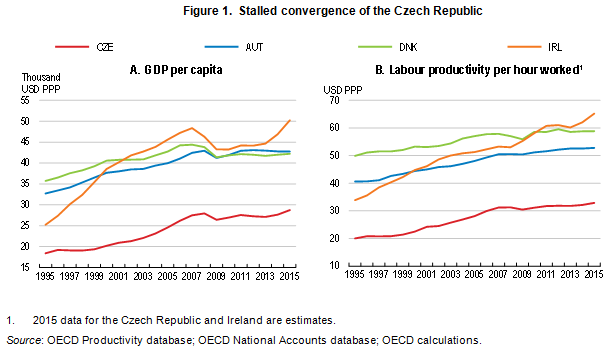
Productivity catch-up along with deeper integration into the global economy played a central role in the convergence of the Czech incomes toward OECD countries before the 2008 financial crisis. However, since then the convergence process has stalled. Labour productivity trends show a clear break in 2008 at the beginning of the crisis (Figure 1).  The growth rate of labour productivity fell from 4.3% per annum in  2001-07 to 0.4% between 2008-14, and affected all sectors except finance and insurance. The strongest decrease was in manufacturing.  As a result productivity is 21% below its pre-crisis trend, and potential productivity is 16% lower (OECD, 2016; Fall and Lewis (2016, forthcoming)). While cyclical developments are at play, the drop in productivity in all sectors indicates that the productivity shortfall is mainly structural. This suggests scope for improved structural policies to boost productivity in the Czech Republic.

Leveraging R&D-Czech Rep

Until 2008, inward foreign direct investment, international linkages of firms and credit availability had a significant impact on productivity growth. As the Czech economy is already one of the most integrated in global value chains, reviving the productivity catch-up process has to be domestically-driven. In particular, there is a need to boost productivity of Czech firms not affiliated to foreign firms and to facilitate the expansion of SMEs and the creation of new firms (Adalet McGowan et al., 2015).

More effective R&D and innovation (RDI) policies are needed to foster domestically-driven productivity growth. So far, R&D and innovation performance has been low despite a noticeable increase in spending. The increase in RDI spending should be continued as it is a key element for upgrading the economy in the global value chains. The Czech Government has put in place programmes to encourage higher business R&D spending by intensifying collaboration between businesses and research institutions. However, direct government funding of business RDI is modest, representing 0.1% of GDP in 2013. More co-financing should be developed to incentivise firms to mobilise their own resources. Well designed and properly administered tax incentives (fiscal deductions) for RDI should also be used to complement direct support. However, a balance should be maintained between different types of government funding through grants, loans, co-financing, loan guarantees and tax provisions.

Furthermore, streamlining the administration and implementation of innovation policy would increase the effectiveness of the different programmes. The organisation and administration of RDI policies is too complex. The fragmentation of innovation policies seems to be partly driven by the specialisation of the different government bodies along with a limited set of financial instruments available to each. The respective role of the different stakeholders (ministries, agencies, research institutions, councils and businesses) should be further clarified as they all intervene in the same areas. Also, it is necessary to unify the design, assessment and coordination of implementation of research and development and innovation policies in a single institution.

Reference

Adalet McGowan, M., D. Andrews, C. Criscuolo and G. Nicoletti (2015), The Future of Productivity, OECD Publishing, Paris,  See: http://www.oecd.org/economy/the-future-of-productivity.htm

OECD (2016), Economic Surveys: Czech Republic 2016, OECD Publishing, Paris.

Fall, F. and C. Lewis (2016), “Fostering productivity for inclusive growth in the Czech Republic”, forthcoming, OECD Publishing, Paris.