The Korean economy: resilient but facing challenges

By Christophe André, OECD Economics Department

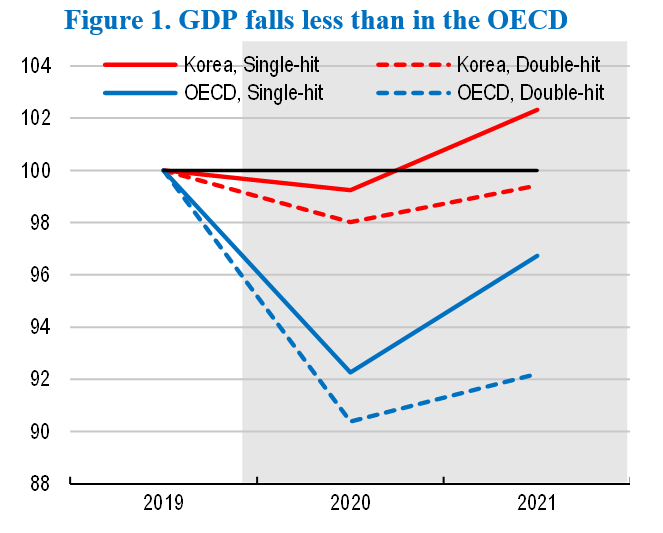
The prompt and effective reaction of the Korean authorities to contain the spread of COVID-19 limited the impact of the pandemic on the economy. Strong fiscal and monetary policy measures were quickly implemented to support households and businesses. As a result, the Korean economy is set to contract much less than other OECD economies in 2020, both in a scenario with no resurgence of the pandemic (single-hit scenario) and in a scenario assuming a second global wave of infections (double-hit scenario) (Figure 1).
Nevertheless, the pandemic generates strong headwinds. Some sectors, like transport, tourism and entertainment still suffer from substantially reduced activity. Exports, traditionally a key growth engine of the Korean economy, are hit by the weakness in the global economy. Additional obstacles to the operation of global value chains, in which Korea is strongly integrated, would deal a further blow to the economy. High uncertainty is holding back investment and employment has fallen, especially for non-regular workers.

Hence, continued support for households and businesses will remain crucial until the recovery is fully under way. It will need to be carefully tailored to preserve long-term fiscal sustainability and avoid hampering the reallocation of resources towards the sectors with the strongest growth prospects. Any additional income support should be targeted towards low-income households and skills training should be provided, even beyond the crisis, to vulnerable people who lost their job. Investment in areas featuring in the recent Korean New Deal, such as 5G, telecommunication and artificial intelligence, will help boost the knowledge-based economy. Green investments are essential to tackle current problems, not least air pollution, and to ensure long-term environmental sustainability.

The pandemic compounds pre-existing challenges, many of which are shared to various degrees by most OECD countries, notably rapid population ageing and relatively low productivity in parts of the economy. Korea has the fastest ageing population in the OECD, with the number of persons aged 65 or over projected to exceed 80% of the working-age population by 2060, the highest ratio in the OECD (Figure 2a). The shrinking working-age population will weigh on GDP growth over the coming decades. However, better mobilising labour resources, especially from women, older workers and youth, can partly counteract this trend, as well as help build a more inclusive economy and society. Moreover, each worker has the potential to create more value. While productivity is high in manufacturing, especially for information and communication technology equipment, it is lagging in services, including digital services (Figure 2b). The productivity gap between big firms and SMEs is wider than in most other OECD countries. Overall, Korea’s GDP per worker is about 20% below the OECD average, pointing to huge potential for catch-up.

As the population ages, scarcer labour resources will need to be used more effectively. Women’s employment rate is about 18 percentage points below that of men, despite very high average academic qualifications among women, especially in younger generations. Relatively low wages and weak career prospects discourage many women from working. The gender wage gap is the widest in the OECD, at about 34% in 2018, compared to an OECD average of about 13%. A number of recent government measures, in particular to enhance childcare quality, improve work-life balance and facilitate return to work after career breaks, could help reduce the gender gap. More broadly, a culture of gender equality needs to be promoted in the workplace and at home.

Koreans effectively retire at an advanced age, but often end their working lives in poor-quality non-regular jobs, after being forced to retire from their career job in their fifties. Maintaining high activity rates, while enhancing the quality of jobs for older workers, will be essential to sustain the economy’s growth potential. At the same time welfare measures are needed to increase support for the elderly who are most in need. Indeed, old-age poverty remains the highest in the OECD, with more than 40% of people aged 65 or over living in relative poverty.

Less than half of youth aged 15-29 were employed before the COVID-19 crisis, the fifth lowest share in the OECD. This reflects long studies, as more than two-thirds of youth obtain tertiary degrees, but also slow transition from education to employment. The crisis exacerbates the difficulties faced by youth entering the job market. To address skills mismatches, the government has stepped up career counselling, developed apprenticeships and vocational education (notably Meister schools) and introduced incentives for tertiary education institutions to propose more market-relevant degrees. Nevertheless, career guidance and counselling will need to be stepped up, in particular through increased resources for the public employment service and stronger involvement of employers.

Digital technologies, in which Korea is a top player, offer vast opportunities to raise firms’ productivity and people’s well-being. Policies should aim at promoting the diffusion of technology across the economy and addressing digital skills gaps. Regulatory reforms, based on the recent experiences with sandboxes, which allow waiving some regulatory obligations to encourage innovation in products or business models, could boost growth and offer people better access to valuable services, as illustrated by telemedicine during the COVID-19 crisis.

Altogether, Korea is proving exceptionally resilient during the annus horribilis the world economy is undergoing, even though the global recession is hurting exports. Korea also has strong cards to address the longer-term challenges it is facing.

References:
OECD (2020), OECD Economic Surveys: Korea 2020, OECD Publishing, Paris.
https://doi.org/10.1787/2dde9480-en


Korea: Roadmap to narrow digital gaps

By Mathilde Pak, OECD Economics Department

When it comes to emerging digital technologies, Korea is a top player, with an outstanding digital infrastructure and a dynamic ICT sector. 5G has been introduced nationwide earlier than in any other country in the world and has spurred numerous projects supported by the governement to enhance competitiveness, innovation and the quality of life: smart factories, smart grids, smart healthcare, smart cities, smart roads. Korea also stands out for its swift and effective use of advanced digital tools to contain COVID-19 without shutting down the economy. For instance, artificial intelligence enables fast testing, mobile apps provide real-time information on locations visited by patients diagnosed with COVID-19 (Figure 1) and untact (contactless) lifestyle limits the spread of the virus. The recent New Digital Deal further supports the use of digitalisation with projects exploiting synergies between the government and the business sector, including strengthening data infrastructures, expanding data collection and usage, establishing 5G network infrastructure early, promoting untact industries and developing artificial intelligence.

However, the diffusion of digital technologies among firms and workers is slow. The digital gap between SMEs and large enterprises is wide because SMEs face obstacles to the adoption of advanced technologies, like cloud computing and big data: lack of innovation, lack of information and funds, lack of skilled workers and low access to training. This digital gap creates wide productivity gaps, weighing on economy-wide productivity, which is far below the OECD average. Moreover, the digital gap between generations is the highest among OECD countries (Figure 2). In an ageing and increasingly digitalised society, this exacerbates well-being inequalities, as part of the population is left behind.

Digital opportunities to boost productivity and well-being are numerous but are not used to their full potential. To promote the diffusion of technology, the 2020 OECD Economic Survey of Korea highlights recommendations focussing on three main areas.

First, regulations for product and service markets remain stringent, holding back innovation and new business models, as well as competition and productivity growth. The government has introduced regulatory sandboxes allowing firms in new technologies and new industries to test their products and business models without being subject to all existing legal requirements. The temporary lifting of the ban on telemedicine during the COVID-19 outbreak illustrates the potential benefits of a timely review of regulations. After four years at most, if a regulatory sandbox is considered effective and safe, it can lead to the permanent suppression of the regulation that was temporarily waived, its amendment, or the extension of the trial period. It can also lead to the creation of licences with a narrower scope, for example for FinTech companies, which could be allowed to provide some banking services without needing a full banking licence. Follow up on this strategy should allow identifying excessive regulation and revise or abolish it, notably in the case of telemedicine.

Second, subsidies to SMEs should better target innovative and productive companies. Extensive government R&D support still largely props up low-productivity companies and scale-up success is limited. Innovation vouchers in the form of a one-off payment should be provided to SMEs in manufacturing and services to commission R&D and studies on potential for new technology introduction from universities and research institutions. They would help develop innovation networks, which are still limited in Korea, and facilitate the diffusion of digital technology. In addition to promoting collaboration between SMEs and academia, collaboration between SMEs and large enterprises should be further strengthened to enhance innovation diffusion, for instance through open collaborative platforms to exchange new products, services and big data. Financial support for technology R&D should also be reallocated to commercialisation for SMEs that successfully developed new technology.

Third, addressing the lack of adequate skills and awareness of digital benefits or dangers is crucial. SMEs face a lack of skilled workers in digital fields, limited access to ICT training and insufficient awareness of managers of the potential of digital technologies. Older generations often lack digital and basic skills to participate in online activities like e-commerce. Most teachers feel they are not sufficiently prepared to use ICT for teaching, which has been a hurdle during the COVID-19 school closures. A relatively high share of individuals experience privacy violation and youth are at higher risk of cyber-bullying and addiction to ICT technologies. More specialists and high-level researchers are needed in fourth industrial revolution core technologies like artificial intelligence and big data, as well as next-generation security technologies like blockchains and quantum cryptography communication. Higher-quality ICT education and training should be provided to enable students, teachers, SME workers and older people to thrive in a digital society.

The COVID-19 outbreak is strengthening the existing trend towards digitalisation, with a growing use of artificial intelligence and remote services like telework, telemedicine and e-commerce by firms and households. Narrowing the digital gap between firms and between workers is key to bring about a more rapid diffusion of technology and to make the most of digital opportunities to raise productivity and well-being.

References:

OECD (2020), OECD Economic Surveys: Korea 2020, OECD Publishing, Paris.
https://doi.org/10.1787/2dde9480-en
Pak, M. (2020), “Promoting the diffusion of technology to boost productivity and well-being in Korea”, OECD Economics Department Working Papers, OECD Publishing, Paris, forthcoming.


Impact of COVID-19 on Housing: how can policies support a healthy recovery?

By Boris Cournède, Federica De Pace and Volker Ziemann, OECD Economics Department

The COVID-19 pandemic has hit the housing sector particularly hard, but governments have swiftly responded with an array of measures to alleviate the negative consequences of the crisis for tenants, borrowers, builders and lenders. Most, if not all, of these measures are meant to be temporary. If they are maintained for too long, they can stand in the way of a robust recovery and/or impair the responsiveness of the housing market to the evolving needs of society. This blog reviews new OECD evidence of the impact of the COVID-19 crisis on construction and discusses policy trade-offs between the objectives of preserving short-term housing affordability for tenants and mortgage-holders, facilitating mobility and ensuring sufficient, environmentally sustainable supply. The full study is available on the OECD “Tackling the coronavirus” online hub: Housing Amid Covid-19: Policy Responses and Challenges.

The COVID-19 crisis has severely hit the housing sector

The spread of the COVID-19 pandemic destabilised the real estate sector throughout the world. Containment measures involved total or partial shutdowns of construction sites in many countries, and the associated income and revenue losses for households and enterprises adversely affected the outlook for the different segments of the property market, depending on the timing and stringency of confinement and the severity of the public health crisis, which differed across countries.

New OECD analysis draws on Google Trend data to mimic the construction sector’s Purchasing Managers’ Index (PMI) for a wide range of countries for which the PMI is not available. The results confirm the slump in the construction sector’s confidence during confinement but also suggest that the conditions have improved markedly across most countries, without, however, reaching February levels (Figure 1). It is noteworthy to remember that, following the original PMI’s definition, a positive reading of the index only suggests that activity is expanding not that output has come back to pre-crisis levels. It will certainly take some time in many countries before residential construction reaches pre-COVID-19 volumes. Besides, there remains considerable uncertainty about the extent to which the economic slump is going to weigh on future demand and the prospects of the sector at large.

Governments have introduced rescue and support measures

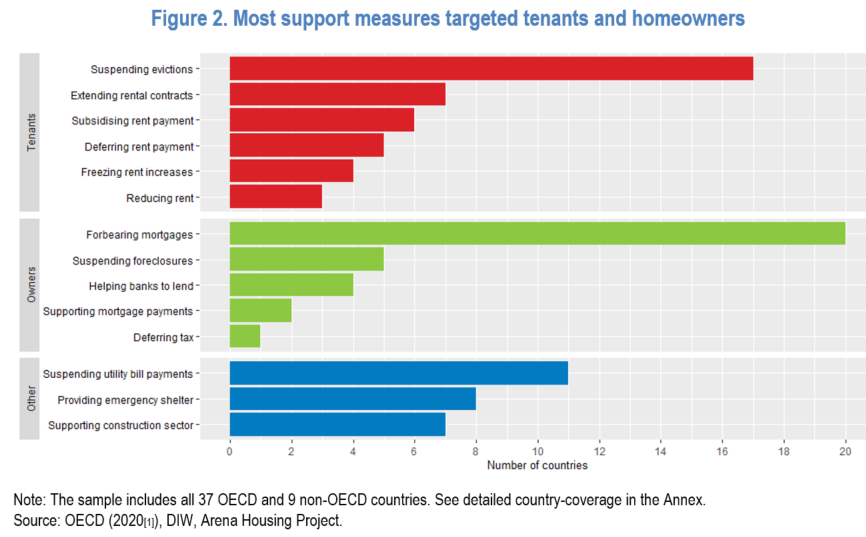
With the onset of the COVID-19 crisis, governments responded with a host of specific measures to protect mortgage-holders and tenants in addition to the support from social safety nets. A number of countries also intervened to help the post-crisis recovery of the construction sector (Figure 2). In most countries, emergency support involved a suspension of eviction procedures, temporary forbearance of rent and mortgage payments, and in some cases moratoria on utility payments. Most governments, at both national and local levels, also took specific steps to shelter the homeless during the lockdown.

Crisis-response measures are needed but involve policy trade-offs

While meeting an important objective of supporting tenants and borrowers during the crisis, several measures pose difficult policy trade-offs over the medium term (Figure 3). For example, if they are maintained for an extended period, measures that aim to preserve near-term affordability may create disincentives for the maintenance and expansion of the housing stock, as well as thwarting residential and labour mobility in the longer term. They may also undermine economic and financial resilience.

Measures that preserve housing affordability for mortgage-holders and tenants in the short term can have adverse longer-term side-effects. They can undermine resilience or compromise the long-term functioning of the housing market. If maintained for too long, tax advantages for mortgage-holders feed into house prices, creating instability and eroding affordability. A tightening of rent controls makes it more difficult for people who don’t already rent a dwelling to rent one and over time exacerbates housing shortages. Public authorities would do well to adopt a calendar for the phasing-out of COVID19-related tax advantages for mortgage holders and rental-market restrictions. Doing so would avoid letting emergency measures become new bottlenecks to the long-term efficiency of housing markets that would ultimately undermine affordability, inclusiveness and sustainability objectives.

By contrast, expanding capital spending on social housing, coupled with provisions ensuring that eligibility is portable, can generate benefits for both near-term affordability and long-term supply with limited adverse consequences for mobility. Furthermore, this kind of direct intervention in the market provides an opportunity for governments to promote and accelerate the spread of construction techniques that are aligned with environmental-transition sustainability objectives.

Furthermore, easing land-use restrictions is a way of facilitating the recovery of homebuilding and better aligning the supply of housing with evolving demand and the needs of society. Reforms to ease land-use restrictions deliver greater benefits if conducted within an integrated spatial planning framework across government sectors and hierarchies. The goal should be to encourage housing construction and improve affordability while enhancing neighbourhood liveability and avoid excessive spatial divergence in the access to public services, transportation systems and social infrastructure. Fostering residential construction could also accelerate the transition to a low-carbon economy provided that the new buildings are required to comply with sufficiently ambitious environmental standards.

Facilitating construction and redevelopment would also allow accommodating the possible long-term change in housing demand that the COVID-19 crisis may prompt. There is a possibility that the COVID-19 crisis may lead to lasting mutually linked changes in housing demand and work organisation. Preferences could shift in favour of living in lower-density areas and working remotely. This could slow or even reverse urban-rural divergences. First, such a shift would relieve demand pressures in overly-dense areas. Second, flexible workplace amid more teleworking would free office space for conversion to residential units in city centres, provided land use can accommodate the change. The combination of such demand and supply effects could reduce regional home price differentials and contribute to reducing residential segregation.

References:

Bétin, M. and V. Ziemann (2019), “How responsive are housing markets in the OECD? Regional level estimates”, OECD Economics Department Working Papers, No. 1590, OECD Publishing, Paris, https://dx.doi.org/10.1787/1342258c-en. [6]

Causa, O. and J. Pichelmann (2020), “Should I stay or should I go? Housing and residential mobility across OECD countries”, OECD Economics Department Working Papers forthcoming. [5]

Causa, O., N. Woloszko and D. Leite (2019), “Housing, wealth accumulation and wealth distribution: Evidence and stylized facts”, OECD Economics Department Working Papers, No. 1588, OECD Publishing, Paris, https://dx.doi.org/10.1787/86954c10-en. [2]

Cavalleri, M., B. Cournède and E. Özsöğüt (2019), “How responsive are housing markets in the OECD? National level estimates”, OECD Economics Department Working Papers, No. 1589, OECD Publishing, Paris, https://dx.doi.org/10.1787/4777e29a-en. [4]

Cournède, B., S. Sakha and V. Ziemann (2019), “Empirical links between housing markets and economic resilience”, OECD Economics Department Working Papers, No. 1562, OECD Publishing, Paris, https://dx.doi.org/10.1787/aa029083-en. [3]

OECD (2020), Policy responses to the Covid-19 crisis, http://oe.cd/covid19tablesocial. [1]


Business support must now facilitate the recovery from COVID-19

by Martin Borowiecki and Jon Pareliussen, OECD Economics Department

These are extraordinary times. Governments have shown through their unprecedented policy actions that they will do whatever it takes to support companies and workers through the COVID-19-induced lockdowns. The OECD COVID-19 Policy Tracker (OECD, 2020a) reports that massive credit supply, cash grants and tax deferrals provided unprecedented liquidity support for businesses. These policies have helped firms weather the sharp drop in demand resulting from the pandemic, and short-time work schemes allowed firms to maintain existing employment relationships to enable them to return fast to full production (OECD, 2020b). Without the extensive policy responses governments have swiftly put in place, nearly one in three companies would have faced liquidity shortfalls during lockdowns, and many otherwise viable firms would now be bankrupt (OECD, 2020c). But these measures came at the price of higher public and corporate indebtedness, may have kept unviable firms artificially alive, and may have increased the scope for lobbying and capture by sectoral interests.

As many countries are entering a new phase of re-opening, economic revival and rebuilding, under continued caution over health risks, governments will need to adjust life support to businesses. Loans and guarantees should be scaled back in favour of policies that help kick-start the economy and at the same time tackle long-term challenges such as climate change and digitalization. As some sectors will see persistently low demand, it is crucial that policies facilitate structural change. Several countries have already started to lay the ground for the recovery.

Policy support kept companies alive during the initial COVID-19 crisis

The COVID-19 shock has led governments and central banks to implement unprecedented measures to keep existing companies alive. They deployed extraordinary lending support in the form of loans and loan guarantees for struggling businesses in response to strict containment measures put in place to contain the impact of the pandemic (OECD, 2020d). For example, Germany has announced EUR 756 billion (22% of GDP) in public sector loans and guarantees in addition to unlimited credit supply by the national development bank KfW, followed by Italy (17% of GDP) and the United Kingdom (15%). The headline figures are upper limits, while the effective uptake of funds is often much lower (Figure 1). Nevertheless, targeted lending support came at massive fiscal costs and brings with it the risk of lobbying by big firms and capture by political powerful sectors. This bias remains even in countries coupling state support with a ban on dividend payments and share-buybacks, and excluding firms domiciled in tax havens.

  • Central banks provided massive liquidity injections to maintain credit supply to solvent firms, averting short-term liquidity issues from toppling otherwise healthy firms, and reducing the tail-risk of cascading failures from the insolvency of interconnected firms (Banque de France, 2020; Barnes et al., forthcoming). Five central banks have extended temporary liquidity facilities and started to directly purchase new classes of corporate bonds, including the Bank of England, the Bank of Japan, and the US Federal Reserve (OECD, 2020d).
  • SMEs are suffering most from the crisis because they have less cash reserves to weather the drop in demand. Several countries have programmes targeting SMEs, including equity funding and convertible loans for tech start-ups in France, Germany and the United Kingdom. Governments also improved access of capital-weak SMEs to existing loan schemes by temporarily easing co-financing requirements, as in Israel, the Netherlands and the United Kingdom.
  • Governments’ actions were also a response to falling global demand. At least 11 countries extended export credit guarantees to help stabilise demand in the wake of the disruption. For instance, the Swedish Export Credit Agency’s loan limit was extended to SEK 200 billion (about 3.8% of GDP) with a higher ceiling for guarantees for export credits.

Tax deferrals and cash support to foot companies’ wage bills and avoid permanent lay-offs provided additional liquidity at a time when many businesses saw a sharp drop in revenues due to the pandemic (Figure 2). They prevented the break-up of existing relationships between firms and their employees, ultimately laying the ground for a quicker recovery. However, their design often risks opportunistic behaviour by firms and unnecessarily restricts activity in sectors that remained open.

  • Tax deferrals were a common measure to alleviate pressures on cash-strapped businesses, with 41 of 43 countries having deferred tax payments at least until the end of June, often until the end of 2020.
  • Short-time work programmes, furloughing schemes and administrative measures to limit dismissals helped businesses stem their wage bill and preserve existing jobs. These schemes helped to dampen the hit to firms’ short-term liquidity (OECD, 2020c), but they may also hinder the transition of workers from unviable jobs to firms with better medium-term growth prospects (OECD, 2020d). In some countries, firms cannot flexibly reduce their workers’ hours as needed and keep some workers employed on a part-time basis, and generous replacement rates risk opportunistic behaviour by firms in sectors where confinement restrictions are lifted or where workers work remotely.
  • 35 out of 43 countries have used cash grants in addition to wage subsidies covering the hardest hit sectors, notably hospitality and tourism. In the Netherlands, for instance, firms that needed to close due to the coronavirus can receive a one-off lump sum allowance of EUR 4 000.
  • Another 18 of 43 countries introduced loan repayment moratoria and loan-maturity extensions to roll over their existing debt. In Hungary, for example, a 3 600 HUF billion (7.7% of GDP) moratorium on loan payments and interest offers debt relief until the end of 2020.

Policy now needs to focus on supporting demand for a sustained recovery

Moving forward, a new set of policies needs to replace life support to businesses. Policy should continue to support demand until the recovery has taken hold. Loans and guarantees should be scaled back in favour of fiscal policies that help kick-start the economy and structural policies that tackle long-term challenges such as climate change and digitalization. As some sectors will see persistently low demand, it is crucial that policies facilitate structural change.

A number of countries have already announced fiscal packages that give priority to private investment and public spending with presumably high multipliers. These packages could inform those currently in preparation in other countries.

  • Governments should prepare public investment plans that can be implemented swiftly in the recovery phase. Public investment in widely accessible digital infrastructure is important to ensure that businesses can reap the full benefits of digitalisation, and improved e-government can reduce the administrative burden for businesses. Among those countries emerging from the immediate health crisis, nine countries have announced public investment in digitalisation. An important component is the frontloading of the rollout of 5G infrastructure, as announced in China, Germany, Japan, Korea, and the United Kingdom. Parts of the German and Korean recovery packages aim to improve e-government services.
  • Streamlining planning regulations could help boost public investment during the recovery. In the United Kingdom, for example, the government announced a reform of the planning system to accelerate construction of public housing, hospitals and infrastructure.
  • Eleven governments provide additional tax relief measures for businesses to help spur private investment. For instance, Austria and Germany are extending the loss carry-back and extend depreciation allowances for the years 2020 and 2021.
  • Countries have also announced investment in the green transition to help put the recovery on a more sustainable footing by reducing CO2 emissions. The Korean government announced KRW 73.4 trillion (3.8% of 2020 GDP until 2025) of investment into renewable energy technologies and smart grids to raise energy efficiency.
  • Governments should take advantage of the ongoing digitalisation wave in response to the pandemic (OECD, 2020e) and support private investment of lagging firms to boost overall productivity. Korea, for instance, is bringing forward parts of its KRW 58.2 trillion (3% of 2019 GDP until 2025) investment plans for digitalisation (in so-called “New Deal” projects), while Japan supports the digitalisation of SMEs with JPY 0.9 trillion (0.2% of GDP).
  • Some countries have put in place measures to facilitate a fast resolution of insolvent firms, either through streamlined debt resolution or debt forgiveness (OECD, 2020d). The Netherlands, for instance, improved a dispute resolution mechanism as an alternative to bankruptcy.
  • Temporary VAT cuts as in Austria, Germany, or the United Kingdom could bring forward consumption spending, but they are often difficult to revert once the situation normalises. Furthermore, there are more transparent and effective instruments to support struggling sectors.

References:

Banque de France (2020), “Do highly indebted large corporations pose a systemic risk?” EcoNotepad Post no. 147, Banque de France, Paris.

Barnes, S., R. Hillman, D. MacDonald, and G. Wharf, “The impact of COVID-19 on corporate fragility: insights from a new calibrated firm-level corporate sector agent-based model” (forthcoming), OECD, Paris.

Brookings (2020), “What’s the Fed doing in response to the COVID-19 crisis? What more could it do?” Brookings Report, Brookings Institution, Washington D.C, https://www.brookings.edu/research/fed-response-to-covid19.

Bruegel (2020), “Government-guaranteed bank lending: beyond the headline numbers”, Bruegel Blog Post, Bruegel, Brussels, https://www.bruegel.org/2020/07/government-guaranteed-bank-lending-beyond-the-headline-numbers.

OECD (2020a), Country Policy Tracker (database), available at https://www.oecd.org/coronavirus/country-policy-tracker/ (Accessed 23 May 2020), Paris.

OECD (2020b), “Lockdown policies and people in the age of COVID-19: Lessons from the OECD Policy Tracker”, OECD COVID-HUB Policy Blog Post, OECD, Paris.

OECD (2020c), “Corporate sector vulnerabilities during the Covid-19 outbreak: assessment and policy responses”, OECD COVID-HUB Policy Brief, OECD Publishing, Paris,

OECD (2020d), OECD Economic Outlook, Volume 2020 Issue 1: Preliminary version, OECD Publishing, Paris, https://doi.org/10.1787/0d1d1e2e-en.

OECD (2020e), “The potential long-term impact of the COVID-induced development of teleworking on productivity” (forthcoming), OECD COVID-HUB Policy Brief, OECD, Paris.


Looking forward to a new summer in Greece: Returning Greece’s economy to a stronger, sustained and inclusive recovery from the COVID-19 shock

by Mauro Pisu and Tim Bulman, OECD Economics Department

Normally in mid-July each year, hundreds of thousands of families across Europe and the world would be packing their summer outfits and swimming costumes and heading to a long-awaited holiday in Greece. The 2020 global COVID-19 pandemic has disrupted such plans for most, just as it has disrupted livelihoods and well-being in so many respects.

COVID-19 has also interrupted Greece’s recovery from the great financial crisis. The newly launched 2020 OECD Economic Survey of Greece reports how Greece has responded swiftly to the first phase of the pandemic. Through tight containment measures, it has effectively limited infections and deaths (Figure 1). But the economy has been hit hard. As in other countries, containment measures, travel restrictions, social distancing and high uncertainty have led to a temporary but extraordinary drop in production. Weak activity is undercutting many jobs and is putting businesses at risk. To buttress households’ incomes and firms’ liquidity, the government swiftly rolled out emergency measures.

COVID-19 creates extraordinary uncertainty (Figure 2). While some parts of the economy have the potential to rebound quickly, others are likely to face an extended period of weak demand. The Survey identifies measures that can help Greece navigate this crisis:

  • Adjusting income and liquidity support measures, as the epidemiological and economic situation requires, will continue to protect households and firms. Boosting guaranteed minimum income support while strengthening job-search and training opportunities would protect households from the shock while opening new opportunities and help firms and workers moving towards activities with better prospects.
  • The COVID-19 shutdown has underscored the benefits of the government’s digitalisation agenda, with many public services moving online. Ensuring all the population has digital skills is likely to become even more essential to job prospects and job quality in the post COVID-19 world. Now is the time to invest in these skills, by boosting opportunities for adults to access education and training.
  • The COVID-19 containment measures have added to the pressures on family caregivers in Greece. More places for children in early childhood education and greater care support for families would open opportunities for primary caregivers to train and work outside the home.
  • The COVID-19 shock is likely to create new non-performing loans, yet reviving investment hinges on returning banks to health. The government’s Hercules plan is expected to lower banks’ non-performing loans significantly over the next two years. However, the shock has slowed progress. Urgently designing a strategy to address the deferred tax credits and the bad loans that will remain on banks’ balance sheets after the Hercules scheme can help banks contribute sooner to financing Greece’s recovery. Priority should also be given to expanding spending on infrastructure and improving support for research and development.

As the emergency passes, the Survey identifies priorities to place Greece back onto a path of a stronger, sustained and inclusive recovery. It finds that these measures together can raise long-term growth rates by 1% a year (Figure 3). These measures include:

  • Allowing small firms to flourish, create jobs and become more productive by reducing regulatory burdens. Greece has made great progress in recent years, but barriers remain high for professional services, such as lawyers and notaries. Codifying existing laws and regulations would make operating in Greece easier, both for firms and for the public administration responsible for implementing and enforcing regulations. The government’s digitalisation agenda makes great promises for reducing red tape, and can make courts more accessible and responsive.
  • The government has many research and development support schemes. Improving the take-up of these, for example by consolidating programmes, would provide a fillip to research and innovation in Greece, raising competitiveness and allowing new activities to emerge.
  • Taxes on labour are very high, discouraging employment. Reducing social security contributions, especially at low incomes, while continuing the fight against evasion, would support revenue.
  • Greeks suffer from high levels of air pollution, especially in urban areas. Reducing the subsidies for fossil fuels, while protecting the most vulnerable, would help clear the air, improve health and well-being.

For more details see:
OECD (2020), OECD Economic Surveys: Greece 2020, OECD Publishing, Paris, https://doi.org/10.1787/b04b25de-en.


Building back better: enhancing equal access to opportunities for all

by Laurence Boone, Aida Caldera Sanchez, Nikki Kergozou, Stefano Scarpetta

As some G20 countries are gradually re-opening their economies after a period of strict confinement measures, governments have the opportunity to build back better and make growth more inclusive. The COVID-19 crisis is generating new sources of inequality but also exacerbating the inequalities that existed before the crisis. Already disadvantaged groups, low-paid workers, those in non-standard forms of employment, including those in the informal sector, as well youth and many women have been disproportionally affected by the economic and social shock of the pandemic. These groups have been particularly exposed because of the nature of their jobs and because they suffer from weaker coverage by social protection tools. G20 Governments have acted quickly and boldly to provide immediate support for people and businesses, but building back better involves tackling these inequalities. Our new report prepared for the G20 discusses why these groups are disadvantaged and which levers governments can use to enhance access to opportunities for groups in more urgent need of support, including young people, women, informal and non-standard workers, low-income, low-skilled workers and SMEs (OECD, 2020[1]).

The pandemic is increasing the risk that children and young people struggle to access learning opportunities and potentially do not graduate, while those who do will find it harder to find work experience and jobs. There is a risk that confinement measures compound the inequalities in children’s learning linked to their family’s socio-economic status as parents with higher levels of education and higher income have more opportunities to telework or arrange their work schedules to spend time with their children. In the lead-up to the crisis many young people already struggled to gain a solid foothold in the labour market, with around 19% of 15-29 year-olds not in employment, education or training (NEET) on average across G20 economies (Figure 1). Young people are also often among the most affected during labour market downturns as they generally hold less secure jobs (Figure 2) (OECD, 2020[2]). While the effects of the pandemic on the labour market are just starting, the increase in the youth unemployment rate was almost double that for the entire working-age population. The youth unemployment rate increased from 14.3 to 18.6 percent between February and May across G20 countries for which data is available, compared to an increase from 6.0 to 8.2% for the working-age population1.

The first experiences of young people in the labour market is crucial: youth unemployment can have long-lasting scarring effects in terms of lower pay and higher unemployment (Bell and Blanchflower, 2011[3]; Schmillen and Umkehrer, 2017[4]). After the global financial crisis it took a whole decade, until 2017, before the youth unemployment rate returned to its pre-2008 level (OECD, 2020[2]). We can promote more equal access to opportunities for children and young people by targeting resources to disadvantaged schools and students, investing in high-quality teachers and school leaders and ensuring qualified educational staff and high staff-child ratios. Effective employment and social support, such as job search assistance and counselling, and work experience opportunities are important to help young people in their transition to the labour market. Targeted employment support and screening for barriers to access opportunities can help ensure that all young people, and particularly the most disadvantaged, receive the type and intensity of employment and welfare support that they need. Close collaboration between schools and the public and private employment services can help increase the effectiveness of these services.

Low-income, low-skill workers are being hit hard by the pandemic on multiple fronts. Low-income workers are less able to work from home, are more likely to be working in sectors affected by shutdowns and are more likely to have suffered job or earnings loss. Even in the years leading up to the crisis, low-income, low-skill workers faced the risk of being replaced by digital and automated solutions (Nedelkoska and Quintini, 2018[5]). The crisis has pushed societies even more towards greater online sales and remote working. This push is likely to speed up digitalisation and automation trends, resulting in an even larger change in the demand for skilled jobs over the coming years. Building a sustainable and inclusive recovery means investing in people. Through upskilling and reskilling, especially in digital technologies, we can make digitalisation an enabler rather than competition for these workers. This calls, however, for reducing financial, time and scheduling barriers to participation in adult learning and for making sure that education and training programmes respond to the demand for skills in today’s and future labour markets. Online training offers many opportunities to expand access to adult learning, but low-skill workers may lack the skills to make the most of this kind of training and may need extra support.

The pandemic recession has affected labour market prospects for women more than men so far. Many of the sectors most directly affected by COVID-19 are major employers of women. Even at the onset of the pandemic, women already faced difficulties accessing the same labour market opportunities as men. Women are less likely to participate in the labour market (Figure 3), and those who do work on average in jobs of poorer quality, with lower earnings and a greater incidence of part-time and informal work. These gender differences in employment rates, hours worked and hourly earnings cumulate over people’s lives into a substantial gender gap in labour income. Across advanced G20 countries with available data, this gap ranges from around 30% in Canada to over 70% in Turkey. Outside of their paid job, the COVID-19 crisis likely amplified women’s unpaid workload at home (OECD, 2020[2]). G20 countries have made significant progress to reducing the gender gap in labour force participation but the pandemic has rolled some of this back. Recovery policies need to double down on reducing gender gaps in labour force participation by expanding access to quality formal childcare, reforming paid family-leave policies and strengthening long-term care systems. Further efforts will be needed to reduce the gender gap in earnings and the incidence of low pay among women by fighting gender biases and stereotypes, by attracting more women into careers in science, technology, engineering and mathematics, and by increasing the representation of women in leadership positions.

Informal and non-standard workers, including workers on temporary contracts, in part-time jobs and the self-employed, are particularly exposed to job and income losses in any crisis (OECD, 2020[2]). At the same time, these workers often benefit less, or do not benefit at all, from social protection measures and health coverage. A sizeable share of workers undertake non-standard work (OECD, 2020[6]), while informal workers make up 33 to 91 percent of all workers in emerging G20 economies with available data (Figure 4). The crisis has highlighted the extent of this vulnerability by forcing some non-standard and informal workers to choose between protecting themselves from the virus and having an income. Many countries have recognised this difficult situation and have put in place emergency income support, scaling up means-tested assistance of last resort, introducing new ad-hoc cash transfers and providing direct support for expenses. However, these disadvantages in labour market conditions have structural roots. These workers are often faced with lower job quality and fewer opportunities for training and career development. To ensure a more resilient and inclusive economy and society, we need to help more workers get good quality jobs and benefit from social protection systems. We can do this by encouraging formal job creation, in part by ensuring effective labour market regulation that avoids unnecessarily adding to the cost of formal employment, increasing the perceived benefits of formal employment, keeping labour taxes moderate and strengthening enforcement methods and compliance. We can improve access to training and career development for these workers by making training rights portable between jobs and available to all irrespective of employment status through individual learning schemes.

SMEs are facing dramatic revenue losses and severe liquidity shortages as a result of the pandemic. Small and medium-sized enterprises (SMEs) account for the majority of overall employment and have a considerable impact on employment growth (OECD, 2019[7]; Koirala, 2019[8]). The sudden loss of revenue could translate into insolvency problems and unnecessary bankruptcy for SMEs who in normal times are viable and sound businesses. Building back better also involves creating the right conditions for SMEs to thrive. We can create these by improving access to finance, creating a business-friendly environment that creates an equal playing field across businesses of all sizes, reducing regulatory barriers and supporting women and youth entrepreneurship.

We have a chance to build back better and make growth more inclusive. But to do this, we need to tackle the inequalities that existed well before this pandemic and are now getting worse. Governments have many levers to make this happen. G20 Governments need to keep acting boldly to make sure that the recovery benefits everyone.

References

Bell, D. and D. Blanchflower (2011), “Young people and the Great Recession”, Oxford Review of Economic Policy, Vol. 27/2, pp. 241-267, http://dx.doi.org/10.1093/oxrep/grr011. [3]

Koirala, S. (2019), “SMEs: Key drivers of green and inclusive growth”, OECD Green Growth Papers, No. 2019/03, OECD Publishing, Paris, https://dx.doi.org/10.1787/8a51fc0c-en. [8]

Nedelkoska, L. and G. Quintini (2018), “Automation, skills use and training”, OECD Social, Employment and Migration Working Papers, No. 202, OECD Publishing, Paris, https://dx.doi.org/10.1787/2e2f4eea-en. [5]

OECD (2020), “Distributional risks associated with non-standard work: Stylised facts and policy considerations”, OECD Policy Responses to Coronavirus (COVID-19), https://read.oecd-ilibrary.org/view/?ref=134_134518-2bfush541w&title=Distributional-risks-associated-with-nonstandard-work-Stylised-facts-and-policy-considerations. [6]

OECD (2020), “Enhancing equal opportunities for all in G20 countries”, Background note to the G20 Framework Working Group (FWG). [1]

OECD (2020), OECD Employment Outlook 2020: Worker Security and the COVID-19 Crisis, OECD Publishing, Paris, https://dx.doi.org/10.1787/1686c758-en. [2]

OECD (2019), OECD SME and Entrepreneurship Outlook 2019, OECD Publishing, Paris, https://dx.doi.org/10.1787/34907e9c-en. [7]

Schmillen, A. and M. Umkehrer (2017), “The scars of youth: Effects of early-career unemployment on future unemployment experience”, International Labour Review, Vol. 156/3-4, pp. 465-494, http://dx.doi.org/10.1111/ilr.12079. [4]


After the Covid-19 crisis, Slovenia needs to focus on population ageing challenges

by Jens Høj, Slovenia Desk, OECD Economics Department

Slovenia was one of the best preforming OECD economies until the Covid-19 outbreak. The health crisis was smaller than in most other counties, helped by early implementation of containment measures.

Extensive fiscal measures were implemented to support jobs and incomes. Nonetheless, the ensuing economic crisis will be as severe as in other countries, reflecting the openness of the small Slovenian economy. The economic recovery should pick up unless a new outbreak materialise, which could lead to higher long-term unemployment and lower growth.

Once the Covid-19 economic crisis is under control, the government needs to start addressing population ageing challenges as this will lead to a higher number of pensioners and as the labour force becomes smaller and older. These developments are creating two main long-term challenges. The first is to contain ageing-related spending increases in pensions and health and long-term care. Longer working lives is key to secure the pension system’s fiscal sustainability, while better use of economic signals is needed to improve the efficiency and effectiveness of the health and long-term care systems. The second challenge is to sustain growth with a changing workforce. In the near-term, underutilised labour resources, such as older and low-skilled workers, need to be mobilised. Thereafter, maintaining growth and income convergence requires faster productivity growth, pointing to a need for continuously improving labour allocation. For this to be realised, labour market institutions have to adjust to ensure that workers’ reward reflects to a higher degree individual productivity and efforts. In addition, more geographical labour mobility is needed, pointing to a need to develop further the housing market.

Reference:
OECD (2020), OECD Economic Surveys: Slovenia 2020, OECD Publishing, Paris, https://doi.org/10.1787/a4209041-en.


A Successful Journey: Costa Rica’s Economic Reforms, 2015-2020

By Alberto González Pandiella, Patrick Lenain, Mauro Pisu and Enes Sunel

On 15 May 2020, Costa Rica was invited to join the OECD as its 38th member, marking the successful completion of a thorough review by the organisation, including three OECD Economic Surveys (OECD, 2016; OECD, 2018a; and OECD, 2020). This “journey” towards accession involved multiple reforms to boost the country’s economic growth and distribute its benefits to all Costa Ricans. Thanks to these ongoing reforms, Costa Rica is better prepared to confront the COVID-19 crisis and to boost its long-term growth.

Steady and resilient growth

With a strong commitment towards trade openness, Costa Rica has attracted large inflows of foreign direct investment, helping to move up the value chain and upgrade the composition of its exports. The country has also been a magnet of international tourism thanks to its rich natural capital, especially its biodiversity and rainforest, and policies to protect it. These factors, together with rising real incomes, have sustained steady and resilient growth, with quick rebounds following exogenous shocks (Figure 1). Real GDP per capita has consequently tripled over the past 30 years and reached nearly USD 20 000 in 2019, close to the Latin American average (OECD, 2018a).

The COVID-19 outbreak has however inflicted a severe hit to economic activity, jobs, and the well-being of Costa Ricans. Innovative policy measures introduced to provide cash and liquidity support to households and firms will help to avoid long-term damages. However, the return to a normal situation is mired with very large uncertainties and depend on epidemiological developments and the speed of the global recovery.

Recent reforms will boost the productivity of local firms

Apart from the coronavirus outbreak, Costa Rica faces several challenges to continue its past performance.  The process of income convergence in emerging economies typically involves increasing productivity towards the “frontier” prevailing in advanced economies. However, in Costa Rica labour productivity growth has lagged peers for many years. Low productivity levels explain to a large extent the income gap with OECD countries (Figure 2). In 2016, GDP per hour worked was only USD 18.6 compared with an OECD average of USD 51.9 (OECD, 2018b).

Openness to foreign direct investment can help to revert these trends. Research published by the OECD shows a positive correlation between the presence of foreign firms and the productivity of local Costa Rican firms in both the manufacturing and the services sectors (OECD, 2018c). Research has also found that public policy to boost linkages between foreign-owned and local firms helps knowledge diffusion (Alfaro-Urena et al., 2019). Nonetheless, Costa Rica remains a dual economy, with a modern sector in free trade zones and traditional enterprises outside them. To boost aggregate productivity the government policy should therefore continue to stimulate the productivity of local firms.

Recent reforms have sought to stimulate business dynamism by enhancing product-market competition and levelling the playing field between state-owned firms and the private sector. As a part of the OECD accession process, legislation adopted by Congress has strengthened the competition authorities and curtailed political interference in state-owned enterprises. Tentative estimates suggest that these two reforms, when fully implemented, could boost the level of GDP per capita by nearly 10% within 5 years – a very significant improvement (OECD, 2020). Closing existing gaps in transport infrastructure, particularly roads, would also have a large productivity pay-off (Pisu and Villabos, 2016).

A fiscal reform to address budgetary challenges

The COVID-19 crisis will increase budget deficits around the world. This along with large drops in nominal GDP will result in higher public debt ratios. Costa Rica is not an exception, with its budget deficit projected to reach 9% of GDP in 2020. This is a large deficit but is, to a large extent, attributable to the deteriorated fiscal position inherited from the past (Figure 3), which has limited the government’s capacity to respond to the COVID-19 shock. Before the pandemic struck, high public debt and low ratings from credit agencies put Costa Rica’s borrowing costs above those of peer Latin American countries. With fast-rising interest payments and large borrowing requirements (projected to reach 15% of GDP in 2021), government policy will need to focus once again on reducing the budget deficit. 

The ambitious fiscal reform approved by Congress in December 2018 will provide the necessary framework to bring down public debt. The approval of this reform, which had been in the works for nearly two decades, has been a major step toward restoring fiscal sustainability. The legislation introduced a VAT system, more progressive income tax rates, and a spending rule constraining government outlays when public debt reaches specific thresholds. If fully implemented, the reform is expected to yield cumulated savings of 3.9 % of GDP over 2019–23. Policy efforts will need also to rationalise the remuneration of public sector workers, which has been growing above private sector wages for a long time, contributing to a high level of income inequality (González-Pandiella and Gabriel, 2017).

Costa Rica’s journey towards OECD membership has already involved many important reforms, which have the potential to boost long-term economic growth and inclusiveness, and improve fiscal sustainability.  But, achieving the OECD membership is not the end of the journey. As a member of the OECD, Costa Rica will be in a better position to design and implement better policies by exchanging views, policy lessons and best practices with other member countries. This can inform the national dialogue and political debates on policies to boost economic performance and share its benefits among all Costa Ricans. Other countries will also learn from Costa Rica’s valuable experiences in areas such as attracting foreign direct investment, diversifying the exports basket, preserving natural resources or ecotourism, making it a really good journey for all.

REFERENCES

Alfaro-Urena, Alonso and Manelici, Isabela and Vasquez, Jose P. (2019), The Effects of Joining Multinational Supply Chains: New Evidence from Firm-to-Firm Linkages, http://dx.doi.org/10.2139/ssrn.3376129.

González Pandiella, A. and M. Gabriel (2017), “Deconstructing income inequality in Costa Rica: An income source decomposition approach”, OECD Economics Department Working Papers, No. 1377, OECD Publishing, Paris, https://doi.org/10.1787/77759015-en.

OECD (2020), OECD Economic Surveys: Costa Rica 2020, OECD Publishing, Paris, https://doi.org/10.1787/2e0fea6c-en.

OECD (2018a), OECD Economic Surveys: Costa Rica 2018, OECD Publishing, Paris, https://dx.doi.org/10.1787/eco_surveys-cri-2018-en.

OECD (2018b), “Setting the scene: An overview of Costa Rica’s productivity performance”, in OECD Economic Survey of Costa Rica: Research Findings on Productivity, OECD Publishing, Paris, https://doi.org/10.1787/9789264298774-2-en.

OECD (2018c), “FDI spillovers in Costa Rica: boosting local productivity through backward linkages”, in OECD Economic Survey of Costa Rica: Research Findings on Productivity, OECD Publishing, Paris, https://doi.org/10.1787/9789264298774-3-en.

OECD (2016), OECD Economic Surveys: Costa Rica 2016: Economic Assessment, OECD Publishing, Paris, https://dx.doi.org/10.1787/eco_surveys-cri-2016-en.

Pisu, M. and F. Villalobos (2016), “A bird-eye view of Costa Rica’s transport infrastructure”, OECD Economics Department Working Papers, No. 1323, OECD Publishing, Paris, https://doi.org/10.1787/5jlswbwvwqjf-en.


Un viaje exitoso: las reformas económicas de Costa Rica, 2015-2020

Por Alberto González Pandiella, Patrick Lenain, Mauro Pisu y Enes Sunel

El 15 de mayo de 2020, Costa Rica fue invitada a unirse a la OCDE como su miembro número 38, lo que marca el final de un proceso de revisión exhaustiva por parte de la organización, incluidas tres estudios económicos de la OCDE (OCDE, 2016; OCDE, 2018a y OCDE, 2020). Este camino hacia la adhesión implicó iniciar múltiples reformas para impulsar el crecimiento económico y distribuir sus beneficios a todos los costarricenses. Gracias a las reformas en curso, Costa Rica está mejor preparada para enfrentar la crisis de COVID-19 e impulsar su crecimiento a largo plazo.

Crecimiento estable y resistente

Con un fuerte compromiso con la apertura comercial, Costa Rica ha atraído grandes flujos de inversión extranjera directa. Esto ha ayudado a progresar en la cadena de valor y mejorar la composición de sus exportaciones. El país también ha sido un imán para el turismo internacional. Esto ha sido gracias a su rico capital natural, especialmente su biodiversidad y la gran extensión de selva tropical, y a las políticas para protegerlo. Estos factores, junto con el aumento de los ingresos reales, han permitido un crecimiento constante y resistente, con rápidas recuperaciones a los shocks exógenos (Figura 1). El PIB real per cápita se ha triplicado en los últimos 30 años y alcanzó casi USD20,000 en 2019, cerca del promedio latinoamericano (OCDE, 2018a).

Sin embargo, el brote de COVID-19 ha infligido un duro golpe a la actividad económica, el empleo y el bienestar de los costarricenses. Se han puesto en marcha innovadoras medidas para proporcionar apoyo monetario y liquidez a los hogares y las empresas afectadas, ayudando a evitar daños a largo plazo. Sin embargo, el retorno a una situación normal está plagado de grandes incertidumbres y depende del desarrollo epidemiológico de la pandemia y la velocidad de la recuperación global.

Las reformas recientes impulsarán la productividad de las empresas locales

Además del brote de coronavirus, Costa Rica enfrenta varios desafíos para continuar con su desempeño anterior. El proceso de convergencia de ingresos en las economías emergentes generalmente implica aumentar la productividad hacia la “frontera” que prevalece en las economías avanzadas. Sin embargo, en Costa Rica, el crecimiento de la productividad laboral ha quedado rezagado con respecto a sus pares durante muchos años. Los bajos niveles de productividad explican en gran medida la brecha de ingresos con los países de la OCDE (Figura 2). En 2016, el PIB por hora trabajada fue de solo USD 18.6 en comparación con un promedio de la OCDE de USD 51.9 (OCDE, 2018b).

La apertura a la inversión extranjera directa puede ayudar a revertir estas tendencias. La investigación publicada por la OCDE muestra una correlación positiva entre la presencia de empresas extranjeras y la productividad de las empresas costarricenses locales en los sectores manufacturero y de servicios (OCDE, 2018c). La investigación también ha encontrado que la política pública para impulsar los vínculos entre las empresas locales y de propiedad extranjera ayuda a la difusión del conocimiento (Alfaro-Urena et al., 2019). No obstante, Costa Rica sigue siendo una economía dual, con un sector moderno en zonas de libre comercio y empresas tradicionales fuera de ellas. Para impulsar la productividad agregada, la política gubernamental debería continuar estimulando la productividad de las empresas locales.

Las reformas recientes han tratado de estimular el dinamismo empresarial mejorando la competencia en el mercado de productos y nivelando el campo de juego entre las empresas estatales y el sector privado. Como parte del proceso de adhesión a la OCDE, la legislación adoptada por el Congreso ha fortalecido a las autoridades de competencia y reducido la interferencia política en las empresas estatales. Las estimaciones provisionales sugieren que estas dos reformas, cuando se implementen por completo, podrían aumentar el nivel del PIB per cápita en casi un 10% en 5 años, una mejora muy significativa (OCDE, 2020). Cerrar las brechas existentes en la infraestructura de transporte, en particular las carreteras, también tendría una gran efecto positivo (Pisu y Villabos, 2016).

Una reforma fiscal para abordar los desafíos presupuestarios

La crisis de COVID-19 aumentará los déficits presupuestarios en todo el mundo. Esto, junto con grandes caídas en el PIB nominal, dará como resultado ratios de deuda pública más altos. Costa Rica no es una excepción, ya que se prevé que el déficit presupuestario alcance el 9% del PIB en 2020. Este es un gran déficit, pero es, en gran medida, atribuible al deterioro de la posición fiscal heredada del pasado (Figura 3), que ha limitado la capacidad del gobierno para responder al shock COVID-19. Antes de que se desatara la pandemia, la alta deuda pública y las bajas calificaciones de las agencias de crédito ya habían colocado los costos de endeudamiento de Costa Rica por encima de los de los países latinoamericanos pares. Con el rápido aumento de los pagos de intereses y las grandes necesidades de financiación (que se proyecta alcanzarán el 15% del PIB en 2021), la política gubernamental deberá centrarse una vez más en reducir el déficit presupuestario.

La ambiciosa reforma fiscal aprobada por el Congreso en diciembre de 2018 proporcionará el marco necesario para reducir la deuda pública. La aprobación de esta reforma, que había estado en discusión durante casi dos décadas, ha sido un paso importante hacia la sostenibilidad fiscal. La legislación introdujo un sistema de IVA, tasas de impuesto sobre la renta más progresivas y una regla de gasto que limita el crecimiento del gasto del gobierno cuando la deuda pública alcanza umbrales específicos. Si se implementa completamente, se espera que la reforma produzca ahorros acumulados del 3.9% del PIB durante 2019–23. Es pertinente también realizar esfuerzos para racionalizar la remuneración de los trabajadores del sector público, que ha estado creciendo por encima de los salarios del sector privado durante mucho tiempo, contribuyendo a un alto nivel de desigualdad de ingresos (González Pandiella y Gabriel, 2017).

El viaje de Costa Rica hacia la membresía de la OCDE ya ha involucrado muchas reformas importantes, que tienen el potencial de impulsar el crecimiento económico y la inclusión a largo plazo, y mejorar la sostenibilidad fiscal. Pero lograr la membresía de la OCDE no es el final del viaje. Como miembro de la OCDE, Costa Rica estará en una mejor posición para diseñar e implementar mejores políticas mediante el intercambio de puntos de vista, experiencias y mejores prácticas con otros países miembros. Esto puede orientar el diálogo nacional y los debates políticos sobre políticas para impulsar el desempeño económico y compartir sus beneficios entre todos los costarricenses. Otros países también aprenderán de las valiosas experiencias de Costa Rica en áreas como atraer inversión extranjera directa, diversificar la canasta de exportaciones, preservar los recursos naturales o el ecoturismo, lo que hará de este viaje un buen viaje para todos.

Referencias

Alfaro-Urena, Alonso, Manelici, Isabela y Vasquez, Jose P. (2019), The Effects of Joining Multinational Supply Chains: New Evidence from Firm-to-Firm Linkages, http://dx.doi.org/10.2139/ssrn.3376129.

González Pandiella, A. y M. Gabriel (2017), “Deconstructing income inequality in Costa Rica: An income source decomposition approach”, OECD Economics Department Working Papers, No. 1377, OECD Publishing, Paris, https://doi.org/10.1787/77759015-en.

OECD (2020), OECD Economic Surveys: Costa Rica 2020, OECD Publishing, Paris, https://doi.org/10.1787/2e0fea6c-en.

OECD (2018a), OECD Economic Surveys: Costa Rica 2018, OECD Publishing, Paris, https://dx.doi.org/10.1787/eco_surveys-cri-2018-en.

OECD (2018b), “Setting the scene: An overview of Costa Rica’s productivity performance”, in OECD Economic Survey of Costa Rica: Research Findings on Productivity, OECD Publishing, Paris, https://doi.org/10.1787/9789264298774-2-en.

OECD (2018c), “FDI spillovers in Costa Rica: boosting local productivity through backward linkages”, in OECD Economic Survey of Costa Rica: Research Findings on Productivity, OECD Publishing, Paris, https://doi.org/10.1787/9789264298774-3-en.

OECD (2016), OECD Economic Surveys: Costa Rica 2016: Economic Assessment, OECD Publishing, Paris, https://dx.doi.org/10.1787/eco_surveys-cri-2016-en.

Pisu, M. y F. Villalobos (2016), “A bird-eye view of Costa Rica’s transport infrastructure”, OECD Economics Department Working Papers, No. 1323, OECD Publishing, Paris, https://doi.org/10.1787/5jlswbwvwqjf-en.


The US COVID-19 recession – Will this time be different?

By D. Azzopardi, M. Hermansen, P. Lenain and D. Sutherland, OECD Economics Department

As COVID-19 hit the United States, non-essential businesses had to shut down and large numbers of workers lost their jobs. The unemployment rate went from a low point of 3.5% in early 2020 to a post-war record high of 14.7% in just two months. With the easing of confinement and the reopening of businesses, many workers were recalled and the unemployment rate fell back to 11.1% in June 2020. After this initial rapid improvement, however, further declines are likely to be slower. The OECD projects that unemployment will still be in the range of 8-10% at the end of 2021, depending on how fast the coronavirus epidemics is controlled, leaving millions of workers without a job (OECD, 2020a).

Business cycle regularities

A striking regularity of business cycles is that unemployment always rises much faster than it falls. The US economy has a remarkable capacity to create jobs after recessions, bringing unemployment back down to a low range of 3-5%. However, this takes time. Many workers lose their link to a previous employer during recessions and need to go through a time-consuming process of job search, retraining, relocation, and temporary contracts before securing stable employment (Gregory et al., 2020). As a consequence, after a recession, the unemployment rate typically declines at the slow average pace of about 0.55 percentage point per year (Hall and Kudlyak, 2020). After the 1981-82 recession, unemployment did not reach 5% until 1989. After the 2008 financial crisis, it took 10 years for the economy to return to full employment (Figure 1). If this historical regularity still applies, the United States may not return to full employment until the early 2030s. Adopting policy reforms to hasten the return to work would mitigate the impact on job seekers in terms of earning losses and well-being (Davis et al., 2011).

A large reallocation shock has hit workers providing in-person services

The COVID-19 crisis is not a typical recession. Instead of coming from the accumulation of imbalances (inflation in early 1980s, credit bubble in 2008), it results from government lockdown orders to protect the population from the pandemic. Once businesses reopen, some workers are quickly reemployed. Judging from the experience of New Orleans after Hurricane Katrina, unemployment can decrease fast as sectors such as retail trade, education and social services restart their activity (Figure 1). However, the COVID-19 pandemic is likely to have a longer-lasting impact: sectors such as air transport, leisure, entertainment, accommodation and food services may remain depressed for a long time if distancing and customer anxiety continue to prevail. In June 2020, despite progress in reopening, 10 million jobs had still been lost in shutdown sectors, and the unemployment rate was still close to 30 percent in the leisure and hospitality industry (Figure 2).

The coronavirus crisis has been characterized as a “reallocation shock” (Barrero et al, 2020) because many workers providing in-person services will have to find work in other parts of the economy. Past sector-specific shocks show that such a reallocation can be difficult. After the China shock of early-2000s (Autor, 2016), which hit the manufacturing industry hard in the Midwest, it took 15 years to return to earlier levels of employment in this region.

The new Job-to-Job dataset of the Census Bureau shows that many manufacturing workers were able to move to other industries or to other parts of the country after the China shock, but low skilled and seniors faced greater difficulties (Azzopardi et al, 2020). The same dataset suggests many construction workers struggled to return to work after the 2008 burst of the housing bubble. This is worrying because the sectors presently locked down employ a large share of workers who will have difficulties moving to new industries, and these jobs are often entry points for workers joining or re-joining the labour force. If previous patterns once again emerge, the sluggish reallocation of workers may prevent the United States from returning quickly to full employment.

Lessons from the past also suggest that a set of regulatory easing measures and support to dismissed workers could help. Regulations introduced in past decades at the state level – especially mandatory occupational licenses, non-compete contracts, and housing regulations ¬– hinder the fluidity of the worker-job matching process and slow down the reallocation of workers across industries (Hermansen, 2019). Easing these restrictions, for instance by eliminating these requirements when not clearly justified or through interstate reciprocity agreements, would quicken the return to full employment. Similarly, a reform of unemployment benefits from passive support to active policies favouring labour-market reintegration, reskilling and geographic mobility — would help the return to work of job seekers and avoid long spells of unemployment and their scarring effects. These policy options are detailed in the new OECD Economic Survey of the United States (OECD, 2020b).

References

Autor, D., D. Dorn and G. Hanson (2016), “The China Shock: Learning from Labor-Market Adjustment to Large Changes in Trade”, Annual Review of Economics,

Azzopardi, D. et al. (2020), ”Why has labour mobility declined in the United States? Insights from a new dataset”, Technical Background Paper, forthcoming.

Barrero, J. M., N. Bloom and S.J. Davis (2020), “COVID-19 Is Also a Reallocation Shock”, Brookings Papers on Economic Activity, Summer 2020.

Davis, Steven J. and Till Von Wachter (2011), “Recessions and the Costs of Job Loss”, Brookings Papers on Economic Activity, Fall.

Gregory, Victoria, Guido Menzio and David G. Wiczer (2020), “Pandemic Recession: L or V-Shaped?”, NBER Working Paper No. 27105

Hall, Robert E. and Marianna Kudlyak (2020), Why Has the US Economy Recovered So Consistently from Every Recession in the Past 70 Years?, NBER Working Paper No. 27234 May.

Hermansen, Mikkel, 2019. “Occupational Licensing and Job Mobility in the United States,” OECD Economics Department Working Paper No. 1585.

OECD (2020a), OECD (2020), OECD Economic Outlook, Volume 2020 Issue 1: Preliminary version, No. 107, OECD Publishing, Paris,

OECD (2020b), Economic Survey of the United States, OECD Publishing, Paris