President Biden’s policy priorities and their impact on the economic outlook

By Miguel R. Gorman, OECD Washington Center, Patrick Lenain, OECD Economics Department, Carl Romer, Brookings Institution, and Ben Westmore, OECD Economics Department

The inauguration of President Biden on January 20 in Washington, D.C, marked the launch of an ambitious policy agenda for the four-year mandate. As he made clear during his inaugural address, President Biden has broad policy priorities in terms of health, jobs, income, climate and equity. If approved by Congress and fully implemented by his administration, these policies will boost the economic recovery in the short term and, in the medium term, will improve the wellbeing of Americans.

US economic situation in early 2021

The US economy has rebounded quickly since the second quarter of 2020, when workers in many states were ordered to stay at home and many businesses were ordered to shut their doors. GDP is now expected by the consensus of economists to have contracted by only 2.5% in 2020 (Q4 over Q4), a much less severe fall than feared initially. After jumping to 13% in May, the unemployment rate quickly dropped below 7% by the end of the year. Boosted by the large fiscal stimulus and monetary support, consumer demand has revived, putting the economy on a pathway toward recovery.

However, these average numbers do not tell the whole story: the pandemic has not impacted all Americans equally. While high-wage workers experienced the recession during only a few weeks and are now in near-normal employment conditions, others have been hit by job losses and are facing weak demand for their labour (Figure 1). Low-wage workers are still unemployed in sectors operating well below capacity such as hospitality, travel, tourism and entertainment. For them, unemployment benefits are essential to make ends meet.

Source: Chetty et al (2020), Opportunity Insights. Change in employment rates (not seasonally adjusted), indexed to January 4-31, 2020. This series is based on payroll data from Paychex and Intuit, worker-level data on employment and earnings from Earnin, and timesheet data from Kronos. The dotted line in the low-wage series is a prediction of employment rates based on Kronos data.

Combatting COVID-19

The COVID-19 pandemic has further increased the existing gaps in income and wealth separating those living in poverty from the well-offs. Job losses have also been disproportionately concentrated in Black and Latino communities, with women particularly hard hit. The pandemic has also highlighted the inadequacies of the health system, where many remain uninsured and even more are under-insured and unable to obtain adequate healthcare when needed.

With COVID-19 contagions and deaths still at record levels (Figure 2), a key priority of the Biden-Harris Administration will be to reduce the spread of the virus and high death tolls. Investment in contact tracing capacity will likely be increased via the US Public Health Jobs Corps, which will hire and deploy 100,000 public health workers. The new administration has also vowed to take a more active role in vaccine distribution, given much of the responsibility to date has been shouldered by state governments, without clear coordination. In the meantime, President Biden has halted the US withdrawal from the World Health Organisation.

Source: Refinitiv.

Fiscal stimulus

The new administration is also prioritising additional fiscal measures to support the economic recovery. The fiscal package of US$900 billion agreed at the end of 2020 is helpful, but insufficient, providing only modest support to the economy beyond Q1 2021. A new package worth US$1.9 trillion (9% of GDP) has been outlined, with spending largely distributed this year. The proposed fiscal package would include another direct cash payment to all Americans (US$1,400 per person), in addition to the previous two payments; it would expand emergency paid leave and unemployment programs, while increasing the minimum wage to US$15; it would extend a 15% increase of benefits under the Supplemental Nutrition Assistance Program; it would expand tax credits for children and child care and reducing health insurance premiums; it would offer grants and investment capital to small businesses; finally, as in some other OECD countries, it would provide funding to help victims of domestic violence. Some of these new initiatives, as well as those designed to contain the pandemic, would entail additional federal funding to state and local governments.

Making growth more inclusive and less carbon-intensive

President Biden has said that longer-term reforms will make growth more inclusive and less carbon intensive (Figure 3). This may include automatic unemployment insurance stabilizers and tax increases for high-income earners and corporations. In addition, significant increase in infrastructure spending could be legislated as well as investment to decarbonise the economy and mitigate climate change. Such pledges accord with the recommendations outlined in the 2020 OECD Economic Survey of the United States. President Biden re-joined the Paris Climate Agreement on the first day of his presidency and intends to introduce more stringent fuel efficiency standards and bolster the climate policies of federal agencies.

Source: OECD.

Working with international partners

President Biden has signalled he would approach international cooperation in a different way, with the objective to “repair alliances and engage with the world once again”. A renewed US commitment to work with international partners to address shared challenges will likely lead to a more ambitious agenda notably on COVID-19, global recovery, climate change, swelling debts in developing countries, trade imbalances, and international corporate taxation.

A bipartisan approach to the reform agenda?

Although President Biden enters office with a united government, his slim majority in both chambers of Congress may make it difficult to enact some aspects of his policy agenda. A simple majority is needed for legislation attached to the budget process (i.e. budget reconciliation legislation) and nominations to executive branch positions and judicial vacancies also only require a simple majority. However, changes not related to the budget, such as related to climate, immigration, minimum wages and labour regulations could be difficult to legislate if the filibuster remains in place (as it means legislation will need 60 votes to pass the Senate compared with the 51  effective votes Democrats currently hold). Similarly, the introduction of a public health insurance option may face resistance. A bi-partisan approach would be essential for all these policies.

The President has already  started to act through Executive Orders. He has announced that he will reinstate environmental regulations. Furthermore, new measures including new appliance and building efficiency standards and changes to make federal government procurement more climate-friendly may be introduced via this pathway. Even so, it is possible that Executive Orders will face challenges in the courts.

What does this mean for the economy?

Overall, the stated policies of the incoming administration would – if implemented — likely boost economic growth in the short-term and make growth more inclusive and less carbon intensive in the medium-term. A well-timed fiscal stimulus would help avoid the recovery losing momentum in early 2021; instead of expanding by about 3½ percent (y-o-y) next year, as projected by the OECD, GDP growth could be notably stronger if much of the proposed stimulus is approved. The immigration and health care policies of the new administration are likely to increase potential labour resources, supporting growth and public finances. While stricter environmental standards may inhibit firm growth, this is typically not the case for more productive firms. Furthermore, such standards have the capacity to drive innovation in environmentally friendly technologies.

Further Reading

OECD information on the United States

OECD Economic Survey of the United States

OECD Economic Outlook, Country Note USA, December 2020

OECD Washington Center

President Biden’s Inaugural Address

President Biden’s American Rescue Plan


The role of online platforms in weathering the COVID-19 shock

By Mauro Pisu, Hélia Costa, Hyunjeong Hwang, OECD Economics Department

While the COVID-19 pandemic has forced many businesses, big and small, around the world to shut down and fire or furlough workers, others thrived. Online platforms that allow people and firms to buy and sell product and services through the internet and without physical contact boomed. A prime example is Amazon, whose revenues in the second quarter of 2020 increased by around 40% on a yearly basis while GDP plummeted worldwide. Likewise, transaction volumes and revenues of digital payment processing companies, such as Paypal and Square, jumped to new highs and their market capitalisation surpassed that of most retail and investment banks.

Understanding the shift of economic activities to online marketplace during the COVID-19 is important as there is no close parallel in recent history to draw insights from. On the one hand, online platforms might have helped to mitigate the negative economic impacts of COVID-19 by allowing firms and people to keep producing and working during lockdowns, thus strengthening resilience to shocks disrupting traditional economic activities. On the other hand, the shift towards online platforms may have helped to strengthen and consolidate their market share, heightening concerns about unfair competition, data privacy and non-standard forms of work. The shift could also outlast the COVID-19 shock as people and businesses build new habits.

A new OECD Policy Brief sheds light on the use of online platforms during the first half of 2020 using a new comprehensive dataset of about 1 400 online platforms active in OECD and G20 countries in nine activity areas. The analysis shows that, during lockdowns, businesses and people increasingly turned to online platforms to pursue economic activities. This was especially the case in activity areas requiring little or no physical proximity for product and service delivery (such as mobile payments, marketplace to consumers, professional services and restaurant delivery) (Figure 1). In these areas, online platform use, as proxied by Google Trends data, increased by about 20% in the first half of 2020. However, in activity areas requiring physical proximity (such as accommodation, restaurant booking and transport), platform activity declined markedly (by around 90% in the first half of 2020), reflecting the generalised economic disruption caused by the COVID-19 pandemic.

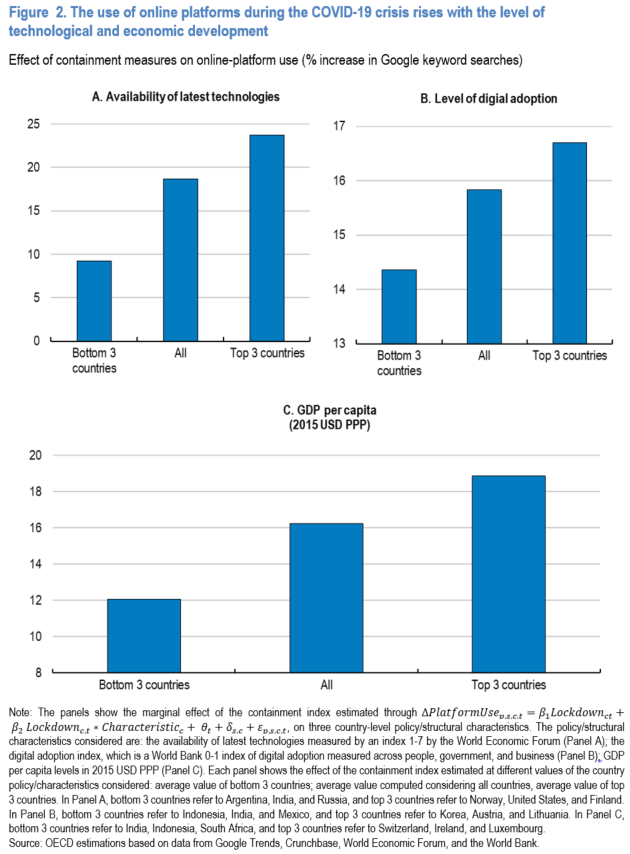
The analysis also reveals that the increase in online-platform use varied across countries depending on pre-existing structural conditions and policies. The increase tended to be larger in more developed and technologically-advanced countries, those with easier access to infrastructure and connectivity, higher skill levels, and more widespread use of the Internet (Figure 2). These results highlight the varying degree of countries’ digital preparedness. When COVID-19 hit, some countries were better prepared than others and in these countries people and businesses may have found it easier to shift activities towards online platforms.

The COVID-19 shock has added urgency to policies aiming at accelerating the digitalisation of public and private sector activities. During the crisis many OECD and G20 countries implemented a range of such policies including, for instance, improving broadband connectivity, helping firms adopt online business models, promoting online payments, and enhancing digital skills (G20, 2020; OECD, 2020a; OECD, 2020b).

This new urgency is welcome but a coordinated approach is needed to exploit synergies across policy areas. For instance, to make the investment in digital infrastructure effective, complementary investment in skills is necessary. Moreover, policies to protect the privacy of personal data and strengthen cybersecurity can enhance trust in digital technologies and online platforms, accelerating their adoption. Designing or updating Industry 4.0 plans in view of the new challenges the COVID-19 has created would be a good way to build such a coordinated approach.

For more details see:

OECD (2020), “The role of online platforms in weathering the COVID-19 shock”, OECD Policy Responses to Coronavirus (COVID-19), OECD Publishing, Paris, https://doi.org/10.1787/2a3b8434-en.

References:

OECD (2020), Policy Options to Support Digitalisation of Business Models during COVID-19, Annex, http://www.oecd.org/sti/policy-options-to-support-digitalization-of-business-models-during-covid-19-annex.pdf

OECD (2020a), Keeping the Internet up and running in times of crisis, http://www.oecd.org/coronavirus/policy-responses/keeping-the-internet-up-and-running-in-times-of-crisis-4017c4c9/ (accessed on 9 October 2020).

OECD (2020b), The potential of online learning for adults: Early lessons from the COVID-19 crisis, http://www.oecd.org/coronavirus/policy-responses/the-potential-of-online-learning-for-adults-early-lessons-from-the-covid-19-crisis-ee040002/ (accessed on 9 October 2020).


Boosting employment in post-COVID Finland

by Naomitsu Yashiro, OECD Economics Department

In the context of the large economic contraction and debt build-up in the wake of the COVID-19 pandemic, the government of Finland is formulating reforms to raise employment by 80 000 persons by 2029. Achieving this would raise the employment rate from the estimated 70.8% in 2020 to 73.7% in 2029, reversing the labour market damage caused by COVID-19 and reducing, but not eliminating the structural budget deficit.

Before the pandemic, Finland’s employment rate was 73% in 2019, lagging behind the average of Scandinavian Nordics (76%).The largest contribution to the employment rate gap was made by the 60-64 year-old age group. Finland grants to older workers with sufficiently long working period unemployment benefit entitlements that are not only longer than those for younger workers but can also be extended from the age of 61 up to the statutory retirement age. This extension, often dubbed the unemployment tunnel, provides strong disincentives to continue working. It also induces employers to target older workers in redundancies, even though large employers are obliged to finance a part of the unemployment benefits claimed by their former employees who entered the tunnel. The risk of unemployment increases markedly as workers near the age at which they become eligible to the unemployment tunnel (Figure 1). Past reforms that raised the eligibility age in steps from 59 to 61 have pushed back the timing of the sharp rise in unemployment risks each time, effectively lengthening the working lives of older workers (Figure 1). The 2020 Economic Survey of Finland, published in 10 December 2020, recommended abolishing the unemployment tunnel. A week later, the government announced its decision to abolish the tunnel by 2025.

In Finland, inflow into disability benefits has often increased when access to other early retirement pathways was tightened by policy changes. Early retirement via disability benefits is facilitated by more lenient eligibility criteria for awarding disability benefits applied to individuals aged 60 and over, which include non-medical factors. The Survey recommends aligning the criteria between older and younger individuals, namely by not taking into account non-medical factors. This is important for avoiding the surge of inflow into disability benefits as the unemployment tunnel is being phased out.

In order to ensure that these supply-side reforms result in higher employment, additional policy efforts to place older workers in jobs are needed. Activation requirements for the older unemployed should be applied with the same vigour as for other unemployed persons. The capacity of the public employment service needs to be strengthened by focusing resources on providing essential services like face-to-face counselling while making more use of private providers expertise and digital technologies. Ample upskilling opportunities should be provided to workers with higher risks of jobs loss at old age, such as those with jobs exposed to automation risks (Yashiro et al., 2021). Although the participation in adult education in Finland is relatively high, old and unskilled workers participate much less, as in other OECD countries. Finland’s adult education is biased toward formal education at higher education institutions, making it less attractive to the low skilled. The government should bolster targeted trainings, referencing successful examples in other OECD countries, such as the Unionlearn scheme in the United Kingdom where Union Learning Representatives help workers identify their training needs and arrange learning opportunities within their companies.

Another population group contributing to Finland’s relatively low employment rate vis-à-vis its Scandinavian peers is young women (30 to 34). However, the lower employment rate among this group is mainly due to differences in the statistical treatment of maternity leave between Finland and Sweden. The work attendance rates, which measure the share of persons who were at work during the surveyed week, are about the same between the two countries. However, the attendance rates are still considerably lower in Finland among mothers of children aged up to three years old, owing to the generous social benefit granted for taking care of children at home instead of using childcare services provided by municipalities. Removing this financial disincentive would encourage return to work by young mothers, thereby avoiding their career development being hampered by a long absence from work, which would help reduce the large gender pay gap.

Further reading:

OECD (2020), OECD Economic Surveys: Finland 2020, OECD Publishing, Paris.  

REFERENCE

Yashiro et al. (2021), “Technology, labour market institutions and early retirement: evidence from Finland”, OECD Economics Department Working Papers, Forthcoming, OECD Publishing, Paris.


Explaining cross-country differences in growth performance in the second quarter of 2020

By Nigel Pain and Łukasz Rawdanowicz, OECD Economics Department

In the second quarter of 2020, as the pandemic spread and many countries implemented strict containment measures, output and consumer spending declined sharply in most economies. However, the extent of the contraction differed significantly across countries, with GDP and private consumption falling by over 15% in some countries, and by 5% or less in others. This blog, based on the latest OECD Economic Outlook, highlights the strong cross-country association between activity, the strictness of containment measures and changes in mobility, complementing the detailed analysis of the relationship between mobility and containment policy measures in OECD (2020).

Containment measures are captured using the aggregate stringency index produced by the Oxford Blavatnik School of Government (Hale et al., 2020), and mobility by the Google location-based indicator of retail and recreational mobility, a measure of visits to places such as shopping centres, restaurants, theme parks, museums and cinemas. Changes in containment measures are associated with changes in mobility, but mobility measures may also pick up other factors, such as voluntary physical distancing, or a reluctance to leave the home when concerns about the pandemic are high. Both mobility and the stringency of containment measures are strongly correlated across countries with GDP growth and private consumption growth in the second quarter of 2020 (see figure).

Note: The panels show OECD countries and selected non-OECD advanced and emerging-market economies from Asia, Latin America and Africa for which data are available (China is excluded, as mobility data are not available). The country coverage differs between the two panels. The vertical axes show changes in the quarterly averages of the Oxford stringency index and the Google mobility index for the retail and recreation sector.
Source: OECD Economic Outlook 108 database; Google LLC, Google COVID-19 Community Mobility Reports, https://www.google.com/covid19/mobility; Oxford Coronavirus government response tracker; and OECD calculations.

Empirical investigation

The relative importance of mobility and the stringency of containment measures can also be assessed by estimating cross‑country equations for quarterly changes in real GDP and private consumption in the second quarter of 2020. Two separate equations are estimated, one for GDP growth and the other for private consumption growth, to assess whether there are differences in the extent to which mobility and stringency affect different activity indicators. For instance, cross-country variation in GDP growth stems in part from factors that may be less directly affected by domestic containment measures, such as government consumption and exports. Both explanatory variables are expressed as the change in quarterly average values.

The equations are estimated for a group of advanced and emerging-market economies for which data are available, and exclude large outliers, leaving a sample of 43 economies for private consumption and 49 for GDP. Excluding the outliers sharpens the results without changing the estimated coefficients substantially. The sample for private consumption is smaller given fewer emerging-market economies with quarterly data for private consumption. In both equations, the two indicators are strongly statistically significant. This finding is robust to exclusion of the country outliers.

  • Both mobility and stringency are found to have been significantly associated with cross-country differences in growth outcomes in the second quarter of 2020.
  • An increase (tightening) of the Oxford stringency index by 10 points is estimated to be associated with a reduction of around 1 percentage point in quarterly GDP growth, for a given level of mobility. A decline of 10 points in the Google community mobility indicator is estimated to be associated with a reduction of around 1.7 percentage points in quarterly GDP growth, for a given level of stringency. For real private consumption growth, the respective numbers are 0.6 and 2.8 percentage points. The larger impact of the mobility indicator on consumption growth than on GDP growth may reflect the fact that retail and recreational mobility is more relevant for household consumption than for other economic activities.
  • The estimated equations account for roughly 60% of the cross-country variation in GDP growth and around 75% of the cross-country variation in private consumption growth.
  • For both GDP and private consumption equations, the residuals tend to be on average positive in Asia, where containment measures have been relatively mild in some countries, but negative in Europe, where more-restrictive measures were applied. This may point to some potential non-linearities in the aggregate relationships between growth, mobility and containment measures, or it may indicate that some particular types of containment measures, such as full shutdowns, have stronger effects than others.

It is too early to know whether the cross-sectional relationships found for the second quarter of 2020 can be used to help track output growth throughout the pandemic. However, initial estimates for GDP growth in the third quarter of 2020 are correlated with quarter-on-quarter changes in mobility across countries. The estimated relationships for the second quarter of 2020 also provide a guide for potential developments in the fourth quarter of 2020, suggesting that growth may again turn negative in countries that are tightening confinement measures substantially and experiencing marked declines in mobility indicators. However, the relation may be slightly weaker as some potentially hard-hit sectors have not reopened, or their activity remains subdued after the first round of containment measures. There may also have been a growing shift to on-line sales of goods and services, which might reduce the strength of the association between mobility and private consumption growth.

References

OECD (2020), “Walking the tightrope: avoiding a lockdown while containing the virus”, OECD Policy Responses to Coronavirus (COVID-19), OECD Publishing, Paris.

Hale, T., et al. (2020), “Oxford COVID-19 Government Response Tracker”, Blavatnik School of Government, Oxford University.


The impact of the COVID-19 pandemic on sectoral output

by Nigel Pain, OECD Economics Department

The economic impact of the pandemic has varied significantly across different industries. Monthly economy-wide output data and the special business surveys being undertaken in some countries provide a timely indication of the different impact of the pandemic across types of activity, both in the early stages of the crisis and subsequently. As shown in the December OECD Economic Outlook, the containment measures used in response to the pandemic and underlying changes in consumer behaviour have both had a significant impact on activity, particularly in many service sectors.

In the first wave of the pandemic, output fell especially sharply in countries such as the United Kingdom and France, where full economy-wide confinement was required for an extended period (see first figure). By April, retail and wholesale trade volumes in these countries were over one-third lower than in February, prior to the pandemic. Retail output also declined by over one-quarter in Canada. In contrast, many other countries, particularly in Asia and Northern Europe, made greater use of targeted measures on regions and sectors and relied more extensively on effective test, trace and isolate systems to control the virus.

Service sectors requiring close proximity between consumers and producers or between large groups of consumers, including hospitality services, leisure activities and cross-border travel, were hard hit across all economies, with output declining by 60-80% in several countries by April. Output in many other parts of the economy, including manufacturing and most other market-based services also tumbled, although the extent of the decline was more varied, reflecting the mix of containment measures being imposed and differences in specialisation. Declines in these sectors were also typically larger in Canada, France and the United Kingdom than in Japan or Norway.

In the subsequent recovery output gradually picked up in all sectors, with many containment measures relaxed until recently, although economy-wide activity and manfacturing output still remained below pre-pandemic levels as of September (see first figure). The rebound was particularly marked in wholesale and retail trade, where output returned quickly to the immediate pre‑pandemic level, helped by a rebound in consumer spending.

A weaker recovery occurred in the service sectors most affected initially, pointing to the risk of persistent costs from the pandemic in these sectors. Activity in hospitality, leisure, and transportation, particularly air travel services, continues to be impacted by physical distancing requirements and border closures, with output in September remaining 20-25% below that in February in some countries. The recovery has also been slow in administrative and support services, a category of output that includes travel agencies, where demand is extremely weak.

The special business surveys being undertaken by some national statistics offices and central banks provide additional insight into the effects of the pandemic across sectors, including on workforce arrangements, the extent to which government support schemes are being used, investment plans, and corporate finances. Even prior to the tighter containment measures implemented in the past two months in most European economies, survey information was already highlighting the pressures that firms in the hardest hit sectors were facing.

In Belgium, around one-fifth of responding firms indicated that they could not meet their financial liabilities for more than three months without receiving additional equity or credit (see second figure, Panel A). An additional sizeable share of firms indicated that financial liabilities could only be met for between three and six months. Such financial pressures were most evident in the arts and recreation (leisure) sector, and the accommodation and food services (hospitality) sector, with around 40% and 30% of firms respectively indicating that financial liabilities could not be met for more than three months.

In the United Kingdom, around one-fifth of responding firms reported that their operating costs were currently exceeding turnover, with the excess being over 50% in half of these cases (see second figure, Panel B). A further one-fifth indicated that operating costs were equal to turnover. Financial fragilities again appeared to be strongest in the hardest hit service sectors.

These findings highlight the message in the December OECD Economic Outlook that flexible and state-contingent government support remains necessary to help sustain viable firms and lower the risks of significant long-lasting costs from the pandemic.

Further reading:

OECD (2020), OECD Economic Outlook, Volume 2020 Issue 2: Preliminary version, OECD Publishing, Paris, https://doi.org/10.1787/39a88ab1-en.


Finland: Recovering from the COVID-19 crisis

By David Carey, Economics Department.

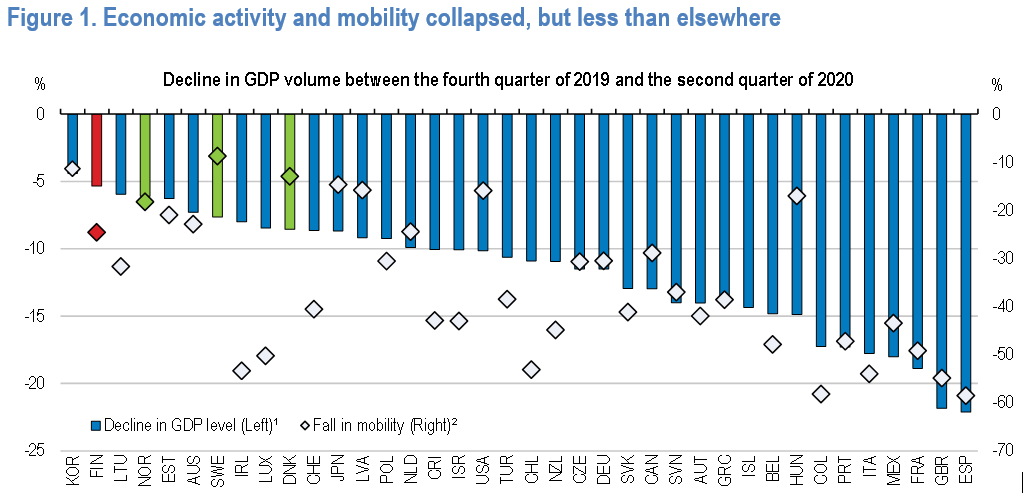
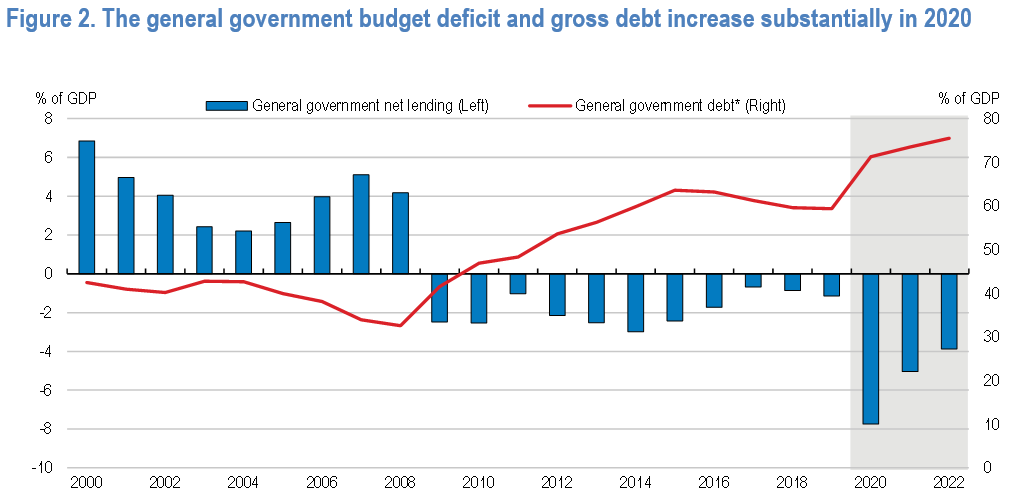
The COVID-19 pandemic has plunged Finland into a deep recession, albeit milder than in most other countries partly thanks to more targeted confinement measures and a relatively small loss of mobility (Figure 1). The economy is projected to shrink by 3.3% in 2020 and recover gradually with growth of 2.1% in 2021 and 1.8% in 2022, led by private consumption and exports. The government provided substantial financial support to protect jobs and help households and businesses get through the crisis. Public finances deteriorated as a result (Figure 2).Once the recovery is underway, fiscal consolidation will be needed to achieve the government’s aim to stabilise the debt-to-GDP ratio by the end of the decade. To this end, the government has set an objective of increasing employment by 80 000 at that horizon. Increasing the employment rate toward the average level of the Scandinavian Nordic countries could make a substantial contribution to the necessary fiscal consolidation and, together with stronger productivity growth, help to reverse the long-term erosion in relative living standards. The 2020 OECD Economic Survey of Finland provides an in-depth analysis of these challenges and offers policy recommendations for meeting them.

Note: 1. % difference between 2019Q4 and 2020Q2 GDP levels.  2. Fall in mobility from the baseline between 1st of March and 27th of June.
Source: OECD, National Accounts database; Google LLC, Google COVID-19 Community Mobility Reports, https://www.google.com/covid19/mobility/.

The greatest potential for increasing employment lies in extending working lives. The employment rate for older workers (aged 55-64 years) is 13 percentage points lower than the average for other Nordic countries, where access to early retirement arrangements is much more limited. The extension of the unemployment benefit from age 61 until 65, combined with a longer entitlement to the unemployment benefit for persons aged 58 or more, results in a spike in layoffs from the late-50s. To increase the employment rate of older workers, extended unemployment benefit should be phased out and non-medical criteria for awarding disability benefits to applicants aged 60 or more no longer taken into account.  

Labour productivity growth weakened substantially in the past decade. A factor that undermines productivity growth in Finland is skills shortages, largely resulting from relatively low tertiary education attainment. This makes it difficult for more productive firms to hire the qualified workers needed to innovate and expand market shares. To boost the supply of tertiary educated workers, the government plans to streamline the resident permit process to attract more high-skilled immigrants. It also aims to increase the tertiary attainment of 25-34 year olds from 42% to 50%. To this end, the number of study places in the highly selective tertiary education admission system is being raised but further increases will be needed.

Reducing relatively high regulatory barriers to competition in upstream service sectors, such as transport, energy and retail, which hold back incumbents’ efforts to reallocate resources more efficiently, would also boost productivity growth. Similarly, repealing the legal restriction that prevents some employers from using the enterprise-bargaining flexibility clauses in their sector collective agreement, as planned, would give these employers greater scope to reorganise their businesses to make them more productive.

Finland is on track to meet its 2020 EU-burden-sharing objective for reducing GHG emissions but will need to implement further cost-effective measures, including making full use of available flexibility mechanisms, to realise its 2030 and 2035 objectives. To reduce transport emissions, which is vital for achieving abatement targets, the government should support the rollout of electric vehicle (EV) charging facilities to lift EV diffusion substantially. There will also need to be an expansion in wind power generation both to meet increased demand for charging EVs and to enable the substitution of electricity for fossil fuels in residential and commercial heating and in industry. 

Note: General government debt refers to Maastricht definition.
Source: Statistics Finland; Ministry of Finance.

Further reading:

OECD (2020), OECD Economic Surveys: Finland 2020, OECD Publishing, Paris, https://doi.org/10.1787/673aeb7f-en.


The increase in bank deposits during the COVID-19 crisis: Possible drivers and implications

By Ane Kathrine Christensen, Alessandro Maravalle and Łukasz Rawdanowicz, OECD Economics Department

Since the end of 2019, bank deposits of non-financial corporations (NFCs) have increased rapidly in Japan, the United States and many European countries, far above the average growth rates over the same period in the past five years (figure below, Panel A). In contrast, in the global financial crisis, corporate deposits declined amid the credit crunch and, in some cases, a delayed policy response. Deposits of households have also increased but to a smaller extent; though still, in many countries, at a faster rate than in the previous years or at the beginning of the global financial crisis (figure below, Panel B). This blog, based on the recently released OECD Economic Outlook, reviews possible reasons for, and the implications of, the increase in bank deposits.

Possible explanations behind the unprecedented increase in bank deposits

Several factors could explain the observed surge in deposits:

  • Containment measures made some household purchases impossible (Boxes 1.1 and 1.2 in OECD, 2020) at a time when incomes were maintained by government support, thus increasing saving and bank deposits. This effect should be temporary and dissipate as containment measures are lifted gradually and pent-up demand is satisfied. Indeed, so far, growth in deposits was concentrated in the March May period, when strict lockdown was in force in many countries. In the following months, until the recent reintroduction of containment measures, the rate of growth in deposits of both households and NFCs slowed in most countries, though it remained above the average rate over the same period in the past five years.
  • Containment measures are likely to have particularly affected consumption of some high ticket services by high-income households, stimulating aggregate saving. High-income households tend to spend a higher share of their income on services that are heavily affected by containment measures, such as international travel, restaurants and cultural events. As the restrictions are likely to persist for some time, so does this motive for saving.
  • High uncertainty about the pandemic and future economic prospects has strengthened motives for precautionary saving, discouraging investment and purchases of durable goods. For example, Mody et al. (2012) show that the change in the unemployment rate – a proxy for variation in economic uncertainty – boosts precautionary savings. These effects are likely to be more persistent.
  • Amid disruptions to revenues, NFCs’ preferences for holding cash have increased with the aim of raising their buffers and avoiding liquidity shortfalls. Cash hoarding has been facilitated by drawing on loan facilities (e.g. revolving credit lines), issuance of corporate bonds by large firms (Goel and Serena, 2020), and by government sponsored loan programmes. In November, the size of the resources made available to businesses through government-sponsored loan programmes (loans and guarantees) was above 10% of 2019 GDP in Canada, France, Germany, Italy, Japan, Spain and the United Kingdom. NFCs could have also reduced riskier financial investments (e.g. in money market funds).
  • Crisis-related tax deferral measures have helped households and NFCs to increase liquidity but may also have encouraged them to set aside money to meet postponed tax obligations. Tax deferrals are officially estimated to be high in some countries, exceeding, for example, 13% of GDP in Italy (including the effect of the moratorium on payments to private companies) and close to 5% of GDP in Japan.

Possible implications

A reversal in any of the above factors may result in additional investment and consumption, boosting aggregate demand and accelerating the economic recovery. Back of the envelope calculations show that “excess” deposits are large relative to pre-crisis business investment, potentially indicating a sizeable future impact on investment (figure below, Panel C). For households, “excess” deposits are relatively small relative to private consumption (figure below, Panel C), but both household deposits and consumption are much larger relative to GDP (figure below, Panels E and F), potentially implying a bigger aggregate impact.

However, there are several reasons why these excess savings may not boost aggregate private demand beyond negative confidence effects. For example, the distribution of deposits may be skewed. If the increase in NFCs’ deposits has been driven by a few large firms that benefitted from the crisis, particularly in the technology sector, excess deposits are unlikely to stimulate future economy-wide investment. Similarly, if the increase in household deposits has been mostly driven by high income households with a relative low marginal propensity to consume, then a reduction in uncertainty and containment measures would not necessarily lead to a broad-based strengthening of consumption. Moreover, firms could use excess deposits to settle payments due to other companies, creditors or tax authorities.

References

Goel, T. and J.M. Serena (2020), “Bonds and syndicated loans during the Covid-19 crisis: Decoupled again?”, BIS Bulletin, No. 29. https://www.bis.org/publ/bisbull29.pdf
Mody, A., F. Ohnsorge and D. Sandri (2012), “Precautionary Savings in the Great Recession”, IMF Working Papers, No. 42, International Monetary Fund. https://www.imf.org/external/pubs/ft/wp/2012/wp1242.pdf
OECD (2020), “General Assessment of the Macroeconomic Situation”, Chapter 1 of OECD Economic Outlook, Volume 2020, Issue 2, OECD Publishing, Paris.


Damit aus Hoffnung Realität wird

Laurence Boone | OECD Chief Economist
Laurence Boone,
OECD-Chefvolkswirtin

Auch verfügbar auf Español | Français | Portugués

Zum ersten Mal seit Beginn der Pandemie können wir wieder hoffnungsvoll in die Zukunft blicken. Durch die Fortschritte bei der Impfstoffentwicklung und der Behandlung von COVID-19 haben sich die Zukunftsaussichten verbessert und die Unsicherheit ist gesunken. Die beispiellosen Maßnahmen der Regierungen und Zentralbanken haben in vielen Sektoren eine rasche Erholung der globalen Wirtschaftstätigkeit bewirkt. In einigen Dienstleistungsbranchen wird die Aktivität jedoch weiter durch die Kontaktbeschränkungen beeinträchtigt. Der Beschäftigungsrückgang hat sich z. T. wieder umgekehrt, viele Menschen sind aber immer noch von Unterbeschäftigung betroffen. Die meisten Unternehmen haben überlebt, häufig sind sie jedoch finanziell angeschlagen. Ohne die massiven Stützungsmaßnahmen wären die Auswirkungen auf die wirtschaftliche und soziale Lage katastrophal gewesen. So aber konnte das Schlimmste verhindert werden: Der Großteil der bestehenden wirtschaftlichen Strukturen blieb erhalten und konnte schnell wieder hochgefahren werden. Viele gefährdete Menschen, Unternehmen und Länder befinden sich jedoch nach wie vor in einer prekären Lage.

Die Aussichten sind freundlicher, es gibt aber noch gewaltige Herausforderungen zu bewältigen. Mittlerweile sind weltweit 1½ Millionen Menschen an oder mit COVID-19 gestorben. In vielen Ländern wütet bereits die nächste Welle der Pandemie, während in anderen Ländern die erste Welle noch nicht unter Kontrolle gebracht wurde. Es steht zu hoffen, dass noch im Jahresverlauf 2021 wirksame Impfungen allgemein verfügbar werden oder ein Durchbruch bei der Behandlung von COVID-19 erreicht wird. In der Zwischenzeit wird die Pandemie die Wirtschaft weiter belasten. Auch in den nächsten Quartalen wird die Wirtschaftstätigkeit noch durch Kontaktbeschränkungen und teilweise geschlossene Grenzen beeinträchtigt werden. Einige Sektoren werden zu alter Stärke zurückfinden, während in anderen Stillstand herrscht. In Entwicklungs- und Schwellenländern, für die der Tourismus eine wichtige Einnahmequelle ist, wird sich die Lage weiter verschlechtern. Diese Länder werden mehr Unterstützung durch die Weltgemeinschaft benötigen. Die Konjunktur muss weiter massiv gestützt werden, gerade weil ein Ende der Gesundheitskrise nun absehbar ist.

Die Weltwirtschaft wird in den nächsten zwei Jahren an Dynamik gewinnen. Ende 2021 dürfte die globale Wirtschaftsleistung wieder das Niveau von vor der Pandemie erreicht haben. Nach einem drastischen Einbruch in diesem Jahr wird das globale BIP den Projektionen zufolge 2021 um 4¼ % und 2022 um weitere 3¾ % wachsen. Durch Fortschritte in der Forschung und Impfstoffentwicklung, effektivere Kontaktnachverfolgung und Isolierung sowie Verhaltensänderungen im Privat- und Geschäftsleben lässt sich das Infektionsgeschehen besser eindämmen. Dadurch können die Mobilitätsbeschränkungen allmählich gelockert werden. Dabei spielen die seit Beginn der Pandemie ergriffenen Maßnahmen zur Stützung von Arbeitsplätzen und Unternehmen eine wichtige Rolle. Sie tragen entscheidend dazu bei, dass sich die Konjunktur nach der Aufhebung der Beschränkungen rasch erholen kann. Dies dürfte zusammen mit der verringerten Unsicherheit bewirken, dass die erhöhten Ersparnisse für Konsumausgaben und Investitionen genutzt werden. Die außerordentliche fiskalische Entlastung, für die 2020 gesorgt wurde und die weiterhin erforderlich ist, wird sich am Ende auszahlen. Mit dem schrittweisen Wiederhochfahren von immer mehr wirtschaftlichen Aktivitäten wird sich die Erholung verstärken und beschleunigen. Dadurch werden die krisenbedingten Einkommensverluste insgesamt begrenzt.

Die Erholung dürfte von Land zu Land unterschiedlich verlaufen. Die Weltwirtschaft könnte sich dadurch dauerhaft verändern. Die Länder und Regionen, die über effektive Test-, Kontaktnachverfolgungs- und Isolierungsstrategien verfügen und in denen Impfungen rasch umgesetzt werden können, dürften vergleichsweise gut abschneiden. Sie werden aber dennoch unter der weltweiten Nachfrageschwäche leiden. In China, wo die Erholung früher begann, wird ein kräftiges Wachstum erwartet. 2021 dürfte mehr als ein Drittel des Weltwirtschaftswachstums auf China entfallen. Die OECD-Volkswirtschaften werden ebenfalls einen Aufschwung verzeichnen. Mit einem Wachstum von 3,3 % im Jahr 2021 werden sie sich zunächst jedoch nur teilweise von der gravierenden Rezession des Jahres 2020 erholen. Europa und Nordamerika werden weiterhin weniger zum weltweiten Wachstum beitragen, als es ihrem Anteil an der Weltwirtschaft entsprechen würde.

Der Ausblick bleibt extrem unsicher und ist sowohl mit Aufwärts- als auch mit Abwärtsrisiken behaftet. Eine günstigere Entwicklung wäre möglich, wenn die Impfstoffe dank effizienter Impfkampagnen und einer besseren länderübergreifenden Zusammenarbeit schneller weltweit eingesetzt werden könnten. Wie sich am aktuellen Wiederaufflammen der Pandemie in vielen Ländern zeigt, kann es aber auch sein, dass die Regierungen die Wirtschaftstätigkeit erneut einschränken müssen, insbesondere wenn die Verteilung wirksamer Impfstoffe nicht zügig vorankommt. Außerdem würde das Vertrauen leiden, wenn die in die Impfstoffe gesetzten Hoffnungen aufgrund von Verteilungsproblemen oder Nebenwirkungen enttäuscht würden. Die wirtschaftlichen Folgen könnten gravierend sein und über die Schwächung staatlicher und privatwirtschaftlicher Schuldner auch das Risiko von Finanzmarktturbulenzen mit globalen Ausstrahlungseffekten erhöhen.

Trotz der immensen geld- und fiskalpolitischen Stützungsmaßnahmen führt die Pandemie selbst im günstigsten Szenario weltweit zu einer Verschlechterung der sozioökonomischen Situation. In vielen Ländern wird die Wirtschaftsleistung auch 2022 noch rd. 5 % unter den Vorkrisenerwartungen liegen. Dies lässt erhebliche dauerhafte Schäden durch die Pandemie befürchten. Dabei werden besonders gefährdete Gruppen weiterhin überproportional betroffen sein. Kleinere Unternehmen und Gründerinnen sind stärker von Insolvenzen bedroht. Viele Geringverdienende haben ihre Stelle verloren und können nun bestenfalls auf Arbeitslosengeld hoffen. Sie haben kaum Aussichten, schnell wieder Arbeit zu finden. Für Bedürftige, die generell weniger gut sozial abgesichert sind, hat sich die Lage weiter verschlechtert. Sozial benachteiligten Kindern und Jugendlichen fiel es häufig schwer, an Fernunterricht teilzunehmen, und geringer qualifizierte Arbeitskräfte konnten oft nicht von zu Hause aus arbeiten. Dies könnte negative Langzeitfolgen haben.

Die Regierungen werden weiter aktiv Unterstützung leisten müssen. Die Maßnahmen müssen jedoch gezielter auf die am stärksten Betroffenen ausgerichtet werden. Die Aussicht auf bald verfügbare Impfstoffe bedeutet nicht, dass die Unterstützung nun zurückgefahren werden sollte. Dies wäre ebenso verfrüht, wie es damals die Konsolidierung nach der globalen Finanzkrise war. Gesundheits- und Wirtschaftspolitik müssen Hand in Hand gehen. Die gesundheitspolitischen Maßnahmen müssen verstärkt werden, um die Auswirkungen neuer Infektionsausbrüche und die damit verbundenen Einschränkungen zu begrenzen. Zugleich muss die fiskalische Unterstützung fortgesetzt werden, um den Erhalt betroffener Sektoren, Unternehmen und Arbeitsplätze zu sichern. Die letzten neun Monate haben gezeigt, dass diese Maßnahmen angemessen waren, was auch weiter der Fall sein wird. Die Geld- und Fiskalpolitik muss ihren Kurs mit Nachdruck weiterverfolgen, zumindest solange die Gesundheitskrise eigentlich tragfähige wirtschaftliche Aktivitäten und Arbeitsplätze bedroht.

Verstärktes staatliches Handeln muss kein Grund zur Besorgnis sein, wenn es dazu dient, ein kräftigeres und gerechteres Wachstum zu fördern. Durch die massiven fiskalischen Stützungsmaßnahmen steigt die Staatsverschuldung auf ein Rekordniveau. Zugleich sind aber die Kosten der Verschuldung niedriger als je zuvor. Auffallend ist, dass zwischen dem Umfang der fiskalischen Maßnahmen und der daraus resultierenden Wirtschaftsentwicklung kein klarer Zusammenhang zu erkennen ist. Dies lässt den Schluss zu, dass nicht alle Maßnahmen zweckmäßig sind. Die beispiellose geld- und fiskalpolitische Unterstützung muss sich tatsächlich auszahlen. Sie muss ein kräftigeres und besseres Wirtschaftswachstum hervorbringen. Mindestens drei Prioritäten sollten dabei im Vordergrund stehen. Erstens: Investitionen in grundlegende Güter und Dienstleistungen, z. B. in das Bildungs- und Gesundheitswesen sowie die physische und digitale Infrastruktur. Zweitens: entschlossenes Handeln, um den Anstieg der Armut und der Einkommensungleichheit dauerhaft umzukehren. Drittens: internationale Zusammenarbeit, da globale Krisen nicht durch einzelstaatliches und selbstbezogenes Handeln überwunden werden können.

Die Umschichtung öffentlicher Ausgaben auf grundlegende Güter und Dienstleistungen würde signalisieren, dass die Regierungen aus der Krise gelernt haben. Um künftig besser gegen Krisen gewappnet zu sein, sollten mehr öffentliche und private Investitionen in Gesundheit, Bildung und Infrastruktur mobilisiert werden. Bei der Steigerung der Krisenfestigkeit des Gesundheitswesens geht es nicht nur um die Verteilung von Impfstoffen oder um die Zahl der Intensivbetten, sondern auch um Prävention und eine bezahlbare Gesundheitsversorgung für alle. Entscheidend sind zudem Investitionen in Kompetenzen, um bessere Bildungs- und Arbeitsmarktergebnisse zu erzielen und dadurch letztlich das Wachstumspotenzial und das gesellschaftliche Wohlergehen dauerhaft zu steigern. Dies umfasst mehr und gezielter eingesetzte Ressourcen in der frühkindlichen Bildung, besser bezahlte und ausgebildete Lehrkräfte sowie eine bessere Weiterbildungsförderung, insbesondere für gefährdete Gruppen, wie etwa Eltern in schwierigen Lebensumständen. Krisen haben in der Vergangenheit oft dazu geführt, dass weniger investiert wurde und dauerhafte Infrastrukturdefizite entstanden, u. a. bei der Digitalisierung und der Dekarbonisierung der Energieversorgung. Das muss sich ändern.

Besonders gefährdete Gruppen, vor allem Kinder, Jugendliche und Geringqualifizierte, die nur unzureichend vor der Krise geschützt wurden, müssen stärker unterstützt werden. In vielen Ländern lassen sich Lehren aus der Krise ziehen, um die Bildungssysteme zu verbessern. Die Staaten müssen mit entsprechenden Investitionen dafür sorgen, dass alle Haushalte, Lehrkräfte und Schülerinnen – insbesondere jene in benachteiligten Verhältnissen – über einen guten Breitbandzugang verfügen und für den digitalen Unterricht ausgestattet sind. Die Krise hat gezeigt, wie dringend die Digitalkompetenzen verbessert werden müssen. Sie hat auch Lücken in den sozialen Sicherungssystemen offenbart. Die Fiskalpolitik sollte gezielter gefährdete Gruppen unterstützen, die durch das Raster der üblichen Sozialversicherungssysteme fallen und keinen Anspruch auf die bislang verfügbaren zusätzlichen Hilfen haben. Dies würde sowohl den Betroffenen als auch der Gesellschaft als Ganzes zugutekommen.

Die internationale Zusammenarbeit hat in den letzten Jahren abgenommen. Dabei wäre sie gerade jetzt wichtiger als je zuvor. Die sogenannte „globale“ Finanzkrise war vor allem eine Krise einiger fortgeschrittener Volkswirtschaften. Sie löste aber eine beispiellose gemeinsame Reaktion aus. Die Pandemie ist die erste wirklich globale Krise seit dem Zweiten Weltkrieg. Sie hat zu außerordentlichen nationalen Krisenmaßnahmen, aber auch Grenzschließungen und wenig Zusammenarbeit geführt. Protektionismus und Grenzschließungen sind keine Lösung. Sie verhindern die Verteilung wesentlicher Güter weltweit und bestrafen Volkswirtschaften, die nur durch die Teilnahme an globalen Wertschöpfungsketten zu anderen aufschließen können. Diese Entwicklung muss wieder umgekehrt werden. Nötig ist eine breite, schnelle und großzügige Produktion und Verteilung wirksamer Medikamente und Impfstoffe, an der alle Länder teilhaben können. Multilaterale Foren müssen sich stärker für Schuldentransparenz sowie bei Bedarf für ein Schuldenmoratorium einsetzen. Zugleich müssen die Aufsichtsbehörden die Unternehmensverschuldung genau überwachen. Es gilt zu verhindern, dass die Gesundheits- und Wirtschaftskrise auch noch eine Finanzkrise auslöst.

Hoffentlich können wir auf die Frage, wie die Welt nach Corona aussieht, einmal antworten: „Fast so wie vorher, bloß ein wenig besser.“

  1. Dezember 2020

Laurence Boone
OECD-Chefvolkswirtin

OECD-Wirtschaftsausblick, Dezember 2020


Walking the tightrope: avoiding a lockdown while containing the virus

By Balázs Egert, Yvan Guillemette and David Turner, Macroeconomic Analysis Division, OECD Economics Department

Recent optimistic news about the availability of a number of vaccines against the coronavirus needs to be tempered by the realisation that, even in the countries that are in the vanguard, it is likely to be the middle of next year before a large share of the population has been vaccinated. In the meantime, governments around the world are trying to calibrate policy interventions so as to keep the spread of the disease under control without crippling economic activity, in many cases with limited success, as virus transmission has recently picked up again in many countries, especially in Europe.

The empirical analysis summarised in this post draws on the experience of a large sample of nearly 150 countries using daily data to consider the relative effectiveness of policy measures to reduce the spread of the virus, while limiting the costs to mobility and, by implication, economic activity (for further details see OECD, 2020). The main conclusions relevant to policy-makers as they tackle further waves of the virus are as follows:

  • The typical lockdown measures applied by many countries in dealing with the first wave of the virus — combining school closures, stay-at-home requirements and workplace closures — do reduce the spread of the virus, but at a substantial cost to mobility and economic activity. From an initial reproduction number of 1.5, such a lockdown would be expected to reduce R to just over 1.0, but also reduce mobility by up to 40%. The analysis also suggests that ramping up the stringency of such lockdown measures beyond a certain point results in further economic losses, but for little gain in reducing the spread of the virus.

Note: Containment policies are measured using a set of variables maintained by the Oxford Blavatnik School of Government (Hale et al., 2020) which is also the source of the test-and-trace variables. The empirical analysis distinguishes policy effects according to the degree of stringency with which they are applied, but this distinction is ignored in the chart. Other public health policies, as well as R estimates, are constructed by the authors, for details see OECD (2020). The policy effects on R are shown on the assumption that each policy is implemented when R is initially 1.5 (the estimations on which these results are based use a log specification for R, which suggests that at lower levels of R policies have smaller effects in further reducing it).
1) The effects of school closures, stay-at-home requirements and workplace closures have been combined into one segment labelled ‘Typical lockdown’, both because such policies have often been imposed at the same time and because it is difficult to separately identify their effects in the empirical analysis.
Source: See OECD (2020) for further details.

  • A comprehensive package of public health measures can be more effective in reducing the spread of the virus (see Figure), with little or no cost to mobility. Test-and-trace policies are the single most effective public health measure to reduce R, but are found to be most effective when the level of infections is low. Other public health policies are also found to contribute to restraining the spread of the virus, including: specific testing in care homes; mandating mask-wearing in public indoor environments; restricting visits to care homes; and stay-at-home recommendations for the elderly population. However, applying them all in their most comprehensive form may be difficult, especially if they are seen to discriminate against particular groups and/or have other social costs: for example, banning visits to care homes is likely to cause considerable distress.
  • Even with a comprehensive test-and-trace regime and supporting public health policies, there may be a need to resort to selective containment measures, especially when the level of infections is high. These should prioritise restrictions on large gatherings and international travel, which have a smaller cost in terms of mobility and economic activity. Where there are localised outbreaks of the virus, then targeted lockdown measures are appropriate.

References
Hale, T. et al. (2020), “Oxford COVID-19 Government Response Tracker”, Blavatnik School of Government, Oxford University.
OECD (2020), “Walking the tightrope: avoiding a lockdown while containing the virus”, OECD Policy Responses to Coronavirus (COVID-19), OECD Publishing, Paris.


América Latina: impulsando una recuperación inclusiva

Por Jens Arnold, Paula Garda, Alberto González Pandiella, Alvaro S. Pereira, Departamento de Economía, OCDE

Por primera vez desde que comenzó la pandemia, comienza a haber esperanza de que una cura a la COVID-19 esté a la vista. Tras un fuerte descenso del 4% este año, se prevé que el PIB mundial aumente algo más del 4% en 2021, y otro 3¾% en 2022. Pero la recuperación será desigual entre países, con aquellos que cuenten con sistemas eficaces de testeo, rastreo y aislamiento mostrando mejor desempeño, aunque se verán frenados por la debilidad general de la demanda mundial.  Mucho dependerá de la distribución masiva de una vacuna o tratamiento eficaz, cuyo calendario aún no se conoce. 

América Latina está siendo una de las regiones más golpeadas por la pandemia Covid-19. No sólo por los números de contagios y muertes, que contabilizan un tercio de las muertes en el mundo, sino también porque los números rojos que arrojan las economías son de los más preocupantes, con las consecuencias negativas en los ámbitos sociales que acarrean. En medio de altas tasas de contagio y muertes, los frágiles sistemas de salud, la alta informalidad, los complejos escenarios fiscales, la disminución de los precios de las materias primas, la fuerte caída en los ingresos del turismo, y el débil crecimiento de la productividad pre-pandemia, se suman a los desafíos económicos que experimentan otros países de la OCDE.

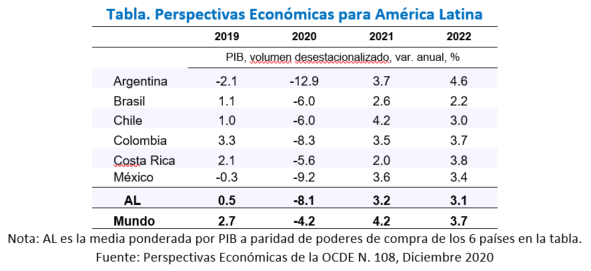
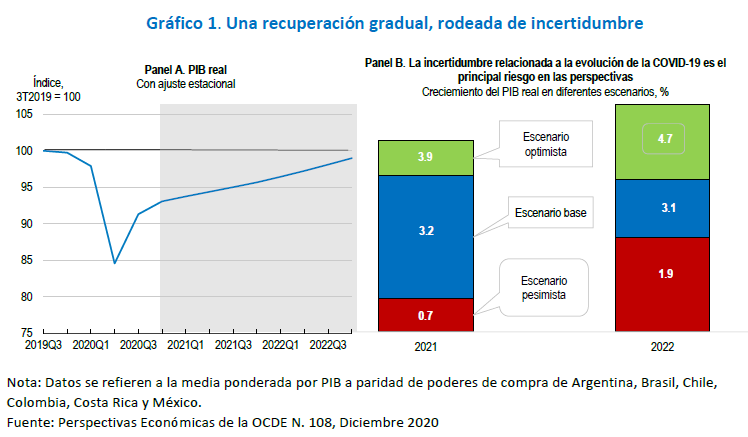
Una recuperación gradual está en marcha, luego de una recesión sin precedentes: se prevé que el crecimiento de seis grandes economías de la región, que abarcan alrededor del 85% del PIB de América Latina, se reduzca 8.1% en 2020 (Tabla). La actividad económica ha comenzado a recuperarse mientras que las medidas de contención en la mayoría de los países se han levantado, pero la recuperación en los próximos años será gradual, casi recuperando los niveles pre-pandemia a finales de 2022 (Gráfico 1, panel A).

Sigue habiendo una inusual incertidumbre en torno a las perspectivas que dependen de la evolución de la pandemia (Gráfico 1, Panel B). En el escenario positivo, la confianza de los consumidores y de las empresas podría mejorar más rápido que en el escenario base si hubiera indicios de que un tratamiento o una vacuna eficaces pudieran desplegarse ampliamente más rápido. En el escenario negativo, la incertidumbre podría agudizarse si se intensificaran los brotes de COVID-19, o si se requirieran medidas de contención más estrictas para controlar su propagación. La confianza podría verse negativamente afectada si la distribución de la vacuna o los efectos secundarios fueran decepcionantes. La prioridad inmediata en la región debe ser evitar posibles brotes de la COVID-19, fortaleciendo los sistemas de salud, y los sistemas de testeo, rastreo y aislamiento, así como asegurar un despliegue rápido de la vacuna cuando esté disponible.

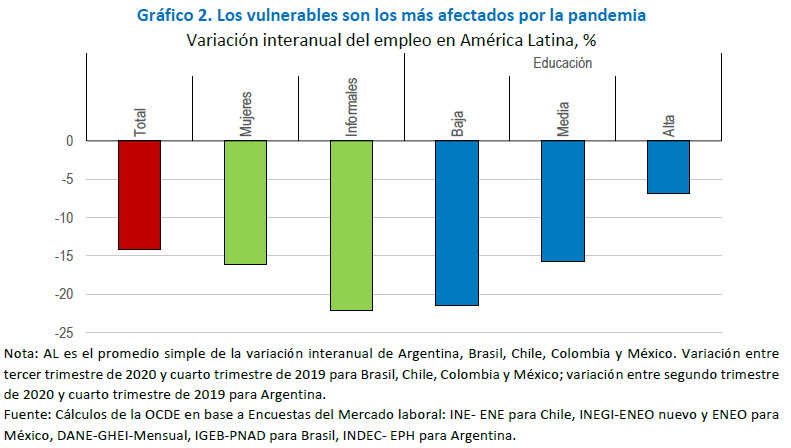
Pero para tener una recuperación vigorosa e inclusiva, América Latina tiene que evitar que esta pandemia deje cicatrices de largo plazo en el mercado de trabajo, y en consecuencia en la pobreza y las desigualdades. Las pérdidas de empleo han alcanzado niveles históricos, afectando sobre todo a los más vulnerables: las mujeres, los trabajadores informales y los de menor calificación (Gráfica 2). Y aunque una incipiente recuperación está en marcha, el empleo de estos grupos vulnerables sigue rezagado. En parte, esto se debe a que los trabajadores menos calificados e informales estaban ocupados en los sectores más afectados por las medidas de contención, y donde la incipiente recuperación es aún débil e incierta. Y el empleo femenino está contenido al menos en parte debido al cierre de las escuelas, que aún no se han completamente abierto en la región.  

Las ayudas que varios gobiernos de la región han implementado a través de programas de trasferencias monetarias, mayor acceso a las cesantías y/o subsidios al empleo son fundamentales para mitigar la crisis. Y aunque es necesario mantenerlos hasta que la recuperación esté afianzada, es hora de repensar y fortalecer los mecanismos de protección social de forma permanente (como lo hemos hablado aquí). Pero si no se logra reactivar el mercado laboral formal, particularmente en sectores intensivos en mano de obra de baja calificación, las ayudas , que son en principio de carácter temporal, van a tener que mantenerse por periodos prolongados. La situación fiscal está ya muy comprometida en la región (como ya lo discutimos aquí) y está situación se agravará por los efectos de la crisis y el consecuente aumento del endeudamiento público, una de las principales vulnerabilidades en la región.  

Se ha vuelto urgente la necesidad de emprender reformas estructurales que permitan una rápida recuperación del mercado laboral, evitando el incremento de la informalidad, la pobreza y las desigualdades. Las políticas de reactivación del mercado laboral, como son los subsidios a la contratación, que han puesto en marcha Chile o Colombia, son un buen primer paso, y necesitan tener un claro foco en los más vulnerables. Dar mayor foco a la protección a los trabajadores, en lugar de a la protección de los trabajos, ayudaría a crear mercados de trabajo más inclusivos y menos segmentados. Adicionalmente, se deben eliminar barreras a la formalización empresarial, sobre todo en las pequeñas y medianas empresas, por ejemplo, a través de la racionalización de los procesos regulatorios, y la creación de mecanismos de ventanilla única. Líneas de crédito específicas para empresas pequeñas, como las que varios países han puesto en marcha desde marzo, también podrían apoyar a empresas que quieran formalizarse, mejorando así los incentivos. Revisar los elevados costos laborales y no laborales, y los sistemas tributarios complejos también incentivarían la formalización. Y no menos importantes son las políticas activas de empleo y sistemas de capacitación de calidad en competencias relevantes que den a todos los trabajadores, en especial a los más vulnerables, la oportunidad de encontrar trabajos de calidad que pueden emerger en el mundo post-COVID.  

Los países deben comenzar el proceso de discusión e identificación de las reformas y planificar la implementación. Algunas de estas reformas deberán esperar a que la recuperación esté afianzada y la pandemia se desvanezca. Pero en todos los casos, el mejor momento para avanzar es ahora. Una agenda de reformas que revitalice el crecimiento contribuiría también de manera clave a la sostenibilidad fiscal.

Para leer en más detalle sobre las proyecciones macroeconómicas, así como los principales desafíos estructurales ir al reporte en la o la versión español y portugués o versión inglés (que incluye proyecciones para todos los países de la OECD y principales desafíos).

Información detallada para estos 6 países con sus notas país correspondientes:

http://www.oecd.org/economy/panorama-economico-argentina/

http://www.oecd.org/economy/panorama-economico-chile/

http://www.oecd.org/economy/panorama-economico-colombia/

http://www.oecd.org/economy/panorama-economico-costa-rica/

http://www.oecd.org/economy/panorama-economico-mexico/

http://www.oecd.org/economy/panorama-economico-espana/