Positive economic outlook for the main economies in Latin America but downward risks have intensified

Alvaro S. Pereira (Director) and Latin American desks, Economics Department, Country Studies Branch, OECD

The global economy is navigating rough seas. Global GDP growth is strong but it has peaked. In many countries unemployment is well below pre-crisis levels, labour shortages are biting and inflation remains tepid.  Yet, global trade and investment have been slowing on the back of increases in bilateral tariffs while  many emerging market economies are experiencing capital outflows and a weakening of their currencies. The global economy looks set for a soft landing, with global GDP growth projected to slow from 3.7% in 2018 to 3.5% in 2019-20. However, downside risks abound and policy makers will have to steer their  economies carefully towards sustainable, albeit slower, GDP growth.

The economic recovery in the Latin American economies has become dissimilar. While in some countries, growth has been revised downwards, in others it has been revised upwards. This disparity is closely linked to how these economies have evolved in the face of the financial stress and increased financial volatility in recent months. The region’s economies with the best macroeconomic fundamentals, independent central banks, countercyclical monetary policies, sound fiscal policy framework and no major currency mismatches in corporate or sovereign debt, were better able to sail the adverse global financial conditions that led to capital outflows, weakening their currencies.
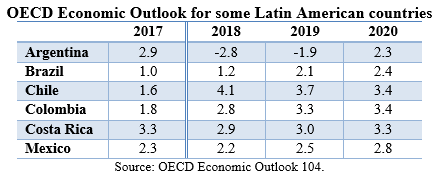
Table LAC EO104

While Chile and Colombia have gained momentum, Brazil has shown lower growth and Argentina has fallen into recession. Mexico and Costa Rica have also experienced less momentum than expected. Growth in Argentina, Brazil, Chile, Colombia, Costa Rica and Mexico, countries covering about 85% of Latin America’s GDP, is expected to be around 1.4% this year and to accelerate to 2.0% in 2019 and 2.7% in 2020 (weighted average) (see Table). However, downside risks abound while the region is vulnerable to the global context. Several indicators, such as the fiscal and current account deficits have been accentuated in the last decade in most of these economies (Figure), suggesting that the region is still vulnerable. Needs to be noted that the situation is uneven and a broader list of indicators should be analysed.

Figure LAC EO104

An accumulation of risks could create the conditions for a harder-than-expected landing. First, further trade tensions would take a toll on trade and GDP growth, generating even more uncertainty for business plans and investment. Second, tightening financial conditions could accelerate capital outflows from the region and depress demand further. Third, a sharp slowdown in China would hit Latin America and other emerging economies, but also advanced economies if the demand shock in China triggered a significant decline in global equity prices and higher global risk premia.

Looking ahead, it will be necessary to strengthen the macroeconomic policy framework to reduce vulnerabilities where necessary. Most of the region’s economies are starting, or will start in the near future, more restrictive monetary policies, while also undertaking fiscal consolidation. Depending on each country, it will be important to find a balance between the needs for social spending and public investment, with the need to put debt on a sustainable path. In Chile, Colombia and Mexico, this consolidation can be done gradually, but Argentina, Brazil and Costa Rica need to do it more urgently. Pension or tax reforms will be necessary in this regard.

Given the limited scope for countercyclical policies, in the face of external risks and a more pronounced slowdown, the time to promote the necessary structural reforms is now to guarantee a future with a sustained increase in productivity and greater inclusion. Many countries in the region have scope to reform the tax system and make it more effective in improving investment incentives and raising more resources. Depending on the characteristics of each country, possible measures may include limiting the use of tax exemptions and reduced rates, particularly in VAT, but also in corporate taxes, extending the tax base by including more people in personal income taxes, reducing evasion or making greater use of property, inheritance or environmental taxes. Other priorities should focus on export promotion and diversification, which would help reduce current account deficits. Investing in quality and innovative human capital, closing infrastructure and logistical gaps, and curbing corruption would support exports and their diversification, strengthening growth. Encouraging women’s participation in the labour force, reducing precariousness and informality in the labour market, as well as pension reforms are also urgent in several countries of the region and necessary to increase productivity and reduce inequalities.

Argentina: A combination of massive fiscal and monetary tightening will keep the economy in recession during 2018 and 2019. Private consumption and investment will remain depressed due to lower real incomes and high interest rates, and unemployment will rise. However, a better harvest and a lower real exchange rate will support stronger exports.

Brazil: Growth will gain momentum during 2019 and 2020 as private consumption, supported by improvements in the labour market, will increase. Recovering credit and greater policy certainty as a new administration takes office will buttress the recovery. Political uncertainty around the implementation of reforms remains significant and could derail the recovery, but if uncertainty fades and reforms advance as assumed, investment will become stronger.

Chile: Growth is projected to remain strong over the next two years. With an uncertain external environment, solid domestic demand will underpin growth, aided by a stable inflation environment, public infrastructure projects and a tax reform. Inequality, though  decreasing, remains high, as informality and unemployment remain high and social transfers low.

Colombia: Growth is projected to pick up as infrastructure projects, lower corporate taxes and higher oil prices will boost investment. Improving confidence and financing conditions will support consumption. As growth gains traction, unemployment will edge down. Social indicators are improving but informality and inequality remain high.

Costa Rica: Growth is projected to recover to around 3¼ per cent in 2020 and be broad-based, underpinned by both domestic and external demand. However, uncertainty, particularly surrounding the planned fiscal reforms, is weighing on growth in the near term. The projections are based on the assumption that the fiscal reforms will be implemented from 2019, with modest fiscal tightening holding back growth in 2019 and 2020.

Mexico: Growth is projected to pick up to 2¾ per cent in 2020. Low unemployment, strong remittances and the recovery of real wages  will support household consumption. Investment, which has been persistently low, will strengthen on the back of announced public investment plans and increased confidence associated with the US-Mexico-Canada trade agreement. Exports will decelerate owing to less favourable global conditions, especially in the United States. Inflation has been pushed up by rising energy prices, but expectations and core inflation remain anchored and within the central bank’s target band. Informality is slowly declining but remains elevated,  contributing to persistently high inequalities and low productivity.

To read more about the Economic Outlook and the main structural challenges visit the english and spanish/portuguese version (it includes OECD forecasts and a chapter on decoupling of wages and productivity and the implications for public policy).

References:

OECD (2018), OECD Economic Outlook, Volume 2018 Issue 2: Preliminary version, OECD Publishing, Paris, https://doi.org/10.1787/eco_outlook-v2018-2-en.


Las perspectivas económicas son positivas en los principales países de América Latina pero los riesgos a la baja se han acentuado

Alvaro S. Pereira (Director) y mesas de países latinoamericanos, Departamento de Economía, Directorado de estudios de países, OCDE

La economía mundial está navegando mares agitados. El crecimiento del PIB mundial es fuerte, pero ha alcanzado su punto máximo. En muchos países, el desempleo está por debajo de los niveles anteriores a la crisis de 2008, la escasez de mano de obra se empieza a sentir, aunque la inflación sigue siendo templada. Sin embargo, el comercio y la inversión mundiales se han desacelerado como consecuencia del incremento de aranceles bilaterales y de mayor incertidumbre política, mientras que varias economías emergentes están experimentando salidas de capitales y un debilitamiento de sus monedas. La recuperación del crecimiento global  comenzará a desacelerarse, mientras que los riesgos a la baja se han acentuado. Se prevé que el crecimiento del PIB mundial disminuya del 3,7% en 2018 a 3,5% en 2019-2020. Sin embargo, abundan los riesgos de recesión y los responsables políticos tendrán que orientar cuidadosamente sus economías hacia un crecimiento sostenible, aunque más modesto, del PIB.

En las principales economías de América Latina, la recuperación económica se ha vuelto despareja. Mientras que en algunas, el crecimiento se ha revisado a la baja, en otras se ha revisado al alza. Esta disparidad está estrechamente ligada a cómo estas economías han evolucionado frente al estrés financiero e incremento de volatilidad financiera de los pasados meses. Las economías de la región con mejores fundamentos macroeconómicos, bancos centrales independientes, políticas monetarias contracíclicas, un marco de política fiscal sólido y sin grande descalce de monedas en la deuda corporativa o soberana, fueron los que sortearon mejor las condiciones financieras globales adversas que sometieron a varios países a una repentina salida de capitales y debilitamiento de sus monedas.

Table LAC EO104 Esp

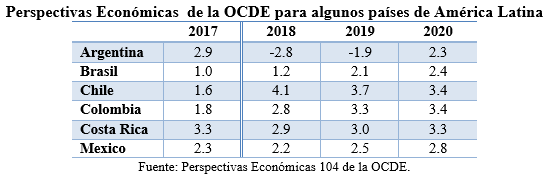
Mientras que Chile y Colombia han ganado ímpetu, Brasil ha mostrado menor crecimiento y Argentina ha caído en recesión. México y Costa Rica también han experimentado menor ímpetu al esperado. Se espera que el crecimiento en Argentina, Brasil, Chile, Colombia, Costa Rica y México, países que cubren alrededor del 85% del PIB de América Latina, se sitúe en torno al 1.4% este año y se acelere a 2.0% en 2019 y 2.7% en 2020 (promedio ponderado) (Tabla). Sin embargo, abundan los riesgos a la baja, mientras que la región se encuentra vulnerable al contexto global. Algunos indicadores, como los déficits fiscales y de cuenta corriente (Figura) se han acentuado en la mayoría de estas economías en la última década, sugiriendo que la región es aún vulnerable. Debe notarse que la situación es dispar y se debe mirarse una lista más amplia de indicadores.

Una acumulación de riesgos podría crear las condiciones para una desaceleración de crecimiento más acentuada de la esperada. En primer lugar, nuevas tensiones comerciales afectarían al comercio y al crecimiento del PIB, generando aún más incertidumbre para las empresas y la inversión. En segundo lugar, el endurecimiento de las condiciones financieras globales podría acelerar las salidas de capitales y deprimir aún más las monedas de la región. En tercer lugar, una fuerte desaceleración en China afectaría a la región y otras economías emergentes, pero también a las economías avanzadas si el shock de la demanda en China provocara un descenso significativo de los precios mundiales de las acciones y un aumento de las primas de riesgo mundiales.

Figure LAC EO104Esp

De cara al futuro, será necesario reforzar el marco de las políticas macroeconómicas para reducir vulnerabilidades donde sea necesario. La mayor parte de las economías de la región están comenzando, o lo harán en el futuro próximo, políticas monetarias más restrictivas, al tiempo que también deben llevar a cabo una consolidación fiscal. Dependiendo de las holguras de cada país, será importante encontrar un ritmo que balancee las necesidades de gasto social y de inversión pública, con la necesidad de poner la deuda en una senda sustentable. En Chile, Colombia y México, esta consolidación se puede llevar a cabo de manera gradual, pero Argentina, Brasil y Costa Rica necesitan hacerlo de manera más urgente. Reformas pensionales o tributarias serán necesarias en este sentido.

Dado el escaso margen para hacer políticas contracíclicas ante la realización de riesgos externos y una deceleración más acentuada, el momento de impulsar reformas estructurales necesarias es ahora, para garantizar un futuro con incremento sostenido de la productividad y mayor inclusión. Muchos países de la región tienen margen para reformar el sistema tributario y hacerlo más eficaz para mejorar los incentivos a la inversión y recaudar más recursos. Según las características de cada país, posibles medidas pueden incluir limitar el uso de exenciones tributarias y tasas reducidas, en particular en el IVA, pero también en los corporativos, extender las bases de imposición incluyendo más personas en los impuestos a los ingresos personales, reducir la evasión o hacer mayor uso de impuestos a la propiedad, a la herencia o impuestos ambientales. Otras prioridades deberían focalizarse en fomentar las exportaciones, y diversificarlas, lo que ayudaría a reducir los déficits de cuenta corriente. Invertir en capital humano de calidad e innovación, cerrar las brechas de infraestructura y logística y frenar la corrupción apoyarían a las exportaciones y su diversificación, fortaleciendo el crecimiento. Alentar la participación de la mujer en la fuerza laboral, reducir la precariedad e informalidad del mercado laboral, así como reformas al sistema de pensiones son también urgentes en varios países de la región y necesarios para aumentar la productividad y bajar las desigualdades.

Argentina: La economía seguirá en recesión en 2018 y 2019 debido a un endurecimiento fuerte y simultáneo de políticas monetarias y fiscales. El consumo privado y la inversión seguirán siendo bajos a causa del descenso de los ingresos reales y de los elevados tipos de interés, y aumentará el desempleo. Sin embargo, una mejor cosecha y un tipo de cambio real más competitivo contribuirán al aumento de las exportaciones.

Brasil: El crecimiento cobrará impulso en 2019 y 2020 gracias al aumento del consumo privado, respaldado por mejoras en el mercado laboral. La reactivación del crédito y el descenso de la incertidumbre política una vez que el nuevo gobierno tome posesión apuntalarán la recuperación económica. La incertidumbre política sobre la implementación de reformas sigue siendo importante y podría frenar la recuperación pero, si desaparece y las reformas siguen adelante como se supone que deberían hacerlo, aumentará la inversión.

Chile: Según las proyecciones, el crecimiento seguirá aumentando en los próximos dos años. Ante una incierta coyuntura externa, el crecimiento estará respaldado por la sólida demanda interna con ayuda de un entorno de inflación estable, proyectos de infraestructuras públicas y una reforma fiscal. A pesar que las desigualdades han disminuido, permanecen altas, debido a que la informalidad y el desempleo siguen siendo elevados y las transferencias sociales escasas.

Colombia: Las proyecciones indican que el crecimiento repuntará, ya que los proyectos de infraestructuras, el descenso del impuesto de sociedades y la subida de los precios del petróleo potenciarán la inversión. La mejora de la confianza y de las condiciones de financiamiento respaldará el consumo. A medida que el crecimiento se vaya afianzando, el desempleo descenderá. Los indicadores sociales están mejorando, aunque la informalidad y la desigualdad se mantendrán en niveles elevados.

Costa Rica: Según las proyecciones, el crecimiento se recuperará hasta el 3¼ aproximadamente en 2020 y será generalizado, sostenido tanto por la demanda interna como externa. Sin embargo, la incertidumbre, particularmente respecto a las reformas fiscales planificadas está lastrando el crecimiento a corto plazo. Las proyecciones parten del supuesto de que las reformas fiscales se aplicarán a partir de 2019, con un modesto ajuste fiscal que frenará el crecimiento en 2019 y 2020.

México: Está previsto que el crecimiento repunte hasta el 2¾ por ciento hacia 2020. El bajo nivel de desempleo, fuertes remesas y la recuperación de los salarios reales reforzarán el consumo de los hogares. La inversión, que ha sido persistentemente baja, se reforzará a consecuencia de los planes de inversión públicos anunciados y del aumento de la confianza vinculado al acuerdo comercial entre Estados Unidos, México y Canadá. El crecimiento de las exportaciones se reducirá debido a unas condiciones internacionales menos favorables, en especial en Estados Unidos. La subida de los precios de la energía ha empujado la inflación al alza, pero las expectativas y la inflación subyacente siguen ancladas y dentro del rango meta del banco central. El alto nivel de informalidad contribuye a que haya una gran desigualdad y una escasa productividad.

Para leer en más detalle sobre las proyecciones macroeconómicas, así como los principales desafíos estructurales ir al reporte en la versión español/portugués o inglés (que incluye proyecciones para países de la OECD, principales desafíos y un capítulo especial sobre la desvinculación de los salarios y la productividad y las implicancias en términos de políticas públicas).


Costa Rica: Distribuir los beneficios del crecimiento más ampliamente

CRI cover ESP smallPor Sonia Araujo y Lisa Meehan, Sección de Costa Rica, Departamento de Economía de la OCDE
La economía de Costa Rica es sólida y continúa convergiendo hacia los niveles de vida de los países miembros de la OCDE (Figura 1). Si bien la productividad ha repuntado recientemente, sigue habiendo una gran brecha con respecto a la de los países de la OCDE. Las tasas de empleo son bajas y el desempleo sigue por encima de los niveles previos a la crisis, afectando predominantemente a los jóvenes y a quienes están poco calificados. Como resultado, y en contra de la tendencia general en América Latina, la informalidad y la desigualdad no están disminuyendo (Figura 2). La OCDE, en su reciente Estudio Económico de Costa Rica, encuentra que las regulaciones anticompetitivas y la alta segmentación del mercado laboral obstaculizan la materialización plena de oportunidades para hacer que el crecimiento sea más inclusivo. Para poner en marcha un “círculo virtuoso” de crecimiento inclusivo será necesario adoptar reformas en varias áreas de políticas que presentan oportunidades beneficiosas para todos, en términos de equidad y mejoras de la productividad.

CRIblog2018launchFig1-2esp

En primer lugar, existen obstáculos importantes al emprendedurismo, amplias exenciones antimonopolio y alto control estatal en muchos sectores. Aportarían grandes beneficios de crecimiento medidas orientadas a mejorar la gobernanza de las empresas estatales según las normas de la OCDE, establecer ventanillas únicas para el registro y la concesión de licencias, simplificar los procedimientos de insolvencia, eliminar las exenciones antimonopolio y mejorar la facilitación del comercio.

Segundo, Costa Rica debe implementar una estrategia integral para combatir la informalidad, que incluya una mayor exigencia al cumplimiento con las obligaciones de pago de contribuciones y la continuación de la reducción de la compleja estructura del salario mínimo, lo que agrava los costos de las empresas y desalienta la formalización laboral. Costa Rica debe de continuar reduciendo su compleja estructura actual de 23 salarios mínimos bajo categorías sectoriales, ocupacionales, de niveles educativos y de habilidades.

En tercer lugar, la educación debería seguir siendo una prioridad política como estrategia para pasar a niveles de ingresos más altos y responder al cambio estructural en curso hacia actividades de mayor valor agregado. Pero Costa Rica obtiene muy poco de su inversión sustancial en educación. Con casi un 8% del PIB, el gasto en educación es más alto que en todos los países de la OCDE. Sin embargo, los resultados de las pruebas PISA revelan que un tercio de los estudiantes carecen de competencias básicas y los resultados están fuertemente influenciados por los antecedentes socioeconómicos. Los recursos deben canalizarse a la educación secundaria, donde hay crecientes presiones demográficas y una necesidad de aumentar el acceso y la educación, y hacia la educación y atención infantil, para que todos los niños puedan desarrollar plenamente su potencial. Se debe brindar un apoyo más focalizado y dirigido a los estudiantes en riesgo desde el principio del proceso educativo. En general, el gobierno debería hacer la transición del enfoque actual basado en los recursos y el financiamiento hacia uno basado en el logro de resultados, así como establecer una meta clara y verificable basada en el desempeño para medir el éxito de sus políticas educativas.

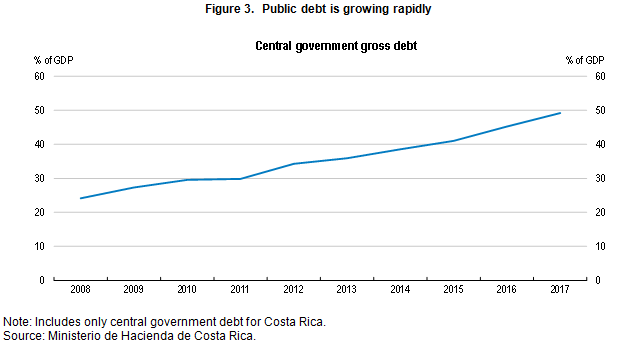
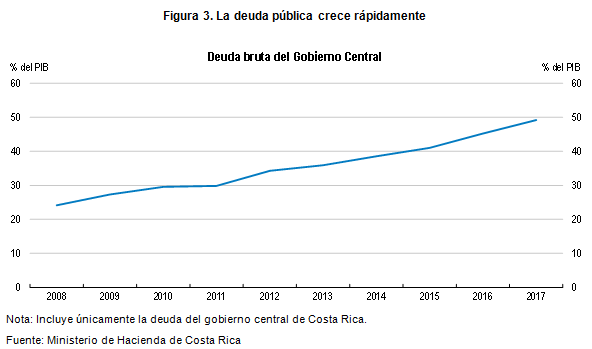
Pero la mayor amenaza para el crecimiento y los niveles de vida en el mediano plazo sigue siendo la sostenibilidad fiscal. El déficit presupuestario superó el 5% del PIB en los últimos cinco años. Los esfuerzos recientes para aumentar la recaudación de impuestos no han reducido el déficit presupuestario, debido al amplio uso de la asignación obligatoria de fondos, la fragmentación del sector público en instituciones autónomas y las obligaciones de gasto vía legislación. Como resultado, la deuda del gobierno central se ha disparado de menos del 25% del PIB en 2008 al 49% en 2017 (Figura 3). Se necesita con urgencia un paquete de reforma fiscal integral que permita estabilizar la relación de deuda a PIB. Existe un amplio margen para recaudar ingresos adicionales ampliando la base tributaria y continuando en la lucha contra la evasión y elusión fiscal. Sin embargo, el aumento de los ingresos fiscales no ayudará a contener el déficit, a menos que se restrinja la marcada asignación de recursos con destinos específicos. Reformar la estructura salarial del sector público, fortalecer el marco presupuestario con una nueva regla fiscal que sea operativa y mejorar la gestión de la deuda, son medidas que contribuirían a equilibrar el presupuesto.

CRIblog2018launchFig3esp

Referencias
Estudios Económicos de la OCDE: Costa Rica 2018


Costa Rica: Sharing the benefits of growth more widely

CRI cover engBy Sonia Araujo and Lisa Meehan, Costa Rica Desk, OECD Economics Department

Costa Rica’s economy is strong and continues to converge towards OECD living standards (Figure 1). Although productivity has picked up recently, a wide gap relative to the OECD remains. Employment rates are low and unemployment remains above pre-crisis levels, hitting predominantly youth and the low skilled. And against the general trend in Latin America, informality and inequality are not declining (Figure 2). The OECD 2018 Economic Survey of Costa Rica finds that anti-competitive regulations and high labour market segmentation hinder the full realisation of opportunities to make growth more inclusive. Setting in motion a ‘virtuous cycle’ of inclusive growth will require reforms across several policy areas that present win-win opportunities in terms of equity and productivity improvements.

CRIblog2018launchFig1-2

First, there are high barriers to entrepreneurship, anti-trust exemptions and state control in many sectors. Improving state-owned enterprises’ governance according to OECD standards, establishing one-stop shops for business registration and licensing, streamlining insolvency procedures, removing anti-trust exemptions and enhancing trade facilitation would bring large growth benefits.

Second, Costa Rica should implement a comprehensive strategy to fight informality, including greater enforcement of compliance and by continuing to reduce the complex minimum wage structure, which increases firms’ costs and discourages job formalisation. Costa Rica should continue to simplify its complex web of 23 sectoral, occupation, education attainment and skill minimum wages.

Third, education should remain a policy priority as a strategy to move to higher income levels and respond to the ongoing structural change towards higher value-added activities. But Costa Rica obtains too little from its substantial investment in education. At almost 8% of GDP, education spending is higher than in all OECD countries. However, PISA results reveal that one third of students lack core competencies and outcomes are strongly influenced by socio-economic background. Resources need to be channelled to secondary education, where there are growing demographic pressures and a need to increase access, and early childhood education and care, in order for all children to fully realise their potential. More focused, targeted support should also be given to students at risk early on. Overall, the government should move from the current focus on resources and funding to outcomes, and establish clear and verifiable performance based targets against which to measure the success of its education policies.

But the major threat to growth and living standards in the medium term continues to be fiscal sustainability. The budget deficit has exceeded 5% of GDP for the past five years. Recent efforts to increase tax collection have not reduced the budget deficit due to the extensive use of earmarking, public sector fragmentation into autonomous agencies and spending mandates. As a result, central government debt has soared, from less than 25% of GDP in 2008 to 49% in 2017 (Figure 3). A comprehensive fiscal reform package is urgently needed to stabilise the debt-to-GDP ratio. There is ample room to raise additional revenue by broadening the tax base and continuing to fight tax evasion and avoidance. However, raising tax revenue will not help to contain the deficit unless strong earmarking and mandated spending are restricted. Reforming public-sector compensation, strengthening the budgetary framework with a new, operational fiscal rule and improving debt management would help to balance the budget.

CRIblog2018launchFig3

References:

OCDE (2018), OECD Economic Surveys: Costa Rica 2018, OECD Publishing,


Does everybody enjoy Pura Vida? Decomposing income inequality in Costa Rica

By Mabel Gabriel and Alberto Gonzalez Pandiella, OECD Economics Department

Despite strong economic growth, Costa Rica’s income inequality has increased in the past decade, in stark contrast with other Latin American countries (OECD, 2016 and González Pandiella and Gabriel, 2017).

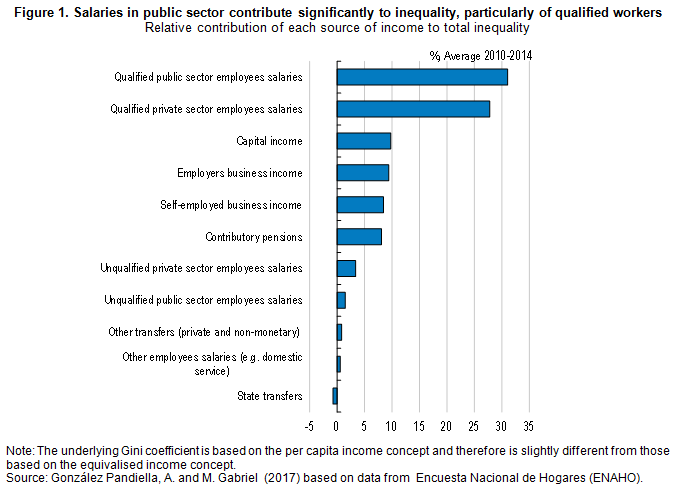
What explains this? A decomposition of income inequality by income sources reveals, surprisingly, that public sector wages are largely behind the country’s high level of income inequality (Figure 1). High wages paid to those employed by public agencies outside the central government contributed the most. Inequality has also been driven by large and increasing skills premiums in the private sector. Workers holding a tertiary degree earn, on average, nearly four times as much as those with only primary education. Social programmes, such as non-contributory pensions, help to reduce inequality, but their impact is limited given their small share in households’ total income.

CRI1

What to do about it? One fundamental advantage of decomposing inequality by income source is that it allows quantifying how marginal changes in a particular income source would affect overall income inequality, which can be useful to guide policies. For Costa Rica, the largest reduction in inequality would come from an increase in wages of low qualified workers in the private sector (Figure 2). Hence, progress to ensure a higher compliance with the minimum wage level would help to reduce inequality. Given that the Costa Rica’s minimum wage system is complex (OECD, 2016), a simplification of its structure would facilitate compliance. A more comprehensive strategy to reduce informality, which is increasing and affects predominately low-qualified workers, would also help to curb inequality.

CRI 2

On the other hand, increases in wages of qualified workers in the public and private sectors would result in the highest increase in inequality. Hence, further increases in public wages of qualified workers do not seem optimal from an inequality perspective. In the private sector, strengthening the links between education and the labour market would help to reduce existing high skills mismatches (Gonzalez Pandiella, 2016) and would also contribute to lower inequality by reducing skill premia.

References:


Mind the gapS: boost early childcare education and care in Costa Rica

By Alberto González Pandiella, Economist, SDD, OECD Economics Department

Costa Rican well-being indicators are comparable or even above the OECD average in several dimensions (OECD, 2016a). Nevertheless, gaps with OECD countries are large in two dimensions:  labour market participation and education.  This hampers both long-term growth prospects and equity.  Boosting early childcare education and care would help to close both gaps (Gonzalez Pandiella, 2016).

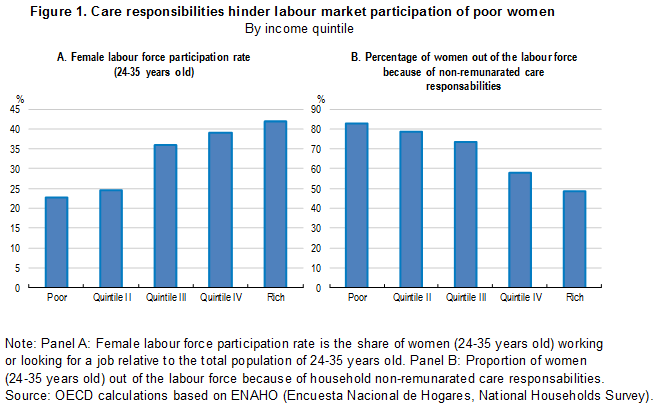
Only slightly over half of the Costa Rican working-age women participate in the labour market. Gaps in participation start at very early ages and remain large thereafter. Women from low socioeconomic background face difficulties to continue in education and tend to drop out of the labour force. Only one out of four women in low income households in the 24-35 age bracket participate in the labour market (Figure 1, Panel A). This low participation is predominantly due to the non-remunerated care responsibilities they have to assume (Figure 1, Panel B). This highlights the need to increase the supply of publicly-funded childcare services, and to target them at women in low income households.

costa-rica-fig-1

Costa Rica shows a strong commitment to invest in education. But the average education attainments remain low. Less than half of the 25-29 cohort has completed secondary education, which is well below graduation rates observed in other Latin American countries such as Colombia, Peru and Panama.  PISA scores are low in all disciplines, indicating that the quality of education is also comparatively low. Moreover, educational gaps depending on households’ income are widening.  These inequalities in education outcomes start early. At the end of primary education, the share of students coming from low income households lagging behind is high, and this is aggravated in lower secondary, when many drop out. Attendance to pre-primary education helps to decreases the likelihood of low performance in secondary education, even after controlling for socioeconomic factors (OECD, 2016b). Thus, boosting attendance to early childhood education and care, with an especial focus on children from low-income households, would also contribute to close educational inequalities and gaps in Costa Rica.

References:
Gonzalez Pandiella, Alberto (2016), “Making growth more inclusive in Costa Rica”, OECD Economics Department Working Paper no. 1300.

OECD (2016a), OECD Economic Surveys: Costa Rica 2016, OECD Publishing, Paris.

OECD (2016b),  Low-Performing Students: Why They Fall Behind and How to Help Them Succeed, PISA, OECD Publishing, Paris, http://dx.doi.org/10.1787/9789264250246-en


Tackling the three main challenges in Costa Rica: fiscal reform, reverting the slowdown in productivity and reducing inequality

By Paula Garda and Mauro Pisu, Country Studies Branch, OECD Economics Department

Costa Rica’s economic, social and environmental achievements are impressive. It has succeeded in combining rising living standards, virtually universal health care, pension and primary education systems with sustainable use of natural resources. Incomes per capita have nearly doubled in real terms over the past three decades and some well-being indicators (health, environment and life-satisfaction) are comparable with or even above the OECD average. However, as the latest Economic Assessment of Costa Rica highlights the country faces old and new challenges that will need be addressed to continue developing in a sustainable way.

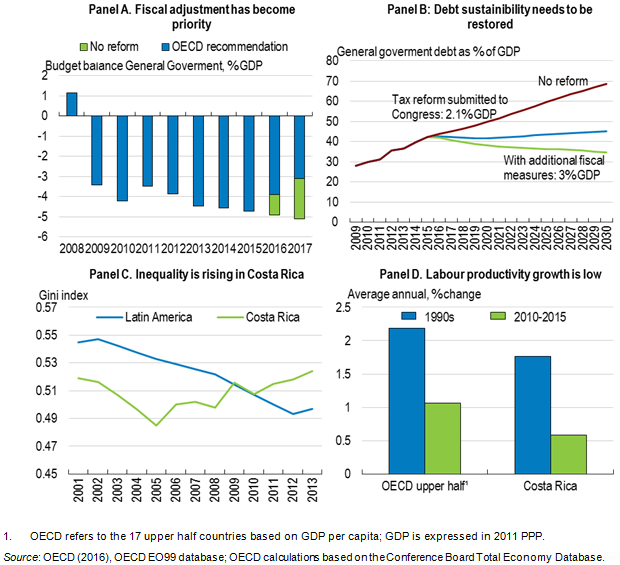
In the period 2008-2015, the public debt-GDP ratio almost doubled to 42.4% (Figure 1, Panel A and B) and interest payments on government debt rose from 15 to 19% of central government revenues. The budget deficit reached 6% of GDP in 2015. Measures to restore fiscal sustainability are now urgent.

In addition, Costa Rica faces long-standing structural problems:

  • Inequality has been increasing since the mid-1990s to high levels by OECD standards. This is in stark contrast with many other Latin American economies, which have recently made significant progress in reducing inequality and poverty (Figure 1, Panel C).
  • Labour productivity growth has been disappointing mainly because of sluggish technical progress. This has taken place despite policies promoting international markets openness and attracting foreign direct investment (FDI) inflows (Figure 1, Panel D).

Costa Rica Fisc

How can policymakers address the three challenges?

The fiscal challenge is the priority. The two bills the government proposed in 2015 – as part of a tax reform package – to replace the sales tax with a full-fledged VAT system and reform the income tax are still under discussion in the legislative assembly. It is urgent to approve them as soon as possible. The VAT and the income tax reform would cut the deficit by about 2% of GDP over the following two years (mostly due to the introduction of the VAT) and would help stabilise the debt-GDP ratio. The two bills are well thought out and consistent with OECD advice: broadening tax bases and relying more on VAT are growth friendly ways to raise tax receipts. Also, most OECD countries have VAT systems, including Mexico and Chile. Additional fiscal or expenditure control measures of 1% of GDP will be needed to put debt on a firm downward path (Figure 1, Panel B). These should focus on reforming the public employment system to prevent excessive automatic salaries increases and raise public sector efficiency. Reforming the public employment system is key to boost productivity and lower inequality as public administration inefficiencies hamper business dynamism and public sector employment contributes to rising inequality in Costa Rica.

Structural reforms and institutional changes are necessary to increase productivity and build a more inclusive society by reducing inequality and poverty.

The three main areas of reforms to boost productivity include: 1) improving the framework of competition policy by strengthening the power of the competition authority and improving the governance of state-owned enterprises, which play a dominant role in many key sectors such as banking, electricity, insurance and telecoms; 2) enhancing links between the foreign and domestic firms and encouraging innovation by local enterprises through better links with universities; 3) improving transport infrastructure by simplifying the sector institutional framework and accelerating project execution.

Reforms to increase productivity need to go hand in hand with making Costa Rica a more inclusive society, especially for women. This will require improving the quality of education – and not just increasing spending on it – enhancing the effectiveness of cash transfers– by reducing programmes’ fragmentation and improving targeting – and lowering informality – by strengthening enforcement, reducing administrative burdens to entrepreneurship and enabling the poor to become formal workers. Costa Rica should also reinforce environmental protection by reducing emissions from the transport sector and improving wastewater treatment.

Find out more:

OECD (2016a), OECD Economic Surveys: Costa Rica 2016, OECD Publishing, Paris.