Towards a more prosperous and inclusive Brazil

By Jens Arnold and Alberto González Pandiella

Over the past two decades, strong growth combined with remarkable social progress has made Brazil one of the world’s leading economies. However, Brazil remains a highly unequal country, recent corruption allegations have revealed significant challenges in economic governance and the situation of its fiscal accounts is challenging with high and rising public debt (OECD, 2018). This calls for wide-ranging reforms to sustain and continue progress on inclusive growth. The government has started to put in place significant reforms, including a fiscal rule and a financial market reform that aligns directed lending rates with market rates. The long and deep recession is over and growth is projected to accelerate significantly this year. But more needs to be done to improve the living standards of all Brazilians.

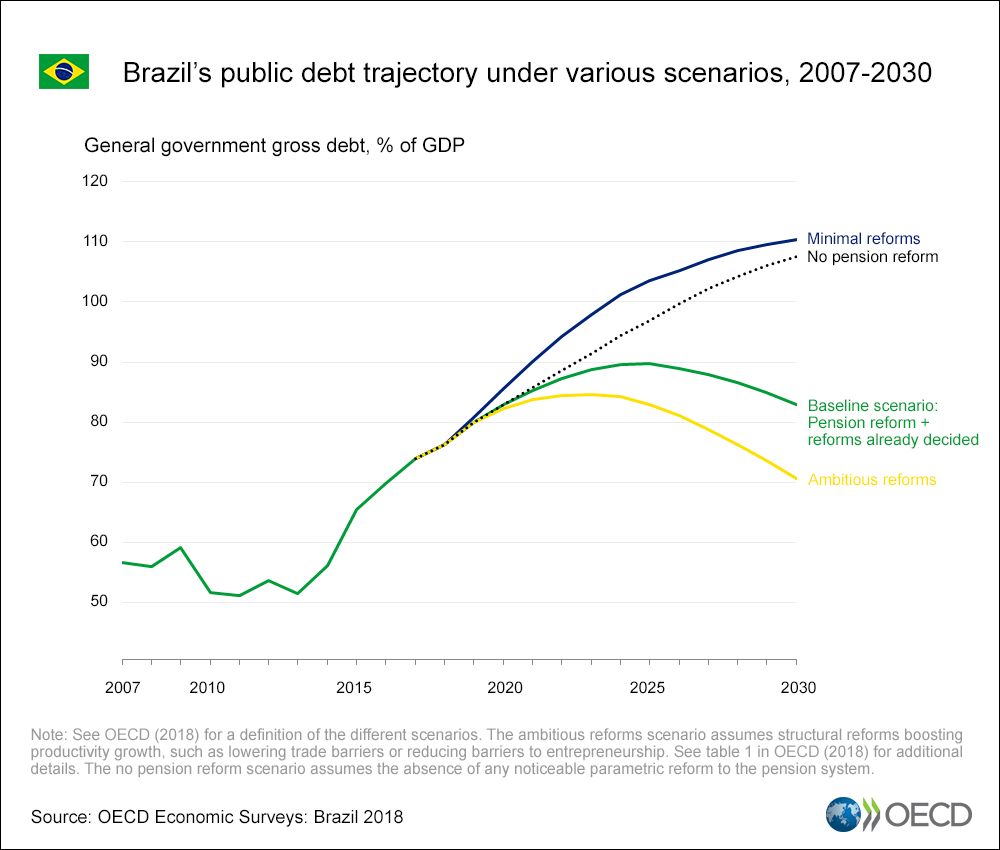
The overall budget deficit is close to 8% of GDP driven by rising expenditures. Gross public debt has increased by approximately 20 percentage points of GDP over the last 3 years and stands around 75% of GDP.  Implementing the planned fiscal adjustment and achieving fiscal targets is crucial for restoring the credibility of fiscal policy and avoiding a fiscal crisis. A comprehensive social security reform has become the most urgent element of the fiscal adjustment, as much of the worsening of the deficits is due to rising pension spending. A pension reform is also an opportunity to make growth more inclusive through better targeting of benefits. Aligning Brazil’s pension rules with those practiced in OECD countries could be done in a way to preserve the purchasing power of pensioners while significantly improving the sustainability of the pension system. For example, in OECD countries people retire on average when they become 66 years old, while the effective retirement age in Brazil is 56 years for men and 53 for women. Establishing a formal minimum retirement age would help, in addition to rethinking the current benefit indexation mechanisms. Without reform, pension expenditure will more than double by 2060 (OECD, 2017), which would lead to unsustainable fiscal dynamics (Figure 1).
6_Public-debt-trajectory_blog


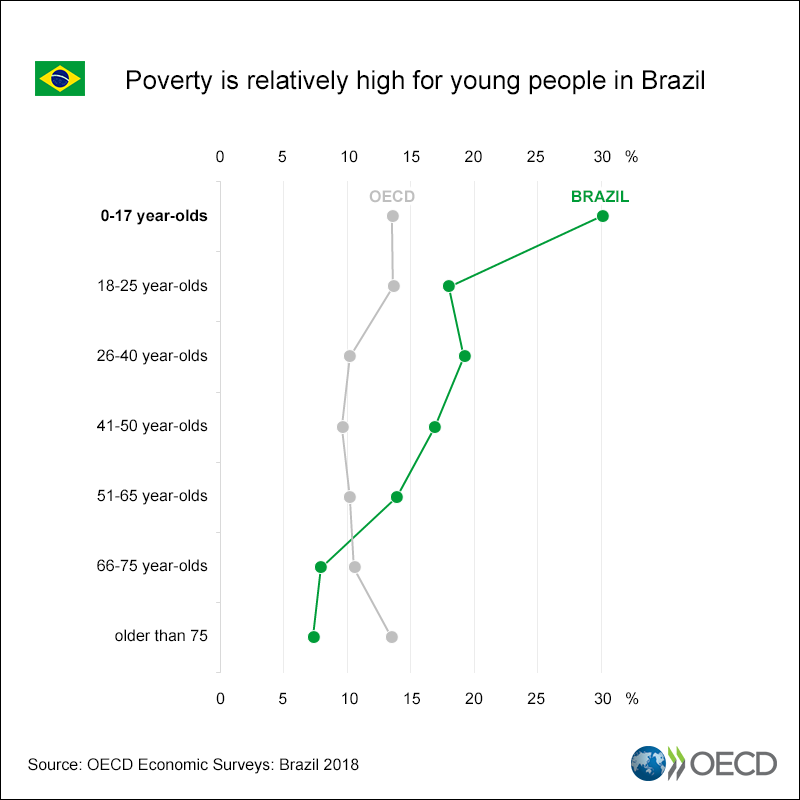
Improving the effectiveness of public spending, and in particular public transfers, will also be crucial for further social progress. At present a large and rising share of social benefits is paid to households that are not poor, which reduces their impact on inequality and poverty. Already, poverty is more than three times higher among children and youths than among those aged above 65 (Figure 2). Limiting future increases in those social benefits that do not reach the poor would be a first step. That would instead allow shifting more resources towards transfers that do reach the poor, such as Bolsa Família, which is highly regarded across the world and reaches the poor like hardly any other social programme in Brazil. This would help particularly children and youths. Currently Bolsa Família only represents 0.5% of GDP out of the 15% of GDP that Brazil spends on social transfers (OECD, 2018). There is also scope to reduce transfers to the corporate sector, which have increased markedly over recent years. These transfers, often granted in the form of tax exemptions or subsidised lending, have not been associated with visible improvements in productivity or investment, but they benefitted primarily the more affluent, besides creating fertile ground for corruption and political kick-backs.
9_Poverty

Further advances in living standards will also hinge on finding a new inclusive growth strategy, ensuring that the benefits of growth will be broadly shared across the population. Productivity will have to become the principal engine of growth in the future, because the demographic bonus that has supported growth in Brazil is reversing. But raising productivity will require significantly higher investment and trade. Brazil has one of the lowest investment rates among OECD and emerging market economies and it is also less integrated into global trade. Boosting investment and trade would raise productivity, helping Brazilians to access higher wages and living standards.

References:

OECD (2018), OECD Economic Surveys:Brazil, OECD Publishing, Paris.

OECD (2017), “Pension Reform in Brazil, OECD Policy Memo“, April 2017, https://www.oecd.org/brazil/reforming-brazil-pension-system-april-2017-oecd-policy-memo.pdf.


Reforming Brazil’s old-age pension system to ensure its sustainability

By Jens Arnold, Head of Brazil Desk at the OECD Economics Department and Hervé Boulhol, Head of Pensions and Population Ageing at the OECD’s Directorate for Employment, Labour and Social Affairs

Pensions have been successful in reducing old-age poverty well below the population-wide average, and below the OECD average (Figure 1). At present, all pension recipients – and this includes around 90% of those aged 65 and above – receive at least the minimum wage, which is more than 5 times as much as the poverty line of BRL 170 (equivalent to USD 55).

However, Brazil’s old-age pension system already costs more than 10% of GDP, despite the country’s young – but rapidly ageing – population.  The combined annual shortfall of the pension schemes is close to 4.5% of GDP, contributing substantially to the budget deficit. If the current parameters of the system remain unchanged, spending on pensions for private-sector workers alone would increase by almost 3% of GDP by 2030, and by almost 5% of GDP by 2040. Taking into account the public sector amplifies imbalances, which will make the system financially unsustainable.  An in-depth reform is necessary and inevitable.

Brazil pov by age

Several policy measures could contribute to containing pension expenditures. Raising Brazil’s low average retirement ages of 56 years for men and 53 years for women appears urgent, by introducing a binding minimum retirement age. Many OECD countries are now gradually moving their normal retirement ages beyond 65 years for men and women. In contrast to Brazil’s pension system, all public pension schemes in OECD countries include a minimum retirement age.

Brazil also stands out for high pension benefits relative to working-age incomes, in particular for low-wage earners, paid at low retirement ages (Figure 2). In the OECD, an average-wage full-career worker will get a pension paying 53% of pre-retirement earnings at the age of 65.5 years, compared to 70% for men and 53% for women in Brazil at age 55 and 50, respectively. Moreover, the minimum pension benefit is equal to the minimum wage, which has led to real increases in the minimum pension of almost 90% over the last 10 years. The minimum pension is available after 35 years of contribution or from age 65 after only 15 years of contribution.

Brazil net repla

References

OECD (2017). Pension Reform in Brazil. OECD Policy Memo, Paris: OECD, available at http://www.oecd.org/eco/surveys/reforming-brazil-pension-system-april-2017-oecd-policy-memo.pdf


Untying the knots strangling Brazil’s competitiveness

by Sónia Araújo
Economist, Brazil Desk, OECD Economics Department

There is strong international evidence that trade liberalisation and increased international integration are key elements of a successful growth strategy. Exposure to international competition, sourcing internationally and learning by exporting accelerates technological upgrading and fosters productivity growth. This column explains how three policy instruments are holding back competitiveness by limiting Brazil’s ability to tap into the global pool of knowledge.  

 Despite a constitutional amendment in 2003 intended to exempt exports from indirect taxes, Brazilian exporters face tremendous hurdles in claiming back indirect taxes paid on intermediate inputs. Poultry exporters, for instance, estimate that the government owes them around 7% of the value of their exports on account of the several indirect taxes paid on inputs. After attempting to claim these credits for years, companies simply prefer to write off these amounts.

The competitiveness of industrial exports is suffering even more than that of raw and semi-processed goods on two accounts: higher rates are applied to products requiring more transformation and indirect taxes are cumulative. Indirect taxes on inputs embodied in exports put Brazilian producers at a disadvantage vis-à-vis foreign competitors who do not pay such taxes.

Brazilian exporters are also penalised by Brazil’s high import tariffs, which are the highest among the BRICS countries for non-agricultural products (see previous post on Brazil: A tale of two industries or how openness to trade matters, March 22, 2016). Together with local content requirements that expand into an increasing number of sectors (oil, chemicals, motor vehicles, telecoms, health, etc.), they prevent Brazilian companies from sourcing at the lowest cost.

Advocates of trade protection often claim that protection raises the performance of domestic industry over time. Brazil’s own experience in this area is sobering. There is no evidence that high levels of protection have spurred Brazil’s exports, which have remained flat relative to GDP (Figure 1).

Figure 1. Brazil’s share of world trade is low relative to its GDP
Share of exports and imports on world’s total exports and imports, respectively
Brazil Sonia 1
Source: Secretaria de Comércio Exterior (SECEX) do Ministério do Desenvolvimento, Indústria e Comércio Exterior (MDIC), World Bank Development Indicators.

In fact, the share of manufacturing output in GDP has been declining for a decade and manufacturing productivity is low and stagnant (Figure 2).

Figure 2. Manufacturing productivity is low and stagnant
Labour productivity in thousands of constant 2005 USD per employee

Brazil Sonia fig2

Source: World Bank, ILO, IBGE.

By international comparison, Brazil’s industrial sector is small for a middle income country (Figure 3; OECD, 2015).

Figure 3. Brazil’s industrial sector is small for an upper middle income country
Share of industry in total value added in middle income countries, in per cent, 2012

Brazil Sonia fig3

Source: World Bank.

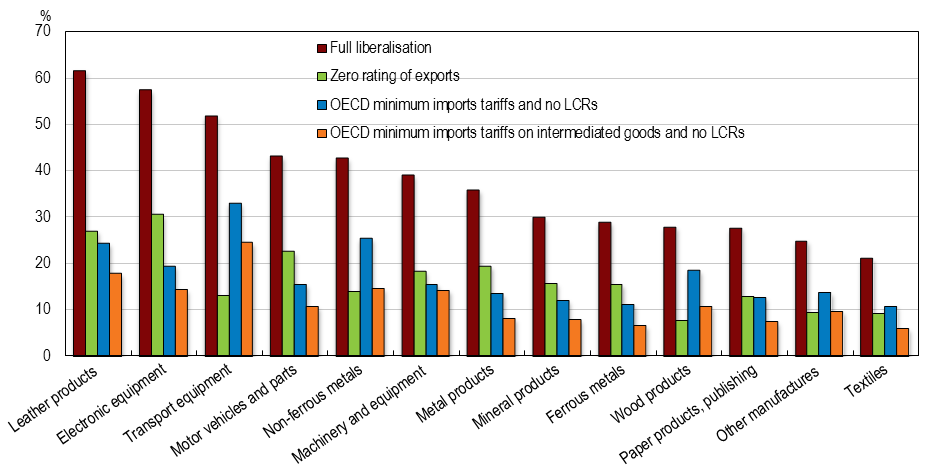
In a recent study we attempt to quantify the effects of lifting these barriers to trade using the OECD Metro model, a computable general equilibrium model of the world economy. The simulation results suggest that reducing import tariffs and local content rules, and effectively exempting intermediate inputs from indirect taxes would boost Brazilian exports, production and jobs substantially. The largest gains would accrue in manufacturing, where exports of leather products, electronic and transport equipment, motor vehicles and non-ferrous metals would all increase by more than 40% (Figure 4). Job creation would be higher in lower skilled occupations, benefiting those at the lower end of the income distribution.

Figure 4. Largest Gains in Exports
Sectors with an increase in exports of at least 20%

Brazil Sonia fig5

The simulation results also suggest that these tax and trade policy reforms would bring clear efficiency gains to the economy: firms would be able to use a higher share of foreign intermediate goods and final goods would in turn be sold at lower prices, enhancing export competitiveness and benefiting Brazilian households.

Another result from our simulations is that it pays to go for a big push. The benefits of a wide-ranging trade liberalisation would far exceed those of partial reforms. Overall, getting rid of these barriers would enable Brazil to develop a stronger manufacturing sector and become much more integrated into the global economy.

Find out more

Araújo, S. and D. Flaig (2016), “Quantifying the Effects of Trade Liberalisation in Brazil: A Computable General Equilibrium Model (CGE) Simulation”, OECD Economics Department Working Papers, No. 1295, OECD Publishing, Paris.

OECD (2015), OECD Economic Surveys: Brazil, OECD Publishing, Paris


Brazil: A tale of two industries or how openness to trade matters

by Jens Arnold
Senior Economist, Head of the Brazil Desk, OECD Economics Department

Brazil has a large and diversified industrial sector, but while parts of it are thriving, others are facing hard times, in part because they are weakly integrated into the world economy. The automotive and the aircraft sectors are two opposite examples of Brazilian industries – one inward-focused and one fully integrated into global trade.

Brazil is the world’s seventh largest automobile producer, but its automotive industry is currently facing severe challenges and production is declining (Figure 1). The industry is heavily protected from foreign competition and Brazil’s car manufacturers have a strong focus on the domestic market and on local content. Only 15% of the production is exported. Despite being the 8th largest producer of cars in the world, Brazil ranks only 24th in automotive exports. Brazilian vehicle exports have the third-lowest foreign value added content among the 62 countries in the OECD-WTO Trade in Value Added database (OECD, 2015a).

Figure 1. Production of motor vehicles, in million units, accumulated over 12 months

Brazil fig 1

Source: ANFAVEA website, available at http://www.anfavea.com.br/tabelasnovo.html

While many foreign producers have set up production plants in Brazil in light of the attractive long-term potential of Brazil’s consumer market, most of them have not integrated their Brazilian plants into global value chains (OECD, 2015b). Possibly due to the low exposure to foreign competition, productivity has fallen sharply behind Mexican car manufacturers, who are fully integrated into global production chains and have achieved remarkable gains in global market share. For example, Mexican plants produce 53 cars per worker and year, as opposed to 27 in Brazil, although the cars produced in Mexico are on average smaller models.

A very different story can be told about Brazil’s aircraft industry. Given that production volumes of airplanes are much smaller than for automobiles, economies of scale mandate that firms in this industry focus on the global market. Embraer, originally created in 1969 as a state-owned company, was privatized in the 1990s and has become one of the top global players in the industry since then. Its initial strategy was largely based on buying almost all components internationally for a final assembly in Brazil, although over time it has started to produce parts itself. As a result of its roots, Embraer has always been strongly integrated into global production chains, and imports still account for 70% of its value added. At the same time, exports have grown steadily, performing significantly stronger than motor vehicle exports (Figure 2). By now, Embraer has become the world’s third largest aircraft producer, and it is the global leader in the 70-130 seat aircraft segment, where it accounts for 60% of global deliveries.

Figure 2. Brazil: Exports of motor vehicles and aircraft, 2005=100, in USD

Brazil fig 2

Source: Ministry of Development, Industry and Foreign Trade, Brazil.

References

OECD-WTO (2015a). OECD-WTO Trade in Value Added (TiVA) database

OECD (2015b). OECD 2015 Economic Survey of Brazil, OECD Publishing, Paris