Charting a course for Australia’s future: navigating the seas of ageing, climate transition and gender equality

Alvaro Leandro and Ben Westmore, OECD Economics Department

The Australian economy rebounded robustly in the wake of the pandemic. However, supply constraints coupled with rising global energy prices sent inflation to its highest level since the early 1990’s, prompting a significant tightening of monetary policy. Subdued economic growth is projected over the coming years, as higher interest rates and cost of living pressures dampen spending.

In the medium term, external forces loom large over the economic outlook. As an economy that benefits significantly from foreign commodity demand, rising geopolitical tensions and global fragmentation are a risk to national income. The global climate transition will impact the economy, both through the influence on demand for Australian fossil fuel exports and the reshaping of domestic industry in line with net zero commitments. At the same time, the ageing demographics will lower the share of the working age population and lead to structural changes throughout the economy.

Addressing fiscal challenges

In anticipation of the challenges ahead, fiscal buffers need to be rebuilt. Australia’s public debt ratio remains in the lower half among OECD countries, but it has risen substantially for both the federal and several state governments over the past decade. The demographic and climate transitions will create further spending pressures and require improved mechanisms for fiscal dialogue across levels of government.

Spending and tax reforms can help address rising fiscal costs. Encouraging more patient care in primary care settings and greater emphasis on preventive health policies would reduce public spending growth as the population ages. Revenues could be raised through reducing exemptions in the goods and services tax base and further limiting tax concessions on private pensions.

Facilitating labour force and business sector adaptation

Amid ongoing structural change, policies need to promote an adaptable labour force and business sector. A concerning trend has been the slowdown in GDP per capita growth in Australia: whereas Australia used to outperform OECD counterparts, GDP per capita growth has been comparatively weak through the past decade (Figure below).

Trend GDP per capita growth has slowed

GDP per capita growth, average rate


Made with Flourish

Source: OECD Growth in GDP per capita, productivity and ULC Dataset.

Immigration will be key for supporting labour supply, but the composition of the skilled migrant intake needs to be more responsive to changes in the skill needs of industry. In parallel, school reforms could improve the foundational skill base. Straightforward measures such as providing all teachers with access to high-quality curriculum resources would allow them to focus on activities where they add most value, helping address declining standardised test scores of Australian students.

As the economy adjusts, greater flexibility in land zoning systems would improve the ability of new businesses to enter new markets and grow in desirable locations. Competition policies can also support healthy competitive dynamics in the business sector, despite Australia’s geographic distance from foreign markets. The authorities have commenced a broad competition policy review, which should consider more closely aligning the merger regime with other OECD countries.

Improving gender equality

Achieving further improvements in gender equality is also a key priority. In addition to being a fundamental human right, improving gender equality would support fuller participation of women in the labour force as the population ages. A significant gender gap in labour income remains, despite recent progress (Figure below). This results from differences in employment rates between men and women (employment gap), the intensity of work (hours gap) and the amount workers are paid per hour (hourly wage gap).

The gender gaps in income persist


Made with Flourish

Note: The gender gap is defined as the labour income of men-women.
Source: The Household, Income and Labour Dynamics in Australia Survey, OECD calculations.

A key factor is high marginal effective tax rates when increasing work hours for low earners, due to the loss of benefits as earned income rises. This is especially the case for single parents, who are disproportionately women, and should be remedied by reducing the speed of benefit withdrawal as earnings increase.

Additional improvements to parental leave and childcare arrangements would support mothers staying in work and labour market re-entry after childbirth. Parental leave duration and the rate at which it is paid is low by OECD standards, while out-of-pocket childcare costs are relatively high, especially for low-income households.

Achieving the climate transition

The authorities are committed to achieving net zero emissions by 2050, a significant challenge given a historical reliance on coal generation and the presence of large mining and agriculture sectors (Figure 3). This will require a rapid transformation of the electricity grid and significant emission reductions in highly-polluting sectors such as industry and transport.

Large emissions reductions are needed

Source: Department of Climate Change, Energy, the Environment and Water.

Given the energy sector’s central role in the climate transition, the government should stand ready to provide further policy support and accelerate the planning and implementation of renewable energy projects to ensure that the renewable energy target of 82% by 2030 is met.

In the industrial sector, welcome reforms to the Safeguard Mechanism, which sets limits on the emissions of industrial facilities, have the potential to deliver significant emission reductions. Regular reviews of the mechanism are planned and should consider design changes if emission reduction targets are not met, such as switching from baselines based on emissions intensity to limits on total emissions.

Based on current policies, transport is projected to become the largest source of emissions in Australia by 2035. Introducing stringent fuel economy standards would help curb emissions in the sector, and these should be progressively tightened to zero emissions by 2035. Existing fuel tax exemptions for heavy and off-road vehicles should also be reconsidered.

Climate adaptation also needs to be a focus given Australia’s high exposure to climate-related hazards such as wildfires, extreme heat, and heavy rainfall. Adapting to climate change will require substantial investment and careful planning. Mandatory disclosure of climate-related risks in certain cases such as the sale of property can help raise awareness and encourage more effective adaptation. In addition, incorporating climate hazard considerations in land-use planning will help reduce risks by limiting development in more hazard-prone areas and mandating specific risk-prevention measures for new and existing constructions.

References
OECD Economic Surveys: Australia 2023, OECD Publishing

https://doi.org/10.1787/1794a7c9-en


Australia: Five takeaways from the new OECD Economic Survey

By Patrick Lenain, Christine Lewis and Ben Westmore, OECD Economics Department

In Australia, the recent outbreak of the COVID-19 Delta variant has prompted the government to adapt its public health response. Instead of attempting to suppress the virus (“zero tolerance”), efforts are now being made in New South Wales and Victoria to contain the virus together with a more active campaign to vaccinate the population. The current strict lockdowns in these states will result in GDP declining in the third quarter of 2021. In an environment of higher community transmission of COVID-19 and lingering uncertainty, the eventual recovery will remain gradual even when restrictions are eased. In the medium-term, the new Economic Survey says that Australia has the potential to return to sustained growth if complementary structural reforms are undertaken. Policy changes can also make growth work for all and put Australia on path toward achieving net zero greenhouse gas emissions. Five takeaways from the report are summarised below.

Figure 1. Confidence has fallen recently

Note: The measures are normalised over the period since 1997.
Source: Refinitiv.

Institutional reforms would strengthen resilience. Fiscal policy is now being conducted in an environment of higher public debt and will be called to play a more active role given the limited space for conventional monetary policy at the lower bound. At the same time, underlying inflation has undershot the target band of the Reserve Bank of Australia (RBA) for an extended period (Figure 2). When the economy fully recovers, the government should outline a medium-term fiscal strategy that is associated with specific timeframes or conditional on measurable economic outcomes. Future fiscal strategies should also be regularly evaluated and monitored by an independent fiscal institution, such as the Parliamentary Budget Office. As in other OECD countries, the RBA should conduct a monetary policy framework review that is broad in scope, transparent and involves consultation with a wide variety of relevant stakeholders.

Figure 2. Underlying inflation has undershot the RBA target for a prolonged period

Note: The measure of underlying inflation is the arithmetic average of the Trimmed Mean and Weighted Median.
Source: RBA.

Regulatory reform will be key to business dynamism and higher productivity growth. Small and young Australian firms have contributed a large share of job creation and business investment over the past decade. However, the creation of new companies was trending down prior to the pandemic and the lockdowns have been particularly harmful to small young businesses. The regulatory landscape is ripe for reform, particularly the licensing and permit system (Figure 3). The government should continue to simplify its regulations and lower administrative barriers. For example, further reforms to the occupational licensing regime and land use regulations are needed.

Figure 3. The licensing system and regulatory complexity are ripe for reform

Product Market Regulation Indicators, subcategories 2018

Source: OECD 2018 PMR database.

Banks have provided financial buffers during the pandemic and will play an important role during the economic recovery. Australia’s banks are well capitalised and many firms have availed of loan deferrals through the pandemic. However, lending has become increasingly skewed towards the household sector (Figure 4) and a relatively high proportion of innovative firms are constrained by access to finance. The digital revolution in financial services can improve lenders’ ability to assess credit risk and provide new forms of competition to the banking sector. For example, open banking is expanding information available to lenders and should be extended to facilitate switching of providers, accompanied by appropriate protections. By facilitating intangible assets to be used as collateral, improvements to the existing Personal Property Securities Register can also support young innovative enterprises.

Figure 4. Lending has become increasingly skewed towards households

Credit by sector

Source: RBA.

Preview(opens in a new tab)

More can be done to make the recovery work for all. Australian workers losing their jobs face larger income losses than any other OECD country (Figure 5) due to low unemployment benefits. As well as increasing the unemployment benefit rate, there should be continued attention to ensuring the network of private employment service providers are incentivised to facilitate training for those out of work. Improving financial literacy in some cohorts is also a priority, especially for Indigenous Australians who have lower levels of financial literacy than the general population.

Figure 5. Unemployment benefits remain very low by international standards

Unemployment benefit net replacement rate, 2020 or latest available year

Preview(opens in a new tab)

Note: Calculation includes social assistance and housing benefits.
Source: OECD Tax-Benefit Models, www.oecd.org/els/social/workincentives.

Greenhouse gas emissions have been declining, but need to fall at a faster pace if net zero by 2050 is to be achieved. Australia is uniquely vulnerable to climate change, but it is also uniquely placed to benefit economically from the global move towards carbon neutrality due to a large (and windy) land mass, high solar radiation, plentiful ocean access and strong human capital to form the basis of innovation in carbon abatement technologies. A coherent and coordinated national strategy that defines clear goals and corresponding policy settings for the path to achieving net zero emissions “as soon as possible and preferably by 2050” is needed. The incentives for the invention and adoption of low emission technologies will be enhanced by increasing the pricing of carbon emissions from relatively low levels. This should be accompanied by policies that support the transition of workers out of fossil fuel generating industries.

Figure 5. Emissions will need to decline faster to achieve net zero emissions by 2050

Greenhouse gas emission projections and required trajectory to achieve net zero emissions at 2050

Note: The data for 2021-2030 correspond to government projections under the department’s baseline scenario as at December 2020. The measure includes land use, land use change and forestry.
Source: Department of Industry, Science and Energy Resources; OECD calculations.

References

OECD (2021), OECD Economic Surveys: Australia 2021, OECD Publishing, Paris. https://doi.org/10.1787/ce96b16a-en.


Asia & Pacific economies are projected to rebound from COVID-19

by Patrick Lenain and Kosuke Suzuki, OECD Economics Department

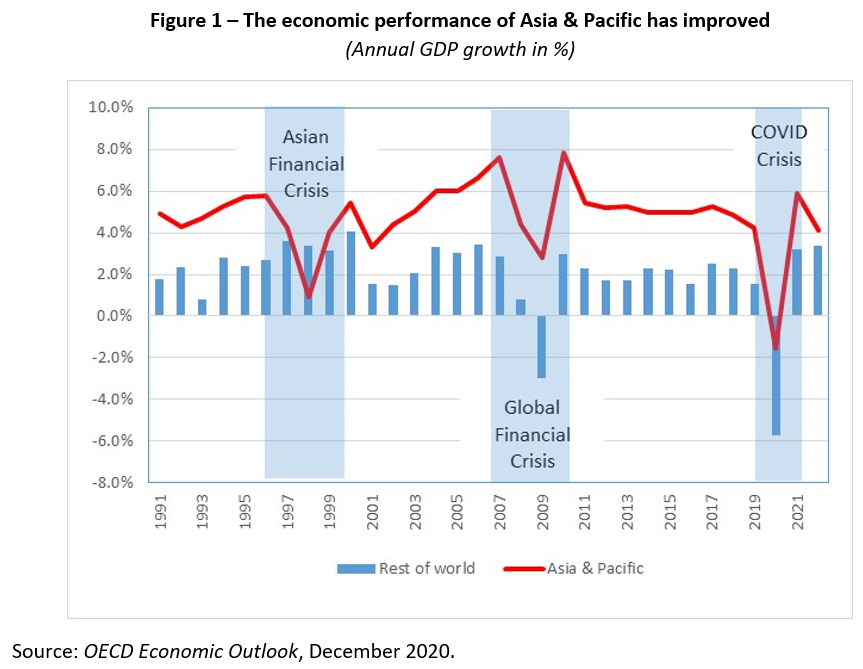
While the world is struggling to exit from the coronavirus crisis, the region Asia & Pacific is a notorious exception: many countries in the region have stopped the COVID-19 pandemic after the first wave, and they quickly returned on a path of growth in the second half of 2020 – a rare accomplishment. The OECD projects that the region’s recovery will continue in 2021 and 2022 (Table 1).

The region’s current resilience is in sharp contrast with the late 1990s, when the Asian Financial Crisis hit it very hard (Figure 1). Governments in the region drew lessons from this experience and were better prepared when the Global Financial Crisis arrived. They were also ready when the coronavirus struck: fiscal space was available, monetary policies were sound, exchange rates were flexible, foreign exchange reserves abundant, bank well capitalised, external indebtedness was low – and health systems had been re-organised.

Strong resilience in the face of crises contributes to long-term growth, especially in poor and emerging countries, as shown by a literature launched by Easterly et al. (1993). Thanks in large part to their growing resilience, the 15 countries and territories of Asia & Pacific doubled their share in world GDP from 19% in the early 1990s to 34% currently. The region has become an economic powerhouse and most likely will gain further ground. The Regional Comprehensive Economic Partnership (RCEP) recently signed will provide another boost to long-term growth, as discussed in the recent OECD Economic Survey of Thailand.

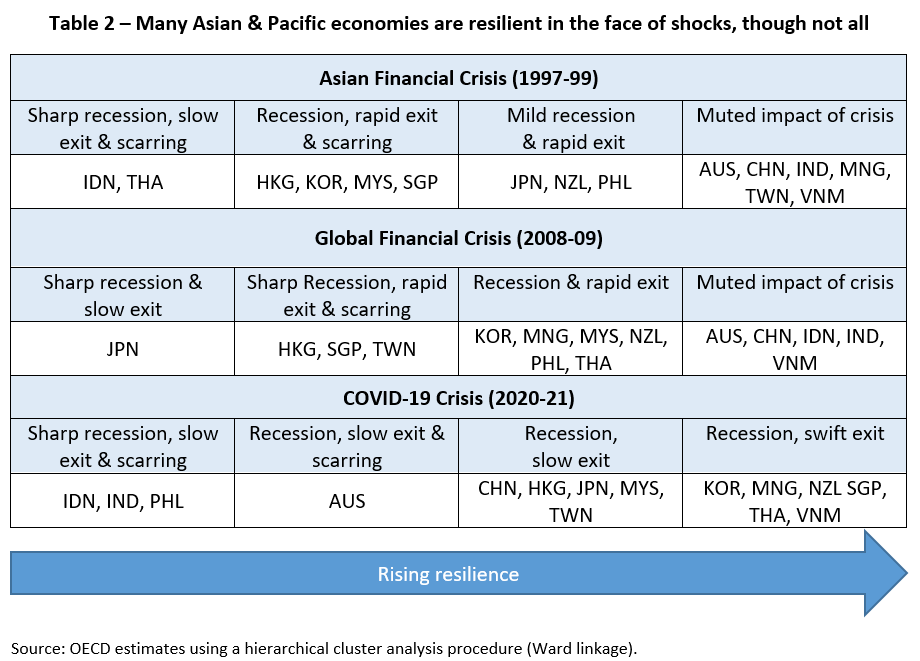
Of course, not all countries of the region have the same resilience. To throw light on this disparity, we use a hierarchical cluster analysis (Ward linkage), a statistical procedure that identifies homogenous groups of observations without making a difference between dependant and independent variables. We identify four groups of countries with common factors for each of the three crises. To group the region’s economies, we use the following indicators: 1) the depth of recession, 2) the speed of recovery, and 3) the post-recession scarring of growth. The first two indicators provide a contemporary measure of resilience when faced with a shock, while the third indicator is an ex-post measure of resilience. For the current crisis, we use the number of COVID-19 deaths as a proxy of ex-post resilience, in line with empirical findings that the spread of the coronavirus has damaged economic activity due a combination of government-imposed lockdowns and self-imposed lockdowns (Golsbee and Syverson, 2020).

Our cluster analysis reveals some diversity within the region. The resilience of individual economies has changed rapidly – in both directions (Table 2). Some key findings are:

  • Australia has shown great resilience during the first two crises, but fell into a recession with the coronavirus.
  • While China and India were resilient in the face of the first two crises, they have lost some ground with the COVID-19 pandemic, especially India.
  • Korea and Thailand have seen their resilience improve after each crisis.
  • Vietnam has consistently been the most resilient economy in the region.

Despite this diversity, the region displays overall a strong resilience and is placed to recover rapidly from the COVID-19 crisis, assuming that the pandemic is brought under control and that the large population can be vaccinated soon. If this happens, Asia & Pacific will confirm its new position as a global powerhouse. The return to economic growth should be an opportunity to address socioeconomic problems inherent in several countries, notably high informality and inequality, and make headways on a path of decarbonisation.

References:

Easterly, W., M. Kremer, L. Pritchett, and L. H. Summers (1993), “Good Policy or Good Luck? Country Growth Performance and Temporary Shocks,” Journal of Monetary Economics, 32, pp. 459–483.

Goolsbee A. and C. Syverson (2020), “Fear, Lockdown, and Diversion: Comparing Drivers of Pandemic Economic Decline 2020”, NBER Working Paper No. 27432, June.

OECD (2020), OECD Economic Surveys: Thailand 2020: Economic Assessment, OECD Publishing, Paris, https://doi.org/10.1787/ad2e50fa-en.

OECD (2020), OECD Economic Outlook, Volume 2020 Issue 2: Preliminary version, OECD Publishing, Paris, https://doi.org/10.1787/39a88ab1-en.


Some Australians are at a significant risk of poverty, despite the strong economy

by Urban Sila, Australia Desk, OECD Economics Department

Australia is a successful economy with high living standards. It has recorded 27 years of uninterrupted GDP growth. Incomes have grown strongly across the entire range of the income distribution and the incidence of both absolute and relative poverty have declined.  Despite this improvement, quite a significant share of Australians live in relative poverty. About 13% of Australians live in households with incomes below the poverty line – less than half of the median household income.

Australiadec20181

The recent OECD Economic Survey of Australia and accompanying paper (Sila and Dugain, 2018) use OECD and Australian data (the HILDA, household panel survey) to establish which groups are vulnerable to poverty. The analysis uses the concept of relative poverty. Specifically, individuals are classified as poor if they live in households that earn below 50% of the median equivalised household income in a given year.

Certain groups are more at risk of poverty than others. People living alone and lone parents are at higher risk of poverty. Although poverty in old age has declined in the last 15 years, it nevertheless remains high. Old people in Australia have more than 30% chance of living in poverty, a high figure in international comparison. However, Australia stands out less in measures of poverty that correct for housing costs, as many older people in Australia are homeowners.

As regards the working-age population, those out of the labour force and the unemployed are at much higher risk of poverty. In addition, casual workers and part-time workers are at risk, as are people with low education and skills.

Australiadec20182Sila

Indigenous Australians are almost twice as likely to be poor than the rest of Australians, and according to the HILDA data, the gap has not been closing over the past 15 years. Indeed, the gap has risen over last two years. Furthermore, statistical analysis shows that indigenous status remains a strong explanatory factor of poverty even after controlling for education, age, industry, skill and remoteness. This means that high poverty among indigenous people reflects a range of unobserved socio-economic issues, including poor health and discrimination.

References:

OECD (2018), OECD Economic Surveys: Australia 2018. OECD Publishing, Paris.

Sila, U., and Dugain, V. (2018), Characteristics of people at risk of poverty in Australia: Evidence from the HILDA survey, OECD Economics department working paper, forthcoming.


Australia’s cooling housing market; is the economy at risk?

by Philip Hemmings, Head of Australia Desk, OECD Economics Department

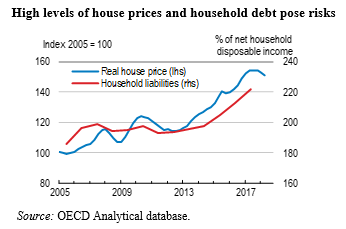
Australia’s housing market is a source of vulnerability. Prices have more than doubled in real terms since the early 2000s and household debt has surged. The market has started to cool over the last year, with prices falling most notably in Melbourne and Sydney. So far, data point to a soft landing without substantial consequence for the overall economy. Nevertheless, risk of a hard landing remains.

To date the decrease in house prices has been gradual. Prudential measures taken by the Australian authorities restricting certain types of housing credit have played a role. So too has a pick-up in new housing supply and construction activity remains elevated. Furthermore, some evidence suggests that Australia’s house prices have not been hugely overvalued; the IMF has estimated that as of Q3 2017 prices were above equilibrium by only between 5 and 15% (Heilbling andLi, 2018).

Several features of Australian financing limit the risk of financial fall-out from a house-price correction. Banks are well capitalised and their liquidity position is sound. Indebtedness is concentrated in middle- and high-income households, and data indicate declining financial stress in recent years, despite rising mortgage debt. Moreover,many mortgage holders have accumulated substantial buffers of advance payments(“mortgage prepayments”).

Nevertheless, risk of a macroeconomic downturn from the cooling housing market remains. Not withstanding the estimates that Australia’s market is not greatly overvalued, house prices could fall more substantially. Should this happen, household consumption could weaken. Households would cut their spending due to lower housing wealth and due to increased economic uncertainty generated by downturn. Households would also reduce expenditures related to the purchase, sale and maintenance of housing (such as spending on renovation and interior decoration). Sustained decreases in house prices would also weaken construction activity. Weakened aggregate demand could in turn lead to losses on loans to businesses, putting stress on the financial sector.

The OECD’s 2018 Economic Survey of Australia recommends authorities prepare contingency plans for a severe collapse in the housing market. These should include the possibility of a crisis situation in one or more financial institutions.

References:

Helbling, H. and G. Bin Li (2018), “Housing Market Imbalances in Australia: Development, Prospects and Policies”, IMF, Australia Selected Issues, IMF Country Report No. 18/45.

OECD (2018), OECD Economic Surveys: Australia. OECD Publishing Paris.