Navigating demographic headwinds in Croatia

Croatia’s economy has experienced robust and resilient GDP growth and improved living standards over the past decade. Yet a rapidly shrinking and ageing population threatens future growth and fiscal sustainability. Advancing pension, health care and labour market reforms will be essential to extend working lives, improve healthy ageing and raise labour force participation.

By Federica De Pace and Oliver Roehn, OECD Economics Department


In the past decade, Croatia’s economy has experienced strong and resilient GDP growth, outpacing OECD and euro area averages. Wide-ranging structural reforms as well as the integration into the EU, euro and Schengen areas all helped boost living standards. However, Croatia’s population is shrinking and ageing rapidly, a combination that bodes ill for future economic growth and public finances. According to UN projections, the working age population will decline by about 25% between 2024 and 2050 (Figure 1). Moreover, for every ten working-age Croatians, there are about four people older than 65 today; by 2050 there will be nearly six. A smaller workforce will drag down growth. According to the OECD Long-Term Economic Model, GDP growth is projected to fall from over 3% per year on average in the last decade to 0.5% by 2050. At the same time, spending on pensions, health care and long-term care will come under increasing pressure.

According to the 2026 Economic Survey of Croatia, addressing demographic challenges requires pension, health care, and labour market reforms to extend working lives, bring more people into the labour force, improve the health of the ageing population, and enhance the efficiency of public spending.

Average pensions of the current generation of pensioners are low, mainly due to short contribution periods. In 2024 the expected duration of working life was just 34.8 years, compared with an EU average of 37.2 years. Short working lives and hence pension contribution periods help explain why relative poverty among older people is nearly twice the OECD average. A recent pension reform aims to increase pension incomes, but comes at a significant fiscal cost. Further tightening early retirement options and increasing the retirement age in line with gains in life expectancy would prolong working lives and help improve pension income without jeopardising the sustainability of the pension system.

Health outcomes also need to improve to enable longer working lives. A higher share of adults aged 65 and over than in most OECD countries report long-standing limitations in their daily activities due to health problems. Improving health outcomes in a cost-effective way requires stronger prevention policies and higher taxes on unhealthy products, more accessible primary care, and higher quality and efficiency of hospital care, including by centralising complex care in specialised facilities.

Population ageing will strain the long-term care system. Today, care relies heavily on informal family caregivers—mainly women—creating significant physical and emotional burdens and limiting their labour-market participation. As care needs grow, this model will become unsustainable. Reforms are needed to expand the formal long-term-care workforce, by improving working conditions and formalising work contracts. Spending on long-term care must rise to improve access and quality of care. Insurance-based models, like those in Germany, Japan, the Netherlands, and Slovenia, can be a solution to ensure adequate funding. Better integration of health and social services would make long-term care more efficient and sustainable.

Bringing younger and older people into the labour force is essential to mitigate the impact of ageing (Figure 2). Stronger work-based learning in vocational education could ease school-to-work transitions. Expanding affordable childcare and formal long-term care would lift employment among women. Among older workers, disability and poor health are major barriers. The employment gap for people with disabilities—36 percentage points in 2024, more than double the EU average—suggests that earlier intervention and broader access to professional rehabilitation are needed. Removing age limits on rehabilitation and linking disability benefits to participation in rehabilitation, would help retain more workers.

Well-designed immigration policy can help ease skills shortages. Croatia has recently seen higher immigration, reversing decades of net emigration, as living standards improved and entry procedures were streamlined. To maximise the gains, however, more efforts are needed to better align migrants’ skills with current and future labour-market needs. Regular assessments and forecasts of skills shortages, more favourable permit conditions for workers in high-demand occupations, and stronger integration services, would improve the country’s ability to attract and retain the workers it needs the most.

References:

OECD (2025), OECD Economic Surveys: Croatia 2026, OECD Publishing, Paris, https://doi.org/10.1787/b52e3ac0-en


The fiscal impact of population ageing: How can we afford getting older?

By Vassiliki Koutsogeorgopoulou and Hermes Morgavi, OECD.

Populations are ageing in most countries, including emerging economies. The share of population aged 65 years and over has more than doubled between 1960 and 2022 across OECD countries on average, to around 18%, and is projected to reach 30% by 2060. To illustrate the magnitude of the demographic transition, the share of population aged 80 and over will rise even more dramatically, by almost two and half times between 2022 and 2060 (Figure 1).

Note: OECD refers to the simple average among the OECD countries, G20 emerging economies include Argentina, Brazil, China, India, Indonesia, Russia, Saudi Arabia, and South Africa. Other OECD partner countries include Bulgaria, Croatia, Romania, Peru, Morocco, Tunisia, and Egypt. The highlighted area refers to the projection period, starting in 2024. Projections are based on the “medium variant” population projections from the United Nations.
Source: United Nations World Population Prospects: The 2024 Revision.

Living longer and ageing in better health are major accomplishments, boosting people’s potential to remain active and work at a later age, participate in society and live independently for longer (Scott, 2021). However, life expectancy has increased in OECD countries in tandem with steadily declining fertility rates – currently well below replacement levels in most OECD economies (OECD, 2023). The old-age dependency ratio (defined as the number of people aged 65+ per 100 people of working age, 20-64 years old) in the OECD area has more than doubled between 1960 and 2022, as the population aged 65 and over grew at an annualised rate of 2.2% during the period, while the working-age population by merely 0.9% (United Nations World Population Prospects: The 2024 Revision).

From a fiscal perspective, population ageing can have profound consequences for the public finances, according to a recent OECD paper (Koutsogeorgopoulou and Morgavi, 2025). This is because, as previous studies have also shown (Rouzet et al., 2019; Guillemette and Turner, 2021; Guillemette and Château, 2023), age-related government spending, notably on pensions, healthcare and long-term care, exerts substantial pressure on public finances. Defined-benefit, pay-as-you-go pension systems are particularly vulnerable, as contribution rates struggle to keep up with growing retirement cohorts and longer benefit durations. While public spending on long-term care as share of GDP is generally low, it has been rising more rapidly than pension and health care expenditure over the past decades and will continue to do so, especially as the share of population 80 years and over is increasing rapidly (OECD Health database). According to OECD Long-Term Model, in the absence of corrective policy action, fiscal pressure would increase in the average OECD country by nearly 6¼ percentage points of GDP between 2024 and 2060, with ageing accounting for more than 40% (Figure 2).


Policies can help economies to adapt to population ageing, harnessing the benefits of longevity, and address the mounting fiscal pressures stemming from ageing, thereby safeguarding public finance sustainability. While the scope of demographic change varies across countries, a comprehensive policy approach is indispensable. The strategy needs to encompass measures to promote healthy ageing, including through disease prevention policies, fiscal reforms to manage the rise in age-related spending, and structural reforms to boost labour force participation of older workers and other under-represented groups.

Indicative of the large fiscal gains of comprehensive reforms, changes in retirement policies that reduce early exit pathways and link retirement ages to two-thirds of projected increases in life expectancy, in combination with labour market reforms, would lower the fiscal pressure in 2060 by around 4 percentage points of GDP for the average country, compared to a baseline no-policy change scenario, based on OECD Long-Term Model (Source: Update of (Guillemette and Château, 2023) based on OECD Economic Outlook No. 115 May 2024 database).

Policy efforts to address the fiscal implications of ageing can be complemented by measures to boost fertility and immigration. While today’s fertility rates would only raise the share of workers in the population in around two decades, ensuring continuity of support over the child’s early life course by avoiding “spending dips” is essential (OECD, 2024). Immigration can help ageing countries to address labour shortages in the short- or medium-term, though is unlikely to fully offset population ageing (André, Gal and Schief, 2024). Addressing integration challenges and enabling immigrants to reach their potential are essential.

* This blog is based on the paper by Koutsogeorgopoulou, V. and H. Morgavi (2025), “Ageing populations, their fiscal implications and policy responses”, OECD Economics Department Working Papers, No. 1844. The paper was prepared as part the work programme of the OECD Crete Centre on Population Dynamics. The Centre, established in 2023 in partnership with the Greek Government, is dedicated to advancing policy-oriented research and advisory work on demographic issues and their impact on economic prosperity: https://www.oecd.org/en/about/programmes/oecd-crete-centre-on-population-dynamics.html.

References

André, C., P. Gal and M. Schief (2024), “Enhancing productivity and growth in an ageing society: Key mechanisms and policy options”, OECD Economics Department Working Papers, No. 1807, OECD Publishing, Paris, https://doi.org/10.1787/605b0787-en.

Guillemette, Y. and J. Château (2023), “Long-term scenarios: incorporating the energy transition”, OECD Economic Policy Papers, No. 33, OECD Publishing, Paris, https://doi.org/10.1787/153ab87c-en.

Guillemette, Y. and D. Turner (2021), “The long game: Fiscal outlooks to 2060 underline need for structural reform”, OECD Economic Policy Papers, No. 29, OECD Publishing, Paris, https://doi.org/10.1787/a112307e-en.

Koutsogeorgopoulou, V. and H. Morgavi (2025), “Ageing populations, their fiscal implications and policy responses”, OECD Economics Department Working Papers, No. 1844, OECD Publishing, Paris, https://doi.org/10.1787/6aec03b3-en.

OECD (2024), “Fertility trends across the OECD: Underlying drivers and the role for policy”, in Society at a Glance 2024: OECD Social Indicators, OECD Publishing, Paris, https://doi.org/10.1787/fa367bad-en.

OECD (2023), Pensions at a Glance 2023: OECD and G20 Indicators, OECD Publishing, Paris, https://doi.org/10.1787/678055dd-en.

Rouzet, D. et al. (2019), “Fiscal challenges and inclusive growth in ageing societies”, OECD Economic Policy Papers, No. 27, OECD Publishing, Paris, https://doi.org/10.1787/c553d8d2-en.

Scott, A. (2021), “The Longevity Economy”, Health Policy, Vol 2, pp. 828–35.

Further related research

Crowe, D. et al. (2022), “Population Ageing and Government Revenue: Expected Trends and Policy Considerations to Boost Revenue”, Economics Department Working Papers, No. 1737, OECD Publishing, Paris, https://doi.org/10.1787/9ce9e8e3-en.

de Biase, P. and S. Dougherty (2023), “From local to national: Delivering and financing effective long-term care”, OECD Working Papers on Fiscal Federalism, No. 45, OECD Publishing, Paris, https://doi.org/10.1787/578b296f-en.

Morgavi, H. (2024), “Is it worth raising the normal retirement age?: A new model to estimate the employment effects”, OECD Economics Department Working Papers, No. 1823, OECD Publishing, Paris, https://doi.org/10.1787/5f2a3b40-en.

Rawdanowicz, Ł. et al. (2021), “Constraints and demands on public finances: Considerations of resilient fiscal policy”, OECD Economics Department Working Papers, No. 1694, OECD Publishing, Paris, https://doi.org/10.1787/602500be-en.


Lithuania: Addressing demographic challenges 

Vilnius, Lithuania overview

By Pierre-Alain Pionnier

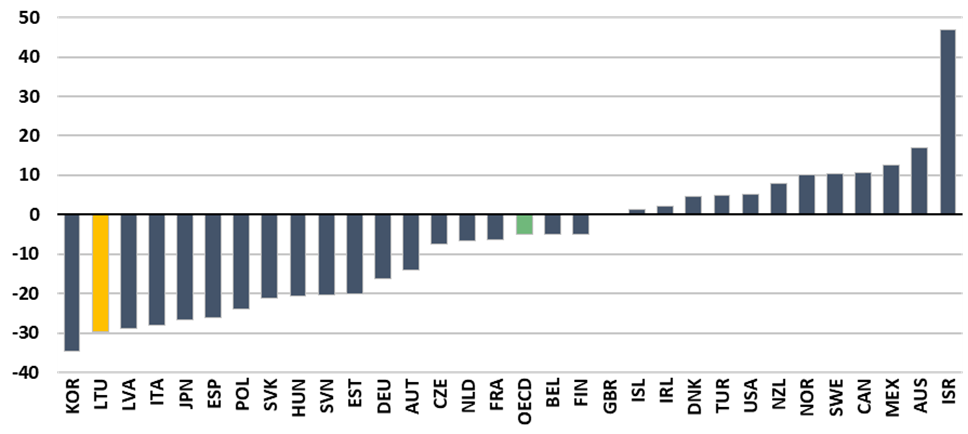
Lithuania’s population is expected to decline by 20% and its working-age population by 30% over the next 25 years (Figure 1). Few countries will face such a large demographic shock. This calls for policy responses across different areas, including fiscal and labour market policies, as explained in the 2025 Economic Survey of Lithuania

Figure 1. Lithuania will face a large demographic shock

Change in the working-age population (20-64 years old), %, 2022-2050

Figure showing Lithuania will face a large demographic shock
Source: UN World Population Prospects 2022 (Medium scenario)

Ageing-related expenditure is set to increase by 3.6% of GDP by 2045, most of it related to the financing of public pensions. At 37% of GDP in 2023 Lithuania’s public debt is one of the lowest in the OECD, but simulations show that it could increase rapidly due to ageing-related costs.

Unfortunately, there is not much that Lithuania can do to contain the expected increase in pension spending, at least in the short term.

The statutory retirement age is currently around 64, similar to the OECD average, and will increase to 65 in 2026 for both men and women. Significant disparities in life expectancy between men and women and across socio-economic groups make further increases in the retirement age difficult. Lithuanian men have one of the lowest life expectancies in the OECD and enjoy relatively short retirement periods. Even in an optimistic scenario, fiscal savings that could be obtained from linking the retirement age to life expectancy would be limited in Lithuania.

Adjusting pension benefits could in principle provide a way to improve the financial sustainability of the pension system. But pension replacement rates, which measure pension benefits relative to pre-retirement wages, are already the lowest in the OECD and old-age poverty is high (25%). This severely limits the scope for savings through benefit adjustments.

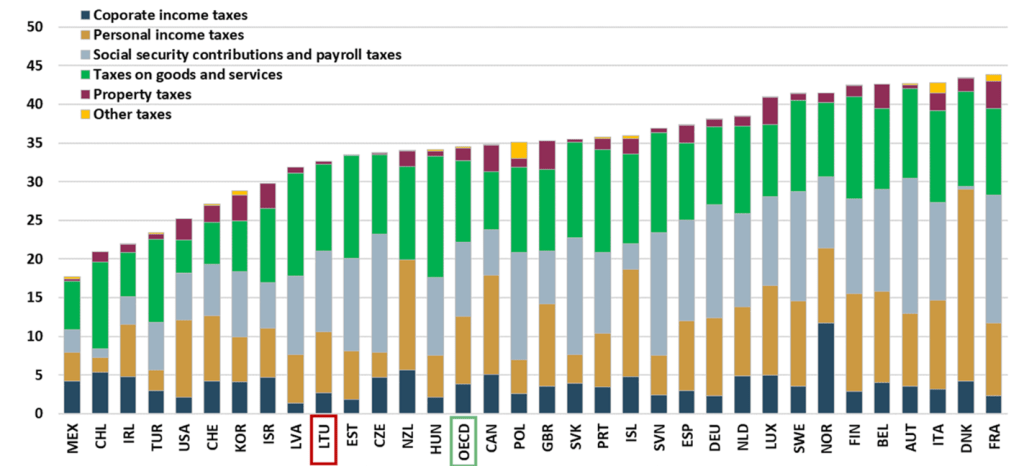
Ensuring fiscal sustainability will therefore require creating additional fiscal space outside of the pension system. Better spending efficiency can help to improve fiscal outcomes. For example, Lithuania has a larger public sector than other OECD countries and available estimates suggest that wages in the public sector are around 10% higher than in the private sector. Moreover, Lithuania’s fiscal revenues are comparatively low (Figure 2). This provides scope to increase taxes to contribute to the financing of ageing-related expenditure. One case in point is property taxes, which are among the taxes that are least detrimental to economic growth but also largely underused in Lithuania. A large shadow economy is another unexploited source of fiscal revenues. This shadow economy reduces revenues from value-added taxes. Further reducing the use of cash in the economy and reducing the tax wedge for low-income earners to make formal work more attractive could help, and the resulting revenue losses could be compensated by increasing income taxes for higher incomes.

Figure 2. Property tax revenues could be increased to strengthen fiscal sustainability

Structure of tax revenues, % of GDP, 2023

Increasing property tax revenues for fiscal sustainability in Lithuania
Note: OECD is an unweighted cross-country average
Source: OECD Revenue statistics

Bringing more people into the labour force would attenuate the impact of the demographic shock on the labour market.

Despite existing labour shortages in many sectors, the employment gap between higher- and lower-skilled workers is high in Lithuania. The creation of learning accounts for training courses in 2024 is a step in the right direction. If it turned out that current funding is insufficient to make a significant difference, targeting could be increased towards the groups that are most in need of training.

Increasing the employment prospects of older-age workers will also require improving their health. Poor health conditions are partly related to preventable diseases and behavioural factors such as poor diets, high alcohol consumption and low physical activity. Regulations and taxes have a key role to play by limiting the affordability of harmful substances.

Immigration is another way to mitigate labour shortages. Simulations presented in this Survey show that extending the positive net migration inflows that were observed just before the outbreak of the war in Ukraine would halve the impact of the demographic shock on the Lithuanian economy. Residence permits for non-EU workers could be made more attractive. With 1.3 million persons of Lithuanian descent living abroad, return migration also has a significant potential. Since migrants of Lithuanian origin may be easier to integrate, outreach towards the diaspora could be strengthened.

Visit the OECD’s Lithuania Economic Snapshot page for further information.

References:

OECD (2025), OECD Economic Surveys: Lithuania 2025, https://doi.org/10.1787/4abf1ea5-en, OECD Publishing, Paris.


Is raising the normal retirement age a good policy? A new OECD model sheds light on employment effects

By Hermes Morgavi, OECD Economics Department

In many developed and ageing countries, pension reforms are crucial yet often controversial. One significant reform, frequently debated, is raising the normal retirement age —the age at which workers can claim their full pension benefits. As governments face the dual pressures of ageing populations and growing fiscal burdens, understanding the effects of such policies on employment is essential.

Morgavi (2024) introduced a new model that explores these effects in detail, addressing key questions: Is raising the normal retirement age worth it? How does it impact employment, particularly for older workers?

A new model for complex realities

While most cross-country empirical studies agree that raising the normal retirement age increases older-age employment, the scale of these effects often seems underwhelming—especially when compared to more detailed, single-country studies. This new OECD model seeks to bridge this gap by accounting for country-specific factors such as demographics, pension systems, and early retirement pathways.

Key findings: More than just small gains

The model introduces four major innovations:

  1. Demographic sensitivity: Incorporating population structure and retirement patterns improves accuracy, predicting stronger employment effects in countries with lower retirement ages.
  2. Retirement ages: Distinguishing between minimum and normal retirement ages allows for more precise simulations. Countries with large gaps between these ages could see substantial gains in employment rates by narrowing the gap.
  3. Private pension systems: In countries where private pensions play a significant role, workers are less sensitive to changes in the public normal retirement age. The model highlights the importance of considering these systems when designing policy.
  4. Early exit pathways: Many countries offer alternatives to early retirement through disability or unemployment benefits. These alternative early exit pathways dilute the effect of raising the normal retirement age. The model quantifies these undermining effects to give policymakers a clearer idea of the potential impact of policy changes.

A more worthwhile reform than expected

The model predicts that raising the normal retirement age can lead to much larger employment effects than predicted by previous cross-country macro models and closer to empirical research using microdata from individual countries. For example, a one-year increase in the normal retirement age is projected to raise the employment rate of those aged 55-74 by 1.5 to 2.3 percentage points, depending on the country. This is a significant improvement over earlier estimates from traditional models. Countries with the lowest employment rates, like Greece and France, stand to gain the most.

Figure 1. Model innovations give larger employment effects from raising the retirement age

Range of effects on employment rate of people aged 55-74, from raising the normal retirement age

Note: The graph compares the long-term effect on the old age employment rate and on the average age of labour market exit of a raise of the normal retirement age by 1 year among the models expressed in percentage points. On the x-axis, for each model, the main innovation introduced with respect to the previous model is shown. For the models including the effects of minimum retirement age and of the pipeline effects, these are also assumed to move by 1 year. The red horizontal marks show the median of the distribution of the effects among the countries in the sample; the blue boxes show the distance between the fifth and the ninety-fifth percentile; and the whiskers show the minimum and the maximum values. The effects are calculated using the data for year 2020 or latest year available.
Source: Author’s calculations.

Moreover, closing the gap between minimum and normal retirement ages, or eliminating early exit pathways, could lead to even greater employment boosts, especially in countries with large discrepancies.

Figure 2. Policy simulations changing the gap between the minimum and normal retirement ages

Note: This graph shows the effects of a set of policy changes by country based on the preferred model using the data for the year 2020: the effects of raising the normal retirement ages by 1 year (without any changes in the minimum retirement ages), raising the minimum retirement ages by 1 year; eliminating the early exit pathways, if present, for all the countries in the sample, based on the estimated model.
Source: Author’s calculations.

The right time to policy changes

While the model predicts more substantial long-term benefits of raising the normal retirement age than previously thought, it also emphasizes the importance of timing. Policy changes in retirement ages take time to bear fruit—often decades due to “grandfathering” provisions that protect current workers. Policymakers, therefore, need to act early to mitigate future fiscal challenges.

The OECD’s new model offers a fresh perspective on an age-old policy debate, providing countries with a more refined tool to navigate the complexities of pension reforms.

Reference:

Morgavi, H. (2024) “Is it worth raising the normal retirement age? A new model to estimate the employment effects”, OECD Economics Department Working Papers, No. 1823, OECD Publishing, https://www.oecd.org/en/publications/is-it-worth-raising-the-normal-retirement-age_5f2a3b40-en.html.

Related research and resources:

Turner, D. and H. Morgavi (2020), “Revisiting the effect of statutory pension ages on the participation rate“, OECD Economics Department Working Papers, No. 1616, OECD Publishing, Paris, https://doi.org/10.1787/3f430e2b-en.

Guillemette, Y. and D. Turner (2021), “The long game: Fiscal outlooks to 2060 underline need for structural reform”, OECD Economic Policy Papers, No. 29, OECD Publishing, Paris, https://doi.org/10.1787/a112307e-en.

OECD (2023), Pensions at a Glance 2023: OECD and G20 Indicators, OECD Publishing, Paris, https://doi.org/10.1787/678055dd-en.

André, C., P. Gal and M. Schief (2024), “Enhancing productivity and growth in an ageing society: Key mechanisms and policy options”, OECD Economics Department Working Papers, No. 1807, OECD Publishing, Paris, https://doi.org/10.1787/605b0787-en.


Addressing Korea’s Fertility Crisis

Asian,Boy,Is,Playing,In,Playground,With,Happy,Face,In

by HyunJeong Hwang, OECD Economics Department

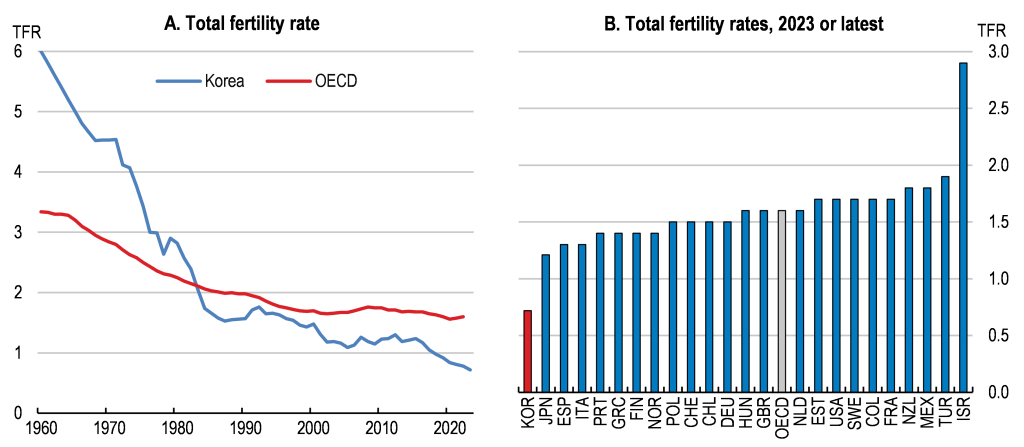
In 2023, Korea’s fertility rate fell to a world-record low of 0.7. Its sharp decline implies a faster increase in the old-age dependency ratio than in any other OECD country. As the proportion of retirees grows, labour shortages will intensify, and the costs of health care, long-term care, and pensions are expected to more than double to 17.4% of GDP by 2060.  The government has declared the situation a national emergency and announced plans to establish a new ministry focused on population strategy, alongside a range of policy initiatives. These demographic challenges are the main topic of the 2024 Economic Survey of Korea. It emphasises the importance of addressing obstacles preventing young adults from having the number of children they desire and implementing policies to mitigate the economic impact of an ageing population.  

Fertility rates in Korea have declined reaching the lowest in the world 

Source: Statistics Korea; OECD (2024), Fertility rates (indicator). doi: 10.1787/8272fb01-en; OECD Pensions at a Glance (2023).

A key cause of ultra-low fertility is the high opportunity cost of having children in Korea. Rapid economic development and higher access to education have enabled women to pursue increasingly rewarding careers. But long hours, insufficient protections against workplace discrimination, and a work culture where work is expected to take priority over family make it very challenging to combine work and motherhood. This leads to a large career cost for women who become mothers and underpins the widest gender pay gap in the OECD.

Improving the work-life balance must be a top priority to reverse the decline in fertility rates. While policies have made childcare nearly free, there is still room to expand access to popular childcare services, ensure consistent quality across all types, and align childcare opening hours with work hours. Raising the take-up of paid parental leave, which is currently very low, especially for fathers, is also essential. This can be achieved by relaxing strict eligibility, raising the benefit ceiling, and strengthening sanctions for workplace discrimination.

The weak financial position of youth holds back family formation. Labour market duality with large differences in pay, job quality and social protection weaken the economic position of young adults. Many young people either postpone their careers to land high-quality jobs in large firms, or start at smaller companies with non-regular contracts. Duality also spurs a race for credentials, which leads to high spending on private education. Addressing labour market dualism by relaxing employment protection for regular workers and expanding social insurance would help strengthen the financial prospects of young people and encourage family formation.

However, boosting fertility alone will not suffice to offset the rapid decline in the workforce. Even tripling fertility to 2.1 children per woman by 2040, the level associated with a stable population in the long term, would not prevent the workforce from declining. Korea must therefore prepare for and adapt to the challenges of an ageing and shrinking population.

Lengthening working lives is essential to counteract inevitable population ageing. Careers are shortened by the seniority-based wage system which renders older workers less appealing to firms when their wage rises above their productivity. Company-specific mandatory retirement ages below the legal pension age and the practice to encourage older employees to voluntarily leave before reaching the mandatory retirement age also contribute to premature retirements from their main job. Reforming these systems, raising the statutory retirement age, and offering upskilling opportunities for older workers can help keep them in the workforce longer.

Increasing the supply of foreign labour is another vital strategy. Although Korea has significant potential to boost immigration, various visa hurdles for skilled immigration as well as poor working conditions for low-skilled immigrants hold back immigration. Korea’s immigration policies need reform to enhance opportunities for both low-skilled and skilled immigrants. Removing entry barriers for qualified foreign talent and integrating low-skilled immigrants better will help increase the foreign labour force.

Further reading:          

OECD (2024), OECD Economic Surveys: Korea 2024, OECD Publishing, Paris. 

Yang, Y., H. Hwang and J. Pareliussen (2024), “Korea’s unborn future: lessons from OECD experience”, OECD Economics Department Working Papers, No. 1824, OECD Publishing, Paris. 

Choi, S., S. Ham., Y. Yang, and J. Pareliussen (2024), “Women’s employment and fertility in South Korea: A literature review”, OECD Economics Department Working Papers, No. 1825, OECD Publishing, Paris. 


Demographic challenges to productivity: How to reconcile population ageing with economic growth?

By Christophe André, Peter Gal, Álvaro Pereira and Matthias Schief

People in OECD countries are, on average, living longer and often ageing in better health than in the past. This a major and welcomed achievement. Nevertheless, rapid ageing in most advanced and many emerging economies also raises concerns about productivity and economic growth (Andre, Gal and Schief, 2024) as well as fiscal sustainability (Rouzet et al., 2019; Crowe et al., 2022).

The steady increase in the share of older people as longevity increases is currently compounded by a cohort effect, as the relatively large cohorts born in the middle of the 20th century retire and are replaced by smaller cohorts, reflecting fertility declines over the past decades. The fall in the share of workers in the population is set to reduce, all else equal, per capita income across the OECD by nearly 8% over the next three decades, with some countries experiencing up to a 20% shortfall. While an extension of working lives resulting from additional years of healthy life would mitigate the fall in GDP per capita, it would generally not be sufficient to fully offset it (Figure 1).

Figure1. Ageing will weigh on GDP per capita, even with longer working lives

Note: The figure shows the estimated impact on GDP per capita of the projected change in the share of workers in the population, everything else equal, under two scenarios. The first one assumes fixed age-specific employment rates. The second one allows employment rates to move in line with healthy ageing, with each year of increased life expectancy assumed to reduce the effective age of older workers by two-thirds of a year for employment rate calculations based on the observed relationship between life expectancy and healthy life expectancy increases in the past (see more details in the source).
Source: Andre, Gal and Schief (2024) using data on age-specific employment rates from the OECD and population projections from the 2022 revision of the UN World Population Prospects. 

Drawing an analogy with climate change, one can think of two policy approaches towards ageing: mitigation and adaptation. Mitigation would aim to prevent further ageing by raising fertility rates and immigration. Fertility is crucial to prevent a fall in population. However, a rise in today’s fertility rates would only raise the share of workers in the population in about two decades, when today’s newborn enter employment. Furthermore, measures promoting fertility have so far had limited success (Shen et al., 2020) and although policies to reconcile work and parenthood can support fertility (Fluchtmann, van Veen and Adema, 2023), their impact remains highly uncertain. Immigration can have a sizable impact on population growth and, with the help of well-designed integration policies, contributes to economic dynamism and innovation (Bernstein et al., 2022). However, even if immigration is important in some individual countries, stabilising the OECD-wide old-age dependency ratio would require much higher net immigration rates than those observed since the turn of the century.

Given the limited scope to mitigate ageing, OECD economies and societies will have to focus on adapting to it. Healthy ageing is a pre-condition for prolonging working lives, which should be supported through better integration of individuals in the economy and society, promoting healthier lifestyles at all ages, adapting health systems, and improving social and environmental health determinants. Fighting age discrimination and removing disincentives to continued work at older ages embedded in pension systems and other institutional arrangements is also crucial.

In many countries, there is scope to increase labour participation in younger groups as well, notably women and youth. Beyond quantity, the quality of jobs can be improved, by promoting better work-life balance – which would also favour gender equality and may help raise fertility rates – and by investing in skills, improving labour market matching and productivity.

Indeed, demographic headwinds could be offset by rising output per worker.  Understanding how population ageing itself impacts productivity growth is therefore crucial. There are various micro- and macro-economic channels to consider, pointing in different directions (Table 1).

Table 1. Productivity and ageing: A summary of the evidence 

Note: This table summarises findings in the literature along two dimensions: the main mechanism through which ageing may impact productivity (captured by rows 1- 6) and the various dimensions of ageing that are mostly mediating the effects (columns I.-III.). The studies and reports underlying this table are discussed in Sections 3.1-3.7. of the source.
Source: Andre, Gal and Schief (2024).

At the more microeconomic level, workers’ productivity increases with experience but may decline at older ages due to poor health or obsolescence of skills. Notwithstanding, the impact of ageing on firms’ productivity is unclear, as younger and older people work in teams and can complement each other (OECD, 2020). However, ageing tends to reduce innovation and business dynamism (Hopenhayn et al., 2022). Conversely, ageing incentivises automation, which can raise productivity. Artificial intelligence may offer new opportunities to overcome the ageing challenge, notably through alleviating labour shortages (Filippucci et al., 2024).

Ageing can also impact productivity through macroeconomic and financial developments. Savings accumulated by older generations can boost investments, but a lower bound on interest rates could prevent interest rates from falling enough, leading to secular stagnation (Eggertson et al., 2019). Risk-aversion among older people may direct savings towards conservative investments, at the expense of innovation financing. Rising age-related government spending may crowd out productivity-enhancing investments, while tax distortions may slow productivity growth, as would demand shifts towards lower-productivity services, like leisure or elderly care. This co-existence of positive and negative effects may explain that so far ageing has not been associated with lower GDP per capita (Acemoglu and Restrepo, 2017).

In sum, policies should reconcile the individual benefits from living longer with the societal challenges that this may create, not only by efforts to mitigate, but also to adapt to ageing. This involves promoting healthy ageing, removing obstacles and disincentives to extending working lives, mobilising labour resources in all age groups, encouraging lifelong learning, and supporting business dynamism.

References

Acemoglu, D. and P. Restrepo (2017), “Secular Stagnation? The Effect of Aging on Economic Growth in the Age of Automation”, American Economic Review, Vol. 107/5, pp. 174-179, https://doi.org/10.1257/aer.p20171101.

Andre, C., P. Gal and M. Schief (2024), “Enhancing Productivity and Growth in an Ageing Society: Key Mechanisms and Policy Options”, OECD Economics Department Working Papers, No. 1807, OECD Publishing, Paris, https://doi.org/10.1787/605b0787-en

Bernstein, S., R. Diamond, A. Jiranaphawiboon, T. McQuade and B. Pousada (2022), “The Contribution of High-Skilled Immigrants to Innovation in the United States”, NBER Working Papers, No. 30797, National Bureau of Economic Research, Cambridge, MA, https://doi.org/10.3386/w30797.

Crowe, D., et al. (2022), “Population ageing and government revenue: Expected trends and policy considerations to boost revenue”, OECD Economics Department Working Papers, No. 1737, OECD Publishing, Paris, https://doi.org/10.1787/9ce9e8e3-en.

Eggertsson, G.B., M. Lancastre and L.H. Summers (2019), “Aging, Output Per Capita, and Secular Stagnation”, American Economic Review: Insights, 1 (3), 325-42, https://doi.org/10.1257/aeri.20180383.

Filippucci, F., et al. (2024), “The impact of Artificial Intelligence on productivity, distribution and growth: Key mechanisms, initial evidence and policy challenges”, OECD Artificial Intelligence Papers, No. 15, OECD Publishing, Paris, https://doi.org/10.1787/8d900037-en.

Fluchtmann, J., V. van Veen and W. Adema (2023), “Fertility, employment and family policy: A cross-country panel analysis”, OECD Social, Employment and Migration Working Papers, No. 299, OECD Publishing, Paris, https://doi.org/10.1787/326844f0-en.

Hopenhayn, H., Neira, J. and Singhania, R. (2022), “From Population Growth to Firm Demographics: Implications for Concentration, Entrepreneurship and the Labor Share”, Econometrica, 90: 1879-1914. https://doi.org/10.3982/ECTA18012

OECD (2020), Promoting an Age-Inclusive Workforce: Living, Learning and Earning Longer, OECD Publishing, Paris, https://doi.org/10.1787/59752153-en.

Rouzet, D., et al. (2019), “Fiscal challenges and inclusive growth in ageing societies”, OECD Economic Policy Papers, No. 27, OECD Publishing, Paris, https://doi.org/10.1787/c553d8d2-en.

Shen, K., F. Wang and Y. Cai (2020), “Government policy and global fertility change: a reappraisal”, Asian Population Studies, 16(2), 145-166, https://doi.org/10.1080/17441730.2020.1757850.


Restoring growth

Economic Outlook November 2023 cover image

by Clare Lombardelli, OECD Chief Economist

Inflation is easing, but growth is slowing. The tightening of monetary policy needed to tackle inflation is taking effect. Despite stronger-than-expected GDP growth in 2023, tightening financial conditions, weak trade, and subdued confidence are taking a toll. Housing markets and bank-dependent economies, particularly in Europe, are feeling the impact.

The pace of growth is uneven. Emerging markets are generally faring better than advanced economies. Europe’s growth lags behind North America and major Asian economies. Inflation, while easing, remains a concern.

We are projecting a soft landing for advanced economies, but this is far from guaranteed. The relationship between inflation, activity and labour markets has changed, making the full impact of monetary policy tightening hard to judge. In the United States, the economy is demonstrating more strength than expected, and there is a risk that inflation proves to be persistent. In the euro area, the full impact of tighter monetary policy is still to appear and activity may be hit more strongly than we expect.

Many emerging markets have shown considerable resilience over the past year, but countries characterised by structural debt vulnerabilities have come under market scrutiny.

Global trade is weak. Not only cyclical, but also structural factors are causing a slowdown in the rate at which value chains are integrating across countries. Opportunities for growth, particularly from greater services trade, are being missed. We must revive global trade. Resilience in global value chains is best delivered by diversification, not by protectionism and inward-looking policies.

In many countries, fiscal pressures are mounting. Demographic changes, decarbonisation, and a combination of rising interest payments and slow growth mean countries face a challenging fiscal outlook. Governments need to take bold action to reduce such pressures and give a greater focus to growth in their policy making. That means reforming labour market and pensions policies, increasing competition, and using fiscal levers to increase human capital and productivity enhancing investment, including the investment needed to deliver the green transition.

In summary, the global economy is grappling with inflation, slowing growth, and mounting fiscal pressures. Policymakers must prioritise macroeconomic stability, structural reforms, smart fiscal policies and international cooperation to foster sustainable and inclusive growth.

For more info and data visit: www.oecd.org/economic-outlook/november-2023/

References

OECD (2023), OECD Economic Outlook, November 2023: Restoring Growth, OECD Publishing, Paris


Population ageing and government revenue: It is not all bad news

By David Crowe, Jörg Haas, Valentine Millot, Łukasz Rawdanowicz and Sébastien Turban, OECD Economics Department

Population ageing is one of the biggest challenges to public finances (Rawdanowicz et al., 2021). It is expected to necessitate a sizeable increase in public spending on pensions and health care. Such spending pressures could be mitigated by structural reforms or cost reductions, but in their absence large increases in tax revenue would be needed to stabilise public debt (Rouzet et al., 2019; Guillemette and Turner, 2021).

In contrast to the existing literature which focuses on government spending, in our latest paper (Crowe et al., 2022), we shed light on the consequences of population ageing for government revenue in OECD countries. We do this in a framework consistent with the OECD long‑term model (LTM) (Chalaux and Guillemette, 2019; Guillemette and Turner, 2021). We show that if the labour and capital income shares in GDP remain constant and pension income increases in relation to GDP, the tax revenue-to-GDP ratio is likely to increase slightly via higher revenues derived from the taxation of pension income and of associated consumption. However, this will not be enough to cover the total increase in government spending due to population ageing.

In view of these results, countries still would have to reduce spending or raise taxes and implement structural reforms to boost labour force participation and growth, if they do not want public debt to increase. Policy options will be constrained by countries’ current levels of overall taxes and debt, and political economy considerations. Countries with high tax revenue and debt may need to favour spending reductions. In contrast, countries with low taxation and debt may envisage raising taxes and increasing borrowing. In practice, a combination of these strategies, which reflects a country’s social preferences, could be desirable to limit negative effects associated with each option.

The modelling framework

Building on the recent analysis of the consequences of ageing populations on government spending and long‑term GDP in the LTM (Guillemette and Turner, 2021), we analyse implications for government revenue. In the baseline scenario, the labour share in GDP remains constant, consistent with the Cobb‑Douglas production function employed in the LTM.

Our model’s general approach is to project shares of the main income components in GDP, which constitute the main income tax bases, and apply calibrated effective tax rates (ETRs), which are assumed to remain constant, to obtain projected government revenue from income taxes and social security contributions (SSCs). The resulting disposable income of households is used to project household consumption (based on constant calibrated saving rates) and then consumption taxes, again based on a constant calibrated ETR.

The proposed framework, while admittedly stylised, has the advantage of ensuring accounting consistency between the assumed split of nominal GDP into labour and capital income shares (the primary allocation of income), taxes and social benefits – including pensions (which are part of the secondary distribution of income) – and household consumption (uses of disposable income). Thus, the model can indicate the orders of magnitude of the impact of selected aspects of population ageing on budget balances.

Given the model’s assumptions, population ageing affects tax revenue mainly via income taxes and SSCs on pensions and via taxes on consumption out of pension income.

The results

The increase in government tax revenues resulting from higher aggregate pension income projected in the model is significant in relation to the size of the pension spending pressures, but by far not enough to solve the fiscal challenge. On average, the additional revenue covers around a quarter of the expected increase in government spending on public pensions; the latter accounts for less than 40% of the total increase in public spending due to population ageing (see figure).

In most countries, more than half of the extra tax revenue is generated from indirect taxes due to growing consumption out of pension income and thus growing consumption tax revenue. In these countries, the coverage ratio correlates positively with the ETR for consumption taxes.

The general smaller importance of direct taxes stems from the fact that ETRs for current taxes and SSCs on pensions are usually low and below the respective ETRs on labour income. Lower ETRs on pensions are due to favourable treatment, exemptions from taxation, and the progressivity of personal income taxation (as average pension income is usually below average wage income). Still, the coverage ratio is large in several countries where ETRs related to current taxes paid by households on social benefits are particularly high (e.g. Denmark, Finland, Luxembourg, the Netherlands, Sweden and Switzerland).

Tax revenue from growing aggregate pension income will likely increase

Per cent of GDP, change between 2023 and 2060

Note: Changes in indirect taxes are mainly driven by taxes related to household consumption as payroll and other indirect taxes do not change in relation to GDP in this exercise. Changes in other revenue refer primarily to changes in current taxes on household income and wealth. They include also changes in social security contributions received by government but, in most countries, this change is rather small. Spending on public pensions is consistent with the long-term model projections.
Source: Crowe et al. (2022), “Population ageing and government revenue: Expected trends and policy considerations to boost revenue”, OECD Economics Department Working Papers, No 1737, OECD Publishing, Paris.

Robustness checks

Given the stylised nature of the model, the results should be treated as indicative of potential magnitudes rather than precise projections. While the results are robust to alternative constant ETRs calibrations, there are other aspects of the model that could affect the results. They are discussed in the paper. Here we mention only two:

  • First, the alternative assumption of a modest decline in labour income shares does not change net fiscal pressures significantly. Lower labour shares reduce labour-related revenue but increase tax revenue from gross profits of companies and self-employed income (all relative to GDP). The net effect on the tax‑to‑GDP ratio is expected to be negative since the taxation of capital income tends to be lower than that of labour income. However, as the LTM specifies pensions relative to the average wage, a fall in the labour share also reduces the increase in public spending on pensions relative to GDP. On net, fiscal pressures are expected to be slightly higher in the scenario with a modest decline in the labour share compared with the baseline scenario in two‑thirds of the analysed countries, and marginally lower in the remaining countries.
  • Second, while saving rates in the model are assumed to be constant over time, they are likely to differ across age cohorts (which can be related to income level and type) and result in a time-varying aggregate saving rate given expected changes in population and income structures. For instance, the saving rate can fall for people transitioning from employment to retirement if they maintain similar consumption level and their pension income is lower than previous wage income. However, savings may not be affected if older people receive higher capital income. Similarly, if the consumption of older people declines proportionally or more than income during retirement, their saving rate could remain unchanged or increase. Available Eurostat household surveys suggest that saving rates tend to decrease with age in several EU countries, but the opposite is true in other countries. Other studies show that on average, the elderly does not decumulate wealth in the United States (Auclert et al., 2021) and in Europe (Horioka and Ventura, 2022). Maintaining wealth could be explained by precautionary or bequest motives, but reasons for cross-country differences in age-specific saving rates are not clear. Thus, although assuming the same saving rate for all age cohorts may not be a realistic assumption, the alternative is not obvious. If the saving rate for the older population would be lower than for the working‑age population, consumption tax revenue would be somewhat larger than in the case of a uniform saving rate. However, sensitivity tests indicate that this assumption does not affect the model simulation results significantly.

References:

Auclert, A. et al. (2021), Demographics, Wealth, and Global Imbalances in the Twenty-First Century, National Bureau of Economic Research, Cambridge, MA, https://doi.org/10.3386/w29161.

Chalaux, T. and Y. Guillemette (2019), “The OECD potential output estimation methodology”, OECD Economics Department Working Papers, No. 1563, OECD Publishing, Paris, https://dx.doi.org/10.1787/4357c723-en.

Crowe et al. (2022), “Population ageing and government revenue: Expected trends and policy considerations to boost revenue”, OECD Economics Department Working Papers, No 1737, OECD Publishing, Paris, https://doi.org/10.1787/9ce9e8e3-en.

Guillemette, Y. and D. Turner (2021), “The Long Game: Fiscal Outlooks to 2060 Underline Need for Structural Reforms”, OECD Economics Department Policy Papers, https://doi.org/10.1787/a112307e-en.

Horioka, C. and L. Ventura (2022), Do the Retired Elderly in Europe Decumulate Their Wealth? The Importance of Bequest Motives, Precautionary Saving, Public Pensions, and Homeownership, National Bureau of Economic Research, Cambridge, MA, https://doi.org/10.3386/w30470.

Rawdanowicz, Ł. et al. (2021), “Constraints and demands on public finances: Considerations of resilient fiscal policy”, OECD Economics Department Working Papers, No. 1694, OECD Publishing, Paris, https://dx.doi.org/10.1787/602500be-en.

Rouzet, D. et al. (2019), “Fiscal challenges and inclusive growth in ageing societies”, OECD Economic Policy Papers, No. 27, OECD Publishing, Paris, https://dx.doi.org/10.1787/c553d8d2-en.


What’s beyond 65? Why Switzerland should step up retirement preparations

by Christine Lewis and Patrice Ollivaud, Switzerland Desk, OECD Economics Department

The statutory retirement age in Switzerland (for men) has been age 65 since 1948 and it is currently 64 for women. Sixty-five appears to be very powerful: almost two-thirds of 60-64 year-olds are in the labour force but this plummets to less than one-quarter of 65-69 year-olds (Figure 1). The pension system, with a redistributive public old-age pension and funded occupational scheme, has delivered good retirement incomes, as highlighted in the latest OECD Economic Survey of Switzerland (OECD, 2019). An average full-time worker retiring today receives around 60% of their final wage from the mandatory part. And most have comfortable pensions thanks to the extra-mandatory scheme. Those with fewer financial resources can access financial support to meet their basic needs.

Back in 1948, retirement would have lasted 13 years – as against the 21 years a 65 year-old today can expect. On current policies, someone starting work today could look forward to some 25 years of retirement, or longer if mortality rates keep improving. But they would have a lower replacement rate of around 40% of their final salary at retirement from the mandatory pension. At the same time, the too-high conversion rate in the occupational scheme (converting assets into an annuity) is reducing future pension benefits.

Meanwhile, the pace of demographic change is quickening as baby boomers retire. This will place upward pressure on ageing-related public spending (OECD, 2019a). Moreover, the ratio of workers to retirees is likely to fall from 2-to-1 to around 1-to-1 by the early 2040s.

Thinking about working lives beyond 65 will help keep future generations on track towards the comfortable retirement enjoyed by many today. Elsewhere “age 67” is becoming the “new 65” (OECD, 2019b). Some countries, like Denmark and Portugal, have linked the retirement age to all, or part, of increases in life expectancy. For these reasons the Survey recommends:

  • Gradually raising the retirement age to 67 and then linking it to life expectancy. This would boost retirement incomes, help fund public spending and shore up the finances of the public pension system.
  • Reforms to help people work into older age. Switzerland’s annual conference on old-age workers could find ways of introducing greater flexibility into the wage-setting system to tackle the seniority wages that make older workers more expensive. This could include training opportunities to help workers upskill. Social security contributions increase sharply with age; this could be flattened.
  • Updating elements of the pension system, and in particular, lowering the conversion rate and making it a more flexible technical parameter.

References

OECD (2019a), OECD Economic Surveys: Switzerland, OECD Publishing, Paris. OECD (2019b), Working Better with Age, Ageing and Employment Policies, OECD Publishing, Paris.


Is age just a number? Meeting the economic challenges of a graying world

by Dorothée Rouzet, Aida Caldera Sánchez, Theodore Renault and Oliver Roehn, OECD Economics Department

How fast is the world ageing?

The world is experiencing a staggering rise in the number of old people and they will live longer than even before. By 2060, the share of people older than 65 will double globally, from 9 to 18%, and the share of people over 80 will triple to 5.1% (Figure 1). Advanced economies are ageing rapidly as life expectancy increases and fertility continues to decline. Across emerging economies, the situations are contrasted, with China, Brazil and Turkey ageing fast while for instance India’s population will age only slowly. Yet, all major economies will experience significant increases in the number of people over 65 supported by each working-age person – and should prepare for it, as highlighted in a new OECD paper. An ageing economy risks being a slower growing and more unequal one, unless policy starts changing now.

Why is it a challenge for many economies?

Older and fewer workers risk dragging down growth in living standards: there will be less working-age people in the population, older workers tend to be employed less, and may be less productive and entrepreneurial. For fiscal and social security systems, pension, health and long-term care costs could become unmanageable for many countries. If reforms are not undertaken rapidly enough to deal with these pressures, ageing-related expenditures would add to already high public debt in many countries in the next decades (Figure 2), or require steep tax revenue increases or severe cuts in productive public expenditure.

Are ageing societies doomed to slow economic decline?

The risk of slow growth and crippled public finances is not an inescapable fate, but rather a call for policy action. To deal with the challenges brought by ageing, governments need a whole of government approach across many policy areas. First, the pressures arising from rising ratios of pensioners to workers can be partly offset by better utilising untapped reservoirs of productive workers. There is a lot that policymakers can do to close the gender gap in employment and wages (Figure 3), to make a better use of migrants’ skills, to raise the employment and opportunities of low-skilled and young workers. Second, today’s seniors often can and wish to remain active longer, and should be given the opportunities and incentives to do so. Third, pensioners are a vibrant consumer market, and there will be many opportunities to develop innovations in mobility and health solutions for the elderly, as well as in automation technologies to help firms cope with scarce labour. Finally, reforms to boost productivity, such as encouraging competition and innovation, and to raise human capital through strong investment in health and education quality, can help offset the effects of ageing.

Will pension systems still be able to provide sufficient retirement income?

Countries have a diversity of pension systems – public and private, pre-funded or pay-as-you-go, with defined benefits or defined contributions. But they share a common thorny challenge: is there an impossible choice to be made between meeting the promises made to the young and to the old, preserving a sustainable path for growth and public debt, and ensuring that the burden is shared in a fair manner within and between generations?

In most countries, the scope for raising contributions or taxes without over-burdening the young, or to reduce pension entitlements without exacerbating old-age poverty, is limited at best. Increasing the retirement age as life expectancy improves offers a better way forward, though the pension design should not penalise the poor with shorter life expectancies. More flexibility to allow people to combine work and pensions can also help keep people active longer if they so wish.

Private pensions schemes
are shifting from employee-sponsored schemes to personal retirement saving
plans in many countries, raising the risk of insufficient contributions and
shifting risks to individuals. Incentivising private savings, through for
instance automatic enrolment mechanisms or matching contributions to subsidise
savings, must go with improving financial education.

Finally, when making pension reforms goverments will need to
avoid unintended regressive effects. Longevity might not be increasing as fast
for lower-income groups than for the rest of the population. Moreover, longer
periods spent in retirement could exarcebate the incidence of old-age poverty.
The poverty risk is higher for people above 75 years than for any other age
category. In addition, pension payments are around 27% lower for women, among
those over 65. To minimise the impact of changing pension rules on low-income people,
adequate provisions are needed, including carefully designed and well targeted
minimum and basic pensions, as well as survivor pensions and anti-poverty
programmes.

Is working longer realistic?

As people live healthier for longer, dedicating a few extra years to work makes sense, but it will require more than the stroke of a (lawmaker’s) pen. Barriers to the hiring and retention of older workers should be tackled. Mandatory retirement ages and pension rules that discourage people from working longer should be eliminated. Today, governments and companies also invest little in retraining older people, but as people work for longer this investment becomes all the more necessary and profitable.

Relying on initial education to provide people with skills
for a lifetime is becoming ever less realistic for longer careers in a
fast-changing world. Training tailored to the needs of senior workers,
especially to keep up with digital tools in the workplace, needs to be stepped
up to enable seniors to find jobs and make the best use of their potential. Businesses
can provide support to older workers by offering opportunities to retrain and
reskill, offer more flexible contracts with shorter working hours or teleworking,
and help seniors move to less physically demanding jobs. At the same time,  ageing underlines the importance of public
investment in education at all stages of life, so that more people acquire the
skills they need to thrive in the modern labour market throughout their careers.

Reference:

Rouzet, D., et al. (2019), “Fiscal challenges and inclusive growth in ageing societies”, OECD Economic Policy Papers, No. 27, OECD Publishing, Paris, https://doi.org/10.1787/c553d8d2-en.