When size matters: scaling up delivery of Czech local services  

By Christine Lewis, Economist, Country Studies, OECD Economics Department

A key argument for small local governments is that they can better deliver the services that their residents want and need. A key question is: what size is too small?  When is the average cost of services too high, the range of choice too narrow or expertise spread too thinly across the country? These questions are especially relevant in the Czech Republic where there are over 6 200 municipalities – the smallest on average in the OECD (Figure 1). Almost one-quarter of municipalities have less than 200 residents; around three-quarters have less than 1 000 residents.
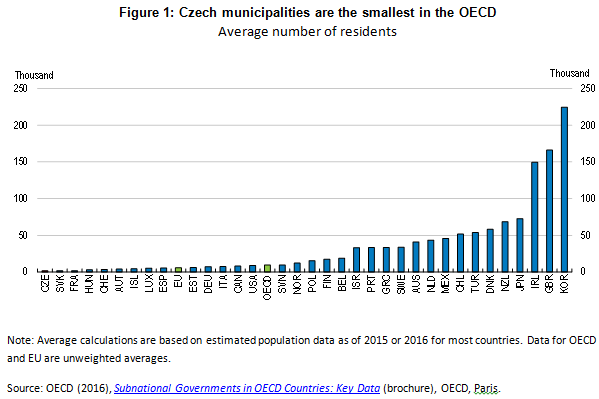
Czech municipalities smallest in oecd

Municipalities have important responsibilities in delivering key services including education, healthcare, transport, public housing and waste removal. It seems that scaling up some services could realise economies of scale and scope. For instance, schools tend to be small – around 60% of basic schools have less than 200 students – which limits their ability to cater to a larger range of needs (Shewbridge et al., 2016). In very small municipalities overheads may be crowding out spending on other services: administration costs per person were 50% higher in 2013 in municipalities with 100-200 residents than those with 1 000-2 000 residents.  Small municipalities also have more difficulties with technical procedures, like public procurement.

Scaling up service delivery does not necessarily mean mergers, although a number of OECD countries have taken this path. In Italy and Hungary certain services must be provided jointly if municipalities are below a threshold size. France provides financial incentives for co-operation. Non-financial incentives could be used to reinforce financial incentives.  Alternatively, service standards could be imposed to guarantee minimum standards across the country and induce greater co-operation to meet these standards. In any case, the central government should create a unit to monitor co-operation and facilitate co-operation between municipalities, with additional support from regional governments and the representative associations of municipalities.  A promising new programme is piloting centres of shared services, which should help mitigate skill shortages, and if successful, should be expanded systematically.

This process should be accompanied by more information about the performance of service providers. Norway’s KOSTRA system is an example of best practice in combining and publishing performance information. In the Czech Republic a lot of data already exist but are fragmented or not published. Publishing performance indicators and using them in benchmarking and in budgetary processes would better inform policymakers and provide stronger incentives to providers to raise service quality. It would also help citizens decide whether the right balance has been struck between municipal size and the service quality that they expect.

Reference:

OECD (2016), Economic Surveys: Czech Republic 2016, OECD Publishing, Paris.

Shewbridge, C. et al. (2016), OECD Reviews of School Resources: Czech Republic, OECD Publishing, Paris, forthcoming.


Tackling the three main challenges in Costa Rica: fiscal reform, reverting the slowdown in productivity and reducing inequality

By Paula Garda and Mauro Pisu, Country Studies Branch, OECD Economics Department

Costa Rica’s economic, social and environmental achievements are impressive. It has succeeded in combining rising living standards, virtually universal health care, pension and primary education systems with sustainable use of natural resources. Incomes per capita have nearly doubled in real terms over the past three decades and some well-being indicators (health, environment and life-satisfaction) are comparable with or even above the OECD average. However, as the latest Economic Assessment of Costa Rica highlights the country faces old and new challenges that will need be addressed to continue developing in a sustainable way.

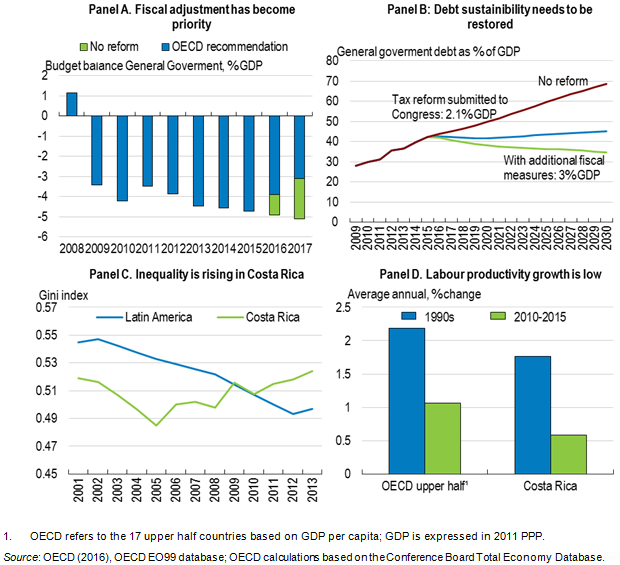
In the period 2008-2015, the public debt-GDP ratio almost doubled to 42.4% (Figure 1, Panel A and B) and interest payments on government debt rose from 15 to 19% of central government revenues. The budget deficit reached 6% of GDP in 2015. Measures to restore fiscal sustainability are now urgent.

In addition, Costa Rica faces long-standing structural problems:

  • Inequality has been increasing since the mid-1990s to high levels by OECD standards. This is in stark contrast with many other Latin American economies, which have recently made significant progress in reducing inequality and poverty (Figure 1, Panel C).
  • Labour productivity growth has been disappointing mainly because of sluggish technical progress. This has taken place despite policies promoting international markets openness and attracting foreign direct investment (FDI) inflows (Figure 1, Panel D).

Costa Rica Fisc

How can policymakers address the three challenges?

The fiscal challenge is the priority. The two bills the government proposed in 2015 – as part of a tax reform package – to replace the sales tax with a full-fledged VAT system and reform the income tax are still under discussion in the legislative assembly. It is urgent to approve them as soon as possible. The VAT and the income tax reform would cut the deficit by about 2% of GDP over the following two years (mostly due to the introduction of the VAT) and would help stabilise the debt-GDP ratio. The two bills are well thought out and consistent with OECD advice: broadening tax bases and relying more on VAT are growth friendly ways to raise tax receipts. Also, most OECD countries have VAT systems, including Mexico and Chile. Additional fiscal or expenditure control measures of 1% of GDP will be needed to put debt on a firm downward path (Figure 1, Panel B). These should focus on reforming the public employment system to prevent excessive automatic salaries increases and raise public sector efficiency. Reforming the public employment system is key to boost productivity and lower inequality as public administration inefficiencies hamper business dynamism and public sector employment contributes to rising inequality in Costa Rica.

Structural reforms and institutional changes are necessary to increase productivity and build a more inclusive society by reducing inequality and poverty.

The three main areas of reforms to boost productivity include: 1) improving the framework of competition policy by strengthening the power of the competition authority and improving the governance of state-owned enterprises, which play a dominant role in many key sectors such as banking, electricity, insurance and telecoms; 2) enhancing links between the foreign and domestic firms and encouraging innovation by local enterprises through better links with universities; 3) improving transport infrastructure by simplifying the sector institutional framework and accelerating project execution.

Reforms to increase productivity need to go hand in hand with making Costa Rica a more inclusive society, especially for women. This will require improving the quality of education – and not just increasing spending on it – enhancing the effectiveness of cash transfers– by reducing programmes’ fragmentation and improving targeting – and lowering informality – by strengthening enforcement, reducing administrative burdens to entrepreneurship and enabling the poor to become formal workers. Costa Rica should also reinforce environmental protection by reducing emissions from the transport sector and improving wastewater treatment.

Find out more:

OECD (2016a), OECD Economic Surveys: Costa Rica 2016, OECD Publishing, Paris.


Reaping the benefits of global value chains to rebalance the Turkish economy

By Volker Ziemann, Economist, Turkey Desk, Country Studies Branch, OECD Economics Department

The growing role of global value chains (GVCs) in international production processes is of critical importance for Turkey’s development. Participation in GVCs is one of the key drivers of successful productivity diffusion in a globalised world. Despite major progress, Turkey still lags behind most comparable countries in terms of exported value added per capita.

Backward integration, that is the use of foreign inputs to produce final and intermediate goods exported by Turkish firms, often entails import competition, in particular in manufacturing and services, and accelerates the reallocation of domestic resources towards the most competitive firms. Backward integration also facilitates the diffusion of knowledge either indirectly through learning from suppliers or directly via knowledge spillovers from foreign direct investment.

Forward integration, that is the production of intermediate inputs used in other countries’ exports, increases and diversifies the potential market, leverages the use of Turkey’s human, capital and natural resources, and, as a result, contributes to rebalancing the Turkish economy. Increased production for foreign markets requires convergence of product standards toward international best practices and triggers virtuous feedback loops between productivity, innovation, human capital endowment and living standards.

While Turkey incorporates an increasing share of foreign value added in its own exports (backward participation), its capacity to provide intermediate inputs to other countries’ exports (forward participation) is still limited (see Figure).

Turkey GVC 2016

Source: OECD/WTO (2016), “Trade in value added”, OECD-WTO: Statistics on Trade in Value Added (database). DOI: http://dx.doi.org/10.1787/data-00648-en.

The 2016 OECD Economic Survey of Turkey argues that Turkey’s participation in GVCs remains below potential owing to institutional features that hamper efficient allocation of capital and labour, obstacles inherent in bilateral trade agreements and entry regulations, underdeveloped human capital and insufficient investment in innovation, R&D and knowledge-based capital. The Survey further identifies substantial room for progress in corporate governance and managerial skills, as well as the use of ICT tools in production and management processes.

Progress along these dimensions would make Turkish firms more competitive, strengthen Turkey’s backward and forward trade linkages and contribute to rebalancing growth. The adjustment process towards a more export-oriented economy operating on a level playing field needs to be flanked by dedicated industrial, social and environmental policies to alleviate adverse consequences on displaced firms and workers and the ecosystem.

Find out more:

OECD (2016), OECD Economic Surveys: Turkey 2016, OECD Publishing, Paris.


Strengthening the Turkish manufacturing sector to rebalance growth

By Rauf Gonenc, Head of the Turkey Desk, Country Studies Branch, OECD Economics Department

Turkey’s economy continued to grow strongly despite substantial domestic and regional headwinds. However, external imbalances have widened making the economy vulnerable to external shocks. The 2016 OECD Economic Survey of Turkey calls for rebalancing to alleviate the enduring tension between growth and external sustainability. A more competitive manufacturing sector, with a heavier weight in the economy and higher net exports is key here.

The Survey documents drivers and bottlenecks for the growth and diversification of Turkey’s manufacturing sector. It suggests that the sector’s segmentation and the outsized tail of poorly performing firms undermine aggregate productivity growth. Indeed, low productivity eases job creation in the short term, but undermines it in the long run and holds back improvements in living standards because of competitiveness losses. A core of well-performing firms (“frontier firms”) is not growing at full potential because of shortcomings in the policy framework. Intermediary (“follower”) firms sustain competition and deliver jobs, but tend to fall behind in productivity. Lower productivity units (“laggards”), which employ a large share of the low-skilled majority of the working age population, survive mostly thanks to the incomplete enforcement of rules and regulations. The resulting stalemate requires a coherent strategy of “systemic upgrading” of the business environment.

Turkey productivity 2016

A number of structural features entrench the deep segmentation between different types of firms, hinder productivity diffusion and curb higher-productivity firms’ share of total employment:

  • Human capital falls behind reflected in weak general management know-how, foreign language proficiency and basic digitalisation knowledge of business owners, as well as limited access to vocational training for their employees.
  • Lack of formalisation and transparency hampers firms’ access to banking and financial services, to the stock market and to international partnerships.
  • Notwithstanding improvements in the 2000s, the credibility of governance institutions needs to be improved further. Young firms are particularly affected by pressures arising from illicit practices, non-level playing competition and political unpredictability.
  • Turkey’s rigid employment regulations deprive law-abiding enterprises of the wide range of employment forms available in other OECD countries. More flexible employment forms are accessible for informal and semi-formal businesses. These jobs, however, are precarious and lack social protection.

Removing these bottlenecks would allow Turkish firms to operate in compliance with the law and on a level-playing field, under supportive regulations, taxation and innovation incentives. They could then achieve stronger productivity gains and the most promising firms could grow faster. A credible flexicurity system needs to be put in place that facilitates adjustment in the labour market while protecting those affected by structural change.

Find out more:

OECD (2016), OECD Economic Surveys: Turkey 2016, OECD Publishing, Paris.


Leveraging R&D and innovation policies to foster productivity in Czech Republic

By Falilou Fall, Head of the Czech Republic Desk, Country Studies Branch, OECD Economics Department

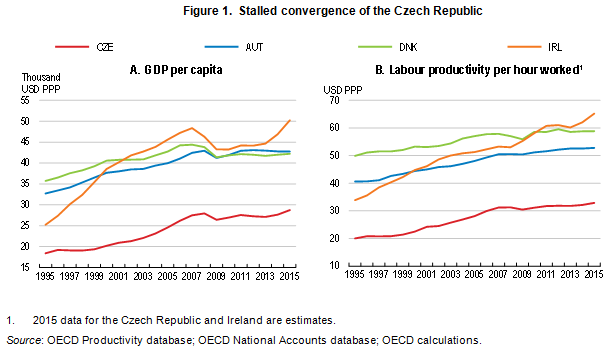
Productivity catch-up along with deeper integration into the global economy played a central role in the convergence of the Czech incomes toward OECD countries before the 2008 financial crisis. However, since then the convergence process has stalled. Labour productivity trends show a clear break in 2008 at the beginning of the crisis (Figure 1).  The growth rate of labour productivity fell from 4.3% per annum in  2001-07 to 0.4% between 2008-14, and affected all sectors except finance and insurance. The strongest decrease was in manufacturing.  As a result productivity is 21% below its pre-crisis trend, and potential productivity is 16% lower (OECD, 2016; Fall and Lewis (2016, forthcoming)). While cyclical developments are at play, the drop in productivity in all sectors indicates that the productivity shortfall is mainly structural. This suggests scope for improved structural policies to boost productivity in the Czech Republic.

Leveraging R&D-Czech Rep

Until 2008, inward foreign direct investment, international linkages of firms and credit availability had a significant impact on productivity growth. As the Czech economy is already one of the most integrated in global value chains, reviving the productivity catch-up process has to be domestically-driven. In particular, there is a need to boost productivity of Czech firms not affiliated to foreign firms and to facilitate the expansion of SMEs and the creation of new firms (Adalet McGowan et al., 2015).

More effective R&D and innovation (RDI) policies are needed to foster domestically-driven productivity growth. So far, R&D and innovation performance has been low despite a noticeable increase in spending. The increase in RDI spending should be continued as it is a key element for upgrading the economy in the global value chains. The Czech Government has put in place programmes to encourage higher business R&D spending by intensifying collaboration between businesses and research institutions. However, direct government funding of business RDI is modest, representing 0.1% of GDP in 2013. More co-financing should be developed to incentivise firms to mobilise their own resources. Well designed and properly administered tax incentives (fiscal deductions) for RDI should also be used to complement direct support. However, a balance should be maintained between different types of government funding through grants, loans, co-financing, loan guarantees and tax provisions.

Furthermore, streamlining the administration and implementation of innovation policy would increase the effectiveness of the different programmes. The organisation and administration of RDI policies is too complex. The fragmentation of innovation policies seems to be partly driven by the specialisation of the different government bodies along with a limited set of financial instruments available to each. The respective role of the different stakeholders (ministries, agencies, research institutions, councils and businesses) should be further clarified as they all intervene in the same areas. Also, it is necessary to unify the design, assessment and coordination of implementation of research and development and innovation policies in a single institution.

Reference

Adalet McGowan, M., D. Andrews, C. Criscuolo and G. Nicoletti (2015), The Future of Productivity, OECD Publishing, Paris,  See: http://www.oecd.org/economy/the-future-of-productivity.htm

OECD (2016), Economic Surveys: Czech Republic 2016, OECD Publishing, Paris.

Fall, F. and C. Lewis (2016), “Fostering productivity for inclusive growth in the Czech Republic”, forthcoming, OECD Publishing, Paris.


Is Mexico a new ‘China’?

By Sean M. Dougherty, Head of the Mexico Desk, OECD Economics Department.

China’s spectacular growth during the 1990s and early 2000s made it the envy of many other emerging economies. Yet more recently, relative labour costs have risen substantially, and economies such as Mexico’s, which lost export market share for some time, have made a partial comeback. However, Mexico’s increasing competitiveness masks one of the country’s fundamental concerns, which is weak productivity improvements. In a new working paper being released today, while the Global Forum on Productivity opens in Lisbon, we examined the evolution of multifactor productivity in Mexico’s manufacturing sector, as compared to China’s (see Dougherty & Escobar, 2016). Firm-level micro-data were used to examine the distribution of productivity across Mexico’s states, and also to track the misallocation of resources.

It turns out that Mexico’s increasing competitiveness and attractiveness masks one of the countries’ fundamental concerns, which is the absence of productivity improvements. Mexico’s productivity lags behind that of other major emerging economies, and it has suffered from a negative growth trend – at least until the recent package of structural reforms (OECD, 2015a). It turns out that multi-factor productivity differs considerably across firms and regions, a situation not unlike that in many OECD countries. While Mexico’s most productive firms are performing relatively well, and can compete with China’s, the vast majority of firms are struggling to perform better with limited success, leading to a growing dispersion in productivity (see figure below). A similar situation is observed in other OECD countries where there is a rising gap in productivity between the most advanced firms and the laggards, and the gains in productivity of the most advanced firms are not enough to improve aggregate productivity (OECD, 2015b).

Mex a new china

We also took advantage of Mexico’s federal structure to study the drivers of productivity using econometric techniques to address potential reverse causality. Our findings suggest that among other factors, a stronger rule of law increases productivity in Mexico. This is robust to previous OECD evidence, which suggests that firms in Mexico’s states with more effective legal systems tend to be substantially larger and more productive (Dougherty, 2014).

Our results also show that among the institutional quality-related variables, informality has the strongest effect on productivity. Moreover, we consider informality as a source of distortions that contribute to the misallocation of resources. Our results are robust to various methods, and imply a strongly negative relationship between informality and productivity. Among different size firms, informality in microenterprises (up to 10 workers) has the strongest negative effects on productivity. The results also suggest – for the first time that we know of – that more productive states and industries suffer more from informality than less productive ones. This is likely due to resources being perversely tied up in informal activities, akin to the ‘Zombie firms’ that are now being investigated at OECD. Tackling informality is a complex challenge, and one that requires a multi-faceted approach (OECD, 2013, 2015a).

The results also suggest that the mere presence of foreign investment improves productivity – with the exception of Maquiladora industries, which are missing out on productivity gains. This is likely due to Maquila’s undue emphasis on low-end, low-skill assembly operations, which have often not fared very well in competition with China. Moreover, weak education quality simultaneously acts as a major restraint on productivity, and it aggravates informality.

In summary, we can conclude that Mexico is not a ‘China’, yet.

References:

Dougherty, S. (2014), ‘Legal reform, contract enforcement and firm size in Mexico’, Review of International Economics, Vol. 22, No. 4, September 2014.

Dougherty, S. and O. Escobar (2016), ‘Could Mexico Become the new “China”?  Policy Drivers of Competitiveness and Productivity’, OECD Productivity Working Papers n°4. (Also forthcoming in the European Journal of Comparative Economics.)

OECD (2013, 2015a), Economic Surveys of Mexico, OECD Publishing, Paris.

OECD (2015b), The Future of Productivity, OECD Publishing, Paris.


Tackling the productivity paradox: The OECD Global Forum on Productivity

Catherine L. Mann, OECD Chief Economist and Head of the Economics Department, and Andrew W. Wyckoff, Director, OECD Directorate for Science, Technology and Innovation.

Today’s post is also being published on the OECD Insights blog.

The nexus of slowing productivity growth and rising inequality is capturing the attention of policymakers and researchers.  The productivity slowdown, its causes, and the link with inclusiveness will be discussed on 7-8 July in Lisbon at the first Annual Conference of the new Global Forum on Productivity, which was created by the OECD in collaboration with a number of Member and non-Member countries.

The fact that productivity growth is slowing in most countries is a puzzle, often referred to as the “productivity paradox”, because you would expect the opposite to happen during a period like the current one where many new technologies are being introduced, more firms and countries are integrated into global value chains, and workers are more highly educated. The crisis may be part of the explanation, but OECD data show that productivity growth has been slowing since the early 2000s in Canada, the United Kingdom and the United States, and even longer, since the 1970s, in France, Germany, Italy and Japan.

A recent OECD study on The Future of Productivity argues that the economic forces shaping productivity developments can be better understood by focusing on three types of firms: the globally most productive (“global frontier” firms); the most advanced firms nationally; and those lagging behind. This suggests a more nuanced picture than simply looking at the overall figures. Labour productivity in global frontier firms increased at an average annual rate of 3.5 per cent in the manufacturing sector over the 2000s, compared to 0.5% for non-frontier firms.

prod frontier

This gap in productivity growth between the global frontier and other firms raises questions about the ability of the most advanced firms nationally to adopt new technologies and knowledge developed by the global leaders, and for the firms trailing them at national level to catch up. Speaking at the China Development Forum in March 2016, the OECD Secretary-General put it like this: “It’s clear that the knowledge and technology diffusion “machine” is broken”, and called on governments to implement structural reforms to promote trade, encourage innovation, and boost competition to fix the machine.  At the same time, a new OECD report, The Productivity-Inclusiveness Nexus, looked into the linkage between these productivity patterns and rising inequality identifying a number of factors that underpin both and thus deserve additional research .

Governments are already thinking about these issues. In the US for instance, the February 2015 Economic Report of the President stated that “The ultimate test of an economy’s performance is the well-being of its middle class. This in turn has been shaped by three factors: how pro­ductivity has grown, how income is distributed, and how many people are participating in the labour force”. Other OECD governments have productivity high on their agendas, too. These include Mexico’s seeking to “democratize productivity” through its new National Productivity Council.  Mexico is not alone: Chile’s president Michelle Bachelet has established a “Productivity, growth and innovation agenda.” Improving productivity is seen as the key to future well-being outside the OECD, too, for instance by the Chinese Academy of Sciences: “the real potential for sustaining Chinese growth is in improving productivity.” And the European Commission has advised countries to establish Competitiveness Councils to deal, among other things, with productivity-enhancing policies.

The OECD proposes a three-pronged approach to boosting productivity: help the firms that are the most innovative at a global level and facilitate the diffusion of new technologies and innovations from the global frontier firms to firms at the national frontier; create a market environment where the most productive firms are allowed to thrive, thereby facilitating the more widespread penetration of available technologies and innovations; and improve the matching of skills to jobs to better use the pool of available talent in the economy.

Some will argue that we don’t know how to ensure that all the factors that contribute to productivity growth will work together, Robert Samuelson for example: “There are always rhetorical solutions: more infrastructure spending; better schools; simpler taxes; more research. Though some policies may be desirable, there’s no guarantee they will improve productivity. Influencing productivity is hard because it depends on so much (management and workers, technology, market behaviour, government policies and more).”

Given the complexity of the issues and their interactions, the Global Forum on Productivity will share analysis, data, experience, and ideas among OECD and non-member countries. The Forum is a practical, interactive tool that will be useful for those inside or outside governments seeking answers to three questions:

  • What factors can explain the productivity slowdown?
  • What can countries do to improve future prospects for productivity growth and innovation?
  • What can countries do to improve the design of institutions seeking to promote higher productivity and inclusiveness

At the 2016 meeting of the Global Forum on Productivity around 200 participants from 43 OECD and non-Member countries will look at the role of public policy in stimulating productivity growth; productivity spillovers, diffusion, and public policies; divergence in productivity and implications for inclusion; the link between trade, global value chains and productivity; getting institutions right for productivity-enhancing policies; public sector productivity; and agglomeration economies and productivity (the benefits for firms of being located near each other).

Useful links

The Future of Productivity

Promoting Productivity & Equality: A Twin Challenge

The Productivity-Inclusiveness Nexus


Fiscal policy in the euro area: in the current juncture, don’t apply sanctions


By Alvaro Pina, Head of European Union and Euro Area Desk, Country Studies Branch, OECD Economics Department

Tomorrow the European Commission will assess again the fiscal situation of Portugal and Spain, and decide whether to recommend to the Council that the Excessive Deficit Procedure be stepped up for those countries, exposing them to various sanctions. This momentous decision can have major consequences for the countries concerned, but also wider implications. It sets a landmark in the application of the Stability and Growth Pact rules, and therefore begs the question of how best those rules should be applied, especially in the current juncture of weak growth in Europe. In turn, this question hinges on what fiscal policies should do to support the recovery more. The recent OECD Survey of the Euro Area provides analysis on what should be done.

Growth has picked up gradually over the past two years, but demand is still weak and unemployment remains very high in several countries, including Portugal and Spain. In the euro area as a whole, support to the recovery has essentially come from monetary policy, with little or no fiscal help. After three years (2011-13) of strong and widespread fiscal consolidation, fiscal policy has turned broadly neutral (Figure 1), but it needs to go further in supporting demand as monetary policy alone cannot do everything. Budget support should mainly come from countries with fiscal space. Those without, like Portugal and Spain, should nonetheless avoid a return to austerity.

Desney1 euro are fisc stance

To maximise growth impacts and make them lasting, budget support should be targeted. Post-crisis consolidation often led to increases in labour taxes and large reductions in public investment (Figure 2), making public finances less growth-friendly. Policy levers to improve the composition and efficiency of public spending and taxes remain largely at national level, and progress on this front across the euro area has been insufficient. But European sanctions could make matters worse. For instance, they would likely imply a suspension (even if only temporary) of structural funds to the countries concerned, putting further downward pressure on public investment.

Desney2 change in public investmen

In the current juncture, sanctions would be an economic mistake. In the absence of temporary fiscal expansion by countries with enough space, sanctions will somewhat tilt the euro area fiscal stance towards austerity, the opposite of what is needed. Further, they risk inducing further cuts to investment, thus hampering potential growth. Not to mention rekindling political tensions and animosities, again the opposite of what is needed. In a word: don’t.

See also:

OECD (2016), OECD Economic Surveys: Euro Area 2016, OECD Publishing, Paris.


Revisiting policy options for more jobs

by Alain De Serres, Head of Division, and Peter Gal, Economist
Structural Surveillance Division, Policy Studies Branch, OECD Economics Department

In many OECD countries, the labour market has yet to recover the lost ground suffered in the aftermath of the financial crisis. In some of them, unemployment has been persistently high, resulting in a very high incidence of long-term unemployment. In part, this reflects the weakness of demand but given that a slow recovery has been a reality for many countries, a number of structural factors also contribute to the situation in the hardest-hit countries.

Lifting employment requires a combination of measures that will boost job creation, encourage labour force participation and facilitate the matching of jobs and job seekers. A recent OECD study reassesses the effectiveness of a wide range of structural labour market policies for spurring employment, building on insights from a vast volume of economic literature and new empirical analyses. Besides the overall labour market, it also considers a number of specific labour market groups, along the demographic dimension (youth, elderly, women, men) and the skill dimension (low-, middle and high educated), as well as a large number of potentially beneficial policies.

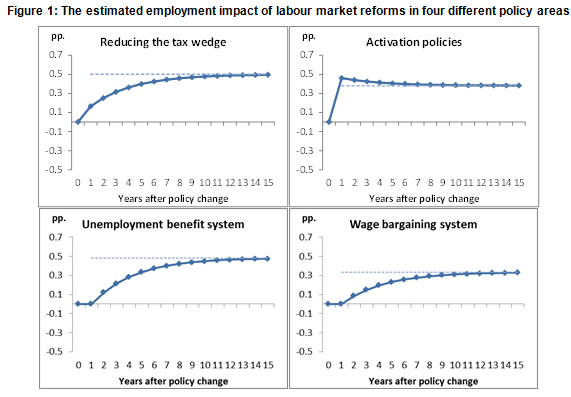
Four policy areas stand out as the key labour market policy levers, showing strong potential for lifting employment rates (See Figure 1 below).

  • First, a reduction in the so-called tax wedge, that is the part of labour costs that governments collect through income taxes and social security contributions boost overall employment. It does so not only by making it more attractive for companies to hire workers (job creation channel), but also by making it more attractive for employees to accept job offers, as they receive a higher take-home pay.
  • Second, spending more on activation policies, in particular job training, facilitates finding a good match between the skills that employers search and what employees can offer.
  • Third, reforms of unemployment insurance systems to provide more effective re-employment assistance and services to jobseekers, while conditioning benefits more strongly on job-search intensity, raise incentives to accept job offers, contributing thereby to stronger employment growth.
  • Finally, striving for a wage bargaining system that raises the responsiveness of wage adjustments to labour market conditions, including by giving firms more leeway in the applications of collective agreements negotiated at the sector level, also raises employment.

AdeS and PGal Structural

Source: Gal, P. and A. Theising (2015), “The macroeconomic impact of structural policies on labour market outcomes in OECD countries: A reassessment”, OECD Economics Department Working Papers, No. 1271, OECD Publishing, Paris.Figure 5.

Note: In these simulations, the magnitude of reforms is chosen to be of a typical size that was observed in the past. More specifically it is the average improvement of the policy indicators over 5 consecutive years, across all the 25 OECD countries and years (1985-2011) included in the study.

Outside the realm of labour market policies, easing regulations of product markets – most importantly, liberalizing entry to markets and thus increasing competition – have an extra potential to create jobs over the medium- to long run.

Importantly in the context of subdued growth, all these findings are valid even under the assumption that the overall government budget remains unchanged, thus making sure that public finances would not be strained further by putting in place these reforms.

Finally, note that the OECD is currently revising the OECD Jobs Strategy, which will delve into more details on the design and the mechanism of labour market policies.

References

Gal, P. and A. Theising (2015), “The macroeconomic impact of structural policies on labour market outcomes in OECD countries: A reassessment”, OECD Economics Department Working Papers, No. 1271, OECD Publishing, Paris.


Norway, higher education could deliver more for less

by Vassiliki Koutsogeorgopoulou , Economist, OECD Economics Department

Norway’s predominately public and tuition-free tertiary education system has encouraged participation and generated high attainment rates. However, few Norwegian universities rank high in international comparisons on the basis of research related and other indicators. Also, many students take considerable time to finish their studies. Moreover, despite an increase, enrolments remain low in fields such as science and engineering, although disaggregated data show quite different labour market outcomes across STEM disciplines; and supply shortages in some more “practical” areas, namely teachers and nurses, are looming. Spending on tertiary education is comparatively high, both in terms of annual expenditure per student and as a share of GDP. Efficiency and quality can be improved.

Degree completion times are long, despite various incentives to shorten them. For instance, conversion of loans to grants for early completion has had limited success. Higher education funding has overly incentivised institutions to produce study credit points (required for the completion of courses), rather than degree completions. Plans to include the graduation rates in the formula for performance-based funding should be pursued. Further incentives and financial support for students to complete their courses on time would be helpful. The outcomes should be monitored closely. Current efforts to improve data and dissemination via mechanisms such as the annual national student survey and the development of a portal of quality indicators need to continue.

Students’ choices should be better directed towards subjects with high demand, for instance, via loan discounts for such subjects. Moreover, the funding system of higher-education providers could offer differentiated rewards to institutions for successful study outcomes for students from disadvantaged backgrounds, or those taking up courses linked closely to labour market needs.

tertiary ed norway

The efficiency and quality of Norwegian higher education can also be influenced by the existence of many small institutions that aim to meet regional educational needs but which often do not have a critical mass of staff and students. Reforms underway to restructure the higher education through mergers that aim to overcome these problems, while retaining regional coverage, are therefore welcome.

Find out more:

OECD (2016), OECD Economic Surveys: Norway 2016, OECD Publishing, Paris.

Koutsogeorgopoulou, V. (2016), “Addressing the Challenges in Higher Education in Norway”, OECD Economics Department Working Papers, No. 1285, OECD Publishing, Paris.

OECD (2014), OECD Skills Strategy Diagnostic Report: Norway, OECD Publishing, Paris.