By Jens Arnold, Paula Garda, Alberto Gonzalez-Pandiella, OECD Economics Department
Social distancing has led to sharp declines in mobility and activity across Latin America. Widespread informality creates particular challenges for the livelihoods of many workers. As their activities are shut down to contain the spread of COVID-19, informal workers or small entrepreneurs are usually not covered by social protection. Largely out of reach of the public sector, they easily fall through the cracks of emergency income support measures. This has highlighted a major need to rethink and strengthen social protection mechanisms in Latin America. Providing more complete social safety nets that are not tied to formal employment and that can react rapidly to income losses would be one solution. In many countries in the region, such safety nets could be built on the basis of existing conditional cash transfer programmes.
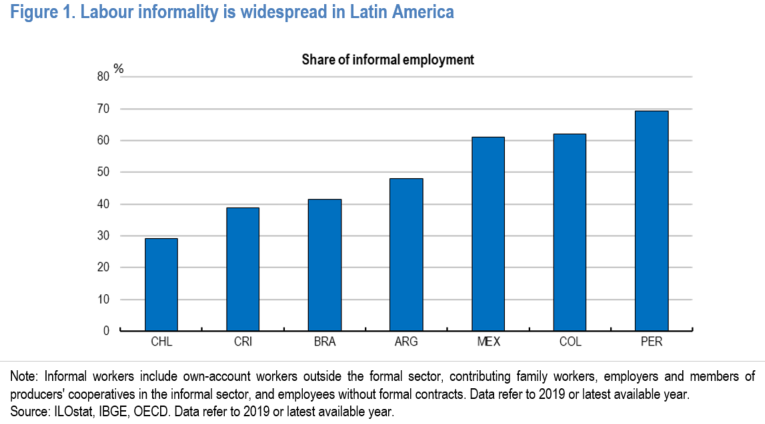
Informal workers and small entrepreneurs account for a significant share of the workforce across Latin America (Figure 1). Most of them have no access to social protection, and almost no savings to carry them through the trough. Informal employees were the first to lose their jobs, while self-employed entrepreneurs such as street sellers and small service providers were left with no source of income as streets became empty. Working from home may be a solution for educated middle-class workers, but it is out of reach for the most vulnerable (Mongey and Weinbergy, 2020).
The crisis has exposed shortcomings in existing social protection mechanisms
Governments in Latin America responded swiftly to the unprecedented challenges posed by COVID-19. Many countries designed temporary support measures, building on existing instruments such as formal-sector unemployment insurance and cash transfers. Formal-sector employees benefitted from more flexible access to unemployment benefits, for example in Brazil and Chile, while temporary short-time work schemes, wage subsidies or lower labour contributions helped to preserve formal labour contracts Brazil, Colombia, Costa Rica and several Mexican states. Cash transfer schemes targeted to low-income households play important roles in Argentina, Bolivia, Brazil, Chile, Colombia, Costa Rica, Ecuador, Mexico and Uruguay, among others. These cash transfer schemes are typically based on large locally-maintained registries of low-income households that can consider both formal and informal incomes. Providing additional resources to these schemes allowed to raise benefit levels and/or expand coverage, including by eliminating previous enrolment waiting lists, as in the cases of Brazil, Chile, Colombia and Peru.
The COVID-19 policy response, however, has also exposed significant gaps in existing social safety networks. Amid policy support for formal workers and for the poor, vulnerable households whose livelihoods depend on informal activities are often left without any social protection mechanism to fall on. Before the pandemic, many of these had successfully escaped poverty and gained incomes above the threshold where they would qualify for cash transfers, but without gaining access to the kind of social protection in place for formal employees. As distancing measures led to unprecedented declines in demand, many of these households were left without any income.
Reaching informal workers is a challenge for public policies and has required innovative ideas. Beyond the grasp of income tax systems, and with no access to social benefits, many informal workers have traditionally been outside the radar of the state. In addition, they often lack access to banking services, so governments had to respond creatively and ensure the creation of basic bank accounts for emergency benefit recipients. More than 50 million Brazilians used a smartphone application to receive an emergency benefit established after the outbreak. Colombia has been similarly successful, paying out benefits to 1.5 million households previously not covered by social benefits, and including free digital banking products. Chile is supporting more than 2 million vulnerable and informal households through different cash transfers, handing out debit cards to those without a bank account. Costa Rica’s new cash transfer also offers the creation of a bank account. Such programmes have replaced significant shares of pre-crisis incomes for low-income households (Busso et al., 2020).
Lessons for the future
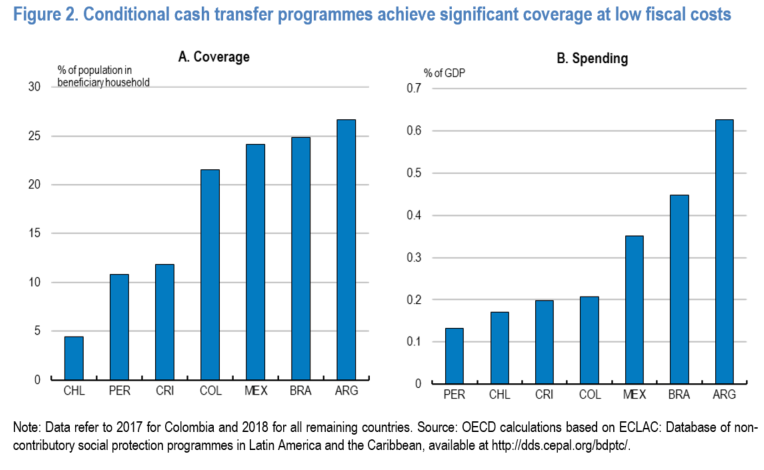
Building more effective universal social safety nets that include informal workers and entrepreneurs emerges as one of the main lessons from the COVID-19 crisis and the social unrest during 2019. Given their wide reach in many countries, existing cash-transfer programmes would be the most straightforward basis for effective social safety nets (Figure 2, Panel A). In several countries, eligibility is in principle universal, but in practice, enrolment processes are too slow or cumbersome to help people in the face of sudden income losses. An important step would therefore be to make cash transfer programmes more agile, so that they can disburse quickly when people lose their livelihoods, following the examples of the UK’s Universal Credit or Malaysia’s BSH programme. More universal social safety nets based on means-tested cash transfers could also help to reduce the widespread fragmentation of social programmes, and strengthen their effectiveness.
Financing universal social safety nets will require additional resources, but building on existing programmes may make the cost manageable. Cash transfer schemes are among the most cost-efficient social expenditure programmes, and they cost relatively little (Figure 2, Panel B). Brazil’s successful Bolsa Família programme, for example, currently only costs 0.5% of GDP, compared with 12% spent on formal social security schemes. During the COVID-19 pandemic, additional spending of 0.04% of GDP was enough to eliminate an accumulated queue of 1 million benefit applicants. Building on existing citizen identification systems and digital technologies could further reduce costs.
Social protection for informal workers should go along with efforts to foster formalisation. Reviewing non-wage labour costs can help to reduce informality, as illustrated by Colombia’s 2012 tax reform. Costly and complex business regulations, including those for starting a formal business, also hamper the formalisation of firms and jobs. Expanding the use of one-stop shops for business regulations would be one way forward. Social programmes could increasingly integrate training and lifelong learning for informal workers. This could create a virtuous circle between formal employment, growth and equity.
Global policy co-operation would strengthen the recovery from the pandemic
Category: COVID-19,Economic outlook
written by oecdecoscope | June 29, 2020
by Nigel Pain and Véronique Salins, OECD Economics Department
The COVID-19 pandemic saw governments throughout the world impose stringent containment measures to contain the spread of the virus, including the partial or total shutdown of the activity in many sectors. These necessary measures succeeded in slowing the spread of infections and reducing the death toll, but have severely impacted economic activity, with GDP declines of more than 20% in many countries during shutdowns and a surge in unemployment.
Governments reacted quickly, with substantial fiscal measures being used to help preserve the incomes of workers and companies despite the collapse of activity. In addition, monetary policy has been eased and financial policy relaxed to support credit provision by financial institutions. While such measures have helped to limit the short-term costs of the crisis, the path to recovery remains exceptionally uncertain in the absence of a vaccine or adequate treatment of the disease,.
The OECD Economic Outlook, released on June 10, presented two possible scenarios: one in which the virus recedes slowly and remains under control (the single-hit scenario), and one in which a second wave of contagion is assumed to erupt later in 2020 (the double-hit scenario). In both cases, the G20 economies are projected to experience a severe output decline in 2020, followed by a slow and gradual recovery in 2021 with output and incomes remaining well below the levels expected prior to the pandemic.
Policymakers face exceptional challenges as the recovery gets underway. Government budget deficits are elevated, public debt is set to rise to exceptionally high levels in many countries, monetary policy space is limited, and there are strong risks that a fragile recovery will leave lasting scars.
Should another virus outbreak occur, as assumed in the double-hit scenario, or the recovery proves unexpectedly weak, additional stimulus will need to be supplied mainly by fiscal policy, with monetary policy helping to ensure adequate liquidity and low interest rates along the yield curve. In either scenario, supportive macroeconomic policies will be required for some time to foster a durable recovery. Debt-financed public spending will need to be well targeted on support for the most vulnerable and on public investment in the health, education, digital and environmental infrastructures that are necessary for a sustainable recovery and which lift demand in the near term.
Potential scars in labour and product markets, the necessary reallocation of workers and capital across sectors in the aftermath of the pandemic, and the significant adverse impact of the crisis on living standards also emphasise the urgent need for renewed and well-targeted structural policy reforms in all economies.
Global policy co-operation would enhance the benefits of these actions. Acting together creates confidence and positive spillovers on trade and investment that will be more effective for all countries than if they acted alone. Co-ordinated policy actions across all the major economies are needed to ensure effective healthcare provision around the world and provide the most effective stimulus to the global economy. They would help restore growth more efficiently than country specific actions, with larger effects on trade, consumer and investor confidence and uncertainty.
Illustrative policy simulations for the G20 economies highlight the benefits of economic policy co-operation. The particular set of co-ordinated fiscal, monetary and structural measures considered includes a debt-financed fiscal easing of 0.5% of GDP in all countries for three years, reductions in policy interest rates in economies with sufficient policy space, and additional competition-enhancing structural reforms that increase productivity slowly over time. In all of the G20 countries (or wider areas) central banks are also assumed to use forward guidance that helps interest rates to remain low and takes into account the longer-term output gains from the package of policies being undertaken. In addition, a temporary reduction in investment risk premia is incorporated when all countries act together to capture the favourable effects on investor confidence.
Taken together, these policy measures raise the level of GDP by around ¾ per cent in the first year in the median G20 economy (Figure below, Panel A) and by 1¼ per cent in the second year, with the level of output permanently higher in the longer term. The near-term boost to output primarily results from the collective gains from more supportive macroeconomic policies, but the structural reform measures also start to raise output in the short run, with their impact continuing to build over time. The near-term impact on GDP is a little higher in the G20 economies that have space to reduce policy interest rates, reflecting positive effects on demand and investment, but output gains nevertheless remain strong in the other economies.
In all G20 countries, there are clear gains from collective action relative to each country acting by itself (Figure below, Panel B). First, acting together enhances the spillovers through stronger trade growth and higher financial asset prices as firmer external demand boosts exports and incentives to invest. Second, there are additional gains for each country from the boost to global confidence and reduction in uncertainty that comes from acting together to tackle a common problem. Altogether, the gains from collective actions add nearly one-half and one-third respectively to the output gains in the median G20 economy in the first and second year of the scenario.
This suggests that co-ordinated policy action across countries remains the most effective response to the large economic disruptions caused by the Covid-19 outbreak and the challenges that result. In practice, it may either not be possible for all countries to undertake actions on all fronts or countries may simply choose to undertake a different mix of fiscal, monetary and structural responses. Nonetheless, it is important that all countries participate in a co-ordinated effort to support growth as this will increase the collective gains and the benefits for each country.
Germany’s short-time work scheme: can its past success be replicated?
Category: COVID-19,Germany,Uncategorized
written by oecdecoscope | June 29, 2020
By Alexandra Effenberger, Michael Koelle and Andrew Barker, OECD Economics Department
Germany has avoided a large jump in unemployment in the early stages of the COVID-19 recession, just as it did during the global financial crisis (GFC). One important factor in this success is the well-established short-time work (STW) scheme (Kurzarbeit), whereby the government subsidises wage payments for employees whose hours are cut at companies in temporary distress. Countries such as Austria, Switzerland and Italy have similar established schemes, while others such as the UK, Denmark and Latvia have just recently implemented job retention schemes. A number of questions are pertinent for countries looking to learn from the German experience: how many jobs have been saved by STW, what are the fiscal costs and how much does the scheme’s success depend on the specific institutional settings in Germany?
In its current form the scheme functions as an automatic stabiliser, as companies are generally eligible to use STW if they face a major drop in activity for economic reasons or due to extraordinary events, provided the drop is temporary and unavoidable. The application process is fairly streamlined. After notifying the labour agency of the intent and demonstrating the need to use STW, firms are flexible in the actual take-up in terms of both workers and individual work-time reductions. Similar to previous economic crises such as the GFC, exceptional measures to extend the scheme during 2020 could be readily implemented including:
The eligibility threshold for the share of workers affected by a lack of demand within a firm has been lowered from one-third to 10%, and temporary agency workers made eligible.
The labour agency reimburses 100% of social security contributions for lost working hours (usually covered by the employer).
To shield workers from large earnings losses, the replacement rate of lost net earnings is increased from 60% for childless workers and 67% for workers with children to 70% and 77% from the fourth month if they have reduced their working time by at least 50%. In the seventh month, payments are increased further to 80% and 87%.
Restrictions on taking part-time jobs while on STW have been lifted. The additional earnings are not credited against short-time working benefits as long as the total income does not exceed the previous income.
The key benefit of STW is moderation of the increase in unemployment during a downturn, with immediate payoffs through avoiding the large wellbeing and scarring costs of unemployment for workers and medium-term gains from maintaining viable job matches. Countries with large STW or job retention schemes have seen substantial take-up of these schemes alongside much smaller increases in unemployment during the current crisis (Figure 1). STW is estimated to have saved in the order of up to half a million German jobs during the GFC when at its peak around 1.4 million workers were in STW (Hijzen and Martin, 2013[1]; Boeri and Brücker, 2011[2]). Based on the number of notifications the labour agency estimates that 6 million individuals were in short-time work in April 2020. The flipside is that by subsidising existing positions, STW can impede labour reallocation, reduce the probability that those without a secure job find work and slow job growth during the recovery (Cahuc, 2019[3]; Hijzen and Martin, 2013[1]).
Will STW be an efficient instrument in the current crisis?
It remains unclear how well STW will perform in the current crisis, but it will be best-suited if there is a relatively rapid economic rebound without substantial changes to the sectoral composition of the economy (Schwellnus, Koelle and Stadler, 2020[4]). STW was well-suited to dealing with the downturn in Germany during the financial crisis as the sectoral composition of the economy changed little. No major industry grouping gained or lost more than 1 percentage point in its share of labour between 2008 and 2011, with manufacturing experiencing the biggest decline from 19% of hours worked to 18.2% (OECD, 2020[5])
Certainly, the current crisis hit the economy faster and more broadly, as many stores and services were required to shut down completely. This is also visible from the concentration of STW notifications and movements into unemployment in those most affected sectors (Figure 2). However, in contrast to the GFC the decline in business activity has been determined by confinement and social distancing rather than pre-existing differences in firm performance, which is mirrored in the so far much greater reliance on STW rather than lay-offs (Weber and Gehrke, 2020[6]). This suggests that the risk of locking workers in unviable jobs through the use of STW might be less pronounced. Sectoral shifts might be avoided again if the lifting of confinement measures continues and consumers’ demand picks up quickly. In addition, Germany entered the current crisis with very low unemployment and a high degree of labour shortages making firms reluctant to lay off valuable workers. Nevertheless, sectors such as tourism, hospitality and aviation might be subject to longer-term interruptions. A fall in demand during the downturn might accelerate structural changes in some industries, such as automotive manufacturing. As a result, reallocation of labour might become more crucial. In this case, relying on STW for an extensive period might be less efficient than implementing measures focusing more directly on job creation.
Some current additional measures increase the efficiency of the scheme. For example, expansion of STW to allow part-time working in a second job is positive as it facilitates reallocation towards sectors with a temporarily higher labour demand. On the other hand, deadweight effects might increase with the full reimbursement of social-security contributions as it makes it less costly for firms to hold on to workers even if their job is not viable and they will be laid off eventually (Crimmann, Wießner and Bellmann, 2010[7]).
How much does it cost?
The fiscal costs from STW are generally low relative to the number of jobs saved. The costs to the labour agency of saving around half a million jobs during the GFC amounted to about EUR 4.6 billion in 2009 and EUR 3.1 billion in 2010 (Bundesagentur für Arbeit, 2011[8]). Based on the estimate of 6 million workers in STW in April 2020, labour agency budget estimates suggest costs could have been running at almost 2% of GDP recently, with the increase in unemployment payments roughly a degree of magnitude smaller. By comparison, increases in unemployment benefits under expanded coverage were costing US governments around 5% of GDP in early May (including substantial increases in payment generosity) and the Israeli government just over 3% per cent of GDP in April.
The generosity of German STW payments is aligned with unemployment benefits, but may cost the government more upfront if it pays for reductions in hours for workers who would have been kept on anyway. Conversely, STW offers fiscal benefits because the government saves on the cost of helping those who become unemployed to find work. Compared with job-saving alternatives, STW schemes such as the German one have a lower cost per job (Cahuc, Kramarz and Nevoux, 2018[9]). By allowing for a partial hours adjustment, the fiscal cost per worker covered is lower than job retention schemes that subsidise workers who stop work altogether. They are also better targeted than wage subsidies.
Can Germany’s successes with STW be readily replicated?
There are some institutional settings that favour working time adjustments in Germany and may limit applicability to other countries. Stringent rules about layoffs make STW more pertinent to firms. Germany, like some other countries with extensive STW programmes such as France and Italy, ranks in the top 10 OECD countries for protection of permanent workers against dismissal (OECD, 2020[10]). Protection includes notice periods, during which the regular salary would have to be paid, and in some cases severance payments. Total costs averaged across different tenures reach almost 22 weeks of salary, among the highest in the OECD (World Bank, 2020[11]).
Similarly, firing and re-hiring is more costly for firms that require specific qualifications such as technology-intensive production. At the time of the GFC, the turnover costs for low-skilled workers were around EUR 7000 in Germany whereas they were almost five times that high for qualified workers (Bach and Spitznagel, 2009[12]). OECD research shows that technology- and skill-intensity is positively related to labour-hoarding tendencies during economic downturns (OECD, 2010[13]). In this context, the relative importance of technology- and skill-intensive manufacturing in Germany may help to explain the modest response of employment to the decline in output during crises.
In addition, internal flexibility measures such as working hour accounts and reductions in weekly hours or overtime play an important role in working time adjustments in Germany and help cushion the effects of cyclical downturns. Such internal flexibility measures are often covered through collective bargaining agreements or agreed between the social partners, which might not be easily transferred to other countries.
What’s to be learned?
In sum, the German experience shows that an established, flexible and quickly accessible STW scheme can help reduce the labour market effects of an economic crisis and save viable job matches when the downturn is short-lived, the sectoral composition of the economy is not affected, and costly firing and hiring by firms might slow the recovery. For the German case, it remains to be seen whether COVID-19 will trigger the need for substantial reallocation of labour, undermining the benefits of keeping employees in their current jobs. Moreover, any such scheme needs to be tailored to country-specific institutional settings and the eligibility for different types of workers and their share in the economy have to be carefully considered. For example, even when they are eligible for STW it might still be easier for firms to lay off workers on fixed-term contracts, which across European OECD countries on average constitute around 8% of all workers in sectors hit heavily by the COVID-19 crisis (OECD, 2020[14]). During the GFC, take-up of STW in Germany was lower in firms with a higher share of fixed-term contracts (Boeri and Brücker, 2011[2]). Similarly, the self-employed cannot use STW and might need different support programmes. Many countries including Germany have established special funds for the self-employed. Finally, as STW is targeted at keeping incumbent workers in employment, it needs to be recognised that potential new hires such as young graduates and those currently unemployed do not benefit and may lose out if subsidised jobs hinder their own entry into the labour market. Rates of transition from unemployment to employment during April and May 2020 were the lowest ever recorded for those months, worse even than as unemployment approached its 2009 peak during the GFC (Bundesagentur für Arbeit, 2020[15]).
References
Bach, H. and E. Spitznagel (2009), “Kurzarbeit: Betriebe zahlen mit – und haben was”, IAB-Kurzbericht No. 17/2009. [12]
Boeri, T. and H. Brücker (2011), “Short-Time Work Benefits Revisited: Some Lessons from the Great Recession”, Economic Policy, Vol. 26/68, pp. 697-765. [2]
Bundesagentur für Arbeit (2020), “Der Arbeitsmarkt im April 2020”, Press release No. 27 April 30, https://www.arbeitsagentur.de/presse/2020-27-der-arbeitsmarkt-im-april-2020. [16]
Bundesagentur für Arbeit (2020), Monatsbericht zum Arbeits- und Ausbildungsmarkt Mai 2020. [15]
Bundesagentur für Arbeit (2011), Aktiv aus der Krise – Geschäftsbericht 2010. [8]
Cahuc, P. (2019), “Short-Time Work Compensation Schemes and Employment”, IZA World of Labor, Vol. 11/2, pp. 1-11. [3]
Cahuc, P., F. Kramarz and S. Nevoux (2018), “When Short-Time Work Works”, Banque de France Working Paper No. 692. [9]
Crimmann, A., F. Wießner and L. Bellmann (2010), The German work-sharing scheme: An instrument for the crisis. [7]
Hijzen, A. and S. Martin (2013), “The Role of Short-Time Work Schemes during the Global Financial Crisis and Early Recovery: A Cross-Country Analysis”, IZA Journal of Labor Policy, Vol. 2/5, pp. 1-31. [1]
Weber, E. and B. Gehrke (2020), Kurzarbeit, Entlassungen, Neueinstellungen: Wie sich die Corona-Krise von der Finanzkrise 2009 unterscheidet. [6]
World Bank (2020), Doing Business 2020: Employing Workers, https://www.doingbusiness.org/en/data/exploretopics/employing-workers. [11]
Policy responses to COVID-19: no worker should be left behind
Category: COVID-19
written by oecdecoscope | June 29, 2020
By Maria Chiara Cavalleri and Orsetta Causa
While the magnitude of the COVID-19 crisis unfolds, millions of people and workers worldwide wonder what the future holds for them. In response to the pandemic, OECD governments implemented unprecedented measures to stop the spread of the virus. Facing the risk of a severe recession, many governments implemented extensive policy packages to help workers and firms weather the COVID-19 storm. Some workers have been more affected than others because of the nature of their work. Those working in the tourism industry and in service sectors involving personal contact, such as hospitality, sports and entertainment, have been suffering the most from the shutdown and the widespread restrictions in mobility. These are sectors where activity is likely to remain affected for quite some time even as economies slowly recovery.
New OECD work shows that some groups of workers face a higher risk of being left behind and experience poverty associated with COVID-19 labour market disruptions. The self-employed, those hired on fixed-term contracts and part-time workers – generally referred to as non-standard workers – account for a sizeable share of total employment in the sectors most affected by containment measures. On average across European OECD countries, they represent around 40% of total employment in hard-hit sectors, reaching more than 50% in Italy, the Netherlands, Spain and Greece (Figure 1).
Policy challenges
Non-standard workers are particularly vulnerable to the COVID-19 crisis because they tend to have weakest access to social safety nets. For instance, in many countries the self-employed have limited, if any, social protection against income loss due to sickness or a halt in activity. Also, employees under temporary contracts may de facto be excluded from job retention schemes as the incentives for firms to include such workers in short-time work schemes are weak because participation costs can be higher than hiring and firing costs.
Tight access conditions to social protection and low benefit replacement rates weigh relatively more on living standards at the bottom of the wage distribution. Non-standard workers in low-paid jobs represent on average around 12% of dependent employment in affected sectors. These workers may work only occasionally or irregularly, sometimes failing to meet the income thresholds required to access unemployment benefits. Finally, involuntary part-time workers – of which the vast majority are women – may be relatively more at risk of economic hardship in the event of job loss.
Policy responses: immediate action and the way forward
Policy responses to the labour market crisis should be inclusive by ensuring that vulnerable workers are not left behind. In the initial phase of the crisis, the main challenge was to address social protection gaps between standard and non-standard workers. OECD countries have generally been responsive to that policy challenge:
About half of OECD countries have exceptionally expanded or eased access to paid sick leave for non-standard workers.
Access to unemployment benefits has been enhanced in a majority of OECD countries.
Some countries have included temporary employees in short-time work schemes.
Several countries have introduced temporary income replacement schemes to support the self-employed experiencing severe income losses.
Looking forward, the policy challenge is to prevent crisis-related adverse distributional effects from becoming long lasting, for instance avoiding that temporary job losses from COVID-19 translate into long-term unemployment with associated scarring effects. Durable changes in the structure of economic activities may require workers to relocate from declining to expanding sectors and new jobs. The reallocation and matching between workers and jobs should be smooth and inclusive, that is, minimising labour market segmentation and inequality. This requires effective active labour market policies and requalification schemes, on top of adequate income support to help job search, for all workers. This crisis is also an eye-opener on the need to provide workers with equal opportunities to access social protection: countries should consider reforming regular social protection schemes to become more accessible to non-standard workers. Reforms in this area would reduce labour market segmentation and inequalities, and accompany the transition towards new forms of employment.
by Cyrille Schwellnus, Michael Koelle, Balazs Stadler, OECD Economics Department
The spread of COVID-19 across countries and measures taken by governments to contain it – including shutdowns of many business and restrictions on travel and mobility – have led to employment losses that dwarf those experienced during the economic crisis of 2008-09 in terms of both speed and magnitude. The OECD projects the OECD-wide unemployment rate to increase by around 6 percentage points between the fourth quarter of 2019 and the second quarter of 2020 as compared to an increase of around 2 percentage points between the third quarter of 2008 and the second quarter of 2009.
A number of countries, including Australia, Japan, New Zealand and most Western European countries, have established or expanded job retention schemes to preserve as many existing jobs as possible (OECD, 2020). These schemes typically operate on the principle that businesses are subsidised to preserve existing job matches while workers experience no or limited wage losses. In practice, businesses continue to pay employees a significant part of their monthly wages even though they are working only part-time or not at all. In return, they can claim a wage subsidy that covers part of the excess wage cost.
Other countries, including a number of Central and Eastern European countries and the United States, have taken very limited labour market measures to support the preservation of existing jobs. Firms in these countries have greater incentives to lay off workers in response to the COVID-19 shock. The unemployment rate in the United States, for instance, increased by about 10 percentage points between February and May 2020, which partly reflects the ease of layoffs and the absence of significant job retention schemes at the federal level.
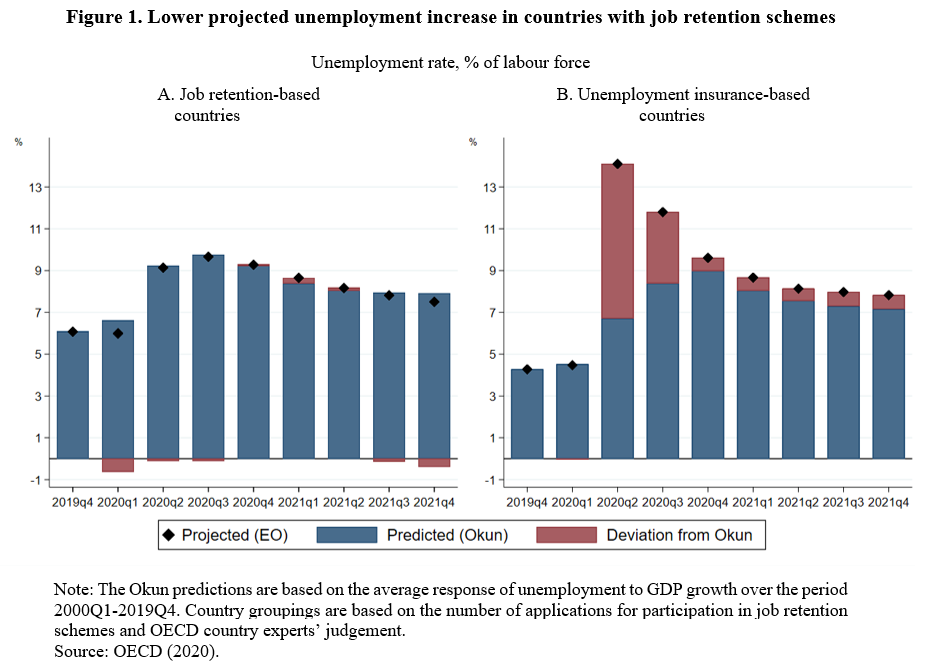
The massive use of job retention schemes during the crisis raises the question of their effectiveness in preserving existing jobs in the short term. Although data on GDP growth and unemployment for the first half of 2020 are not yet available, a first assessment can be made by analysing OECD projections. OECD country specialists integrate real-time information on GDP growth and unemployment from high-frequency indicators in their projections, as well as information on the extent of job-preserving measures, including past experience and real-time information on programme uptake, thereby summarising the currently available information in a synthetic way. The analysis suggests that – relative to predictions based on the historical relation between unemployment and GDP growth (“Okun’s law”) – countries that have resorted to large job retention schemes during the crisis are projected to experience smaller increases in unemployment than other countries (Figure 1).
A complementary way to assess the effectiveness of policies to preserve existing jobs is to compare real-time unemployment developments across countries with and without large job retention schemes. Ideally, such comparisons would take into account differences across countries in the magnitude of the GDP shock. However, GDP is available on a less timely and lower-frequency basis than unemployment data, which makes conditioning on GDP impossible. The approach taken instead is to report changes in registered unemployment along with the workforce covered by applications to job retention schemes. The results, shown in Figure 2, suggest that increases in unemployment have been systematically smaller in countries with larger coverage of applications, suggesting that – at least in the short term – these schemes have been effective in limiting increases in unemployment.
Job retention schemes may be effective in preserving existing jobs in the short term, but this may come at the cost of a less efficient reallocation of workers from unviable jobs to industries and firms with better medium-term growth prospects (Barrero, Bloom and Davis, 2020). Restrictions on some non-essential activities (e.g. travel; hotels and restaurants; parts of the retail sector; recreational services) may persist for some time and consumer demand may not fully recover even thereafter, while industries and firms with business models that are compatible with social distancing may grow (e.g. e-commerce; courier, express and parcel services; parts of the health sector; as well as activities that rely mostly on tasks that can be performed remotely), suggesting that the COVID-19 shock may require significant reallocation of resources.
The optimal mix of job preservation and unemployment benefit policies to support workers and ensure a rapid recovery thus depends on whether the exogenous COVID-19 shock turns out to be purely transitory or more persistent. Given large uncertainty about the longer-term consequences of the crisis for the reallocation of resources across industries and firms, policies to preserve existing jobs can be combined with temporary expansions of unemployment benefits where generosity and/or coverage is currently low.
For instance, employers’ contributions to the cost of job retention schemes could be set in such a way that only businesses expecting to be viable in the medium term select into them rather than using the unemployment insurance system (OECD, 2018). This may require gradually increasing employers’ contributions from the low level put in place during the acute phase of shutdowns.. Moreover, access to training and restrictions on combining income from short-time work schemes with income from other jobs could be eased to allow workers to seize new job opportunities as they arise.
An appropriate balance between preserving existing jobs and reallocation could also be achieved by strengthening incentives in unemployment insurance systems to recall dismissed workers once economic conditions improve (Fujita, Moscarini and Postel-Vinay, 2020). Combining generous unemployment benefits with rules that provide subsidies or tax relief for firms that recall previously dismissed workers could support workers and preserve job matches to a similar extent as short-time work schemes, while allowing for a sufficient degree of reallocation. In Israel, for instance, the government introduced a recall subsidy of around USD 2100 at the end of May.
As the COVID-19 crisis evolves, finding the right balance between job preservation and reallocation of resources will involve some degree of experimentation regarding the sharing of costs related to job retention schemes between employers, employees and the government, as well as a focus on restoring viable job matches in countries that have experienced large numbers of layoffs. As activity in a number of industries resumes, a renewed focus on active labour market policies, including training and public employment, on top of appropriate income support may limit the costs of reallocation for workers. In order to provide timely and granular labour market policy advice, the OECD is monitoring ongoing reallocation across firms, industries and regions using real-time data on online job advertisements. The results of this work will be reported in forthcoming OECD policy briefs.
References Barrero, J., N. Bloom and S. Davis (2020), COVID-19 Is Also a Reallocation Shock, National Bureau of Economic Research, Cambridge, MA, http://dx.doi.org/10.3386/w27137.
Corporate sector vulnerabilities during the Covid-19 outbreak: assessment and policy responses
Category: COVID-19,finance,Uncategorized
written by oecdecoscope | June 29, 2020
by Lilas Demmou, OECD Economics Department, Guido Franco, OECD Economics Department, Sara Calligaris, OECD Directorate for Science, Technology & Innovation, and Dennis Dlugosch, OECD Economics Department
The health crisis caused by the COVID-19 outbreak has led public authorities to take unprecedented measures to contain the propagation of the virus. Administrative business shutdowns, quarantines and restrictions on mobility and social contacts have brought large parts of our economies almost to a standstill. Sales across many sectors have plummeted and are beginning to recover only slowly. Nevertheless, financial commitments with respect to suppliers, employees, lenders and investors remain, depleting liquidity buffers of firms.
The liquidity crisis may turn into a global corporate solvency crisis. With much less or no incoming revenues for an extended period of time and fewer options to deal with this shortfall, the long-term viability of firms has been impaired, and firm voluntary closure and bankruptcies may follow. In turn, a corporate solvency crisis could have serious long-term negative effects on our economies by dragging down employment, productivity, growth and well-being. Mindful of these risks, governments have adopted a range of emergency measures aimed at supporting firms’ liquidity. Aside from monetary measures taken by central banks, fiscal interventions have included direct and indirect financing of the wage bill, tax deferrals, debt moratoria and extension of state loan guarantees.
An issue note published in the latest issue of the OECD Economic Outlook evaluates the risk of a widespread liquidity crisis and discusses the pros and cons of different kinds of public support measures. Building on the methodology developed by Schivardi and Romano (2020) and on illustrative assumptions regarding the evolution of sales and costs during the epidemic, a simple accounting framework is used to calculate the percentage of firms that become illiquid month by month following the introduction of confinement measures. The key role of policies to avoid massive unnecessary bankruptcies is emphasised by comparing the share of firms that would turn illiquid under two scenarios: one where there is massive policy support for firms and one where there is no such support.
The risk of liquidity shortages is high for a large portion of healthy firms
The analysis relies on 2018 firm-level financial data, obtained from the latest vintage of the Orbis dataset (provided by Bureau Van Dijk), and covers a sample of almost one million firms located in 14 European countries, operating in both manufacturing and non-financial services sectors.
The economic shock from measures of physical distancing on firms’ liquidity is modelled as a change in firms’ operating cash flow, resulting from the decline in sales and from firms’ limited ability to fully adjust their operating expenses. Next, the liquidity available to each firm is calculated as the sum of the liquidity buffer held at the beginning of each month and the shock-adjusted cash-flow.
Measures on distancing and mobility restrictions have heterogeneous effects on different sectors. Therefore, we assume the decline in activity to be different across sectors, but identical across countries; for a set of severely hit sectors, the decline in output ranges between 50% and 100% of sales, while it is conservatively set at 15% for the other non-financial sectors. In line with the projections published in the Economic Outlook, we consider two alternative scenarios with respect to the dynamic of the recovery:
A “single-hit” scenario, whereby a sharp drop in activity lasting two months is followed by a four-month progressive recovery, with a return to pre-crisis activity levels seven months after the start of the epidemic.
A “double-hit” scenario, which overlaps with the single-hit scenario for the first seven months, but then assumes a second outbreak from the eight month onwards.
The solid lines in the left and right panels of Figure 1 report the main results of the exercise: in the absence of government intervention, 20% of firms in the sample would likely run out of liquidity after one month and 30% after two months. As the economy is expected to recover only slowly after the two months of collapse in activity, the percentage of firms facing liquidity shortfalls would reach 40% after six months, and starts to decline from the seventh month onwards, when the economy returns to the pre-crisis level of production (“single hit” scenario). In the case of a second episode of widespread confinement, this share would increase instead to 45% (“double-hit” scenario).
The analysis also shows that firms facing a high risk of experiencing liquidity shortages are mostly profitable and viable companies (Figure 1, dashed lines). At the same time, even though solvent, a sizeable share of these firms might face difficulties in accessing new bank financing to bridge a shortfall in liquidity, as they lack the collateral to tap into additional debt. (Figure 1, dotted lines).
The exercise is based on several assumptions, which calls for cautious interpretations. Even so, it underlines the merit of swift and decisive public intervention to safeguard companies and avoid potential bankruptcies of otherwise healthy companies. This intervention is crucial to avoid that the temporary shock implied by the COVID-19 crisis permanently scars the corporate landscape, with serious consequences for the shape of the recovery and long-run growth prospects.
Public policies to reduce liquidity shortages and curb bankruptcy risk
Countries have already introduced a wide range of measures to help firms to cope with the disruptions associated with COVID-19. We used our accounting model also to illustrate the expected impact of stylised policy interventions in three areas:
Deferral of taxes. To support business during the epidemic, several countries have introduced tax deferrals. We model the tax deferral as the moratorium of the (hypothetical) monthly tax payments.
Financial support for debt repayment. A large number of countries have also established legislative frameworks that temporarily allow firms to postpone their debt payments or alternatively, that offer State guarantees to facilitate access to short-term debt facilities. The potential impact of such policies is modelled as a moratorium on short-term debt.
Temporary support to wage payments. A critical response to avoid widespread liquidity shortfalls consists of relaxing firms’ financial commitments vis-à-vis their employees. Schemes such as a shortening of working time, wage subsidies, temporary lay-offs and sick leave have been introduced across countries, though in different combinations. All these measures reduce the wage bill firms have to pay. The labour support is modelled as an unconditional reduction of the wage bill by 80% in all sectors.
Figure 2 illustrates the extent to which each measure curbs the risk of a liquidity crisis compared to the no-policy intervention situation. Tax deferral has the lowest impact on firms’ liquidity positions, followed by debt moratorium policies. Subsidies to the wage bill seem to be the most powerful measure (yet potentially costly), in line with the fact that wages and salaries are often the most important component of operating expenses. Adding up the three different measures, public intervention after two months, for instance, would decrease the number of firms running out of liquidity from 30% to 10%.
Challenges in the design of policies
Public intervention on such a massive scale raises several challenges related to the design of policies. In particular:
Country-specific dimensions. Country-specific institutional settings may shape the extent and the efficiency of the policy response. Given the importance of labour market policies highlighted in the note, it is likely that countries with already well-developed labour market support schemes are able to provide a quick response with less distortive effects.
Conditionality. In some countries, loans forbearance and wage subsidies are conditioned on the actual reduction in payroll, with the requirement to be used to cover fixed costs only or to rehire fired employees after the crisis. The design of transfers and subsidized loans to corporations should ensure that firms preserve jobs when possible and do not divert resources towards exclusively private interests (e.g., to boost CEO compensation or dividend payments).
Short-term versus medium-term policy answer. Given the need of an urgent policy response during the so-called “phase one” of the crisis, policy has often not been particularly targeted in the short term. Going forward, short-term, cross-cutting policies might need to be better refined to ensure that public support does not contribute to resources misallocation. Moreover, policies will also need to account for the heterogeneous impact of the shock, as firms will not be on the same foot to face the crisis other than for liquidity reasons when the activity will slightly recover in the medium-term (see also Gopinath, 2020).
New normal. The extent to which the COVID-19 crisis will disrupt the economies is still uncertain. In European countries a large set of policies, in particular in the labour market, is tailored on the principle to protect the pre-crisis allocation of resources. In other countries, like in the U.S., the adjustment largely hinges on payroll reduction via layoffs. Their relative efficiency during the recovery and beyond may be related to whether economies will structurally change coming out of the COVID-19 crisis.
Notes: 1. The detailed analysis in the Economic Outlook includes also a “prolonged confinement” scenario, which is agnostic on the length of the confinement and avoids modelling the recovery. 2. The issue note published in the Economic Outlook also provides the outcome of an alternative labour support, whose generosity is conditional on the sectoral size of the shock. This option, while of course being less costly from a fiscal perspective, is found to reduce less the risk of a liquidity crisis.
References
Gopinath G. (2020), “Limiting the economic fallout of the coronavirus with large targeted policies”, in R. Baldwin and B. Weder di Mauro (eds.), Mitigating the COVID economic crisis: Act fast and do whatever it takes, VoxEU.org eBook, CEPR Press.
Eight priorities to strengthen international cooperation against Covid-19
Category: COVID-19
written by oecdecoscope | June 29, 2020
By Aida Caldera Sanchez and Shashwat Koirala, OECD Economics Department
International cooperation amplifies individual countries’ efforts; in the fight against the COVID-19 pandemic, international cooperation is not only useful, but indispensable[1]. In the short run, cooperation between governments is needed to curb the pandemic and expedite exit from the crisis. In the medium and long run, internationally coordinated policies can facilitate recovery and the rebuilding of socioeconomic systems in inclusive and sustainable ways and help prepare for future risks and pandemics.
Co-operation for crisis response
Scaling up of medical capacity for treatment and testing: Mobilising health professionals is at the core of the fight against COVID-19.However, it is also critical that these professionals are equipped with sufficientmedical supplies, whether for effective and safe patient care (e.g. ventilators, personal protective equipment) or for the implementation of test, track, and trace programs (e.g. swabs, chemical reagents). Yet, the global supply of medical supplies has been insufficient to meet the increased demand, prompting countries to reduce exports and favour domestic use (see Figure 1). Export restrictions on vital goods can hinder global health efforts by delaying trade (which is concerning in times of urgent need) or by putting upward pressure on prices (which can constrain poorer hospitals and countries) (OECD, 2020[1]). Governments should co-operate to preserve trade openness while scaling up global medical and testing capacity and enabling access to vital medical goods at affordable prices (OECD, 2020[2]). The G20 has called against excessive protectionist approaches (G20, 2020[3]), but it could go further as a coordinating body, for example, by monitoring supplies of certain medical equipment and advocating for the least developed countries to get the materials they need, as it did with food supplies following the global food spikes of 2007-2008 (Bown, 2020[4]). Moreover, given the large dependence of OECD countries on migrant doctors and nurses, international cooperation is needed to smooth the international mobility and recruitment of migrant health professionals, by easing their arrival and recognition of their qualifications (OECD, 2020[5]).
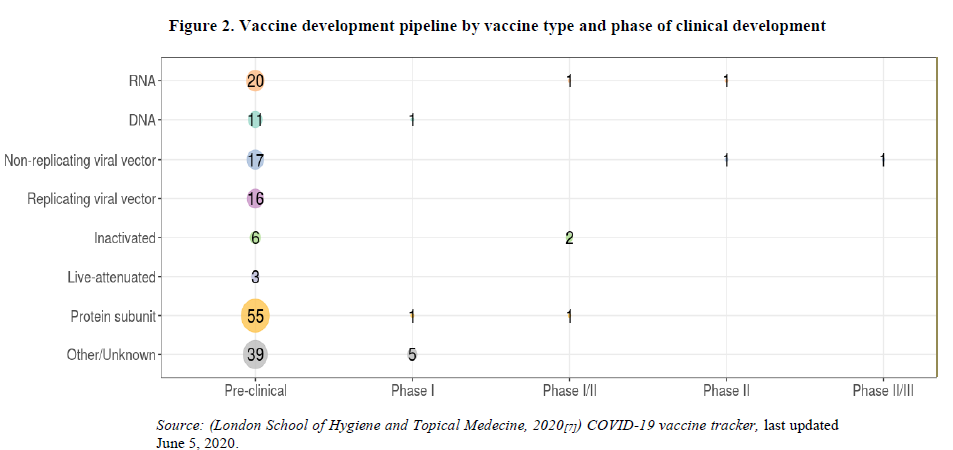
Effective vaccine development and deployment. A vaccine would be the best route to end the pandemic; currently, 181 candidates are in development (see Figure 2) (London School of Hygiene and Topical Medecine, 2020[7]). Because a vaccine will be most effective if it is available cheaply everywhere, cooperation – rather than competition and ‘vaccine nationalism’ – is necessary to expedite its development and distribution. Globally, governments will have to spend tens to hundreds of billions of USD to vaccinate every person on the planet. Although this cost pales in comparison to the number of lives the vaccine could save, the price tag can be reduced significantly and vaccination accelerated if governments cooperate to avoid a bidding war that could drive up prices. Multilateral fundraising efforts for a vaccine are already underway, such as the Coronavirus Global Response pledging event that raised EUR 7.4 billion for universal vaccine access (European Commission, 2020[8]), the International Finance Facility for Immunisation’s vaccine bonds, and advanced market commitments proposed by GAVI, the vaccine alliance (Schäferhoff and Yamey, 2020[9]); these should be supported and bolstered. In addition, manufacturing capacity has to be built while R&D is underway, meaning that countries should collaborate to project demand and plan the necessary capacity to produce sufficient quantities of the vaccine (OECD, 2020[10]). Governments also need to agree upfront on rules for international property rights and procurement (OECD, 2020[10]) and impose universal standards of evidence for vaccine approval (OECD, 2020[11]). Finally, an international commitment to a fair allocation system to ensure that the vaccine will be widely available, and that the countries that need it most are not deprived, would be welcome. Such a system could rely on existing instruments and institutions – including global purchasing agents, advance purchase commitments, and financial instruments like concessional loans – and prioritise delivery of vaccines to health-care workers and high-risk populations (Yamey et al., 2020[12]). Simultaneous support to strengthen the delivery capacities of developing countries is also critical for vaccine access for vulnerable populations.
Continued surveillance to detect re-emergence of the virus: There is also a need for a collaborative approach to virus reporting and surveillance, including of mutated viruses. Initial efforts to contain the virus were hampered by slow and incomplete reporting of the outbreak (Yuan, 2020[13]). Efforts to assess the progression of the pandemic will succeed only if the information is continuously, rapidly, widely and freely shared across borders, as reiterated by the World Health Organisation (Moorthy et al., 2020[14]). However, there are major roadblocks, such as ambiguous criteria for data sharing (Modjarrad et al., 2016[15]) and a lack of common measurement methodologies (e.g. cross-country differences in counting COVID-19 deaths) (Hirsch and Martuscelli, 2020[16]). Overcoming these obstacles requires clear guidance and harmonised standards for health data terminology and exchange (OECD, 2020[11]). Continuous cooperation is also pertinent as countries (e.g. Korea and Israel) start leveraging digital technologies, such as mobile and smartphone data, for disease surveillance and control. The potential of these technologies must be balanced with the concerns of privacy that they provoke, which entails developing appropriate health data governance frameworks, such as secure systems for data exchange (OECD, 2020[11]). Developing these frameworks would benefit from cross-country sharing of best practices, especially since disease surveillance is a multilateral exercise (OECD, 2020[11]).
Continuous and strong support for less developed countries: The virus has particularly profound implications for developing countries. Their health systems are vulnerable and underfunded, with about 90% of low-income countries facing health-worker shortages, and many continue to suffer from the lingering effects of previous health crises (e.g. Ebola, malaria, HIV) (OECD, 2020[17]). Mechanisms for knowledge sharing about protocols of screening and treatment could help, especially in countries with stretched health systems. Countries that had a head start in dealing with the pandemic could offer important lessons and share best practices; but, fiscal support will also be needed. In developing countries, containment measures (e.g. school closures, work reduction) are harder to implement, and they have high opportunity costs in terms of poverty and educational-attainment (OECD, 2020[17]). These countries also have high levels of informal work, which limits governments’ ability to provide social protection for workers and fiscal support for businesses. Moreover, in low and middle-income countries, this crisis comes at a time of rising concern for the sustainability of public debt (OECD, 2020[17]). Thus, sweeping international efforts are needed to help developing countries weather the storm. The G20 has already agreed on a “debt service standstill” until the end of 2020 from all official bilateral creditors, and called on private investors working through the International Institute for Finance to follow suit (G20, 2020[18]). The IMF is replenishing its Containment and Relief Trust and is prepared to use its entire USD 1 trillion lending capacity, and the World Bank has set up a fast track facility for emergency support and is ready to deploy up to USD 160 billion over the next 15 months (OECD, 2020[17]).
Co-operation for inclusive and sustainable recovery
Fiscal policy: To date, countries have individually implemented significant fiscal measures (OECD, 2020[19]). As the goal of these measures shifts to recovery, fiscal stimulus coordinated across countries will magnify the benefit for all economies. Stimulus packages have international spillovers through both the trade and investment channels, suggesting an important role for coordination to maximise benefits (OECD, 2019[20]). In fact, OECD simulations for G20 countries suggest clear gains from collective action, compared to singular country actions (Pain and Salins, Forthcoming[21]). Recovery from the 2008-2009 crisis has also elucidated the value of fiscal coordination (Kalinina, 2020[22]). Fiscal coordination can also involve sharing best practices on how to operationalise long-term projects (OECD, 2009[23]).
Monetary policy: Monetary and financial policy cooperation has been relatively strong. An important act of cooperation has been the activation and establishment of swap lines between major central banks. In theory, there are several avenues through which central banks can further enhance their cooperation. First, major central banks could set up liquidity facilities that allow foreign central banks to exchange sovereign assets for cash without disrupting the securities markets of issuing countries (Collins, Potter and Truman, 2020[24]). Central banks could also further expand their swap lines to more economies (Collins, Potter and Truman, 2020[24]). However, in practice, given the fiscal risks associated with extending swap lines, they remain restricted and only certain emerging economies with deep currency markets are included as recipients (Levy-Yeyati, 2020[25]).
Trade policy and supply chains: Since the start of 2020, 89 jurisdictions have implemented a total of 154 export controls on medical supplies (Figure 1), and 28 jurisdictions have executed 40 export curbs on agricultural and food products (Global Trade Alert, 2020[6]). These actions have exacerbated pre-existing trade tensions and protectionist tendencies, heaping further pressure on global trade. If a second COVID-19 outbreak occurs triggering a return to lockdowns, world trade is forecasted to plummet by 11.4% this year; if a second wave of infections is avoided, global trade is expected to fall by 9.5% in 2020 (OECD, 2020[19]). Experience with trade restrictions in the food sector shows they increase prices and threaten supply (Gillson and Fouad, 2015[26]). Supply chains have received particular attention during the COVID-19 crisis due to the perception that that complex and long supply chains have worsened the implications of the pandemic. However, risk management literature suggests that shorter supply chains and domestic self-sufficiency do not necessarily imply reduced vulnerabilities; rather, supplier diversification can help firms maintain production in times of crises (Miroudot, 2020[27]). Recovery from this crisis, thus, necessitates co-operation to reverse protectionist policies, resist implementing further barriers, and strengthen the robustness and resilience of supply chains.
Improved preparedness for future pandemics and risks: Between 1980 and 2010, the number of annual infectious disease outbreaks has more than tripled (Smith et al., 2014[28]), and the risk of future epidemics and pandemics is high, as well as those linked to environmental changes (World Economic Forum, 2019[29]). Better preparedness is crucial to mitigate these risks (Commission on a Global Health Risk Framework for the Future; National Academy of Medicine Secretariat, 2016[30]). This could include globally co-ordinated mechanisms, such as early warning systems and common protocols for temporary travel and border control restrictions (Derviş and Strauss, 2020[31]). The international community may also rethink and reinforce global frameworks for emergency preparedness and facilitate research agendas and technology development in domains where market forces are lagging or stagnant (e.g. vaccine research) (OECD, 2020[32]). An example of this is the Coalition for Epidemic Preparedness Innovations, a global network of public and private stakeholders created after the Ebola epidemic to fill critical gaps in the vaccine development pipeline, notably by advancing vaccines and keeping investigational stockpiles, funding vaccine development, and coordinating responses to epidemics (CEPI, 2019[33]). Enhanced efforts to address the global shortage of health workers through initiatives such as the ILO/OECD/WHO Working for Health programme would also be welcome.
COVID-19 is an existential threat that has upended global systems. Without international co-operation, both the exit from the crisis and the recovery is likely to be slow and weak. First, this is true for the health sector, as effective disease surveillance, swift vaccine development and deployment, and preparedness for future epidemics benefit from multilateral action. Second, preserving trade openness and increasing the robustness and resilience of supply chains can not only ensure countries’ access to vital medical goods, but also invigorate the post-pandemic economy. Finally, internationally coordinated fiscal and monetary policies, in tandem with support for developing countries, can help the global economy weather the current shock, while preparing it for a sustainable and inclusive recovery.
References
Baldwin, R. and S. Evenett (eds.) (2020), Resilience versus robustness in global value chains: Some policy implications, https://voxeu.org/content/covid-19-and-trade-policy-why-turning-inward-won-t-work. [27] Bown, C. (2020), China should export more medical gear to battle COVID-19, Peterson Institute for International Economics, https://www.piie.com/blogs/trade-and-investment-policy-watch/china-should-export-more-medical-gear-battle-covid-19 (accessed on 12 May 2020). [4] CEPI (2019), Creating a world in which epidemics are no longer a threat to humanity, https://www.who.int/immunization/sage/meetings/2019/april/1_CEPI_Summary_WHO_SAGE_Meeting_April.pdf?ua=1 (accessed on 4 June 2020). [33] Collins, C., S. Potter and E. Truman (2020), “Enhancing central bank cooperation in the COVID-19 pandemic”, Peterson Institute for International Economics, https://www.piie.com/blogs/realtime-economic-issues-watch/enhancing-central-bank-cooperation-covid-19-pandemic. [24] Commission on a Global Health Risk Framework for the Future; National Academy of Medicine Secretariat (2016), The Neglected Dimension of Global Security, National Academies Press, http://dx.doi.org/10.17226/21891. [30] Derviş, K. and S. Strauss (2020), What COVID-19 means for international cooperation, https://www.brookings.edu/opinions/what-covid-19-means-for-international-cooperation/ (accessed on 13 May 2020). [31] European Commission (2020), Coronavirus Global Response: €7.4 billion raised for universal access to vaccines, https://ec.europa.eu/commission/presscorner/detail/en/ip_20_797 (accessed on 3 June 2020). [8] G20 (2020), Communiqué: G20 Finance Ministers and Central Bank Governors, April 15, 2020, http://www.g20.utoronto.ca/2020/2020-g20-finance-0415.html#a2 (accessed on 12 May 2020). [18] G20 (2020), G20 Trade and Investment Ministerial Statement, http://www.g20.utoronto.ca/2020/2020-g20-trade-0330.html (accessed on 12 May 2020). [3] Gillson, I. and A. Fouad (eds.) (2015), Trade Policy and Food Security: Improving Access to Food in Developing Countries in the Wake of High World Prices. [26] Global Trade Alert (2020), 21st Century Tracking of Pandemic-Era Trade Policies in Food and Medical Products, https://www.globaltradealert.org/reports/54. [6] Hirsch, C. and C. Martuscelli (2020), The challenge of counting COVID-19 deaths, https://www.politico.eu/article/coronavirus-the-challenge-of-counting-covid-19-deaths/. [16] Kalinina, A. (2020), “What the world can learn from regional responses to COVID-19”, World Economic Forum, https://www.weforum.org/agenda/2020/05/covid-19-what-the-world-can-learn-from-regional-responses/ (accessed on 12 May 2020). [22] Levy-Yeyati, E. (2020), “COVID, Fed swaps and the IMF as lender of last resort”, https://voxeu.org/article/covid-fed-swaps-and-imf-lender-last-resort. [25] London School of Hygiene and Topical Medecine (2020), COVID-19 vaccine tracker, https://vac-lshtm.shinyapps.io/ncov_vaccine_landscape/. [7] Modjarrad, K. et al. (2016), “Developing Global Norms for Sharing Data and Results during Public Health Emergencies”, PLoS Medicine, Vol. 13/1, http://dx.doi.org/10.1371/journal.pmed.1001935. [15] Moorthy, V. et al. (2020), Data sharing for novel coronavirus (COVID-19), World Health Organization, http://dx.doi.org/10.2471/BLT.20.251561. [14] OECD (2020), “A systemic resilience approach to dealing with Covid-19 and future shocks”, OECD Policy Responses to Coronavirus (COVID-19), No. 55, OECD Publishing, Paris, https://dx.doi.org/10.1787/36a5bdfb-en. [32] OECD (2020), “Beyond containment: Health systems responses to COVID-19 in the OECD”, OECD Policy Responses to Coronavirus (Covid-19), No. 12, OECD Publishing, Paris, https://dx.doi.org/10.1787/6ab740c0-en. [11] OECD (2020), “Contribution of migrant doctors and nurses to tackling COVID-19 crisis in OECD countries”, OECD Policy Responses to Coronavirus (COVID-19), No. 74, OECD Publishing, Paris, https://dx.doi.org/10.1787/2f7bace2-en. [5] OECD (2020), “Developing countries and development co-operation: What is at stake?”, http://dx.doi.org/10.1787/2334182B-EN (accessed on 12 May 2020). [17] OECD (2020), OECD Economic Outlook, Volume 2020 Issue 1, OECD Publishing, Paris, https://dx.doi.org/10.1787/0d1d1e2e-en. [19] OECD (2020), “The face mask global value chain in the COVID-19 outbreak: Evidence and policy lessons”, OECD Policy Responses to Coronavirus (COVID-19), No. 62, OECD Publishing, Paris, https://dx.doi.org/10.1787/a4df866d-en. [1] OECD (2020), “Trade interdependencies in Covid-19 goods”, OECD Policy Responses to Coronavirus (COVID-19), No. 67, OECD Publishing, Paris, https://dx.doi.org/10.1787/79aaa1d6-en. [2] OECD (2020), “Treatments and a vaccine for COVID-19: The need for coordinating policies on R&D, manufacturing and access”, OECD Policy Responses to Coronavirus (COVID-19), No. 88, OECD Publishing, Paris, https://dx.doi.org/10.1787/6e7669a9-en. [10] OECD (2019), OECD Economic Outlook, Volume 2019 Issue 2, OECD Publishing, Paris, https://dx.doi.org/10.1787/9b89401b-en. [20] OECD (2009), Policy Responses to the Economic Crisis: Investing in Innovation for Long-Term Growth. [23] Pain, N. and V. Salins (Forthcoming), “Dealing with a significant weakening of global growth”, ECOscope. [21] Schäferhoff, M. and G. Yamey (2020), “Ending The COVID-19 Pandemic Requires Effective Multilateralism”, Health Affairs, https://www.healthaffairs.org/do/10.1377/hblog20200522.123995/full/. [9] Smith, K. et al. (2014), “Global rise in human infectious disease outbreaks”, Journal of the Royal Society Interface, Vol. 11/101, http://dx.doi.org/10.1098/rsif.2014.0950. [28] World Economic Forum (2019), Outbreak Readiness and Business Impact: Protecting Lives and Livelihoods across the Global Economy, http://www3.weforum.org/docs/WEF%20HGHI_Outbreak_Readiness_Business_Impact.pdf (accessed on 29 May 2020). [29] Yamey, G. et al. (2020), Ensuring global access to COVID-19 vaccines, Lancet Publishing Group, http://dx.doi.org/10.1016/S0140-6736(20)30763-7. [12] Yuan, L. (2020), Coronavirus Crisis Shows China’s Governance Failure, The New York Times, https://www.nytimes.com/2020/02/04/business/china-coronavirus-government.html (accessed on 29 May 2020). [13]
[1] To support information exchange and international cooperation, the OECD has launched a policy tracker that provides updates on fiscal, monetary, financial and macro prudential policy actions taken by countries around the world to minimise the economic and social costs of Covid-19 and to promote recovery
* We thank Laurence Boone, Federico Guanais, David Haugh, Mark Pearson, Nick Tomlinson and Martin Wenzl for their useful comments and feedback.
América Latina se enfrenta a una recesión como ninguna otra
Category: Economic outlook,Latin America,Posts in Spanish
written by oecdecoscope | June 29, 2020
by Jens Arnold, Paula Garda, Alberto Gonzalez-Pandiella, Robert Grundke, Nicolas Ruiz, Enes Sunel, Departamento de Economía, OCDE
La propagación del Covid-19 ha sacudido la vida de las personas en todo el mundo de manera extraordinaria, amenazando la salud, interrumpiendo la actividad económica, afectando el bienestar y los empleos. El confinamiento y otras medidas de distanciamiento social para retrasar la propagación de COVID-19 han llevado grandes partes de las economías a una detención. Los pronósticos de pérdidas de producto y empleo se han disparado a medida que los gobiernos se enfrentan a una crisis que no tiene precedentes. Reflejando el inusual grado de incertidumbre, en estas Perspectivas Económicas de la OCDE se presentan dos escenarios: un escenario en el que se produce un segundo brote hacia finales de este año, y un escenario alternativo en el que se evita el segundo brote. En el escenario con segundo brote, se prevé que el PIB mundial disminuya en un -7.6% en 2020 con un débil crecimiento de 2.7% en 2021; en el escenario en que el segundo brote es evitado, el crecimiento será del -6% en 2020 y del 5.2% en 2021. En muchas economías avanzadas, los ingresos reales per cápita podrían perder el equivalente a de cinco a ocho años de crecimiento.
La rápida expansión del Covid-19 ha empujado a América Latina a convertirse recientemente en el epicentro de la pandemia, a la vez que entra en la recesión más profunda de la historia reciente. Como ninguna otra recesión, ésta se ve agravada por shocks simultáneos de salud, económicos, de precios de las materias primas y sociales, al unísono en toda la región. La región se enfrenta a desafíos propios que agravan el panorama: un espacio fiscal limitado, sistemas de salud y seguridad social menos desarrollados, grandes salidas de capital, una caída en picada de las remesas, una gran proporción de trabajadores informales sin ningún tipo de protección social y un gran descontento social. Adicionalmente, la economía global y el turismo se encuentran en cuidados intensivos, y su recuperación será muy lenta, excluyéndolos de ser un salvavidas, como ha sucedido en otras recesiones.
Una recesión sin precedentes: se prevé que el crecimiento de las seis economías más grandes de la región, que abarcan alrededor del 85% del PIB de América Latina, se reduzca 8.8% (Cuadro) en caso de que se produzca un segundo brote del virus durante 2020. En caso de que se evite este segundo brote, se espera que la actividad económica disminuya en un 7.3%. En ambos casos, la recuperación en el 2021 será lenta y gradual, y el PIB en 2021 seguirá por debajo de los niveles pre-pandémicos (Figura, panel A). Los niveles de desempleo alcanzarán niveles históricos. En caso de que se produzca un segundo brote los niveles de desempleo permanecerían altos durante más tiempo (Figura, panel B).
Los gobiernos y las autoridades monetarias de la región reaccionaron con notable rapidez a la crisiscon políticas audaces e innovadoras. Y su intervención seguirá siendo necesaria.Los países de la región deberían seguir prestando apoyo a los sistemas de salud, reforzando programas de testeo, rastreo, localización y aislamiento para evitar futuros brotes. También deberían continuar dando apoyo a los tantos trabajadores informales y las empresas más vulnerables.
La recesión puede dejar múltiples cicatrices, profundizando las ya altas desigualdades en la región. Muchos de los sectores de servicios más afectados por la pandemia son relativamente intensivos en empleo, con una gran proporción de trabajadores informales y de bajos ingresos y en ocupaciones en las que el teletrabajo no es una opción. Los cierres forzosos, la reapertura a niveles de capacidad más bajos y los cambios en las preferencias de los consumidores pueden hacer que muchas empresas dejen de ser viables, que las pérdidas de puestos de trabajo duren más tiempo y que muchas empresas se enfrenten a un mayor riesgo de impago. Es posible que muchos empleos formales no vuelvan a aparecer rápidamente, y que muchos trabajadores no tengan otra oportunidad que la de convertirse en informales, con cicatrices duraderas en los salarios y la productividad. Otro riesgo latente es la aparición de problemas masivos de liquidez y solvencia entre las empresas, que podrían dar lugar a un deterioro de la cartera de crédito, afectando así a la oferta de crédito y dando lugar a vulnerabilidades financieras, retrasando la recuperación, especialmente en los países con una deuda corporativa ya elevada.
El alto endeudamiento público es una de las principales vulnerabilidades en la región. Muchos países ya tienen un espacio fiscal acotado, con déficits fiscales y deuda pública elevados. Esta situación se agravará por el mayor gasto destinado a la pandemia, la caída de los ingresos debido a la recesión y, en algunos países, a la drástica reducción de los precios de las materias primas. Es probable que muchos países tengan que enfrentar condiciones financieras más difíciles en el futuro, sobre todo si la creciente preferencia de los mercados financieros por activos más seguros se consolida. Las líneas de financiación específicas puestas en marcha por organismos multilaterales están ayudando actualmente en varios países a afrontar los mayores gastos asociados a la pandemia, y serán también fundamentales durante la recuperación, en particular para aquellos países con más dificultades para obtener financiación en los mercados de capital.
La crisis refuerza la necesidad de gastar mejor. Medidas para aumentar la eficiencia del gasto, incluida la reducción de las numerosas exenciones fiscales y los regímenes tributarios especiales, permitirían encontrar cierto espacio fiscal. Orientar las transferencias hacia los trabajadores vulnerables desempleados e informales limitaría los efectos adversos en los hogares y la demanda agregada. Paquetes fiscales temporales bien focalizados, junto con anuncios creíbles de medidas para colocar la deuda en una trayectoria sostenible a largo plazo, ayudarán a las economías a evitar el deterioro de las condiciones financieras, especialmente cuando los mercados se vuelvan más exigentes. Las medidas post-pandemia para preservar la sustentabilidad fiscal deberán llevarse a cabo cuidadosamente y con un timing correcto para que sean coherentes con los objetivos de crecimiento e inclusión.
Perspectivas económicas en países individuales de la región:
Argentina: Cuando la pandemia de COVID-19 azotó Argentina, la economía ya se encontraba en recesión y la incertidumbre era elevada, sobre todo en lo que respecta a la reestructuración de la deuda pública elevada. Si bien la adopción de medidas oportunas de contención mitigó la propagación del virus, también redujo la capacidad de producción y la demanda interna. Con el levantamiento gradual del confinamiento, la demanda interna se recuperará, pero seguirá siendo débil debido al aumento del desempleo y a la disminución de los ingresos en los hogares. Las perspectivas para un repunte significativo de la inversión dependerán de que se acometa con éxito una reestructuración de la deuda pública. Se prevé una caída del PIB del 10% en 2020 en el escenario con un segundo brote del virus a finales de este año. Si se evita un segundo brote, se eludirá una nueva caída de la actividad económica y será posible una recuperación más rápida. En este escenario, se prevé una caída del PIB del orden de 8% en 2020.
Brasil: La economía se estaba recuperando de una larga recesión cuando se produjo el brote de COVID-19, y ahora se prevé que el país padezca una recesión mucho más profunda que en 2015/16. Los gobiernos estaduales y municipales impusieron medidas de confinamiento, con un cumplimiento considerable de la población a pesar de las dificultades derivadas de la precariedad de las viviendas, la pobreza y el elevado nivel de empleo informal. Estas medidas provocaron que se detuviera la actividad hasta un 20% y ocasionarán una fuerte contracción del producto en 2020. Se prevé que el PIB caiga en un 9,1% en 2020 en el escenario que supone un segundo brote de la pandemia en el último trimestre de 2020. En el escenario de un solo brote de la pandemia, la caída sería del 7,4%. A medida que se suavizan las medidas de confinamiento y se reanuda la actividad, se estima que la economía se recupere lenta y parcialmente, si bien algunos empleos y empresas no sobrevivirán. El desempleo alcanzará máximos históricos antes de retroceder gradualmente.
Chile: Tras las protestas sociales de finales de 2019, que afectaron al crecimiento, el brote de COVID-19 y la caída de los precios de las materias primas empujarán a la economía a la recesión más profunda desde 1982. Si se produce un segundo brote más adelante durante el año, el PIB disminuirá un 7% y no comenzará a repuntar hasta 2021. En caso de que la pandemia actual remita, comenzará una recuperación impulsada por el consumo durante el tercer trimestre, si bien el PIB disminuirá un 5,6% en 2020. El comercio seguirá en niveles muy bajos por la lenta recuperación mundial.
Colombia: La economía está entrando en una profunda recesión, la peor en un siglo, impulsada por las medidas de confinamiento necesarias para limitar la propagación del COVID-19, la contracción económica mundial, la caída de los precios del petróleo y el endurecimiento de las condiciones financieras. En caso de que produjera un segundo brote de COVID-19 a finales de 2020, el PIB disminuiría un 7,9% en 2020 y la recuperación gradual se retrasaría hasta 2021. Si la pandemia quedara controlada tras el brote actual, se espera que el PIB disminuya un 6,1% en 2020. La recuperación será moderada, liderada por mejoras en la confianza de los consumidores y una recuperación gradual de la inversión, tras la reducción de la carga impositiva sobre las empresas introducida en la reforma fiscal de 2019. La debilidad del entorno exterior mantendrá el comercio en niveles muy bajos y aumentará la vulnerabilidad de los precios de las materias primas, ya de por sí bajos.
Costa Rica: En caso de que se produzca un nuevo brote de coronavirus en otoño este año, se prevé que la actividad económica se contraiga en cerca de 5% en 2020, antes de repuntar en torno a un 1½% en 2021. La prolongada recuperación dependerá del retraso en la normalización del turismo, dado que los sectores afectados podrían estar prácticamente paralizados hasta el último trimestre de 2020. Si la pandemia remitiera pronto, el PIB se contraería alrededor del 4% en 2020 y se expandiría en torno al 2¾% en 2021, gracias a una mejor recuperación de la demanda doméstica y de las exportaciones. La inflación general disminuirá inicialmente más que la inflación subyacente por la debilidad de los precios de la energía. El aumento del desempleo debilitará al consumo privado.
México: La pandemia empujará a la economía a una grave recesión en 2020, impulsada por la contracción mundial, la caída del turismo, el descenso de los precios del petróleo y las necesarias medidas de confinamiento adoptadas. La economía caería un 8,6% este año según el escenario de doble impacto. Si remitiera el virus tras el primer brote, la economía se contraería más de un 7%, y en la segunda mitad del año veríamos una recuperación motivada por las exportaciones y el consumo. En ambos escenarios, el nivel del PIB seguiría siendo inferior al de finales de 2019, ya que los sectores del turismo y las exportaciones tardarán algún tiempo en volver a los niveles anteriores a la pandemia. La población más desfavorecida y vulnerable, incluidos los trabajadores del sector informal, se verán especialmente afectados por la recesión.
Para leer en más detalle sobre las proyecciones macroeconómicas, así como los principales desafíos estructurales ir al reporte en la o la versión español y portugués o versión inglés (que incluye proyecciones para todos los países de la OECD y principales desafíos).
After the lockdown, a tightrope walk toward recovery
written by oecdecoscope | June 29, 2020
by Laurence Boone, OECD Chief Economist
The spread of Covid-19 has shaken people’s lives around the globe in an extraordinary way, threatening health, disrupting economic activity, and hurting wellbeing and jobs. Since our last Economic Outlook update, in early March, multiple virus outbreaks evolved into a global pandemic, moving too fast across the globe for most healthcare systems to cope with effectively. To reduce the spread of the virus and buy time to strengthen healthcare systems, governments had to shut down large segments of economic activity. At the time of writing, the pandemic has started to recede in many countries, and activity has begun to pick up. The health, social and economic impact of the outbreak could have been considerably worse without the dedication of healthcare and other essential workers who continued to serve the public, putting their own health at risk in doing so.
Governments and central banks have put in place wide-ranging policies to protect people and businesses from the consequences of the sudden stop in activity. Economic activity has collapsed across the OECD during shutdowns, by as much as 20 to 30% in some countries, an extraordinary shock. Borders have been closed and trade has plummeted. Simultaneously, governments implemented quick, large and innovative support measures to cushion the blow, subsidising workers and firms. Social and financial safety nets were strengthened at record speed. As financial stress surged, central banks took forceful and timely action, deploying an array of conventional and unconventional policies above and beyond those used in the Global Financial Crisis, preventing the health and economic crisis from spilling over into a financial one.
As long as no vaccine or treatment is widely available, policymakers around the world will continue to walk on a tightrope. Physical distancing and testing, tracking, tracing and isolating (TTTI) will be the main instruments to fight the spread of the virus. TTTI is indispensable for economic and social activities to resume. But those sectors affected by border closures and those requiring close personal contact, such as tourism, travel, entertainment, restaurants and accommodation will not resume as before. TTTI may not even be enough to prevent a second outbreak of the virus.
Faced with this extraordinary uncertainty, this Economic Outlook presents two possible scenarios: one where the virus continues to recede and remains under control, and one where a second wave of rapid contagion erupts later in 2020. These scenarios are by no means exhaustive, but they help frame the field of possibilities and sharpen policies to walk such uncharted grounds. Both scenarios are sobering, as economic activity does not and cannot return to normal under these circumstances. By the end of 2021, the loss of income exceeds that of any previous recession over the last 100 years outside wartime, with dire and long-lasting consequences for people, firms and governments.
The pandemic has accelerated the shift from “great integration” to “great fragmentation”. Additional trade and investment restrictions have sprung up. Many borders are closed across large regions and will likely remain so, at least in part, as long as sizeable virus outbreaks continue. Economies are diverging, depending on when and to what extent they were hit by the virus, the preparedness of their healthcare system, their sectoral specialisation and their fiscal capacity to address the shock. Emerging-market economies have also been shaken by the crisis. Commodity prices have plummeted. Large capital outflows, plummeting remittances, weaker healthcare systems and a large share of informal workers have threatened their health, economic and social resilience. Everywhere, the lockdown has also exacerbated inequality across workers, with those able to telework generally highly qualified, while the least qualified and youth are often on the front line, unable to work or laid off, with the effects further compounded by unequal access to social protection. Private debt levels are uncomfortably high in some countries, and business failure and bankruptcy risks loom large.
Extraordinary policies will be required to walk the tightrope towards recovery. Even if growth does surge in some sectors, overall activity will remain muted for a while. Governments can provide the safety nets that allow people and firms to adjust, but cannot uphold private sector activity, employment and wages for a prolonged period. Capital and workers from impaired sectors and businesses will have to move towards expanding ones. Such transitions are difficult, and rarely happen fast enough to prevent the number of failing firms from rising and a sustained period of unemployment. Governments will need to adapt support and accompany the transition, allowing fast restructuring processes for firms, with no stigma for entrepreneurs, providing income for workers in between jobs, training for those laid off and transitioning to new jobs, and social protection for the most vulnerable. We have previously called for a rise in public investment in digital and green technologies to promote long-term sustainable growth and lift demand in the short term. This is even more urgent today with economies having been hit so hard.
Today’s recovery policies will shape economic and social prospects in the coming decade. Ultra-accommodative monetary policies and higher public debt are necessary and will be accepted as long as economic activity and inflation are depressed, and unemployment is high. However, debt-financed spending should be well targeted to support the most vulnerable and the investment necessary for a transition to a more robust economy. Public support needs to be transparent and fair. Corporate support from governments must come with transparent rules, with private bond and equity holders taking a loss when government steps in, so that their rewards for taking risks are not excessive. Improving employer-employee relationships should accompany ongoing public support for workers and firms, paving the way for stronger social cohesion and ultimately a stronger and more sustainable recovery.
The recovery will not gain steam without more confidence, which will not fully recover without global cooperation. Confidence needs to be boosted both at the national and international levels. Household saving rates have soared in most OECD countries, with high uncertainty and rising unemployment holding back consumption. Trade disruptions and the associated threats to supply chains also impede the necessary reduction in uncertainty for investment to resume. Global cooperation to tackle the virus with a treatment and vaccine and a broader resumption of multilateral dialogue will be key for reducing doubt and unlock economic momentum. The international community should ensure that when a vaccine or treatment is available it can be distributed rapidly worldwide. Otherwise the threat will stay. Likewise, resuming a constructive dialogue on trade would lift business confidence and the appetite for investment.
Governments must seize this opportunity to engineer a fairer and more sustainable economy, making competition and regulation smarter, modernising government taxes, spending, and social protection. Prosperity comes from dialogue and cooperation. This holds true at the national and global level.
Après le confinement, une reprise sur la ligne de crête
Category: Economic outlook,Posts in French
written by oecdecoscope | June 29, 2020
by Laurence Boone, Cheffe économiste de l’OCDE
La pandémie de COVID-19 a bouleversé de façon extraordinaire la vie des citoyens partout dans le monde, menaçant leur santé, désorganisant l’activité économique et mettant à mal le bien-être et l’emploi. Depuis la dernière mise à jour de nos Perspectives économiques, au début de mars, la multiplication des foyers de contamination s’est muée en une pandémie planétaire, se répandant trop rapidement à travers le globe pour que la plupart des systèmes de santé puissent y faire face sans de nécessaires ajustements. Pour réduire la diffusion du virus et se donner le temps de renforcer les systèmes de santé, les gouvernements ont mis à l’arrêt de larges pans de l’activité économique. À l’heure où nous écrivons, la pandémie a amorcé un recul dans de nombreux pays, et l’activité a entamé son redémarrage. Les conséquences sanitaires, sociales et économiques de la pandémie auraient pu être considérablement plus graves sans le dévouement des professionnels de la santé et d’autres travailleurs essentiels qui ont continué de servir le public, au péril de leur propre santé.
Les gouvernements et les banques centrales ont adopté des mesures de grande ampleur destinées à protéger les individus et les entreprises des conséquences de l’arrêt brutal de l’activité. Dans tous les pays de l’OCDE, l’activité économique a subi un choc sans précédent en temps de paix, dévissant dans des proportions comprises entre 20 et 30 %. Les frontières ont été fermées et les échanges se sont effondrés. Les gouvernements ont, simultanément et très rapidement, pris des mesures de soutien innovantes et de grande ampleur pour atténuer le choc, subventionnant une large partie des salaires et des entreprises. Les filets de protection sociale et financière ont été renforcés à une vitesse record. Alors que les tensions financières s’accumulaient, les banques centrales ont agi rapidement et vigoureusement et déployé tout un arsenal de mesures conventionnelles et non conventionnelles allant bien au-delà des leviers qui avaient été mobilisés pendant la crise financière mondiale, empêchant ainsi la crise sanitaire et économique de déboucher en plus sur une crise financière.
Tant qu’aucun vaccin ou traitement ne sera largement accessible, les responsables politiques et décideurs économiques vont, partout dans le monde, continuer d’avancer sur une corde raide. Les mesures de distanciation physique et les opérations de dépistage, suivi, traçage et isolement (DSTI) seront les principaux instruments de lutte contre la diffusion du virus. Les actions de DSTI sont indispensables à la reprise des activités économiques et sociales. Cependant, dans les secteurs affectés par la fermeture des frontières et dans ceux où la distanciation physique est difficile à assurer, comme le tourisme, les voyages, les loisirs, la restauration et l’hôtellerie, l’activité ne reprendra pas comme avant. Les mesures de DSTI pourraient même ne pas suffire à empêcher une reprise de circulation accentuée de l’épidémie.
Dans ce contexte d’incertitude extraordinaire, ces Perspectives économiques présentent deux scénarios possibles : l’un qui voit la pandémie continuer de refluer et rester sous contrôle, et l’autre qui voit survenir une deuxième vague de contagion rapide vers la fin 2020. Ces scénarios ne sont en aucun cas exhaustifs, mais ils permettent de mieux appréhender le champ des évolutions possibles et d’affûter les instruments de l’action publique dans un contexte aussi hasardeux. Dans ces deux scénarios, l’activité économique ne va pas, et ne pourra pas, revenir à un niveau normal. D’ici la fin de 2021, la perte de revenu excédera celles des récessions des 100 dernières années, exception faite des périodes de guerre, avec des conséquences profondes et durables, pour les personnes, pour les entreprises et pour les gouvernements.
La pandémie a accéléré le passage d’une ère de « grande intégration » à une ère de « grande fragmentation ». De nouvelles restrictions aux échanges et à l’investissement se sont multipliées. De nombreuses frontières sont fermées entre et au sein de grandes régions du monde et vont probablement le rester, du moins en partie, aussi longtemps que la pandémie sera menaçante dans certaines régions. Les performances économiques diffèrent, en fonction du moment où les pays ont été frappés par l’épidémie et de l’ampleur du choc, de la préparation de leurs systèmes de santé, de leur spécialisation sectorielle et de leur capacité budgétaire à y faire face. Les économies de marché émergentes ont été elles aussi secouées par la crise. Les prix des matières premières se sont effondrés. L’ampleur des sorties de capitaux, la chute des transferts financiers des expatriés, des systèmes de santé parfois moins robustes et un grand nombre de travailleurs dans le secteur informel sont autant de facteurs qui ont mis à mal la résilience de leurs systèmes de santé, de leurs économies et de leurs sociétés. Partout, le confinement a aussi exacerbé les inégalités entre les travailleurs, entre ceux, généralement très qualifiés, qui avaient la possibilité de télétravailler et les moins qualifiés et les jeunes, qui sont souvent en première ligne, qui n’ont pas pu continuer de travailler ou bien qui ont perdu leur emploi, cette disparité étant encore accentuée par les différences d’accès à la protection sociale. Dans certains pays, la dette privée atteint des niveaux dangereusement élevés et les risques de défaillances et de faillites d’entreprises sont très préoccupants.
Des politiques hors du commun seront nécessaires pour avancer sur une ligne de crête en direction de la reprise. Même si la croissance se redresse dans certains secteurs, globalement, l’activité demeurera atone pendant quelque temps. Les pouvoirs publics peuvent offrir aux citoyens et aux entreprises les filets de protection qui vont leur permettre de survivre, mais ils ne peuvent pas subventionner sur longue période, l’activité, l’emploi et les salaires dans le secteur privé. Le capital et les travailleurs des secteurs et entreprises qui vont rester durablement pénalisés ou ne se remettront pas de cette crise vont devoir se réorienter vers les secteurs en expansion. De telles transitions sont difficiles, et il est rare qu’elles soient suffisamment rapides pour empêcher une augmentation du nombre des faillites d’entreprises et des périodes de chômage prolongées. Les gouvernements devront donc adapter leur soutien et accompagner la transition, en mettant en place des procédures rapides de restructuration des entreprises, sans stigmatiser les entrepreneurs, en prévoyant des aides au revenu pour les travailleurs entre deux emplois, en organisant la formation des personnes sans emploi ou en transition vers un nouvel emploi, et en offrant une protection sociale aux plus vulnérables. Nous avons déjà appelé à une hausse de l’investissement public dans les technologies numériques et vertes pour promouvoir une croissance durable à long terme et stimuler la demande à court terme. C’est encore plus urgent aujourd’hui, alors que nos économies ont été aussi durement frappées.
Les politiques de reprise mises en œuvre aujourd’hui façonneront les perspectives économiques et sociales pour la décennie à venir. Des politiques monétaires ultra-accommodantes et une hausse de la dette publique sont nécessaires et seront comprises aussi longtemps que l’activité économique et l’inflation resteront anémiques, et que le chômage sera élevé. Mais les dépenses financées par l’emprunt devront être mieux ciblées, particulièrement pour mieux soutenir les plus vulnérables et les investissements nécessaires pour assurer la transition vers une économie plus robuste. Le soutien public doit être transparent, et équitable. L’aide publique fournie aux entreprises doit s’accompagner de règles transparentes, notamment les porteurs d’obligations et actionnaires privés devraient enregistrer des pertes lorsque l’État intervient, de façon à que prises de risques et rémunérations aillent de pair. Le soutien public actuellement apporté aux travailleurs et aux entreprises devrait par ailleurs s’accompagner d’un plus grand dialogue entre les employeurs et les salariés, ouvrant la voie à un renforcement de la cohésion sociale et, en dernier ressort, à une reprise plus forte et plus durable.
La vigueur de la reprise dépend crucialement du niveau de confiance.Il faut renforcer la confiance au niveau national comme au plan international. Le taux d’épargne des ménages a grimpé dans la plupart des pays de l’OCDE, l’incertitude et la crainte de hausse du chômage freinant la consommation. Les perturbations commerciales et les menaces qu’elles font peser sur les chaînes d’approvisionnement empêchent également la réduction des incertitudes nécessaire au redémarrage de l’investissement. La coopération internationale pour la recherche d’un traitement et un vaccin contre le COVID-19 et une reprise plus large du dialogue multilatéral sont indispensables pour réduire l’incertitude et relancer la dynamique de l’économie. La communauté internationale devrait assurer que lorsqu’un vaccin ou un traitement sera découvert, il puisse être distribué rapidement dans le monde entier. Sinon la menace restera. De la même façon, la reprise d’un dialogue constructif sur les échanges donnerait un coup de pouce à la confiance des entreprises et raviverait l’investissement.
Les gouvernements doivent saisir cette occasion pour inventer une économie plus juste et plus durable, en améliorant la concurrence et la réglementation, et en modernisant la fiscalité, les dépenses publiques et la protection sociale. La prospérité naît du dialogue et de la coopération. Cela est vrai au plan national comme au niveau mondial.